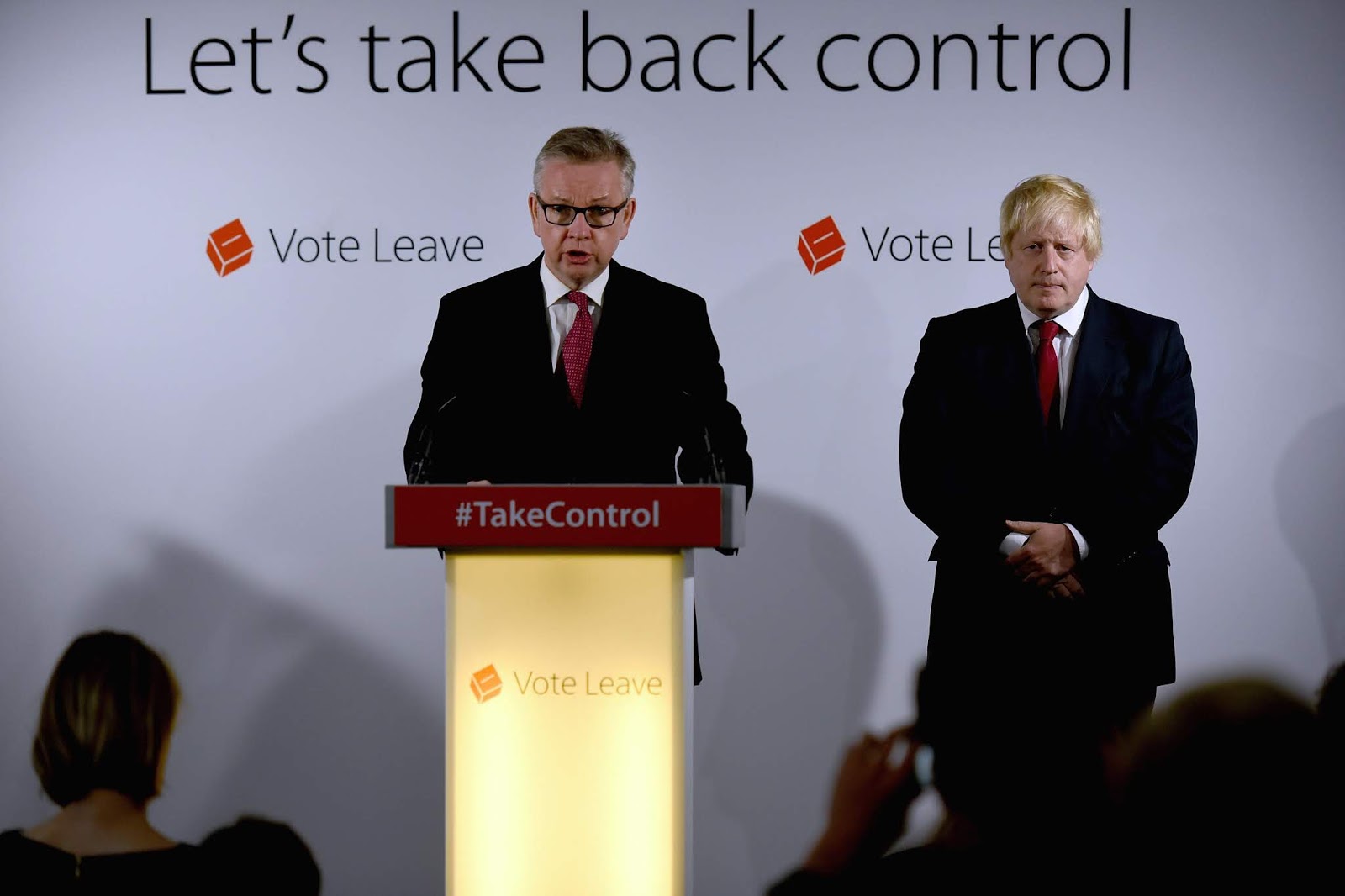
In 2016 Boris
Johnson and Michael Gove narrowly won the referendum on EU
membership. It turned out they had no idea how to turn their victory
into a concrete policy. They had dismissed every potential difficulty
as just more ‘Project Fear’, and it became clear they were not
just doing this just because it was effective rhetoric. They had not
throught through any of the major problems that implementing Brexit
would create. They looked rather shocked when they won, realising
that these problems airily dismissed would now have to be resolved.
Cameron resigned,
and the Conservative party needed to choose a new Prime Minister
whose main preoccupation would be negotiating the terms of our exit.
Their choice was Theresa May, who was known
from her previous job as being non-collegiate, slow to adapt but
obstinate in the views she held. These were almost the exact opposite
of the qualities needed in any negotiation with a more powerful
neighbour. Perhaps knowing this, she chose David Davis to handle the
details of negotiation, a man who had the charm that May lacked but
who had no interest in the details, in part because he clung on to
the belief that the EU would cave at the last minute.
If we cross the
Atlantic, then the story is the same but more so. The hard part is
thinking about an issue or decision where Donald Trump has displayed
any competence. Most recently he tried and failed to appoint two
people, Stephen Moore and Herman Cain,
to the board of the central bank, where their main qualifications
were, respectively, that their predictions were always
wrong, and they ran a Pizza company.
You could perhaps
put all this incompetence down to the exceptional peculiarities of
Brexit and Trump. But May also appointed as Northern Irish secretary
someone
who didn’t realise voters there voted along sectarian lines. Chris
Grayling, after his disastrous
privatisation of the probation service, then awarded a Ferry contract
to a company that had no ferries, and so on. A key campaign theme of
the Republican party in 2016 was to repeal Obamacare, but once Trump
was elected and they had control of Congress it turned out they had
no idea what to replace it with.
Nor did this
incompetency suddenly emerge out of thin air in 2016. David Cameron
implemented a policy of cutting public spending in the middle of the
worst recession since WWII, leading to the slowest recovery in
centuries. He allowed his minister for health to implement a
fundamental reorganisation of the NHS that turned out to be a
disaster,
at the same time as his austerity policy starved the service of
funds. Of course it was also David Cameron who made a commitment to
hold the EU referendum in the first place under terms that were most
favourable to the Leave side. .
Simon Kuper, in a
brilliant article
in the Financial Times, has an interesting explanation for this
epidemic of incompetence. He writes how leaders like Macmillan,
George HW Bush or Clement Attlee had their formative experiences in
fighting WWII, while Lyndon B Johnson, Bill Clinton, and John Major
had a visceral experience: of poverty. They knew in their bones that
government mattered. He goes on
“But both countries have now fallen into the hands of well-off baby boomers, born between 1946 and 1964 - the luckiest members of the luckiest generation in history. These people had no formative experiences, only TV shows. They never expected anything awful or unknown to happen. They went into politics mostly for kicks.”
I’m sure Kuper is
right that if our current leaders had had the strong formative
experience of living with poverty or living through WWII their
behaviour would have been different. In particular they might have
thought twice about using populist tropes like ‘the will of the
people’. But surely being ‘the luckiest members of the luckiest
generation in history might be a necessary but not sufficient
condition for being incompetent.
An interesting
example here is Tony Blair The son of a barrister, he attended
a school in Edinburgh that is sometimes described as Scotland’s
Eton *** and went to Oxford University. Together with Gordon Brown he
presided over an administration that championed
evidence-based policy. A clear example
was the decision in 2003 not to enter the Euro. The Treasury spent a
year researching the pros and cons of joining the Euro, consulting
widely with outside experts. The 18 background studies that effort
produced are excellent examples of literature reviews or, in some
cases, applied research. Although Blair was predisposed to favour
entry, he was content to allow the evidence the Treasury produced to
persuade him not to join.
There is of course
one glaring exception to this record, and that is Iraq. The war was
the idea of Bush Jr, and it was a nonsensical response to 9/11. Most
of the evidence
at the time suggested that there was no connection between Iraq and
al-Qaeda, and
that although the war could be won keeping the subsequent peace would
be very difficult. Blair followed Bush because of a simple but
tragically incorrect idea,
that the close UK-US alliance had to be preserved at all costs. He
ignored domestic advice about the problems any post-war period would
create.
The Labour
government of 1997 to 2010 was not flawless by any means, but it
terms of competence it is clearly better than what came later. It is
hard not to see that evidence based policy protects you from many,
but not all, policy mistakes. Cameron made the commitment to a
referendum in 2013 because the political imperative was to stop the
rise of UKIP and possible defections from the party. The evidence
were opinion polls
at the time, which suggested that Leave could easily win. At a deeper
level he should have realised the influence a very pro-Brexit press
could have, and also that his own immigration missed targets and the
rhetoric that he himself had used to justify them would beat economic
forecasts in voters minds..
An ideology is a
collection of ideas that can form a political imperative that
overrides evidence. Indeed most right wing think tanks are designed
to turn the ideology of neoliberalism into policy based evidence. It
was this ideology that led to austerity, the failed health reforms
and the privatisation of the probation service. It also played a role
in Brexit, with many of its protagonists dreaming of a UK free from
regulations on workers rights and the environment. It is why most of
the recent examples of incompetence come from the political right.
A pluralist
democracy has checks and balances in part to guard against
incompetence by a government or ministers. That is one reason why Trump and the
Brexiters so often attack
elements of a pluralist democracy. The ultimate check on incompetence
should be democracy itself: incompetent politicians are thrown out.
But when a large part of the media encourage
rather than expose acts of incompetence, and the non-partisan media
treat knowledge as just another opinion, that safegurd against
persistent incompetence is put in danger.
Postscript 08/05/19 It has been pointed out to me that at the age of 10, Blair's father had a stroke and lost the power of speech for over 2 years, meaning he could not work and his family fell on hard times. So here too Kuper's point may apply.

