Winner of the New Statesman SPERI Prize in Political Economy 2016


Showing posts with label Rob Ford. Show all posts

Tuesday, 4 February 2020

What causes concern about immigration


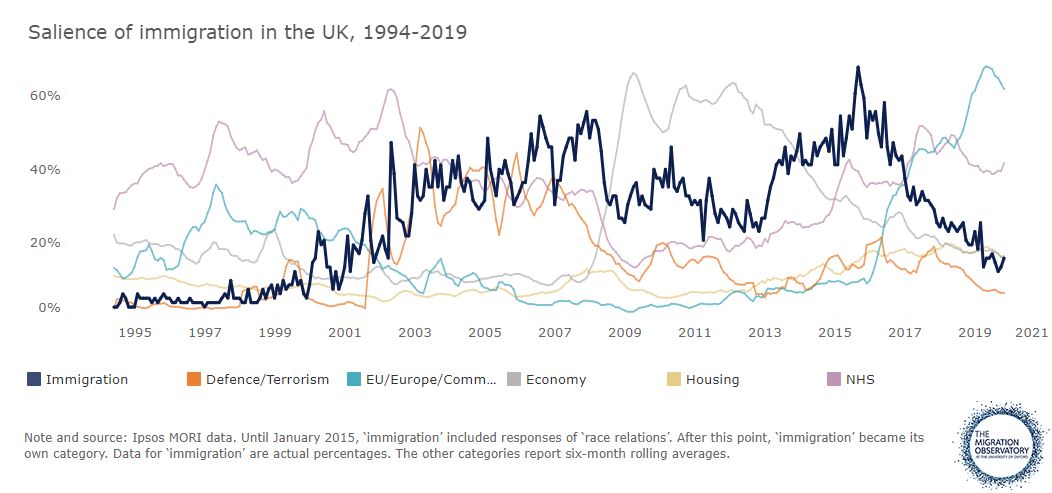
It is part of folk lore among politicians and most social scientists that concern about immigration is governed by the number of immigrants. So how do we account for the decline in the relative salience of immigration since the EU referendum (source)?


There are of course many explanations for this decline. Perhaps people now see the benefits of immigration after all the post-referendum talk of nursing and doctor shortages. A rather more straightforward explanation is that people think that by leaving the EU the immigration 'problem' is being solved (i.e immigration numbers are much reduced). If it is the latter, then their knowledge is incomplete.


Immigration from the EU has declined dramatically, which is not surprising, but this has been partly offset by a significant rise in non-EU immigration (source). Are people really more concerned about EU immigrants than non-EU immigrants?

Roy Greenslade notes that the newspaper articles full of stories of immigration peril have all but disappeared. He writes
“It was the press phenomenon of the age 10 years ago, and for at least the following six years – right up to the EU referendum. Since then, however, immigration has all but disappeared from newspaper pages.”

Could it be that the explanation for the diminished salience of immigration is the very simple one that it is no longer in the news?

The folk law comes from the fact that the increase in concern about immigration at the turn of the century coincided with the increase in immigration numbers, first from outside the EU and then from the A8 countries joining the EU. However, as I note here, there is a two or three year lag between the initial increase in immigration and public attitudes. The lag is much shorter with a time series for the number of stories in the press about immigration.

This shouldn’t be a surprise. Much of the concern about immigration is in areas that see very few immigrants. If people are getting their information ‘first hand’ from friends or relatives living in areas of high immigration you might expect a relatively short lag between numbers and concern, but if people are getting their information from the media you would require some change in how the media covered this issue before salience changed. Or to put it more crudely, salience to some extent is inevitably going to reflect what is ‘in the news’.

This does not mean salience is completely divorced from what people think. You could fill newspapers with stories about the housing problems of the very wealthy and it is unlikely that housing would start climbing the salience ranking. It is also true that rising immigration numbers helped newspapers write stories of 'floods' and 'waves'. But what it does mean is that if stories about immigration start disappearing, salience will gradually decline.

The more interesting question is why newspaper headlines about immigration, which in newspapers like the Sun and the Mail were explicitly or implicitly hostile to immigration, should decline sharply after the referendum vote. Roy Greenslade writes
“Yet the undeniable truth, the sad, sick, unvarnished truth, is that migration is off the media’s central agenda for two reasons. Firstly, it is no longer a political issue. With the pro-Brexit vote having been achieved, there is no need to keep on injecting the same poison into public debate. Job done. Secondly, seen from the newspaper editors’ perspective, it is not a sales-winning topic at present. No need to play to the gallery. There is no “value” in running anti-immigrant stories.”

In other words, newspapers are not publishing alarming stories of waves of non-EU immigrants coming to the UK because there is no political or sales motive for doing so. It is like saying if people who are hostile to immigration think leaving the EU means job done then let them. Increasing immigration salience was politically important for these newspaper owners while Labour was in government and to push the Tory government to support Brexit, but no longer.

Which, in turn, is why a Conservative government not led by Theresa May and without immigration targets can contemplate a fairly relaxed immigration regime, as Jonathan Portes notes. The other reason is that opposition to immigration (rather than salience) has been declining since a couple of years before the referendum, as the Migration Observatory also shows. Since 2017 more people think immigration has had a positive impact on the UK than think the opposite.

As Rob Ford notes, we don’t know why the public are feeling more positive about immigration, but equally too many have failed to notice how things have changed. I would add that too few also realise how changes in the salience of immigration tells us a lot about what has been in newspapers, and rather less about the underlying views of voters or, indeed, the number of immigrants coming in to the UK.


Tuesday, 16 July 2019

There is only one alternative to Prime Minister Boris Johnson


Corbyn may not be a great or even a particularly good leader, but it seems few in the media recognise he is the only viable opposition to the far right we have.

While I have been critical of the Labour leadership’s Brexit stance for some time, and still do not think Corbyn has gone far enough to maximise Labour's chances of General Election victory, he has done enough to ensure one thing: his survival. While his Brexit stance, together with continuing problems with antisemitism, will have lost some members and made others luke warm, there is little appetite to replace him amongst most members. This view will only strengthen as the likelihood of a General Election increases. It is Labour party members who choose the party’s leader.

But what about antisemitism? Could this issue be the downfall of the Labour leadership? The answer is almost certainly no. As the poll discussed here shows, while 66% of Labour members think antisemtism within the party is a genuine problem, 77% think the problem is deliberately exaggerated to damage Labour and Corbyn himself. On the basis of current evidence, and that includes any rebuke from the EHRC investigation, Corbyn’s position among members on this issue is secure.

The only other factor that might raise questions among the membership about their leader is very bad poll ratings. But two factors mean this is not a risk factor for Corbyn’s leadership. First, the new Brexit policy will win some voters back. As Rob Ford notes here, there are signs that the electorate’s flirtation with four party politics is coming to an end, as both Labour and the Conservatives move their own Brexit position. Second, Labour under Corbyn have been there and done that in 2017, such that there will always be the hope of a pre-election surge for Labour.

Could Labour’s continuing antisemitism crisis create another serious split between MPs and the leadership, along the lines of the vote of no confidence in 2016 after the Brexit vote? A split of this kind would only make sense if Labour MPs believed that they had a chance of defeating Corbyn in a ballot of members, and as I have already suggested they would be delusional. MPs may demand this and that in terms of how disciplinary procedures are handled within Labour, but any attempt to unseat Corbyn, or mass defections by Labour Mps, seems unlikely.

The security of the Labour leadership’s position within the party is one of two key factors in which to evaluate the impact of continuing criticism of Labour within the mainstream media and elsewhere. The second is the threat we face from what has become the most far right and dangerous government the UK has experienced for decades if not centuries.

The Conservative party is looking increasingly like the US Republican party, and its likely leader increasingly looks like a UK version of Donald Trump. However the Conservative party has got itself into a far more dangerous position than the Republican’s have ever faced. The Tories have Nigel Farage and a right wing press pushing them to implement a No Deal Brexit that goes way beyond anything Trump might be contemplating with tariffs. Furthermore opposition within the Tory party towards Johnson’s leadership ideas and No Deal looks vanishingly small.

Two recent events have underlined how far the UK government has descended into far right territory. The first was of course Johnson’s failure to stand up for one of our own ambassadors in the Darroch affair. A corrolorary of No Deal is that a trade deal with the US becomes politically essential, and that in turn means that Trump’s not so polite requests become the UK’s actions. This is a President who tells non-white Congresswomen born in the USA to go back to “the crime infested places from which they came”. In practice a US trade deal that UK politicians desperately want will be disastrous for UK agriculture, UK consumers and many more, people already hit hard by the UK leaving the EU with no deal.

The second recent event was Amber Rudd preferring a job in any future Johnson government to her previous opposition to No Deal. It has been an object lesson to those who thought Conservative MPs would always stand up for business and the Union to see how quickly all but a few have chosen political expediency instead. Again parallels with the Republican party in the US are instructive. Just as the right wing media in the US was able to use the Tea Party movement to shift the Republicans to the right, so the right wing press have used Farage to shift the Conservative party in a similar way.

The net result will be the normalisation of a No Deal Brexit over the next few months. Leaving without a deal was not what all of the 52% of Leave voters in 2016 voted for, but virtually no one in the broadcast media will be brave enough to push this point. The lie that the 2016 vote provides a mandate for No Deal will go unchallenged. Broadcasters will balance the nonsense that the impact of No Deal on the UK will be, to quote Johnson, “infinitesimally small” against the truth that it is the biggest act of political and economic self-harm ever inflicted on the UK.

Allowing Johnson to become leader shows that the Conservative party has completely lost its moral compass. All of Johnson’s misdeeds in his past mean nothing, just as Trump’s behaviour means nothing to his supporters and the Republican party. Both individuals lie all the time, but it doesn’t matter to his own side. Johnson encourages a friend to beat up a journalist, but it doesn’t matter. Johnson uses racist language on many occasions, most recently comparing Muslim women wearing the niqab and burqa to letterboxes, but this was deemed acceptable by his party. Johnson gets advice from Steve (“Let them call you racist. Wear it as a badge of honour”) Bannon, and even the BBC does not think Johnson lying about these contacts matters.

And so, as the Conservative party loses its moral compass, the chances are that large sections of the country’s elite will do so as well, and our standing overseas will plummet even further. Although Tory party members may find Johnson’s insults acceptable, don’t expect other countries to take a UK run by Johnson as more than a bad joke. Don’t expect other countries to do business with a UK that proposes to destroy its trade relationship with the EU and many other countries at a stroke. An elite that treats threats to prorogue parliament as acceptable will not be respected by countries that value democracy, although some others will welcome the development.

Yet those who say not in my name need to ask themselves whether they are prepared to make the choice required to stop this happening. There is only one realistic opposition to a Johnson led government. Believing the Liberal Democrats could ever play that role was unrealistic, because Labour has enough loyal voters to ensure that the anti-government vote would be split. Farage along with the LibDems might also take away votes from the government, but it would be foolish to rely on an English vote split four ways just happening to go against a Conservative government.

The awkward truth for those who for whatever reason dislike Corbyn’s Labour party is that Labour is the only party that can defeat this government, and its leader in the next election will be Corbyn. Voting is always a choice between the lesser of two evils. Supporting smaller parties when that lets the Conservatives win, or supporting none, may make those who dislike Corbyn’s Labour feel better, but it is in effect a statement that Corbyn’s Labour party would be just as bad for the country as a whole as out current government, and that is simply not a credible belief. Corbyn is not going to leave the EU with no deal, and in practice will be unable to leave the EU in any way. Corbyn is not threatening to prorogue parliament, is not desperate to do a trade deal with Donald Trump, does not lie all the time, does not get friends to beat up opponents, and does not have a history of using racist language. Whereas Johnson promises tax cuts for the rich, a Corbyn led government would help the many, not the few.

Yet there are few in the mainstream media who seem prepared to recognise the choice we face for what it is. Even wise and perceptive commentators like Martin Wolf, who lament the situation the Conservative government has led us to, often feel it necessary to balance their piece with a derogatory remark about the Labour leadership. Those remarks may or may not be accurate, but a plague on all your houses just allows this Tory government to stay in place.

Worse still are those in the centre or centre-left who refuse to give up hope of getting ‘their party’ back and will do anything that in their view helps that cause. In the first year after Corbyn was elected many MPs and journalists waged a constant war against the left in the media. I said at the time it was utterly futile and self-destructive, and I was right. It led to an attempt to unseat Corbyn that everyone on the left calls a coup, and a clear majority of members saw it the same way. Polls suggest the same is true today. Those in the centre and centre-left need to realise that for all Corbyn’s faults and mistakes he will be Labour’s leader going into the next election, and if they repeatedly attack him they are helping Boris Johnson do terrible damage to our country.

Of course the right wing press will do anything to discredit Labour: that is what their owners pay them to do. But often their task is made easier by the non-partisan media who think they are making choices using simple journalistic criteria, such as going with the story. What we are in danger of seeing with 24/7 criticism of Corbyn is a repetition of what happened to Hilary Clinton in the US elections. As I showed here, the mainstream media spent much more time talking about her email server than any of the sins of Donald Trump, or indeed all those sins combined. In that sense the US media chose Trump over Clinton. It was of course not a thought-through or considered choice, but just the outcome of lots of individual decisions that seemed to make sense in journalistic terms, but were disastrous in political terms.

Of course the constant tunes the media play matter. One of the incredible poll findings of that US election was that more people trusted the serial liar Donald Trump more than Hillary Clinton. That makes no sense unless you note the constant stream of media stories suggesting Clinton had something to hide. No one is suggesting Labour’s failures over antisemitism should not be exposed, just as no one was suggesting that Clinton should not have been criticised for using her own email for government business. What is missing in both cases is a sense of perspective, as here for example, or here. Without that perspective constant attacks on Corbyn will have an impact. The impact will be to keep a destructive far right government in power.