Winner of the New Statesman SPERI Prize in Political Economy 2016


Showing posts with label Jonathan Portes. Show all posts

Tuesday, 1 September 2020

Will taxes have to rise?


That is the question addressed in this debate between Jonathan Portes and Bill Mitchell. I found the discussion very frustrating, because it is really a debate about medium term inflation forecasts dressed up as something more fundamental. Both Mitchell and Portes agree that there is no need for taxes to rise to ‘pay for’ the fiscal costs of the pandemic. In an age of ultra-low real interest rates, shocks to the debt to GDP ratio like the Global Financial Crisis and the pandemic should be allowed to gradually wither away as growth outstrips interest rates on that debt. Trying to reduce debt by running deficits close to zero, or even surpluses, as Osborne tried to do, threatens to derail a full recovery.

I think it would be fair to say that the argument from Jonathan Portes is that we should increase the share of current public spending in GDP in various ways over the next few years, and without higher taxes, or substantially higher interest rates, that will at some point lead to a permanent rise in inflation above target. To prevent that, taxes should rise. Bill Mitchell would agree that public spending should rise, but he doesn’t think inflation will rise as a consequence. If inflation did rise, it is standard MMT (at least according to Stephanie Kelton) that fiscal policy should be the “primary tool for macroeconomic stabilisation”. Thus the debate between the two on whether taxes should rise is essentially a disagreement about medium term inflation forecasts.

This point is illustrated in the final statement from Bill Mitchell. He writes:

Should the government seek to command a far bigger share of productive resources—say, for a green transition—then, yes, perhaps tax rises would have a role in offsetting the extra spending and warding off inflation.”

Jonathan Portes might well respond that his argument is premised on just such a situation. In his opening statement he writes:

And as well as more on the NHS and social care, structural economic shifts—from the aftermath of Covid-19 to decarbonisation—will mean more is needed for education and training. We don’t need higher taxes to pay for the virus; but the virus has exposed, economically, socially and politically, that we need them to build a better future.”

This illustrates that there is no disagreement in principle here, but just a disagreement about what levels of public spending increase would tend to lead to above target inflation. Indeed as these quotes suggest, there may not even be a disagreement here, but just a distinction between what should happen to public spending (Portes) and what is likely under current or prospective governments (Mitchell).

I want to argue that the whole debate about whether taxes should rise to pay for additional public spending is unnecessary. We can afford to wait and see. If inflation does appear to be permanently rising above target, you can be sure that the central bank will raise interest rates to bring inflation back down. Exactly when central banks should act is a live issue right now in the US, where the Federal Reserve has decided it will allow inflation above target for some time to ‘make up’ for inflation being below target in the past. But important though this change is, it remains the case that no independent central bank worth its salt is going to allow inflation to permanently rise above the inflation target.

It is only when central banks start raising interest rates in earnest that governments need to think about raising taxes. By raising taxes they reduce the pressure on aggregate demand and inflation, and therefore moderate the extent to which interest rates need to rise. It would be foolish for governments to make the same mistake that central banks made before the pandemic hit, and try and anticipate what might happen to inflation based on outdated ideas about the NAIRU. [1].

What about deficits? Isn’t good fiscal policy all about trying to achieve sustainable deficits (deficits that stabilise the government debt to GDP ratio)? As Jonathan Portes and I have argued, those rules should not apply when interest rates are stuck at their lower bound. When interest rates are at their lower bound, fiscal policy should become the primary tool for macroeconomic stabilisation. When interest rates are at their lower bound, standard academic macro and MMT should be on the same page.

While academic macroeconomists now generally accept that fiscal consolidation is a bad idea when interest rates are at the lower bound, the UK Treasury appears to think otherwise. There is much talk of tax rises or spending cuts to 'pay for the (fiscal) costs of the pandemic'. No doubt this will be justified by OBR forecasts and talk of structural deficits, just as it was in 2010. But whether its spending cuts or tax rises, fiscal consolidation coming out of a recession where interest rates are at the lower bound risks turning what should be a temporary downturn into a permanent fall in output.


[1] The changes at the Fed are welcome, because they address an error that central banks have been making since the Global Financial Crisis (GFC). Before that crisis, they tried to guess where inflation would go in the future by looking at forecasts and indicators like unemployment, and they were pretty successful at that. But, as some of us argued at the time, after the GFC it was foolish to continue in the same way, because the crisis had fundamentally changed the way the economy worked and because the risks of getting it wrong were asymmetric.


Tuesday, 7 July 2020

Sabotaging the recovery


I wrote last week about how a premature easing of lockdown in the UK would cost many more lives. This post will be about how it is also likely to create a weak recovery where some businesses will go to the wall and many jobs will be lost.

A good starting point in thinking about the kind of recovery we could have is to think about synchronized holidays, like Christmas or the summer holiday in much of France. Most of the economy closes down for a few weeks, but starts up again without any long term harm done. You get a V shaped recovery, which we never notice because it gets seasonally adjusted out of the data.

A few months is not fundamentally different from a few weeks, if the government provides sufficient support to firms, the self employed and individuals? The absence of such support gives us the first reason why a recovery might not be V shaped. Yet the UK government’s support over the last few months has been reasonably good, albeit with some notable exceptions.

After a holiday involving a few weeks, consumers’ preferences will be unchanged. Is the same true of a pandemic? If the virus has disappeared for good, or immunity against the virus is complete (with a vaccine, say), there seems no compelling reason to believe otherwise, although overseas travel will require the virus to have disappeared in other countries as well. Perhaps some consumers might initially not believe the virus has disappeared, but this might be offset by other consumers spending more time on social consumption than normal in celebration that the pandemic has ended. In some sectors this second effect could even lead to a larger recovery than the initial recession.

The main reason a V shaped recovery is not going to happen in the UK is because the virus has not disappeared. Compared to other European countries the number of new infections remains high, and as a result many consumers will be understandably reluctant to resume their normal patterns of social consumption. If the government also withdraws support from social consumption sectors, this inevitably means firm closure and firm downsizing, leading to a large increase in unemployment. Restoring confidence in countries where the virus has largely disappeared will not be easy, but that task is much harder when the risks of catching the virus are non-negligible.

There is a further hurdle in the face of a recovery that this government has created. Whatever the new number of infections are, will consumers trust the government when they are told they should resume social consumption? Almost everything the government has done to combat the virus has been a failure. The latest is withholding until recently Pillar 2 data from local authorities and the public. When people are told it’s their civic duty to resume social consumption, rather than simply being told what the risks of doing so are, they are bound to be suspicious of the government’s motives, and who can blame them.

The continuing high level of infections and lack of trust mean that many consumers will not resume social consumption. This poll shows that people’s perception of the risk from the virus has recently increased. This is the inevitable result of prioritising the economy rather than getting new infection numbers right down.

So what can be done? The government is not going to drive new infections down much lower by opening up pubs! It is not going to get trust back anytime soon. Can the Chancellor encourage reluctant consumers to resume social consumption by some means? A general fiscal stimulus, in the form of a tax cut, is unlikely to do much in this respect, because most of it will be saved. Furthermore what is spent is likely to go into sectors that can make a reasonable recovery, like clothing and consumer durables. Other forms of standard fiscal stimulus, including a VAT cut, are unlikely to avoid large scale redundancies from social consumption sectors.

The Resolution Foundation has a more interesting proposal, which is to give vouchers that are time limited that can be spent in vulnerable social consumption sectors (and which are switched off if a second wave appears and we have to go back into lockdown). This is the kind of sector specific stimulus we need. Another possibility would be a temporary cut in VAT on social consumption goods.

Even with such schemes, we are unlikely to see a full rebound in social consumption for some months to come. In a few specific areas social distancing means venues will inevitably be operating at a loss. Subsidies of various kinds to keep firms going and to avoid as far as possible large scale redundancies will be necessary.

While a general fiscal stimulus will not solve sector specific problems, if interest rates remain at their lower bound there is strong a case for economy wide fiscal support. Aggregate demand may remain low as investment is depressed by Brexit and uncertainty about a second wave. If the Chancellor is looking at ideas for what this stimulus could be, or more generally in how to meet our climate change goals, here is a report from NEF.

However unemployment will inevitably remain too high. As Paul Gregg notes, this prolonged recession will be much more unemployment intensive than the recession after the Global Financial Crisis. But just as fiscal stimulus can be regarded as an opportunity, so job losses can be seen as a chance to reskill the UK workforce, along the lines suggested by Jonathan Portes and Tony Wilson. However some of those working in areas where social consumption is low because of the pandemic may wish to remain in those sectors once demand picks up because new infections decline significantly or a vaccine is developed. It is worth noting that a Job Guarantee, if such a scheme existed, would provide an excellent chance for these people to do something useful in this enforced break in their careers.

These are all policies that will have much more work to do because this government made yet another error in their handling of this pandemic, which was to ease the lockdown while the number of new infections was still quite high. Most experts, and indeed most academic economists, understood it would be an error before it happened. It is an error that could sabotage what might have been something close to a V shaped recovery.


Wednesday, 26 February 2020

Low paid jobs for British born workers


I have always had a problem with those who focus on the need to reduce low skilled immigration. Skilled migrants are OK, so the argument goes, because the UK needs their skills, but we don’t need low skilled immigrants because British workers can do those jobs. At a microeconomic level it makes sense, and in a world where there is widespread unskilled unemployment it may make sense. But in a high employment economy like the UK today, it makes no sense at the macro level.

To see this, let’s think about a stylised example. Suppose there are a fixed number of jobs at each skill level. You will always need the same number of engineers, care workers and so on. To make things easy suppose 50% of jobs are skilled and 50% are unskilled. You then allow some skilled immigration but not unskilled immigration. These immigrants demand goods and services like anyone else, increasing the overall number of jobs in the economy but not its skill mix. That has to mean that among British born workers, less than 50% are now skilled and over 50% are unskilled. The immigration system is shifting the British born workforce into more unskilled jobs.

It gets worse if we recognise that a skill based immigration system is, in essence, about pay, not skill. With the exception of those with a recognised qualification like a PhD, it is hard to measure how people's skills compare. What you can assess is how much they will be paid in the job they have been offered. So in the first instance an immigration system that is designed to exclude unskilled workers is actually excluding low paid workers. If you combine that insight into the stylised example above, it must mean that the immigration system is shifting the British born workforce into lower paid jobs.

So when people call for an end to unskilled immigration, they are in effect calling for more British born workers to be low paid.

That is a necessary conclusion from the assumptions I have made, but are my assumptions wrong? Home Secretary Priti Patel says there are 8.5 million economically inactive people in the UK who could do these unskilled jobs. By implication, unskilled migration is preventing these people getting jobs. The ONS estimate that only 1.9 million of those people want a job, and it is an open question how many can actually do the kind of jobs we are talking about, as very few are discouraged workers and many more are students, the sick, carers, or have retired early.

A second key assumption I made is that the number of high and low paid jobs does not change. Could stopping most low paid immigration force firms who pay low wages to pay more, or invest in labour saving machinery? For example, in talking about the care sector, the recent MAC report says
“We remain of the view that the very real problems in this sector are caused by a failure to offer competitive terms and conditions, something that is itself caused by a failure to have a sustainable funding model.”

But as Polly Toynbee points out, working in the care sector (which should be classed as skilled but isn’t because the pay is so bad) is poorly paid because the money comes from the government via local authorities. Restricting immigration will not push up wages because the government ensures there is no money to pay higher wages. All that would happen is firms would be unprofitable and close down. A social care disaster is a very expensive way of getting the government to pay more.

But there is a more general point to be made here. We have a more efficient way of raising low pay than starving particular sectors of overseas workers, and that is by raising the minimum wage and enforcing that minimum. Take the food processing sector, which is another area that depends on many low paid workers from overseas. If you steadily raise the minimum wage, and pre-commit to doing so, you give firms time to adjust through mechanisation or raising wages. If the flow of workers suddenly dries up, it is more likely the firm will decide to locate its production overseas, which in turn may damage domestic supply industries.

One Brexiter, the CEO of the Scottish Seafood Association, has already said the plans would be disastrous for the Scottish fishing industry, for exactly this reason. As Jonathan Portes points out, the government’s plans largely follow MACs recommendations, and they could have been a lot worse. In practice the number of sectors where some unskilled immigration is allowed in is likely to expand from industry pressure.

If it doesn’t, then the UK food processing industry is not the only one that is likely to shrink. The UK tourism industry, that brings in lots of export earnings, will also be hard hit. Some industries cannot be so easily shifted overseas. The construction sector may just have to delay completion of some projects. I have already noted the problems in the care sector.

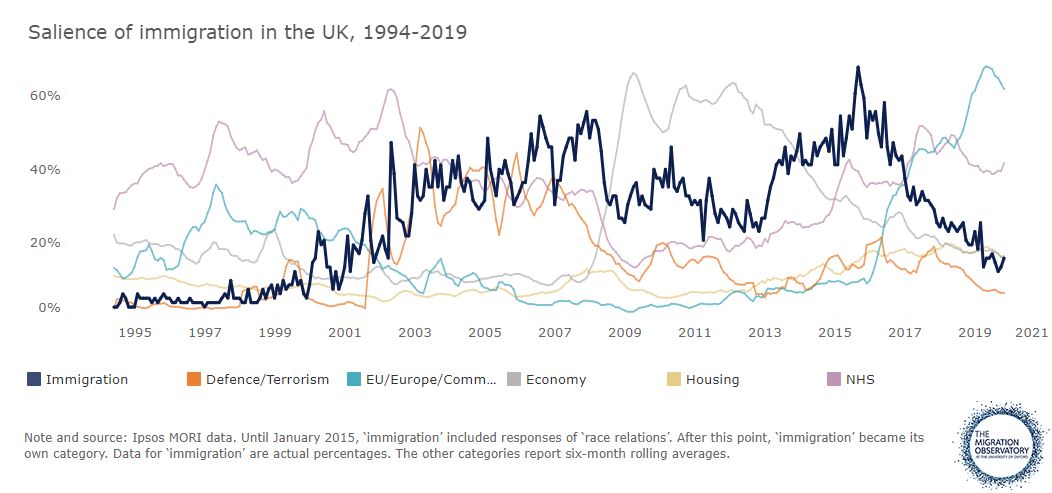
Why has the government chosen to go with the 'skilled immigrants good/unskilled immigrants bad' idea? As Bronwen Maddox says, it is a political rather than economic choice. It reflects the fact that the economic case for immigration cuts through. As I noted here, the salience of immigration has been falling since just before the referendum vote. It is easy to put that down to voters thinking that Brexit has solved the immigration problem, but an IPSOS/MORI poll suggests that is not the most important factor.


Half the people surveyed are less worried about immigration because they have understood the importance of the contribution immigrants make. Now immigrants with skills, in many people's minds, provide a clear contribution to the economy because of their skill, particularly if there are not enough workers with similar skills from the UK. That does not apply to unskilled workers, hence the focus on stopping unskilled immigration. In addition, all the negative stories they read about immigrants involve those who are unskilled.

As a result, politicians who want to appear ‘anti-immigrant’ focus on stopping unskilled immigration. But if you asked voters do they want British born workers to do more low paid work, the answer would be an overwhelming no. Thinking in macro terms is not easy. The reality is that, unless the government is planning to close down whole industries, restricting low paid immigration implies lower pay for British born workers.


Tuesday, 4 February 2020

What causes concern about immigration


It is part of folk lore among politicians and most social scientists that concern about immigration is governed by the number of immigrants. So how do we account for the decline in the relative salience of immigration since the EU referendum (source)?


There are of course many explanations for this decline. Perhaps people now see the benefits of immigration after all the post-referendum talk of nursing and doctor shortages. A rather more straightforward explanation is that people think that by leaving the EU the immigration 'problem' is being solved (i.e immigration numbers are much reduced). If it is the latter, then their knowledge is incomplete.


Immigration from the EU has declined dramatically, which is not surprising, but this has been partly offset by a significant rise in non-EU immigration (source). Are people really more concerned about EU immigrants than non-EU immigrants?

Roy Greenslade notes that the newspaper articles full of stories of immigration peril have all but disappeared. He writes
“It was the press phenomenon of the age 10 years ago, and for at least the following six years – right up to the EU referendum. Since then, however, immigration has all but disappeared from newspaper pages.”

Could it be that the explanation for the diminished salience of immigration is the very simple one that it is no longer in the news?

The folk law comes from the fact that the increase in concern about immigration at the turn of the century coincided with the increase in immigration numbers, first from outside the EU and then from the A8 countries joining the EU. However, as I note here, there is a two or three year lag between the initial increase in immigration and public attitudes. The lag is much shorter with a time series for the number of stories in the press about immigration.

This shouldn’t be a surprise. Much of the concern about immigration is in areas that see very few immigrants. If people are getting their information ‘first hand’ from friends or relatives living in areas of high immigration you might expect a relatively short lag between numbers and concern, but if people are getting their information from the media you would require some change in how the media covered this issue before salience changed. Or to put it more crudely, salience to some extent is inevitably going to reflect what is ‘in the news’.

This does not mean salience is completely divorced from what people think. You could fill newspapers with stories about the housing problems of the very wealthy and it is unlikely that housing would start climbing the salience ranking. It is also true that rising immigration numbers helped newspapers write stories of 'floods' and 'waves'. But what it does mean is that if stories about immigration start disappearing, salience will gradually decline.

The more interesting question is why newspaper headlines about immigration, which in newspapers like the Sun and the Mail were explicitly or implicitly hostile to immigration, should decline sharply after the referendum vote. Roy Greenslade writes
“Yet the undeniable truth, the sad, sick, unvarnished truth, is that migration is off the media’s central agenda for two reasons. Firstly, it is no longer a political issue. With the pro-Brexit vote having been achieved, there is no need to keep on injecting the same poison into public debate. Job done. Secondly, seen from the newspaper editors’ perspective, it is not a sales-winning topic at present. No need to play to the gallery. There is no “value” in running anti-immigrant stories.”

In other words, newspapers are not publishing alarming stories of waves of non-EU immigrants coming to the UK because there is no political or sales motive for doing so. It is like saying if people who are hostile to immigration think leaving the EU means job done then let them. Increasing immigration salience was politically important for these newspaper owners while Labour was in government and to push the Tory government to support Brexit, but no longer.

Which, in turn, is why a Conservative government not led by Theresa May and without immigration targets can contemplate a fairly relaxed immigration regime, as Jonathan Portes notes. The other reason is that opposition to immigration (rather than salience) has been declining since a couple of years before the referendum, as the Migration Observatory also shows. Since 2017 more people think immigration has had a positive impact on the UK than think the opposite.

As Rob Ford notes, we don’t know why the public are feeling more positive about immigration, but equally too many have failed to notice how things have changed. I would add that too few also realise how changes in the salience of immigration tells us a lot about what has been in newspapers, and rather less about the underlying views of voters or, indeed, the number of immigrants coming in to the UK.


Friday, 8 March 2019

Is the German Debt Brake the worst fiscal rule ever?


The answer is probably not: a simple balance budget is worse. The German Schuldenbremse fixes the total cyclically adjusted deficit at 0.35% of GDP, which implies a gradually falling debt to GDP ratio. If actual outturns exceed this figure, there is a control mechanism which reduces the permitted deficit to get the path of debt back on target. So this debt brake improves on a simple balance budget by allowing a very modest deficit and cyclically adjusting. On the other hand it is worse than a simple balanced budget because it error corrects.

The fundamental mistake the rule makes is to make control of debt its central aim. Doing this only makes sense if you ignore macroeconomic common sense. The deficit and debt are macroeconomic shock absorbers. Running a variable deficit allows taxes and spending to be reasonably stable, which is beneficial for obvious and not so obvious reasons. Trying to tightly control the deficit and debt does the opposite. It makes sense to smooth taxes and government spending, but no sense whatsoever to smooth the deficit and debt.

The aim of a good fiscal rule is to eliminate deficit bias, which is the tendency of government debt to rise over time because, for example, politicians always want to spend more and tax less. The timescale for deficit bias is decades rather than years, so there is no need in principle to tightly constrain year to year deficits, or worse still to try and stay on some path for debt, and as I have already noted it is actually harmful from a macroeconomic point of view to do so.

Doesn’t the debt brake make some concession towards the macroeconomic stabilising role of the deficit by cyclical correction? There are two problems here. First, cyclical correction is a very imprecise art, and there is evidence the method used in the German debt brake and elsewhere does not work very well. Second, cyclical shocks are not the only thing that disturbs the government’s deficit. In practice all kinds of things can lead to erratic movements in the deficit, and it makes no sense to have to adjust tax rates or spending to exactly offset this erratic behaviour.

As Jonathan Portes and I explain in our paper on fiscal rules, a better way of keeping the stabilising role of deficits while still ensuring they do not steadily increase over time is to have a rolling target for the future deficit. Five years is the typical length of an economic cycle, so looking ahead five years makes sense, and also avoids the need for imperfect cyclical adjustment.

This kind of rolling future target is open to cheating, because the government can always promise but never intend to deliver on meeting the target. The problem here is that governments can cheat in so many ways when it comes to fiscal planning. No rule, even a draconian one like the debt brake, will stop all forms of cheating. The best way to avoid cheating is to establish a fiscal council with political weight that can distinguish between a government that fails to meet its targets through bad luck and one that fails because of cheating.

Do we need the debt error correction in the debt brake? A consistent result in academic research is that debt correction should be very slow, if it happens at all. That happens automatically with a deficit target, while the debt brake corrects too quickly. So the answer is no.

Another problem with the debt brake, alongside many other fiscal rules, is that it has a target for the overall deficit which includes public investment. Public investment should not be included in any deficit target, because there is no reason the current generation should pay for something that will benefit future generations. As investment is less painful to cut than current spending (or raising taxes), rules for the total deficit often lead to under investment, and we can see this in Germany. That only hurts future generations.

This is not about Anglo-Saxon economists telling Germany what to do. There are plenty of German economists who also see that the German debt brake makes no sense, and anyway economics is universal. The debt brake is a bad fiscal rule. It is doing the German people harm. It needs to change.


Thursday, 1 March 2018

The dangers of pluralism in economics: the case of MMT


MMT (Modern Monetary Theory) is a ‘school of thought’ in economics, by which I mean that it deliberately sets itself apart from the mainstream. I like a lot about MMT as a set of ideas. On the key issue of whether monetary or fiscal policy should be used as the main stabilising tool, although I go with the mainstream in looking to monetary policy outwith the lower bound, I think that issue should always be kept open, and too many mainstream economists just presume that monetary policy must be better. I am also attracted to the idea of some version of a Job Guarantee type scheme, and the mainstream has often failed to recognise the amount of autonomy the banking system has to create demand. I could go on but you get the idea. As I result, I have tried probably more than most mainstream economists to engage with MMT ideas.

As far as I can see there is nothing in MMT that cannot be presented using standard mainstream tools. But I also know that the microfoundations hegemony in mainstream macro excludes many, like MMT economists, who would prefer to do macro in different ways. I dislike the microfoundations hegemony for reasons I have set out elsewhere. For that reason I cannot argue that MMT, or any other school of thought, should be part of the mainstream, because right now it would be impossible because of the microfoundations hegemony. [1]

Having said all that, I think MMT sometimes demonstrates many of the dangers of a school of thought. It tends to be antagonistic to the mainstream, and some (not all) of its leading lights give their followers the idea that the only truth is to be found within MMT, and everything the mainstream says has to be wrong. That proposition is so absurd but I can understand why it can be believed. It was a long time ago, but I was told as a student that neoclassical economics was fundamentally flawed, and would soon be replaced in some kind of Kuhnian revolution. I know how easy it is to follow your political instincts and thereby miss out on so much important and useful knowledge.

It is very difficult not to come across MMT followers (MMTers) if you write a blog on macroeconomics. Most recently this happened when I wrote this on Trump’s tax cuts. Now unusually this post examined how to discuss these tax cuts split into two parts: one which followed the mainstream view where monetary policy controlled inflation, and another that described an MMT view where fiscal policy controls inflation.

My post was criticised by some MMTers on twitter. Not because I had got the MMT part wrong, but because I had argued in the mainstream part that a deficit generated by a tax cut could alter the intergenerational distribution of income. Now this idea is standard, but it can confuse, because you cannot transfer real resources (output) through time in a closed economy. I show how it can be done in an overlapping generations framework here. It is much easier to see how it can happen in an individual open economy, because a generation can consume overseas goods as well as domestically produced goods.

If that all seems a bit abstract, it is also important. I have argued in the past that one of Margaret Thatcher’s failures was to give taxes from the North Sea back to consumers (who spent rather than saved them) instead of following Norway in creating a sovereign wealth fund. Subsequent generations have therefore been deprived of the benefits of North Sea oil. By giving tax cuts funded by borrowing, governments can do the opposite of creating a sovereign wealth fund: future generations inherit more government debt which they have to service.

Those MMTers criticising my blog said such intergenerational transfer was impossible. I tried the best I could to explain why it was possible, but the responses I got ranged from intelligent denialism to simple insults along the lines that I was neoliberal, I didn’t care about the working class and so on.

I’m used to that kind of interchange as a result of Brexit. But there was an important difference here. I was not attacking MMT, but outlining how things work in a mainstream view. So I was not attacking their school or their politics. They had no reason to be defensive. But it was clear to some that I was the enemy simply because I was not an MMTer. This very tribal attitude reflects one of the dangers of plurality in economics. Another is language. MMTers have their own way of describing things, so if you say something like a ‘tax financed increase in government spending’ you are jumped on: according to MMT tax never finances spending, but follows it, or something like that. I don’t mean to make fun, and I can see what they are trying to do, but talking separate languages is a key problem when you have different schools of thought, particularly if you insist that only your language is the right language.

Another problem is that schools of thought also tend to be political. As a result, to use Paul Romer’s phrase, all too often scientific discourse is replaced by political discourse. To some of these MMTers because I was a mainstream economist I had to be neoliberal, as if those two things had to go together. The idea that deficits could redistribute income between generations moved from being an economic statement to a political one. Presenting models that showed how it could happen meant those models had to be unrealistic, without specifying why that lack of realism mattered to the issue in hand.

It is a shame, because these MMTers are clearly interested in economics because of their political interest, so I would love them to be discussing both mainstream as well as MMT ideas. I probably spent too much time on twitter with them as a result. Those that tell them the mainstream is neoliberal and a waste of time are in my view almost criminal because that attitude leads to such a waste of enthusiasm and interest.

It does not have to be like this. I have had plenty of good discussions with MMT academics and some supporters which I have found interesting. They have been courteous and not aggressive. But not all the leading lights in MMT encourage these things. Such as those who write
“Wren-Lewis just should stick to Twitter. He seems to like that. It would save us the time reading the other stuff.”

He wrote that, and worse still which I will not repeat, because he is angry that Labour have adopted a fiscal rule based on my own work with Jonathan Portes rather than MMT’s ideas. Actually I didn’t enjoy the conversations he is referring to at all, and I should have stopped much earlier because it was a waste of time, but as I said above it is a shame to see people who have closed themselves off to so much interesting and, for them, politically useful knowledge.

As I said, I do not blame anyone being in a macroeconomic school of thought because the current mainstream is exclusionary. Many MMTers are open and my discussions with them have been interesting for me at least. But unfortunately some in MMT appear to want to make it a kind of cult, where only MMT sees the truth and everything in the mainstream is neoliberal and wrong. They attract followers because of their politics, but then they turn their followers into converts with closed minds. Which I think is a real shame and completely unnecessary, because MMT is strong enough to stand on its own feet and encourage open minded thinking, not dogma.

[1] I do not think that is the only aspect of the mainstream that excludes other schools. There is too little room in mainstream journals to discuss policy or history in a discursive, holistic way. I happen to like the way most mainstream economists use models to discuss issues, but sometimes it is useful to make sure we are not abstracting from what is really important.


Wednesday, 31 January 2018

Brexit is fantastic project

Leavers often say they do not understand why Remainers cannot just accept that we are leaving. There are many good reasons, but the one that I keep coming back to is this. Brexit is fantastical. There is nothing about the case for Brexit that is based in reality. This is why everything Brexiters say is either nonsense or untrue.

Take, for example, the leaked government estimates of how much poorer we will be on average as a result of Brexit. There is no surprise here for economists, because the estimates are in line with the wide range of large negative long term impacts made by various groups or organisations before the referendum, including the UK Treasury. But these new official estimates are made by the department for exiting the EU, and if any massaging went on in producing them it will surely have been to promote Brexit. These new estimates include, for example, the impact of yet to be discussed trade deals with the US and others. The fact that they still come out with numbers that are not very different from those produced before the referendum is, in effect, an official acknowledgment that these earlier estimates were reality based, and not the Project Fear of Brexit spin.

So what do we get in response from the government? Just different varieties of nonsense. They say the bespoke deal the UK is hoping to get is not included. As Jonathan Portes notes, this bespoke deal is somewhere between Norway (2% GDP loss) and Canada (5% GDP loss). You have to be totally innumerate not to realise that this would mean a GDP loss between 2% and 5%.

And there is the good old ‘all forecasts are wrong’ line. I am tired of inventing new ways to distinguish between conditional and unconditional forecasts, but I guess I will have to continue to do so as long as some political journalists fail to understand the point, and economic journalists fail to make the point. Here is an example for Brexiters. Mr. Fox thinks making trade deals with pretty well anyone he can is good for the economy. That is a forecast. It is a forecast using many of the same elements as those behind the latest official estimates of the cost of Brexit. The reason that deals with all and sundry cannot replace being in the EU is down to gravity, which as Chris notes is one of the most successful and robust ideas in economics.

And then there is the even more tiresome “according to economic forecasters the economy was going to collapse” type of argument. I got wise to this kind of thing with austerity. A few allowed themselves to over-egg the impact of the government cuts and that allowed others to declare 2013 growth as a vindication of austerity, just as I predicted they would. In reality austerity caused years of stagnation and the slowest economic recovery in living memory. The reality of Brexit is that we have already lost about 1% of output, as the rest of the world including the EU leaves the UK behind.

Source: Jonathan Portes in the New Statesman here

So the economic arguments of the Brexiters are nonsense: describing them as fantasy gives fantasy a bad name. But why don’t Remainers like me accept that this is really a culture thing, and that Leave voters are willing to pay for their independence from the EU. One reason is that there is clear evidence that most Leave voters believed they would at least be no worse off after Brexit, which is of course why Brexiters continue to try and rubbish estimates of how bad the hit will be. I’m pretty sure those arguing that this is only about culture are not worrying each week about how to make ends meet.

But the ‘taking back control’ idea is itself a fantasy. Trade deals today, and the Single Market in particular, are about harmonisation and cooperation. Why is this such a terrible loss of independence when the cooperation is with the EU, but no problem when it is with the US? There is a real debate to be had about the extent to which globalisation erodes national democracy. But this is not the debate the Brexiters are having. Their dislike is with the EU in particular. I have yet to hear a single voter complain about the specific directives that come from Brussels: indeed the UK government often pretend ownership because they tend to be popular. The idea that Leave voters are objecting to a “remote Brussels bureaucracy” imposing standards to keep our beaches and air clean and to prevent workers being forced to work long hours is a myth. Voters would like to take back control, but not from Brussels or the EU.

There is even a large fantasy element when it comes to immigration. Yes, there are a few Leavers who would pay a large amount to avoid hearing a foreign language spoken in their town, but they do not represent most Leave voters. Instead there is the belief, carefully cultivated by the Conservative party, that immigration has reduced real wages and our access to public services. Large numbers voted Leave because they thought less EU immigrants would mitigate the NHS crisis. Now those EU immigrants who also happened to be doctors or nurses are leaving, and the NHS cannot fill vacancies. And, of course, those lower growth numbers mean less money to spend on the NHS: the Brexit dividend is negative.

To see how much of a fantasy it all was, why not take an article by Andrew Marr, who as the presenter as the BBC’s flagship Sunday current affairs programme should know what he is talking about, written just over a year ago. He writes
“some things are already becoming clearer. We will be out of the single market and will be out of a customs union – because if we weren’t, we wouldn’t be able to negotiate our own trade agreements around the world. Theresa May would hardly have created a new Department for International Trade if she intended it to have no purpose.”

All this, of course, was based around the fantasy of invisible customs posts on the Irish border. The UK committed to staying in the Customs Union when it signed the first stage agreement, but yet still clings to the fantasy that it has not. And then
“The logical conclusion is that we will see sector-by-sector agreements to allow in X thousand electricians, or Y thousand careworkers, with industry bodies given coupons by the government and allowed to issue the work visas they require.”

which fails on the simple logic that the EU could never allow such a thing. And then
“Some of the measures the left would like to take to support and protect the steel industry, or engineering, or to enhance our growing advantage in robotics, are made impossible not by British Conservatives, but by EU regulations on competitiveness and state funding. Make no mistake: an awful lot is back in play. Rail renationalisation, for one …”

Again, a fantasy, this time from the left. He then goes on to list lots of exciting things we can do, most of which we can do more easily inside the EU.

For all those who will tell me that the British people knew what they were doing (or rather the 52% who voted Leave), I ask did they really know more than Mr. Marr writing six months later? I suspect you could still find far greater flights of fancy among Leave voters. This is not because people are stupid, but because they soak up the propaganda in their newspapers, propaganda which the BBC is too timid to contradict. 

In the end, the economics is key to how the Brexit fantasy will end. No sane government or parliament will allow an outcome that makes people on average 8% worse off. That is why we have to make a deal with the EU, and the only deal the EU will allow is one that prevents a hard Irish border. That means staying in the Customs Union and much, possibly all, of the Single Market. Brexit will end with the UK becoming what Rees-Mogg describes as a vassal state. It will not be the fantasy people voted for, nor the fantasy the Brexiters had in mind. 

When reality bites, almost no one who voted Leave will be happy with the result. So should Remainers stay quiet and just wait for this disappointment to sink in, just for the sake of a particularly partial concept of democracy? To allow peoples lives to be impoverished and their opportunities to be diminished because of a referendum based on lies? There are democratic ways out of this fantasy turned nightmare, and we should take them.

Postscript (1/02/18)

Rees-Mogg suggested today to minister Steve Baker that the forecasts produced by government economists made Brexit look costly because civil servants had deliberately designed them to do just that, and Baker made no attempt to defend his civil servants. While this attack on the integrity of the civil service has gone unremarked by No.10, when minister Philip Lee said that the Brexit process needed to take account of "evidence not dogma", he was reprimanded. It is almost as if the government had decided that it needed to show that Brexit was indeed a fantasy project in which evidence, alongside 'saboteur' MPs, 'enemies of the people' judges, 'in the pay of the EU' economists and now 'conspiratorial' civil servants, are not welcome.     


Wednesday, 1 November 2017

Links between austerity and immigration, and the power of information

This discussion by Roger Scully about why people in the Welsh Valleys voted Leave is depressing although not surprising. In essence it is immigration, bolstered by local stories of Polish people coming into communities and reducing wages. I doubt if quoting econometric studies about how little immigration influences wages would make much difference to these attitudes (although that is no excuse for people in authority who should know better ignoring these studies). I think it is attitudes like this, in places unused to immigration partly because work is not plentiful, that makes some politicians say that arguing in favour of immigration is ‘politically impossible’.

This is the first link between immigration and austerity I want to draw. The Labour party before 2015 had also decided that attacking austerity was politically impossible: ‘the argument had been lost’. Focus groups told them that people had become convinced that the government should tighten its belt because governments were just like households. The mistake here, as I wrote many times, was to assume attitudes were fixed rather than contextual. I was right: austerity is no longer a vote winner. [1]

Why might attitudes to immigration change? I strongly suspect that anti-immigration attitudes, along with suspicion about benefit claimants, become stronger in bad times. When real wages are rising it is difficult to fire people up with arguments that they would have risen even faster in the absence of immigration. But when real wages are falling, as they have been in the UK in an unprecedented way over the last decade, it is much easier to blame outsiders. Equally when public services deteriorate it is easy to blame newcomers.

It is wrong to think that this only happens among working class, left behind communities. Catalonia is a relatively rich part of Spain, and there has always been resentment about this area ‘subsidising’ the rest of the country. But it is very noticeable how support for pro-independence parties increased sharply as Spain turned to austerity, although that could also be a reaction to corruption scandals.

Here is the second link between immigration attitudes and austerity. Austerity has contributed to the slow growth in real wages and is the main cause of deteriorating public services, but often outsiders are easier to blame.

This is particularly true when it is in the interests of the governing political party and its supporters in the press to deflect criticism of austerity by pretending immigration is the real cause of people's woes. This is the third link between austerity and immigration, and it is one deliberately created and encouraged by right wing political parties. In this way Brexit has its own self-reinforcing dynamic. People vote for it because of immigration, its prospect leads to falling real wages as sterling falls and the economy falters, which adds to bad times and anti-immigrant attitudes.

If all this seems very pessimistic, it shouldn’t be. While the right will almost certainly continue to play the anti-immigration card in the short term, because they have few other cards to play, they can be opposed by a left that makes the case for immigration. As just as views on austerity have clearly changed, so can views on immigration. particularly once hard times come to an end.

However it is a mistake to imagine it is all about economics, or even ‘culture’. One of the unfortunate consequences of the culture vs economics debate over populism is the implication that one way or another views are deterministic, and the only issue is what kind of determinism. The reason I go on about the media so much is that information matters a lot too. Although people may be anti-immigration because they have xenophobic tendencies which are reinforced when times are bad, they can also be anti-immigration because they have poor information, or worse still have been fed deliberately misleading facts.

In my intray of studies to write about for some time has been this paper by Alexis Grigorieff, Christopher Roth and Diego Ubfal. (Sam Bowman reminded me it was there from this piece.) It is well known that people tend to overestimate the number of immigrants in their country. This international experiment showed that when people were given the correct information, a significant number changed their views. What is more, this change of view was permanent rather than temporary. Here is a VoxEU post about an experiment from Japan pointing in the same direction.

As well as emphasising simple information like this, politicians should expose the kind of tricks people promoting tougher controls on immigration play. The public tends to be receptive to the idea that it is beneficial for the economy to have immigrants with important skills, so they switch to calling for controls on low paid, low skilled workers. As Jonathan Portes demonstrates, that in practice can involve plenty of pretty skilled workers. The trick for pro-immigration politicians is to ask which occupations do we want to exclude: nurses, care workers, construction workers, primary school teachers, chefs? With UK unemployment relatively low, there are not many jobs where employers are not complaining of shortages.

Of course most people want to stop immigrants coming here and claiming unemployment benefit. This is why newspapers keep playing the trick of talking about the large number of migrants ‘who are not employed’, conveniently forgetting to mention that this includes people like mothers looking after children. In reality unemployment among EU immigrants is below that among the native population. In addition, we can already deport EU immigrants that remain unemployed under EU law if the government could be bothered to do so.

For politicians who do want to start making the case for immigration, the place I would start is public services. Few economists would dispute that immigrants pay more in tax than they take out in using public services. Yet most of the public believe the opposite. In this post entitled ‘Is Austerity to blame for Brexit’ I show a poll where the biggest reason people give for EU immigration being bad is its impact on the NHS. Getting the true information out there will have a big effect. Just as public attitudes to austerity can change, so can they over immigration, but only if politicians on the left start getting the facts out there.

[1] To be fair, whether I would have been right in 2014/15 if Labour had taken a clear anti-austerity line we do not know.