Winner of the New Statesman SPERI Prize in Political Economy 2016


Showing posts with label forward guidance. Show all posts

Saturday, 1 March 2014

Forward Guidance is not Forward Commitment

Some recent discussions I have had with those who follow monetary policy in the UK and US, and indeed some who actually make that policy, suggest deep confusion between forward guidance and forward commitment. By forward commitment I mean a policy of committing to a future stimulus that would raise future output and inflation, in order to assist the current recovery. This is the policy that was first suggested by Paul Krugman for Japan and championed by Michael Woodford in particular. For more background, I discussed a recent paper exploring this policy here.

Why am I so confident that central banks are not undertaking this policy? First, because this policy only works through its influence on expectations. So those undertaking forward commitment have to be completely clear about what they are doing. The more opaque they are about the policy, the less effective it will be, particularly as the policy is time inconsistent. (The central bank has an incentive to change its mind once the recession is over)

Second, there is a defining characteristic of a forward commitment policy that no central bank has so far committed to, and that is to raise output above its natural rate (or equivalently to reduce unemployment below its natural rate) in the future. In short, to create a future boom. So, if that is a defining characteristic of the policy, yet no central bank has committed to do this, then as the policy has to be clear to be effective it must follow that central banks are not following the policy.

So why the confusion? First, I think there is a presumption that central bank communication will always be obscure, and that money can be made from trying to decipher their true intentions. Sometimes that may be true. In those circumstances, statements by certain policymakers that talked positively about a Woodford type policy might be relevant. However for this particular policy clarity is central. To pursue forward commitment yet to be mysterious about doing so is like announcing that you are targeting inflation but not announcing what your inflation target is.

The second source of confusion comes from focusing on inflation. A second feature of the forward commitment policy is that inflation will be above target during the boom (and perhaps before). So some have taken the part of forward guidance that says the central bank will be relaxed about inflation up to 2.5%, when their target is 2%, as indicating forward commitment. Yet that same forward guidance also features unemployment thresholds, which are above the estimated natural rate. [1] That would be a perverse thing to announce as part of forward commitment, because the whole idea is to get future unemployment below its natural rate.

A much more plausible explanation of forward guidance in the UK and US is that it is clarifying the short term trade-off the central bank will allow between inflation and unemployment. That could simply be informing the public about existing policy at a time when shocks might push inflation above target without also pushing output above the natural rate. Alternatively it could be indicating a change in that trade-off - a change in policy. In either case, the framework of that policy is entirely traditional. There is no commitment to engineer a future boom.

If I am right about this, it raises the interesting question of why no central banks during this recession have tried forward commitment. A closely related question is why no central banks have established price level or nominal GDP targets. In the case of the former this is the puzzle addressed in a recent paper by Steve Amber. To quote from the introduction: “Price-level targeting has convincing advantages, especially as a tool for avoiding the worst consequences of economic downturns. Then why haven’t central banks experimented with the regime?” He suggests that central banks are too fond of their current discretion to make this kind of commitment. If I have something interesting to say about this it will be for a future post.

[1] Here is the Fed's discussion of forward guidance. It suggests that it will be "appropriate to maintain the current target range for the federal funds rate well past the time that the unemployment rate declines below 6-1/2 percent". But at no point does it say it intends to reduce unemployment below the natural rate (between 5% and 6%) in order to raise inflation above target in the future. 

Thursday, 13 February 2014

Why Mark Carney is a breath of fresh air

The British establishment is excessively secretive, and the Bank of England is part of that establishment. I have for too many years (e.g. pdf, para 105) argued that central banks should publish their forecast for the interest rate they set. Unsurprisingly the innovative New Zealand Fed did it first, followed by the ever rational Swedes and Norwegians, and then of course the US Fed itself. I really did hope that at this point the Bank of England’s line that the naive British public would not understand the difference between a forecast and a commitment would buckle, but no, the Bank continued to base its forecasts for everything on the market’s forecast for interest rates, rather than their own. Even wise ex-MPC members continued to suggest all this openness elsewhere would end in tears.

Things began to change with Canadian Mark Carney’s arrival as governor. In my view there were two things the forward guidance he introduced last August was trying to achieve. The first was to clarify what the MPC’s objectives were. In particular, they were not (or at least were no longer) trying to target two year ahead inflation regardless of what was expected for output or unemployment. The second aim was to give a clear indication that the MPC (or at least the governor) did not think rates were going to rise anytime soon. This is important, because it either gives us additional information about the Bank’s forecasts or their objectives.

Now many in the press have made great play about the fact that the Bank got its forecast for unemployment wrong, and that therefore the August guidance lasted only 6 months. I love the way journalists can at the same time write that macroeconomic forecasts are ‘notoriously’ unreliable (even though it is a well known and acknowledged fact), and at the same time think that the headline ‘Bank makes forecasting mistake’ is somehow news. But Carney was not providing a forecast for unemployment because he thought that forecast was going to be particularly good, but because he wanted to convey his current view about when interest rates were likely to rise. As his view has not changed, then he is quite justified in claiming that the August guidance was worth doing.

What we had yesterday was not really a new version of forward guidance, but rather another stage in making public the information the Bank is basing its thinking on, and a further nudge towards publishing an interest rate forecast. We have (pdf) “When Bank Rate does begin to rise, the appropriate path so as to eliminate slack over the next two to three years and keep inflation close to the target is expected to be gradual.” So you can think of that as a kind of average of the individual committee member forecasts that the Fed publishes, in non-numerical form! We also now know much more (pdf) about the forecast behind this judgement.

As this post from Tony Yates makes clear, this must be very frustrating for those who were or still are inside the Bank and had been arguing for more openness for many years, but before Carney to no avail. Chris Giles makes the point very clearly. Yet, as Tony says, Carney has not swept away all the cobwebs yet. You still have the silly position of the Bank publishing a forecast which is entirely their own work apart from one key variable - interest rates (where they use market forecasts) - which they actually set!  

There was plenty more of interest in the inflation report. One was the Bank’s view about what economists call the natural real interest rate in the medium term, which they think is going to remain low compared to historic levels. It’s partly for this reason that they do not think nominal interest rates are going to rise very quickly. In other words, they are part converts to the secular stagnation idea. Their large upward revision to expected growth was good news, but their rather low (and until now fairly secret!) estimate of the output gap was not. It was interesting that Carney described the UK recovery so far as “neither balanced nor sustainable”.

The really big news on the UK economy, floods apart, continues to be the stagnation of productivity growth, which is partly why the Bank got its forecast of unemployment wrong. However we have recently had some good news on that front from another bank. At least amongst workers at Barclays Bank productivity grows apace. How do I know this? Because their bonuses continue to increase, even though profits are down. And as at least one comment on my earlier post on executive pay said, the 1% are just getting paid more because they are getting more productive.    


Friday, 24 January 2014

Adapting forward guidance

I have a personal form of forward guidance: that I try and wait a day between writing and publishing blog posts. So yesterday I wrote a post reacting to the previous day’s news that UK unemployment had fallen rapidly to 7.1%. That news led to some speculation that the Monetary Policy Committee (MPC) of the Bank of England might change the number for their unemployment ‘knockout’ (the point at which they might start thinking about raising rates) from 7% to, say, 6.5%. There has been similar speculation about US monetary policy. I wrote that I thought this would be unlikely, but rather than let guidance wither away, they would instead prefer to change the nature of their guidance.

So today, as that post laid waiting on my hard drive, I read that Governor Carney indicated that the Bank has decided not to revise its 7 per cent unemployment threshold. “We’re trying to get across that it’s all about overall conditions in the labour market . . . We wouldn’t want to detract from that focus by unnecessarily focusing on one indicator.” So I’ve lost my opportunity of showing that I can anticipate MPC thinking. Perhaps instead I can write about why they might be thinking this way, and what they might specifically do.

The place to start is with why unemployment has been falling much faster than expected. As Chris Dillow explains, it indicates that UK productivity continues not to grow. The Bank hoped that the return of output growth might be accompanied by a resumption in productivity growth, so that unemployment would come down more slowly. They can hardly be blamed for this. Zero productivity growth for four years during a recession was puzzling, but continuing flat productivity when there is a recovery in output growth is in macroeconomic terms just weird. 

So how might forward guidance change? Here we need to make one point, and then ask one question. The point is that forward guidance is all about providing information to the public about what policy might do if events deviate from forecasts. As a result, those critics of such guidance who use poor forecasting as an argument completely miss the point. It is not what I call forward commitment. This leads us to the question: what is it that makes the MPC relaxed about the unexpectedly rapid fall in unemployment?

The answer is in this chart, which shows year on year growth in private sector earnings (source:ONS).


The series can be erratic, in part because of bonuses. Indeed, to quote the Bank’s inflation report (pdf): “... growth was volatile in 2013 H1, rising from 0.1% in Q1 to 2.8% in Q2. That largely reflected some people taking advantage of the reduction in the top rate of UK income tax in April 2013, and deferring bonus payments and earnings they would have received in 2013 Q1.” So we can call this the ‘Osborne hiccup’. However smoothing this out, year on year growth has been gradually moving down towards a little above 1%, and there is no sign so far of any reaction to falling unemployment. (Public sector earnings are not growing at all.)

With earnings growth at 1%, and productivity flat, that means unit labour costs are rising well below the inflation target of 2%. If earnings growth stays at 1%, there is no reason coming from the labour market for raising interest rates. If private sector earnings do start increasing by more than 2%, then the focus will then shift to productivity growth. Only if this fails to match the increase in earnings will a rise in rates become a distinct possibility.

So the natural way to change forward guidance is to incorporate this thinking. The unemployment knockout could be replaced with one that says interest rates increases will not be considered as long as private sector earnings growth is not more than 2% above private sector productivity growth. And now I think I should post this, to avoid another rewrite. 


Sunday, 29 December 2013

Werning on Liquidity Trap Policy

For macroeconomists

I finally got round to reading this paper by Iván Werning - Managing a Liquidity Trap: Monetary and Fiscal Policy. It takes the canonical New Keynesian model, puts it into continuous time, and looks at optimal monetary and fiscal policy when there is a liquidity trap. (To be precise: a period where real interest rates are above their natural level because nominal interest rates cannot be negative). I would say it clarifies rather than overturns what we already know, but I found some of the clarifications rather interesting. Here are just two.


1) Monetary policy alone. The optimum commitment (Krugman/Eggertsson and Woodford) [1] policy of creating a boom after the liquidity trap period might (or might not) generate a path for inflation where inflation is always above target (taken as zero). Here is a picture from the paper, where the output gap is on the vertical axis and inflation the horizontal, and we plot the economy through time. The black dots are the economy under optimal discretionary policy, and the blue under commitment, and in both cases the economy ends up at the bliss point of a zero gap and zero inflation. 


In this experiment real interest rates are above their natural level (i.e. the liquidity trap lasts) for T periods, and everything after this shock is known. Under discretionary policy, both output and inflation are too low for as long as the liquidity trap lasts. In this case output starts off 11% below its natural level, and inflation about 5% below. The optimal commitment policy creates a positive output gap after the liquidity trap period (after T). Inflation in the NK Phillips curve is just the integral of future output gaps, so inflation could be positive immediately after the shock: here it happens to be zero. As we move forward in time some of the negative output gaps disappear from the integral, and so inflation rises.

It makes sense, as Werning suggests, to focus on the output gap. Think of the causality involved, which goes: real rates - output gap (with forward integration) - inflation (with forward integration), which then feedback on to real rates. Optimum policy must involve an initial negative output gap for sure, followed by a positive output gap, but inflation need not necessarily be negative at any point.

There are other consequences. Although the optimal commitment policy involves creating a positive output gap in the future, which implies keeping real interest rates below their natural level for a period after T, as inflation is higher so could nominal rates be higher. As a result, at any point in time the nominal rate on a sufficiently long term bond could also be higher (page 16).

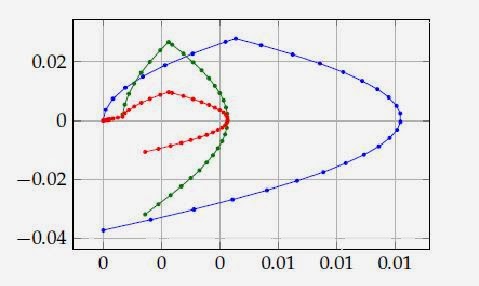
2) Adding fiscal policy. The paper considers adding government spending as a fiscal instrument. It makes an interesting distinction between ‘opportunistic’ and ‘stimulus’ changes in government spending, but I do not think I need that for what follows, so hopefully it will be for a later post. What I had not taken on board is that the optimal path for government spending might involve a prolonged period where government spending is lower (below its natural level). Here is another picture from the paper.


The blue line is the optimal commitment policy without any fiscal action: the same pattern as in the previous figure. The red line is the path for output and inflation with optimal government spending, and the green line is the path for the consumption gap rather than the output gap in that second case. The vertical difference between red and green is what is happening to government spending.

The first point is that using fiscal policy leads to a distinct improvement. We need much less excess inflation, and the output gap is always smaller. The second is that although initially government spending is positive, it becomes negative when the output gap is itself positive i.e. beyond T. Why is this?

Our initial intuition might be that government spending should just ‘plug the gap’ generated by the liquidity trap, giving us a zero output gap throughout. Then there would be no need for an expansionary monetary policy after the gap - fiscal policy could completely stabilise the economy during the liquidity gap period. This will give us declining government spending, because the gap itself declines. (Even if the real interest rate is too high by a constant amount in the liquidity trap, consumption cumulates this forward.)

This intuition is not correct partly because using the government spending instrument has costs: we move away from the optimal allocation of public goods. So fiscal policy does not dominate (eliminate the need for) the Krugman/ Eggertsson and Woodford monetary policy, and optimal policy will involve a mixture of the two. That in turn means we will still get, under an optimal commitment policy, a period after the liquidity trap when there will be a positive consumption gap.

The benefit of the positive consumption gap after the liquidity trap, and the associated lower real rate, is that it raises consumption in the liquidity gap period compared to what it might otherwise have been. The cost is higher inflation in the post liquidity trap period. But inflation depends on the output gap, not just the consumption gap. So we can improve the trade-off by lowering government spending in the post liquidity trap period.

Two final points on what the paper reaffirms. First, even with the most optimistic (commitment) monetary policy, fiscal policy has an important role in a liquidity trap. Those who still believe that monetary activism is all you need in a liquidity trap must be using a different framework. Second, the gains to trying to implement something like the commitment policy are large. Yet everywhere monetary policy seems to be trying to follow the discretionary rather than commitment policy: there is no discussion of allowing the output gap to become positive once the liquidity trap is over, and rules that might mimic the commitment policy are off the table. [2] I wonder if macroeconomists in 20 years time will look back on this period with the same bewilderment that we now look back on monetary policy in the early 1930s or 1970s? 


[1] Krugman, Paul. 1998. “It’s Baaack! Japan’s Slump and the Return of the Liquidity Trap.” BPEA, 2:1998, 137–87. Gauti B. Eggertsson & Michael Woodford, 2003. "The Zero Bound on Interest Rates and Optimal Monetary Policy,"Brookings Papers on Economic Activity, Economic Studies Program, The Brookings Institution, vol. 34(1), pages 139-235.

[2] Allowing inflation to rise a little bit above target while the output gap is still negative is quite consistent with following a discretionary policy. I think some people believe that monetary policy in the US might be secretly intending to follow the Krugman/Eggertsson and Woodford strategy, but as the whole point about this strategy is to influence expectations, keeping it secret would be worse than pointless.


Friday, 25 October 2013

In defence of forward guidance

Although this post is prompted by the bad press that the Bank of England’s forward guidance has been getting recently, much of what I have to say also applies to the US, where the policy is very similar. But there is one criticism of the policy in both countries that I agree with which I will save that until the end.

A good deal of the criticism seems to stem from a potentially ambiguity about what the policy is designed to do. The policy could simply be seen as an attempt to make monetary policy more transparent, and I think that is the best way to think about it in both countries. However the policy could also be seen as a commitment to raise future inflation above target in an attempt to overcome the ZLB constraint as suggested by Michael Woodford in particular [1]. Let’s call this the Woodfordian policy for short. (John Cochrane makes a similar distinction here.)  Ironically the reason why it helps with transparency is also the reason it could be confused with the Woodfordian policy.

In an earlier post written before the Bank of England unveiled its version of forward guidance, I presented evidence that might lead those outside the Bank to think that it was just targeting 2% inflation two years out. We could describe that as the Bank being an inflation forecast nutter, because it gave no weight to the output gap 2 years out. An alternative policy is the conventional textbook one, where the Bank targets both inflation and the output gap in all periods. I suggested that if the Bank published forward guidance, this could clearly establish which policy it was following. It has and it did: we now know it is not just targeting 2% inflation 2 years out, because it says it will not raise rates if forecast inflation is expected to be below 2.5% and unemployment remains above 7%. 2.5% is not hugely different from 2%, but in the world of monetary policy much ‘ink’ is spilt over even smaller things.

So forward guidance has made things clearer, as long as you do not think monetary policy is trying to implement a Woodfordian policy. Unfortunately if you really believed a central bank was an inflation forecast nutter, then you could see forward guidance in Woodford terms. Now I think there are good arguments against this interpretation. First, 2.5% is an incredibly modest Woodfordian policy. Second, for the US, there is a dual mandate, which would seem to be inconsistent with being an inflation forecast nutter. Third, for the UK, the MPC has made it pretty clear (most recently here) that it is not pursuing a Woodfordian policy. For all these reasons, I think it is best to see forward guidance as increasing transparency.

For those who just want to know whether monetary policy changes represent stimulus or contraction, this can be confusing. We saw this in the UK with the questioning of Mark Carney by the Treasury Select Committee, and Tony Yates has pursued a similar theme. Mark Carney kept saying that the stance of monetary policy is unchanged, but forward guidance makes monetary policy more ‘effective’. Now you could spend pages trying to glean insights into disagreements among the MPC from all this, and I do not want to claim that the Bank is always as clear as it might be here. However it seems to me that if the Bank wants for some reason to call reducing uncertainty increasing effectiveness, then there is nothing wrong with what Carney is saying. Forward guidance helps agents in the economy understand how monetary policy will react if something unexpected happens. In particular, growth could be stronger than expected (UK third quarter output has subsequently increased by 0.8%), but the decline in unemployment could remain slow (it fell from 7.8% to 7.7% over the last three months). Charlie Bean makes a similar case here. [2]

In much of the UK media forward guidance has been labelled a failure because longer term interest rates went up as forward guidance was rolled out. Now if you (incorrectly) see forward guidance as a Woodfordian policy, you might indeed be disappointed that long rates went up (although you would still want to abstract from other influences on rates at that time). However if it is about clarifying monetary policy in general, no particular movement in long rates is intended.

Ironically, some of the apparent critics of forward guidance in the UK, like Chris Giles here, also think the Bank of England could be much more transparent in various ways. The most comprehensive list is given by Tony Yates, and I agree with much of what he says. But we all know that central banks are very conservative beasts, and do things rather gradually. So any improvement in transparency is going to be incremental and slow. When they do happen, in this case through forward guidance, they should be welcomed rather than panned. Criticising innovation by central banks risks fuelling their natural conservatism.

This suggests that the major weakness with forward guidance is that it does not go far enough. In the current context, as events in the US have shown, the major problem is that it applies only to interest rates and not to unconventional monetary policy. This allowed the market to get very confused about what the Fed’s future intentions about bond buying are. So why not welcome forward guidance by saying can we have more please.  


[1] Gauti B. Eggertsson & Michael Woodford, 2003. "The Zero Bound on Interest Rates and Optimal Monetary Policy,"Brookings Papers on Economic Activity, Economic Studies Program, The Brookings Institution, vol. 34(1), pages 139-235. See also Krugman, Paul. 1998. “It’s Baaack! Japan’s Slump and the Return of the Liquidity Trap.” BPEA, 2:1998, 137–87.
[2] If you wanted to be pedantic, you could argue that to the extent that some thought growth might be faster than expected, and that this would lead to higher rates even if unemployment remained high, then dispelling this particular possibility must mean that averaged across all states of the world policy has become more stimulatory. Carney might not want to acknowledge that because some on the MPC would get upset. My reaction to this would be, why do you want to be pedantic. 


Wednesday, 7 August 2013

The MPC’s Forward Guidance

So, as expected, the MPC (pdf) is catching-up with the Fed, in introducing forward guidance that looks very similar. There are two notable differences: the unemployment threshold is 7%, rather than 6.5%, and there is a caveat (which the MPC calls a ‘knockout’) about financial stability as well as a caveat about inflation expectations. The MPC has also committed to not cut back on its QE purchases as well as not raise interest rates until unemployment falls below 7%, provided expectations of inflation do not exceed 2.5% and these caveats/knockouts do not apply.

We should be grateful for small mercies. This does clearly show that the MPC is not targeting 2% inflation two years ahead regardless, which I have argued it seems to have been doing recently. It focuses on unemployment, which does at least marginalise the idea that there is currently no spare capacity in the economy. In addition, by saying they do not currently expect unemployment to fall below 7% before mid-2016, they have provided a forecast of interest rates of sorts. The 7% unemployment figure is not a guess at the NAIRU, but just an upper threshold, and there is no commitment to raise rates if unemployment goes below 7%. To those in the Bank, where the regime has hardly changed since 1997, all this will seem like a big deal, even if to outsiders it seems less radical.

Yet this remains a very weak recovery, as the new Governor concedes. Although the Bank has raised its forecast for future growth, it is still a fairly pathetic 2.4% in two years time. The choice of 7% for the unemployment threshold is very conservative: UK unemployment did not go above 6% from 2000 to 2008. A ‘knockout‘ of 2.5% for expected inflation may copy the Fed, but given how high UK inflation has been recently, it is arguably more conservative - and anyway pretty low. I am not surprised by any of these things, because Carney had to get every member of the MPC to sign up to this, and so the numbers were always going to reflect the position of its more conservative members.

One additional thing has become clearer. By saying that, even with this new guidance, they do not expect unemployment to fall below 7% until 2016, the MPC has made it more transparent how prolonged this recession is going to be. Only two conclusions can follow: either high inflation is preventing the MPC from doing something about this, or they do not think they have any effective instruments left. If the first is true, that should focus discussion on whether consumer price inflation should be allowed to be such a tight constraint on growth. If the second, then why not turn to a proven instrument for stimulating demand?  


Sunday, 4 August 2013

Playing catch-up at the Bank of England

On Wednesday (7th August) the Bank of England will announce what it intends to do on forward guidance. Many seem to expect it to follow the Fed, and indicate a combination of (expected) unemployment and inflation that would not result in monetary tightening. Expectations may turn out to be wrong, however, because there is a quite wide divergence of views on the MPC about these things.

I think it is pretty clear that they should announce something like this, for two main reasons. First, it would help clarify what the overall objective of UK monetary policy is. As I argued here, a quite plausible interpretation of recent MPC’s behaviour is that they are simply targeting inflation two years or so ahead, and ignoring the expected output gap. Such a strategy is not consistent with how most academics think monetary policy should work, and it would not be compatible with Fed style forward guidance. So by adopting the latter, they could signal that they are in fact following a more orthodox, and appropriate, monetary policy. Second, forward guidance of this type gives us an indication of how they currently view the trade-off between the objective of achieving the inflation target and the objective of achieving a zero output gap. (My reading of the Treasury paper in March is that it makes clear, which it was not before, that having such a trade-off is compatible with the UK’s inflation targeting regime.) I cannot see how revealing that information can be a bad thing.

There are two other areas where the Bank could usefully receive forward guidance from the Fed. The first is to end the nonsense of not revealing what it expects future interest rates to be. I have always found the arguments for not publishing its own forecasts for interest rates particularly weak - they often amounted to the view that the public was too stupid to understand the difference between a forecast and an unconditional commitment. However, as long as only a few ‘minor’ central banks did publish this information (New Zealand, Sweden, Norway), the Bank of England could get away with this. Once the Fed starting publishing this information, the case for the Bank not to do so collapses. (See more here.)

The second is to be honest about fiscal policy and Quantitative Easing. This does not mean the Bank should say that the current government’s austerity programme is wrong (even though it is), but that it should say that it makes it much more difficult for monetary policy to achieve its objectives. As I have argued before, this statement is almost undeniably true, so why not go on the public record as Bernanke has done? It is in the Bank’s own interest to do this.

When the Bank was given independence in 1997, the regime the Labour government then established was arguably ‘state of the art’. Within the context of inflation targeting, it was very sensible to establish a symmetrical range where getting inflation too low was considered as bad as allowing inflation to be too high. Having an MPC that included some academics was a good idea, obviously (and debate within the MPC has clearly been much better as a result). However the Bank has largely stood still since then, in terms of practice and transparency, in part because the Bank itself is an inherently conservative institution that instinctively avoids public discussion. (A recent example, now rectified, is here.) So now it is behind best practice, and needs to catch up. Anyone who still thinks the Bank is transparent enough should read this recent post from Tony Yates.

Playing catch-up is all the more important because ‘best practice’ (what the Fed currently does) is still probably a long way behind what is optimal. This is not a criticism of central bankers so much as an acknowledgement that the game today is much more difficult than we thought it was just ten years ago. Miles Kimball has a very nice little piece on the major challenges that future monetary policy faces. Even if the recovery gathers pace and unemployment falls back to more normal levels and central banks can safely raise interest rates above the floor, the lessons of the Great Recession need to be learnt. To do better next time (because there will be a next time), is there a role for explicit policy commitment to mitigate the impact of the ZLB, and would level nominal GDP targets be a means of achieving that? Are there more inventive ways of removing the ZLB constraint, or if not, should we think about raising the inflation target? Is there a permanent role for unconventional monetary policy, and how does macroprudential regulation coordinate with conventional policy? Do we really have to keep discussion of using inflation to help reduce debt a taboo? All that, even before we start thinking about the financial sector and banks.


So there are huge challenges ahead, and it would be great if the Bank of England could be at the forefront in addressing these. The Bank should be given substantial credit for undertaking Quantitative Easing, and innovative programmes like Funding for Lending. However it would be even better if it could be at the innovative frontier across the whole range of monetary policy practice, as I think it was fifteen years ago.