Winner of the New Statesman SPERI Prize in Political Economy 2016


Showing posts with label liquidity trap. Show all posts

Wednesday, 8 March 2017

Budget Day Nonsense

For the last several budgets/autumn statements I have agreed to write an immediate response for some media outlet, and have therefore felt obliged to watch either the speech itself, or the media reports on the day. The good news is that no one has asked this year, and so I can ignore all budget coverage until tomorrow. This will leave me better off, because in macroeconomic terms most budget day coverage has over the last seven years been largely nonsense.

I can confidently forecast that today you will hear a great deal, at great length, about how the path of government borrowing has changed since the Autumn Statement. Journalists will ask endlessly whether he has done enough to reduce borrowing, or whether he had enough money to spend more. At the moment this is all utterly meaningless. In fact it is worse than that. It encourages people to think that government budgeting is just like household budgeting. It is, to be blunt, what gave us the disaster that was austerity.

What any macroeconomist should ask of this budget is has the Chancellor done enough to get UK interest rates off the zero lower bound: to get us out of what economists call a liquidity trap. When interest rates have gone as low as the Bank of England feels able to take them, then it has lost control of the economy. That is the situation right now. The only duty of the Chancellor in that situation is to give the Bank back control through a fiscal stimulus. [1] If he does do that the short term deficit and borrowing numbers that go with that stimulus are completely irrelevant. If he does not do that his budget has failed.

That is basic macroeconomics. But you will not hear any macroeconomics from the Chancellor, or most of the mainstream media. The idea that the Bank does macroeconomic stabilisation and the Chancellor does bookkeeping has become embedded in mediamacro, and even seven years in a liquidity trap has not been able to change this. Alas even the IFS, which is so brilliant at everything else, does not do macro and so reinforces the household budgeting metaphor.

Mediamacro will also spend hours talking about the OBR forecasts for this year and next. This too is pointless. I am sure the OBR will do what it normally does, which is put together a short term forecast that is not far from the average of other forecasters. To their great credit, they also forecast GDP per capita. It will be interesting to see who in the media picks that up. No doubt Brexiteers will go on about how great the economy has been in 2016 despite all the gloomy forecasts. There is a simple antidote to this, which any journalist can apply. Note that a great deal of the growth in GDP in 2016 was due to immigration, the same immigration that the Prime Minister has said was the cause of the Leave vote. [2]

What the better journalists focus on from the OBR is its forecast of where trend output is and how fast this trend will grow in the future. That is the only thing that will influence how much the Chancellor thinks he can borrow in future years. It is the only forecast that matters for future budgets, and as I have already noted it should have no influence on the current budget. Note particularly how the OBR has had to adjust its forecasts for future growth and tax receipts as a result of Brexit. (On this, see some good analysis by IPPR’s Catherine Colebrook.)

Of course the individual measures the Chancellor announces (either in his speech or elsewhere) are important. But even here a day’s reflection is useful, to deconstruct the spin and put the measures in context. (Once again, the OBR’s document can be very useful in that respect.) For pretty well anything the Chancellor does on the spending side, one important context is the extent to which he is just reversing the cuts his predecessor ordered. This is why the IFS wisely waits a day before presenting its post-budget analysis.

What I hate most about budget days nowadays is the constant repetition by government politicians, echoed by mediamacro, about not being able to afford improvements to public services. The reality, the detail of which Polly Toynbee sets out clearly, is that this government has managed to cut plenty of taxes which seem to have been affordable. But there is a deeper concern.

As I showed in this post, the performance of the economy since 2010 has been terrible. There has been no recovery, using the proper meaning of the word, from the Great Recession. All this time the Bank has been forced to keep interest rates at or near their floor, and use incredibly inefficient instruments like QE, because the government has kept on cutting spending. It is not normal to cut spending in what should be a recovery phase of the business cycle: at least not normal since the mistakes of the 1920s and 1930s.

In the years immediately following 2010 the government could claim its austerity policies were the international consensus, but no longer. In the Eurozone outside Greece austerity has come to an end and their recovery is gathering pace. In the US the central bank, for better or worse, is raising rates. Only in the UK does austerity continue and the economy continues to stagnate. Which is why I’m glad I do not have to watch lots of people completely ignoring all these points today.

[1] I’m not talking measures that might allow the Bank to raise interest rates by a quarter of 1%. I’m suggesting a stimulus such that members of the MPC say unequivocally rates will need to rise, and the only debate is by how much. Anything less than this just allows the economy to get blown back into a liquidity trap when something mildly bad happens.

[2] As background, GDP per capita increased by just over 1% in 2016, which does not sound so good. Average growth from 2010 to 2016 has been 1.2%, compared to 1997-2010 when the average was 1.4%, a period which included a global financial crisis and the worse recession since WWII. Having to get the deficit down is no excuse for this terrible performance, because fiscal consolidation need not reduce GDP if it is done outside a liquidity trap. This is the basic bit of macroeconomics that both this government and mediamacro fail to recognise.   

Friday, 24 April 2015

Mediamacro myth 4: The immediate necessity of belt tightening

In previous posts in this series (0, 1, 2, 3) we have established that the large increase in the deficit in 2010 was a consequence of the recession and not Labour profligacy - the Labour government was clearly not profligate - and that this deficit was not causing any panic in the financial markets. But surely it is a good idea for the government to tighten its belt when it runs a large deficit, just as individuals who spend more than they earn need to take action? Mediamacro is fond of drawing this analogy.

The first point to clear out of the way is that individuals do not always try and ‘balance their books’. People generally spend more around Christmas, and make up any deficit through the rest of the year. You can think about deficits and surpluses that are just the result of the normal economic cycle in a similar way.

As the 2010 deficit was a consequence of the recession, can we therefore assume that it will correct itself as the economy recovers? The answer depends on the extent of the recovery. If we returned to the pre-recession trend level of output then roughly yes [1], but not many economists think that is likely. Instead organisations like the OBR assume that much of the impact of the recession on output will be permanent. We can call the additional deficit that arises from this permanent loss of output ‘structural’. The structural deficit will not go away without some government action.

A good rule for an individual with a ‘structural deficit’ is to take action to correct it sooner rather than later, particularly if there are limits to their ability to borrow. Our mediamacro myth is that the same applies to governments: the 'maxing out the national credit card' idea. This is something that every economics student learns is wrong in the first year of their studies. Cutting the government’s deficit reduces aggregate demand, which reduces output. An individual that cuts their spending does not need to worry about the impact their decision will have on the rest of the economy, but the government because it is so large does have to think about this. When the government is free to borrow more at no extra cost (which we have seen that in the UK it was), then it has an important choice about when to start reducing its deficit.

Is there ever a good time to reduce the deficit, if output will always take a hit? There are two reasons why some times are much better than others. First, there is now quite a lot of evidence that cutting deficits in a recession has a larger impact on output than cutting deficits at other times (see here and here). Second, theory tells us that cutting deficits need not in principle harm the economy at all if monetary policy can offset their deflationary impact. If the Bank of England can cut interest rates at the same time as the government cuts its spending, the net effect on the economy could be zero.

This is a crucial point. Indeed it is the half-truth on which the coalition’s policy of immediate austerity seems to have been based. Modern mainstream macroeconomics says that in normal times governments do not need to worry about the impact their fiscal decisions (like austerity) will have on the economy, because monetary policy will offset that impact. In a speech to the RSA in 2009 this was the idea that the future Chancellor put at the centre of his macro strategy.

There was only one problem, which turned out to be extremely serious. Just before he made that speech, UK short term interest rates hit 0.5%, and the Bank of England decided they could be cut no further. They had reached what economists call the ‘Zero Lower Bound’, sometimes described as a liquidity trap. As a result conventional monetary policy was unable to offset the deflationary impact of austerity, and 2010 austerity killed the recovery that seemed to have just started. We had to wait until 2013 for a period of sustained output growth. The Bank did have some unconventional policies that it tried - most notably Quantitative Easing - but as it had no idea how effective these were, they were hardly an adequate substitute for cuts in interest rates.

Was the problem of nominal interest rates hitting a floor and therefore not being able to offset the impact of fiscal austerity on output something economists had not foreseen? Is that why the Chancellor ignored this possibility in his 2009 speech? Far from it! Keynes had dealt with the problem in the Great Depression in the 1930s. More recently, the same problem had arisen in Japan in the 1990s. By 2009 a large number of articles had been written about this problem, which is why economists like Paul Krugman and myself were such strong critics of fiscal austerity the moment it was proposed.   

Most mediamacro myths in this series just need a look at the data and common sense to bust. In those cases it is natural to look at the media itself for the source of the mediamacro problem. In this particular case busting the myth requires some (entirely conventional) macroeconomics. The fact that this macroeconomics has not found its way into political discussion of fiscal policy may reflect other problems in the knowledge transmission mechanism, including the fact that outside the US central banks seem very reluctant to acknowledge the severity of the Zero Lower Bound/liquidity trap problem.

It is difficult to overstate the consequences of this. As we have seen, the prospective Chancellor in a 2009 speech setting out the theoretical framework behind his policy ignored the problem, even though it was in front of his eyes. Each household in this country lost on average at least £4000 as a result. Yet incredibly, the same person proposes to make exactly the same mistake after 2015, and it is largely left to a few academic bloggers to point this out.
 
Previous posts in this series


[1] Not a complete yes, because although the deficits caused by this kind of recession would be temporary, they will have raised the level of debt, and the interest on that debt will add to future deficits. We can only ignore that if we soon expect a future boom of equal magnitude, which would be an unwise thing to do. 

Thursday, 23 April 2015

A criticism of the IFS

Everyone agrees that the UK Institute of Fiscal Studies is great. It is perhaps best known for its commentary of macro budgetary issues, but it does a great deal of detailed top class research into the micro impact of different forms of taxation, and much more. Today it released its assessment of the different political parties’ plans for spending and taxation policy after the election. It makes two very important points: that the Conservatives plan much greater cuts than the other parties, and that there are important gaps in how much each party have told us about how they will achieve their aggregate plans (with probably the biggest ‘black hole’ with the Conservatives, although do not expect to hear that comment on the BBC).

At the same time as reading this document, I was also writing my next macromedia myths post, where I complain about the lack of media exposure given to the problem of the liquidity trap or Zero Lower Bound, and why this problem is central to the critique of austerity during a recession. So I thought I would just check that these terms appeared somewhere in the IFS document. They do not. All I can find is this paragraph:

“A lower level of borrowing would imply debt falling more quickly. This would have the benefits of leading to a lower level of debt interest payment and potentially leaving the UK better placed to deal with any future adverse event (such as the public finance challenge posed by an ageing population or any future recession). But reducing debt more quickly would also require more in the way of tax rises and/or spending cuts.”

If I have missed a section where the risks of rapid deficit reduction when interest rates are still so low are discussed, I shall remove this post. But if such a discussion is indeed absent, I think I can reasonably complain. Why has the IFS chosen to go long on numbers, and short on ideas? Their analysis is a key resource for the media, and so if the IFS do not even mention such basic macro points when discussing macro policy, it becomes a little less surprising that the media also ignores them.

I have always tried to emphasise that I regard the mediamacro problem as a system failure, rather than a problem with particular newspapers or journalists or editors. I have also tried to stress that I remain unclear as to what the critical drivers of this problem are: a biased print media, the role of the City or something else. That something else could potentially include, at least in the UK, the way academic ideas fail to be transmitted to the media by academic think tanks.


Wednesday, 31 December 2014

On the Stupidity of Demand Deficient Stagnation

In my last post I wrote about “why recessions caused by demand deficiency when inflation is below target are such a scandalous waste. It is a problem that can be easily solved, with lots of winners and no losers. The only reason that this is not obvious to more people is that we have created an institutional divorce between monetary and fiscal policy that obscures that truth.” I suspect I often write stuff that is meaningful to me as a write it but appears obtuse to readers. So this post spells out what I meant.

First a preliminary. If you do not understand why economies can suffer from deficient demand, and why this is a needless waste of resources, then to be honest your best bet is to read a few chapters of a popular book on macro, like Tim Harford’s latest. If you have done a macro course and do not believe prolonged demand deficiency is possible, just tell me how you get out of a liquidity trap in a world with inflation targets after reading this post (and maybe this).

Demand deficiency when inflation is persistently below target (the stagnation of the title) should not occur, because it is easy to solve technically. If I was a benevolent dictator in charge of both monetary and fiscal policy instruments, stagnation would never persist in my economy. The way I would ensure this most of the time is by varying interest rates, but if nominal interest rates hit zero (a liquidity trap) I have a whole range of alternative instruments, ranging from cutting various taxes to increasing transfers or raising public spending. I know of no macroeconomic theory on earth which tells me that everyone of these instruments will fail to raise demand.

Whatever instrument I use to raise demand in a liquidity trap, I need to finance it. I can do this by issuing bonds (increasing government debt) or creating money. A higher stock of government debt or money is the only legacy (apart from happier people) of my successful operation to remove demand deficiency. We generally prefer governments to use bond finance, for reasons I will come to. But supposing there is some constraint (real or imagined) on issuing bonds. As a benevolent dictator I can just create money, which we call money financed fiscal stimulus. Money financed fiscal stimulus is a sure way of ending demand deficiency in a liquidity trap.

If that higher stock of money proves too great later on when the economy has recovered, I can reduce it by various means. There will be no subsequent above target inflation. There are no technical problems that I as a benevolent dictator need to worry about here. Of course creating lots of money on a temporary basis is exactly what central banks in the UK, US and Japan have recently done (QE - Quantitative Easing). The problem is that they have not been accompanied by sufficient tax cuts, increased transfers or increased government spending. Creating money to buy financial assets is by comparison to money financed fiscal stimulus an unreliable way of raising demand.

So that is it. Demand deficient stagnation is easy to prevent technically. The huge waste of resources that we see in the long and incomplete US recovery, the even slower UK recovery and the absence of recovery in the Eurozone are all unnecessary, because we know how to fix them. [1]

What stops this happening in the real world is that we have become fixated by the labels ‘monetary’ and ‘fiscal’ policy, and created an independent institution to handle the former. Central banks do monetary policy (varying interest rates and creating money) but are not allowed to give money directly to the people (helicopter money, or John Muellbauer’s QE for the people). Governments run fiscal policy, so can do bond financed fiscal stimulus, but are not allowed to create money. So a self-imposed institutional setup prevents either central banks or governments doing money financed fiscal stimulus alone.

A major reason why this institutional arrangement exists is to discourage non-benevolent governments creating inflation through fiscal profligacy, or more recently in order to increase policy credibility. Of course during a period of stagnation there is no danger of rampant inflation. Unfortunately this institutional arrangement creates a problem when governments – in my view for largely imaginary reasons - put a priority on reducing deficits. Money financed fiscal stimulus is not available to get you out of a liquidity trap. So we get this huge waste of resources.

Within the existing institutional framework, there is plenty to be done to convince fiscal policy makers that reducing deficits should not be a priority in the short term, or in trying to improve the monetary policy framework so liquidity traps happen less often. Yet it would be better still if we had an institutional framework which was a little more robust to failures on either front. We need to regain the possibility of money financed fiscal stimulus in a liquidity trap.

[1] What I say here has a lot in common with the advocates of Modern Monetary Theory. However, it also appears to be perfectly standard macroeconomics to me, so here I will simply commend them for highlighting these aspects of mainstream thought. 

Saturday, 23 August 2014

Draghi at Jackson Hole

To understand the significance of yesterday's speech (useful extract from FT Alphaville here), it is crucial to know the background. The ECB has appeared to be in the past a centre of what Paul De Grauwe calls balanced-budget fundamentalism. I defined this as a belief that we needed fiscal consolidation (austerity) even when we were in a liquidity trap (i.e. interest rates were at or very close to their zero lower bound). Traditionally ECB briefings would not be complete without a ritual call for governments to undertake structural reforms and to continue with fiscal consolidation.

An important point about these calls from the central bank for fiscal consolidation is that they predate the 2010 Eurozone crisis. As I noted in an earlier post, the ECB’s own research found that “the ECB communicates intensively on fiscal policies in both positive as well as normative terms. Other central banks more typically refer to fiscal policy when describing foreign developments relevant to domestic macroeconomic developments, when using fiscal policy as input to forecasts, or when referring to the use of government debt instruments in monetary policy operations.” The other point to note, of course, is that the ECB had in the past always called for fiscal consolidation, whatever the macroeconomic situation.

How can we explain both this obsession with fiscal consolidation, and the ECB’s lack of inhibition in its public statements? I suspect some might argue that the ECB feels especially vulnerable to fiscal dominance - the idea that fiscal profligacy will force the monetary authority to print money to cover deficits. In my earlier post I suggested this was not plausible, because in reality the ECB was less vulnerable in this respect than other central banks. Unfortunately I think the true explanation is rather simpler, and we get an indication from the Draghi speech. There he says:

“Thus, it would be helpful for the overall stance of policy if fiscal policy could play a greater role alongside monetary policy, and I believe there is scope for this, while taking into account our specific initial conditions and legal constraints. These initial conditions include levels of government expenditure and taxation in the euro area that are, in relation to GDP, already among the highest in the world. And we are operating within a set of fiscal rules – the Stability and Growth Pact – which acts as an anchor for confidence and that would be self-defeating to break.”

The big news is the first sentence, which suggests that Draghi does not (at least now) believe in balanced-budget fundamentalism. Instead this speech follows the line taken by Ben Bernanke, who made public his view that fiscal consolidation in the US was not helping the Fed do its job (and who was quite unjustifiably criticised in some quarters for doing so). However note also the second sentence, which clearly implies that the size of the state in Euro area countries is too large. Whether you believe this to be true or not, it is an overtly political statement. I think part of the problem is that Draghi and the ECB as a whole do not see it as such - instead they believe that large states simply generate economic inefficiencies, so calling for less government spending and taxation is similar to calling for other ‘structural reforms’ designed to improve efficiency and growth.

The simple explanation for the ECB’s obsession, until now, with fiscal consolidation is that its members take the neoliberal position as self evident, and that their lack of accountability to the democratic process allows them to believe this is not political.

As a result, it might be possible to argue that the ECB never believed in balanced-budget fundamentalism, but instead kept on calling for fiscal consolidation after the Great Recession through a combination of zero lower bound denial, panic after the debt funding crisis, and a belief that achieving a smaller state remained an important priority. It is hard to believe that members of the ECB, unlike other central banks, were unaware of the substantial literature confirming that fiscal policy is contractionary: there does not seem to be any difference in educational or professional backgrounds between members of the ECB and Fed, for example. 

Should we celebrate the fact that Draghi is now changing the ECB’s tune, and calling for fiscal expansion? The answer is of course yes, because it may begin to break the hold of balanced-budget fundamentalism on the rest of the policy making elite in the Eurozone. However we also need to recognise its limitations and dangers. As the third sentence of the quote above indicates, Draghi is only talking about flexibility within the Stability and Growth Pact rules, and these rules are the big problem.

The danger comes from the belief that the size of the state should be reduced. Whether this is right or not, it leads Draghi later on in his speech to advocate balanced budget cuts in taxes. He says: “This strategy could have positive effects even in the short-term if taxes are lowered in those areas where the short-term fiscal multiplier is higher, and expenditures cut in unproductive areas where the multiplier is lower.” My worry is that in reality such combinations are hard to find, and that what we might get instead is the more conventional balanced budget multiplier, which will make things worse rather than better.  

Tuesday, 25 March 2014

More thoughts on ‘expectations driven’ liquidity traps

Warning - this is technical, so really just for macroeconomists.

The idea that we could get stuck in a steady state with nominal interest rates at zero and negative inflation has been dismissed by some because it has been associated with the policy proposal to raise nominal interest rates to avoid that outcome. Here I want to explore an alternative interpretation that disconnects the theory from the policy.

First, a recap on the theory. Take a really simple model, where the real interest rate is positive and constant. The central bank sets the nominal rate according to a Taylor rule that obeys the Taylor principle. The rule is calibrated such that there is a steady state at which nominal interest rates are positive and inflation is at target. Furthermore under rational expectations/perfect foresight, if agents know the inflation target, the real rate and the rule, we immediately go to that steady state. In more complex and realistic models it may take time to get to this ‘intended’ steady state, but it is ‘locally’ or ‘saddlepath’ stable.

However there is another steady state, because nominal interest rates cannot go below zero. For given real interest rates, this Zero Lower Bound (ZLB) steady state must involve negative inflation. This steady state is ‘indeterminate’, which means that we can describe dynamic perfect foresight paths that start at some arbitrary level of inflation below the central bank’s target, but end up at the ZLB steady state. To see this diagrammatically, look at this earlier post, or (plus algebra) this from David Andolfatto, or pages 123 to 135 in Woodford’s Interest and Prices. [1]

Stephanie Schmitt-Grohe and Martın Uribe have a paper which embeds this logic in a more elaborate model of involuntary unemployment based on nominal wage rigidity. They suggest that it tells a better story about the US recession than the New Keynesian idea involving a downward shift in the natural real interest rate. It is a story of a jobless recovery: growth resumes at the ZLB steady state, but involuntary unemployment is also positive at that steady state, because inflation is negative and nominal wages are downward rigid.

The paper interprets the ZLB steady state as one where agents have the wrong expectations about the central bank target. Call this the ‘mistaken beliefs’ story. With that story, raising rates could reveal or signal the authority’s true inflation target. In Stephanie and Martin’s paper, because raising nominal rates leads to an immediate change in beliefs and therefore a rise in expected inflation, we see an immediate jump to output growth above trend, which allows unemployment to fall. Many will just think this idea is incredible, but as Paul Krugman keeps emphasising, ZLB economics often turns things upside down.

In an earlier post I suggested that this story could possibly be plausible for (pre Abe?) Japan or the Euro area, because their inflation targets are one-sided: they seem content if inflation is below target, so in principle it might be possible to believe they might be content to end up at the ZLB steady state. In addition there is no QE in the Eurozone, and was only briefly in Japan. I suggested, I hope correctly, that the situation is different in the US, and it clearly is in principle in the UK. For that reason alone, I thought the mistaken beliefs story unlikely for these two countries.

However, after seeing Stephanie present her paper last week and thinking more about it, I wondered whether we could give the ZLB steady state a different interpretation? Suppose agents believe that is where inflation is heading because they do not think monetary (or any other) policy is capable of achieving the inflation target. Given current attitudes to fiscal policy, and a pessimistic view of the power of QE, this interpretation does not seem so farfetched for the US or UK. Economists sometimes worry about a deflationary spiral, where inflation just keeps falling into a bottomless pit. But maybe the ZLB steady state is like a ledge that can stop this descent. [2]

Under this interpretation, the policy of raising interest rates could be a disaster. There is no boost from any increase in expected inflation, because beliefs do not change. We lose the negative inflation equilibrium, but what seems likely in that situation is that we just get a negative deflationary spiral. The ledge preventing descent into the deflationary pit crumbles away. [3] If this interpretation is tenable, then it means that the possibility of becoming stuck in a ZLB steady state is not necessarily linked to the policy proposal of raising rates to get out of it.

My own view of the evidence is that the ‘balance sheet recession/natural rate too low’ story is still the more convincing, and that we are currently seeing in the US and UK a very slow return to the inflation target equilibrium. However that story is not without its problems: with a simple New Keynesian Phillips curve, a gradual reduction in the output gap should be associated with inflation gradually rising towards target, which is not what we are seeing at the moment. So I am not so confident that I can dismiss the ZLB steady state story out of hand. The message I draw from that possibility is that inflation targets need to be two sided and clear, and that policy (monetary and fiscal) at the ZLB should do everything it can to try and achieve that target. Assuming that below target inflation must eventually rise because nominal rates are zero could turn out to be a big mistake. [4]


[1] At the intended steady state, where inflation is at target, the target fixes the end-point of any dynamic process, and this (rather than history) then determines the initial level of inflation. At the ZLB steady state, there are multiple dynamic paths that lead there, so something else (‘confidence’) fixes the initial point. It cannot be history, because the model is forward looking and history does not matter. This may be a little too arbitrary or extreme for some tastes.

It is also controversial whether an inflation target is sufficient to fix an end-point for any dynamic inflation process, rather than allowing dynamic processes that explode. As I note in my earlier post, John Cochrane says: “Transversality conditions can rule out real explosions, but not nominal explosions.” I have less of a problem than he does with this. 

[2] A third interpretation might be that agents revise down their beliefs as inflation falls. The problem there is that this involves learning, which may make the stability of the ZLB steady state problematic. Jess Benhabib, George Evans, and Seppo Honkapohja have modelled learning when there are the same two steady states, and what they find is that the ZLB steady state is unstable: inflation keeps on falling. (It is a deflationary spiral.) My intuitive explanation for their result is that learning is equivalent to introducing backward looking expectations dynamics, and typically an indeterminate equilibrium with rational expectations dynamics (which the ZLB steady state is) becomes unstable with backward looking dynamics. Equally a ‘saddlepoint’ perfect foresight equilibrium (which the intended steady state is) becomes stable when expectations are backward looking, so they find that the inflation target steady state is stable under learning.

[3] Following on from footnote [1], you might ask why agents in this case will not select the only steady state left, and therefore raise their expectations. Why can I imagine agents assuming a deflationary spiral, but I want to rule out inflationary spirals? The answer is because the ZLB provides asymmetry. If it looks like an inflationary spiral is developing, the central bank can depart from its Taylor rule and raise rates substantially. That should change beliefs. They cannot do the same for a deflationary spiral.

[4] In an early draft of this post I had a different introduction, based on Narayana Kocherlakota’s recent dissent. Some may recall that Kocherlakota originally put forward the mistaken beliefs ZLB steady state idea, but then seemingly recanted. So my idea was that perhaps what had changed was not his view about the theory, but his interpretation of it. However having read some more about his current views, I don’t think this stands up, but it was such a neat idea I cannot resist mentioning it as a footnote. 


Sunday, 29 December 2013

Werning on Liquidity Trap Policy

For macroeconomists

I finally got round to reading this paper by Iván Werning - Managing a Liquidity Trap: Monetary and Fiscal Policy. It takes the canonical New Keynesian model, puts it into continuous time, and looks at optimal monetary and fiscal policy when there is a liquidity trap. (To be precise: a period where real interest rates are above their natural level because nominal interest rates cannot be negative). I would say it clarifies rather than overturns what we already know, but I found some of the clarifications rather interesting. Here are just two.


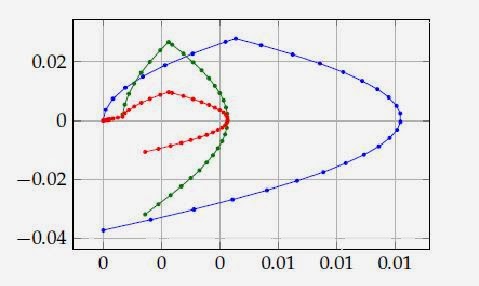
1) Monetary policy alone. The optimum commitment (Krugman/Eggertsson and Woodford) [1] policy of creating a boom after the liquidity trap period might (or might not) generate a path for inflation where inflation is always above target (taken as zero). Here is a picture from the paper, where the output gap is on the vertical axis and inflation the horizontal, and we plot the economy through time. The black dots are the economy under optimal discretionary policy, and the blue under commitment, and in both cases the economy ends up at the bliss point of a zero gap and zero inflation. 


In this experiment real interest rates are above their natural level (i.e. the liquidity trap lasts) for T periods, and everything after this shock is known. Under discretionary policy, both output and inflation are too low for as long as the liquidity trap lasts. In this case output starts off 11% below its natural level, and inflation about 5% below. The optimal commitment policy creates a positive output gap after the liquidity trap period (after T). Inflation in the NK Phillips curve is just the integral of future output gaps, so inflation could be positive immediately after the shock: here it happens to be zero. As we move forward in time some of the negative output gaps disappear from the integral, and so inflation rises.

It makes sense, as Werning suggests, to focus on the output gap. Think of the causality involved, which goes: real rates - output gap (with forward integration) - inflation (with forward integration), which then feedback on to real rates. Optimum policy must involve an initial negative output gap for sure, followed by a positive output gap, but inflation need not necessarily be negative at any point.

There are other consequences. Although the optimal commitment policy involves creating a positive output gap in the future, which implies keeping real interest rates below their natural level for a period after T, as inflation is higher so could nominal rates be higher. As a result, at any point in time the nominal rate on a sufficiently long term bond could also be higher (page 16).

2) Adding fiscal policy. The paper considers adding government spending as a fiscal instrument. It makes an interesting distinction between ‘opportunistic’ and ‘stimulus’ changes in government spending, but I do not think I need that for what follows, so hopefully it will be for a later post. What I had not taken on board is that the optimal path for government spending might involve a prolonged period where government spending is lower (below its natural level). Here is another picture from the paper.


The blue line is the optimal commitment policy without any fiscal action: the same pattern as in the previous figure. The red line is the path for output and inflation with optimal government spending, and the green line is the path for the consumption gap rather than the output gap in that second case. The vertical difference between red and green is what is happening to government spending.

The first point is that using fiscal policy leads to a distinct improvement. We need much less excess inflation, and the output gap is always smaller. The second is that although initially government spending is positive, it becomes negative when the output gap is itself positive i.e. beyond T. Why is this?

Our initial intuition might be that government spending should just ‘plug the gap’ generated by the liquidity trap, giving us a zero output gap throughout. Then there would be no need for an expansionary monetary policy after the gap - fiscal policy could completely stabilise the economy during the liquidity gap period. This will give us declining government spending, because the gap itself declines. (Even if the real interest rate is too high by a constant amount in the liquidity trap, consumption cumulates this forward.)

This intuition is not correct partly because using the government spending instrument has costs: we move away from the optimal allocation of public goods. So fiscal policy does not dominate (eliminate the need for) the Krugman/ Eggertsson and Woodford monetary policy, and optimal policy will involve a mixture of the two. That in turn means we will still get, under an optimal commitment policy, a period after the liquidity trap when there will be a positive consumption gap.

The benefit of the positive consumption gap after the liquidity trap, and the associated lower real rate, is that it raises consumption in the liquidity gap period compared to what it might otherwise have been. The cost is higher inflation in the post liquidity trap period. But inflation depends on the output gap, not just the consumption gap. So we can improve the trade-off by lowering government spending in the post liquidity trap period.

Two final points on what the paper reaffirms. First, even with the most optimistic (commitment) monetary policy, fiscal policy has an important role in a liquidity trap. Those who still believe that monetary activism is all you need in a liquidity trap must be using a different framework. Second, the gains to trying to implement something like the commitment policy are large. Yet everywhere monetary policy seems to be trying to follow the discretionary rather than commitment policy: there is no discussion of allowing the output gap to become positive once the liquidity trap is over, and rules that might mimic the commitment policy are off the table. [2] I wonder if macroeconomists in 20 years time will look back on this period with the same bewilderment that we now look back on monetary policy in the early 1930s or 1970s? 


[1] Krugman, Paul. 1998. “It’s Baaack! Japan’s Slump and the Return of the Liquidity Trap.” BPEA, 2:1998, 137–87. Gauti B. Eggertsson & Michael Woodford, 2003. "The Zero Bound on Interest Rates and Optimal Monetary Policy,"Brookings Papers on Economic Activity, Economic Studies Program, The Brookings Institution, vol. 34(1), pages 139-235.

[2] Allowing inflation to rise a little bit above target while the output gap is still negative is quite consistent with following a discretionary policy. I think some people believe that monetary policy in the US might be secretly intending to follow the Krugman/Eggertsson and Woodford strategy, but as the whole point about this strategy is to influence expectations, keeping it secret would be worse than pointless.


Wednesday, 14 August 2013

Why the Pigou Effect does not get you out of a liquidity trap

For macroeconomists

This issue has surfaced again (see Krugman and Rowe). I wrote a post awhile back on this, but it was quite difficult (for me at least!), so here is an attempt to restate the key conclusions more directly. Ashok Rao has a post covering some of the same themes as my earlier post. The key point here is that I am going to follow Nick in saying that money is different from bonds because money is irredeemable, but even then the Pigou effect is not a magic bullet that gets us out of a liquidity trap.

How is the Pigou effect supposed to get you out of a liquidity trap? In a liquidity trap nominal interest rates are at zero (ZLB). However pretty well everyone agrees that if by some means the monetary authority could induce higher inflation expectations, then the ZLB could be overcome, because real interest rates would fall, stimulating demand. That is a real interest rate effect. It is what some people think Friedman had in mind when he was so critical of Fed policy in the Great Depression. (I have no idea if this is true.) It is what Michael Woodford argues the Fed should now promise to mitigate the impact of the ZLB. It is what Paul Krugman recommended Japan do to get out of the lost decade. But none of these things is the Pigou effect.

The Pigou effect is when the authorities keep the current stock of money constant, and falling prices mean that its real value increases. The idea is that at some point people feel sufficiently wealthier that they spend more, which adds to demand. For this to work, we have to assume that the nominal stock of money will remain unchanged, unaffected by falling prices. Now you might say fine, let’s assume that. But if you do, you might also agree that the fall in prices is temporary. Simple neutrality implies that if you hold the money stock constant, falling prices today will mean higher prices tomorrow. But we have already established that in that case you do not need a Pigou effect, because higher inflation tomorrow at the ZLB will mean lower real interest rates, and you get the demand stimulus the good old real interest rate route. Furthermore, if people understand that prices will rise, they are not really wealthier in an intertemporal sense, because their extra real money balances will be inflated away. If you like, they save their extra real money balances today to pay for future inflation taxes. [1]

The alternative case is where future inflation does not increase as current prices fall - as would happen if the monetary authority targeted future inflation for example, and did not raise that target as prices fell. That would imply that the current nominal money stock was not fixed, because to prevent future inflation rising, the monetary authority must at some stage reduce the nominal stock of money - long run neutrality again. How does it do that without raising interest rates? It could raise taxes. But if it did that, then Ricardian consumers would not think of their higher real balances today as wealth, because this would be offset by future tax increases.

The central bank could reduce the money stock by selling some of its government debt. But under the conditions that Ricardian Equivalence holds, that has the same effect. Now the government will have to raise taxes to pay the interest on that debt, whereas before any interest they did pay came straight back via the central bank.

We can sum this up rather neatly, as Willem Buiter did here with the aid of lots of maths, by saying that what matters is the terminal stock of money, not its current value. The government can only make people feel wealthier by printing money if people believe that the increase in its real value is permanent.

We can apply the same reasoning to a helicopter drop. The first issue is whether issuing money to pay for a tax cut is any different from issuing bonds, and in particular does Ricardian Equivalence apply? Now macroeconomists are confused on this (see my earlier post), but here I’m happy to follow Nick and agree that money financing is different, because money is not redeemable. So a permanent helicopter drop of money will tend to increase consumption. To put it another way, the Ricardian Equivalence mechanism does not apply to a helicopter drop.

However there is another, more economy wide mechanism. If long run neutrality holds, and if people understand this, they will realise that their extra wealth will eventually be inflated away, so they are no better off. (Equivalently, their tax gain today will be offset by a higher inflation tax at some point.) But those expectations of higher inflation, if we are stuck in a liquidity trap, will shift consumption to the present, so the helicopter drop increases demand through a real interest rate mechanism.

The bottom line is that we can forget about the Pigou effect as a way out of the liquidity trap, at least in what is now our baseline macro model. What is important for the liquidity trap is expectations about future monetary policy. If monetary policy allows future inflation to rise, and expectations are rational, we can get out of the trap. If they do not, then we stay in the trap until some other force gets us out. That force will not be the Pigou effect.

[1] What if neutrality does not hold? Neutrality is pretty basic, but for the sake of argument let’s briefly consider this. Consumers are now wealthier, because they have more real money with no future costs to come. However I have the following problem if we stick with intertemporal consumers of the Ricardian type, who only consume the annuity value of any increase in their wealth. When do these agents consume their new found wealth? Any answer except never appears to violate consumption smoothing.


Saturday, 10 August 2013

Expectations driven liquidity traps

For macroeconomists

This is my own take on the idea of expectations driven liquidity traps (as opposed to liquidity traps where the natural real interest rate is low and unobtainable). I note some of the literature that has promoted these thoughts at the end, but I am not trying to summarise what these papers actually say, but rather to give my own thinking on how such a trap could arise. The usual health warning on such occasions applies: if you think I have got something wrong, or missed something important from the literature, please let me know.

Consider the diagram below, which represents the simplest possible model. Real interest rates are always constant, which is the 45 degree line. Monetary policy follows the Taylor principle, but nominal rates cannot go below zero, so the bold monetary policy line kinks. There is one ‘locally stable’ equilibrium at the inflation target (let us call that the ‘intended’ equilibrium), and one ‘indeterminate’ equilibrium when we are at the ZLB (which involves negative inflation).


It is often said that the intended equilibrium is ‘globally unstable’. (Michael Woodford in Interest and Prices  - page 123 onwards - talks about global ‘multiplicity of equilibria’.) By this is meant that, in the absence of imposing an endpoint constraint that has to be met, there are infinitely many rational expectations solutions to the model, many of which involve inflation exploding. I trace one: if we start at A, the monetary authority raises nominal interest rates, but for constant real rates that must mean that expected inflation next period is even higher etc etc.

John Cochrane says: “Transversality conditions can rule out real explosions, but not nominal explosions.” As a result, he suggests, we cannot rule out travelling along this unstable path. After all, hyperinflations do occur. I am less worried about this. Hyperinflations occur when monetary policy makes no attempt to stabilise inflation. Here we have a model where everyone understands it does, so it makes sense to impose an endpoint on any dynamic path. 

For example, what happens when interest rates and inflation go up when we are at A. Do agents say to themselves ‘hyperinflation here we come’. Of course not. This is inconsistent with the model, which involves an inflation target. They say instead ‘that was unexpected - we must have got something wrong’. We only travel along the unstable path for as long as agents do not revise their ‘beliefs’ (in this case, expectations about the inflation target and the real interest rate). Once they revise their beliefs, whether it is their belief about the inflation target or the real interest rate, inflation is likely to fall towards the intended steady state. [1]

Note that we cannot just say - suppose we start at A, as if history put us there. History does not put us there: in this forward looking model history is irrelevant. Given the Taylor principle, there are only two reasons we could be at A within the context of this model: agents get the real interest rate wrong, or the inflation target wrong. Once we allow beliefs to be revised, it seems inconceivable that hyperinflations would occur within the context of this model.

In looking at how beliefs change we are applying a simple notion of learning. The fact that learning helps stabilise inflation around the intended steady state should not be surprising, because what we are in effect doing is adding some backward dynamics into the model. A locally stable steady state with forward looking dynamics will tend to flip to a stable steady state with backward dynamics. This property is helpful, because we probably do not know the mixture of backward and forward looking dynamics we have in the real world, so it is good that policies should be robust to this.

A consumer has to eventually get on to their stable saddlepath because it is stupid for them to accumulate infinite wealth and stupid for others to carry on lending them more and more (no Ponzi games). But things in this model are not so very different - all we are saying here is that we are working with a model in which we rule out hyperinflation because that is a stupid thing for central banks to allow. But unlike the consumer case, it is not impossible that central banks could allow it, which is why we sometimes see hyperinflation. [2]

If we start off with inflation below the inflation target, then we can apply a symmetrical argument. Nominal interest rates will fall. This is inconsistent with agents’ beliefs, so if they revise these beliefs it seems likely that inflation will rise rather than carry on falling. But suppose they do not revise their beliefs. In that case we do not shoot off to hyper negative inflation. This path will converge on the ZLB steady state. This steady state is not ‘locally stable’, but ‘indeterminate’.

Indeterminacy means that the model does nothing to tie down the initial point. We could start anywhere below the intended steady state, and a solution of the model would get us to the indeterminate steady state. While this may sound desirable, it is not, because we normally want the model to give us a unique dynamic path. With a forward looking model where history does not matter we need something to give us our starting point. Often indeterminate steady states flip to unstable points if we change from forward looking to backward looking dynamics.

This is where the desirability of the Taylor principle comes from. If we replace the Taylor rule plus the Taylor principle by a constant nominal interest rate that passes through the intended steady state, then the fact that this steady state would be indeterminate is conventionally seen as a very strong argument against constant nominal interest rate policies. The ZLB is just a particular constant interest rate policy.

To put this point another way, recall that in this purely forward looking model history is irrelevant. We cannot say ‘history means we start somewhere, and then we converge to the indeterminate steady state’. Now incorrect beliefs could start us anywhere, but beliefs are not completely independent of the model and subsequent dynamic paths. All along the approach to the ZLB equilibrium, events are contradicting those initial beliefs.

However, it may be as unrealistic to assume beliefs are continually revised as it is to assume they are never revised. Suppose beliefs are not revised for some time, and the initial belief involves an inflation target which is below the actual target. Inflation is below target, which leads to interest rates falling, which if real rates are constant implies still lower inflation next period. If beliefs do not get revised, we do not go to hyper disinflation, but to the ZLB steady state. Suppose agents only revise their beliefs once they get close to the ZLB steady state. What will happen then?

Recall that originally agents thought that the inflation target was a bit below the actual target (1% rather than 2%, say). Inflation has now fallen much further (to -3%, say). Is it possible that they might conclude that they originally overestimated the true inflation target? If they ignored the fact that the ZLB is a constraint, they might decide that current stability implied that the inflation target was -3%. The central bank cannot demonstrate that this is incorrect by lowering nominal rates, because of the ZLB. This is why this situation is very different from the hyperinflation case.

In a model this simple, we have stretched credibility a bit to get us to a point where we stay at the ZLB steady state. Agents ignore all the observations on the path towards that position, each of which was inconsistent with a -3% inflation target. But if you add in additional uncertainty, allowing the real interest rate to temporarily change for example, things get more complicated. Agents could interpret falling nominal rates when inflation was 1% as being due to temporarily lower real interest rates.

So for a time, at least, we could stay at the ZLB steady state because of ‘self-fulfilling’ but mistaken expectations. If we allow real interest rates to change, then at some point real interest rates will rise and agents will recognise this. Instead of nominal rates rising (as they should if the inflation target was -3%), they will stay at zero, which should make agents revise their belief about the inflation target. So the ZLB steady state remains transitory. But we could stay stuck in the ZLB steady state because of mistaken beliefs for some time: for as long as beliefs remain unchanged or no information arrives that makes them change.

Does this story of an expectation driven liquidity trap fit the evidence better than stories based on an unobtainable negative natural real rate? Or is it instead just a cute (‘liberating’) theoretical construct with zero application. I think it is difficult to argue that something like this applies today to countries like the US or UK. Expectations of inflation are still positive, and central bank inflation targets are clearly positive and pretty credible. (The concept of pessimistic beliefs, or animal spirits, might well be more applicable in the context of other models with different unobservable variables.)

However, if we take the idea seriously at all, it does suggest that one-sided inflation targets are dangerous. Central banks that have a target of 2% or less invite speculation that they would settle for zero inflation if that came around, which would make falling into an expectations driven liquidity trap that much easier. Perhaps the major economy where the central bank’s intentions towards inflation have been least clear, and therefore the potential for an expectations driven liquidity trap greatest, has been (until very recently) Japan.


Some literature:

Benhabib, J, and Farmer, R (2000) ‘Indeterminacy and Sunspots in Macroeconomics’ , in John
Taylor and Michael Woodford (eds.): Handbook of Macroeconomics, North Holland.

Benhabib, J, Schmitt-Grohe, S and Uribe, M (2002) ‘Avoiding Liquidity Traps’, Journal
of Political Economy 110(3), pp. 535–563. (pdf)

Cochrane, John, 2011, “Determinacy and Identification with Taylor Rules”, Journal of Political Economy 119(3), pp. 565–615. (pdf)

Farmer, R (2012a) “Confidence, Crashes and Animal Spirits,” Economic Journal, Vol. 122, No. 559, Pages, 155-172

Mertens, K and Ravn, M (2012) ‘Fiscal Policy in an expectations driven liquidity trap’ (pdf)


[1] With asset market bubbles, we can get the rather interesting possibility that we continue to travel along the explosive path, not because expectations of the fundamentals are wrong, but because agents think they can make money along that path but get out before the bubble bursts. However, this does not seem to apply to inflation and monetary policy.

[2] Of course it is not completely impossible that some people are misers or get away with Ponzi schemes, which illustrates the point that the difference in rationale for imposing end point conditions in each case is not that great.


Thursday, 23 May 2013

The Liquidity Trap and Macro Textbooks


Over the last eleven days something unusual has happened – I have not only failed to post a blog of my own, but I have not even read anyone else’s posts. Instead I have taken advantage of a sabbatical term to take a break [1] in Umbria, during a time of year when it is still cool enough to walk, but not too cold in the Piano Grande. Before I left I did write a couple of things that I thought I might quickly post while away, but with the help of the Italians’ penchant for starting dinner late and eating four (or more) courses that idea somehow got lost.  

So I’m spending part of today catching up, and reminding myself why Paul Krugman and Martin Wolf are such great writers. (For example, from the former, a masterful analysis of the decent into worldwide austerity, and from the latter, a perfect short account of why when it comes to government debt the Eurozone really is different.) What I want to pick up on here is this Krugman post, where he questions the description in a Nick Crafts piece of higher inflation as a way out of the liquidity trap as being ‘textbook’. (See also Ryan Avent.)

So is raising inflation expectations to avoid the liquidity trap textbook or not? Let’s take the 2000 edition of the best selling undergraduate macro textbook. Here ‘liquidity trap’ does not appear in the index. There is a page on Japan in the 1990s, and in that there is one paragraph on how expanding the money supply, even if it was not able to lower interest rates, could by raising inflation expectations and therefore reducing real interest rates stimulate demand. One paragraph among 500+ pages is not enough to make something ‘textbook’, so it seems as if Paul Krugman has a point.

Yet how can this be? It is not one of those cases where textbooks struggle to catch up with recent events, because the Great Depression was a clear example of the liquidity trap at work. How can perhaps the major macroeconomic event of the 20th century, which arguably gave rise to the discipline itself, have so little influence on how monetary policy is discussed? Yet it is possible to argue that the discussion is there, in an oblique form. A standard way of analysing the Great Depression within the context of IS-LM, which this popular textbook takes, is to contrast the ‘spending hypothesis’ with the ‘money hypothesis’: was the depression an inevitable result of a negative shock to the IS curve, or as Freidman argued could better monetary policy have prevented this shock hitting output?

A standard objection to the money hypothesis is that nominal interest rates did (after a time) fall to their lower bound. The counterargument – which the textbook also suggests - is that, if the money supply had not contracted, long run neutrality would imply that eventually inflation would have to have been higher, and therefore real interest rates on average would be lower. So in one way the story about how higher inflation could avoid a slump is there.

What is missing is the link with inflation targeting. Because textbooks focus on the fiction of money supply targeting when giving their basic account of how monetary policy works, and then mention inflation targeting as a kind of add-on without relating it to the basic model, they fail to point out how a fixed inflation target cuts off this inflation expectations route to recovery. Quantitative Easing (QE) does not change this, because without higher inflation targets any increase in the money supply will not be allowed to be sustained enough to raise inflation. In this way inflation targeting institutionalises the failure of monetary policy that Friedman complained about in the 1930s. Where most of our textbooks fail is in making this clear.    


[1] Sometimes known as holidays, these are things that we Europeans are forced to take many more of than Americans, leading to great frustration and misery (or maybe not).

Thursday, 3 January 2013

Did Ricardian Equivalence kill the Pigou effect?


For macroeconomists

After the last time the world got into a liquidity trap, there was a debate about whether price flexibility would be sufficient to get us out of the trap. That debate tended to assume a fixed money supply. With that assumption, the answer today would be yes, if falling prices raised inflation expectations (given long run neutrality) and therefore reduced real interest rates. Back then that story was not so popular, perhaps because the debate pre-dated rational expectations. Instead the argument at the time focused on the Pigou or Real Balance effect. Falling prices raised the value of outside money, so everyone would feel wealthier and spend more.

We do not hear this argument so much nowadays. I have not seen this discussed in the advanced textbooks I know well (for example neither term is in the index of Romer or Obstfeld and Rogoff), so I was wondering why that was. Is the Pigou effect not what it was once thought to be? I could not find a clear answer to this question anywhere, but of course that may be my failing. So here are my thoughts, but they come with the possibility that I have just missed something. If I have, I will rewrite the post accordingly.

What I did find were a few papers that appeared to suggest that Ricardian Equivalence (REq) killed the Pigou effect. Here is a quote from a paper by Peter Ireland. After talking about REq, he writes

“Less widely appreciated, however, is a closely related finding, presented most explicitly by Weil (1991) but also implicit in earlier work by Sachs (1983) and Cohen (1985). These authors show that government-issued fiat money will not be perceived as a source of private-sector wealth if the households owning that money are the same households that, first, receive all of the transfers or pay all of the taxes associated with future changes in the money supply and that, second, incur all of the opportunity costs associated with carrying the money stock between all future periods. We are used to the idea of Ricardian Equivalence implying that government debt is not net wealth. Essentially consumers internalise the government’s budget constraint. But that argument applies to outside money as much as government debt. We can replace initial values of debt and money by the discounted future stream of primary surpluses they support.”

The easiest way to describe REq is that the infinitely lived representative consumer consolidates the government’s intertemporal budget constraint (IBC) into its own. Suppose this consumer owns some nominal (non-indexed) government debt, and the price level falls. Is that consumer better off? The real value of the future interest they receive on that debt will be higher, but this will be offset by the higher taxes in real terms that the government will raise to pay for this. The same argument applies to the higher real redemption value of the debt.

Ireland argues that exactly the same points can be made about outside money. Suppose money pays no interest, but consumers hold it because of the liquidity services it provides.
But if the consumer already has all the liquidity services they need (as they do in a liquidity trap), a fall in prices that creates more of this asset in real terms does not make the consumer better off on this account. So what about the redemption value of the additional real balances?

Here I’m inclined to think that money is different from government debt. In a paper[1] that I do not think has been published, Willem Buiter argues that money is irredeemable. The government only promises to redeem money with itself. So if I get a tax cut that is financed by printing money rather than issuing debt, there is no offsetting future tax liability. For this reason, money – unlike government debt – is net wealth for the consolidated public and private sectors.

Now a standard response is to say that a money financed tax cut does not make the consumer better off because the price level will rise, reducing the purchasing power of that money. It seems to me that is a different argument to REq – it requires going beyond just thinking about budget constraints. It is also an argument that does not apply to the Pigou effect, which is what happens if prices fall, raising the value of real balances.

Does the irredeemable nature of money rescue the Pigou effect from the REq argument? Yes and no. There is a crucial difference between Buiter’s analysis and the traditional view. In Buiter, it is the present discounted value of the terminal stock of base money that is net wealth for the consolidated private and public sectors, rather than its current value. To see why this matters, consider the liquidity trap case again.

As we have already noted, there is no liquidity trap in the flexible price case when the government holds the nominal stock of money constant, because falling prices today imply higher expected inflation. We do not need a Pigou effect. But the more interesting case, which I have talked about before, is where the government or central bank has an inflation target. In this case the authorities prevent inflation expectations rising, so real interest rates do not fall.

In that case nominal money will not be held constant when prices fall. Instead, the authorities will contract the nominal money stock in line with falling prices, to make sure inflation does not rise. As a result, there will be no increase in consumption, because the terminal value of nominal money falls, and its real value stays constant. Or, to put the same point another way, higher future taxes required to reduce the money stock will offset the wealth impact of higher current real money balances. There is no Pigou effect.

This is all terribly stylised and unrealistic, so there is no need to add comments that just point this out. However, I hope I’m not the only one who thinks this thought experiment is 
interesting. I also think that the proposition that inflation targets prevent macroeconomic ‘self-correction’ even when prices are flexible has a symbolic importance.


[1] Buiter, W.H. (2003) Helicopter Money: Irredeemable Fiat Money and the Liquidity Trap, NBER Working Paper No. 10163.