Winner of the New Statesman SPERI Prize in Political Economy 2016


Tuesday, 13 June 2017

Conservative zugzwang

Would really like to get back to macro, as some interesting things have been happening, but there are just too many compelling issues following GE2017 to talk about first.

The GE2017 result left the Conservatives in a position that chess players call a zugswang, which means whatever you do makes your position worse. They needed to turn to the DUP to get an overall majority, which leaves them with a secure hold on power. But that move in itself will lose them some popularity, kills their ‘coalition of chaos’ charge, and runs the risk of damaging Northern Ireland. The Good Friday agreement says that the sovereign should exercise power with “rigorous impartiality”. It will be up to the DUP to persuade Sinn Fein that all they are getting from the government is extra money for Northern Ireland. So to hold on to power, the Conservatives put the Northern Ireland peace process in jeopardy and give a gift to Labour.

The Conservatives will not fight another election with May as their leader. Their MPs, whatever they may say in public, are angry at her incompetence in running a campaign, putting together a manifesto, responding to the press, and almost everything else. The longer she stays in post, the longer the memory of that dismal campaign lingers and the more the brand gets tainted. However an election to replace her will reopen the split over Brexit which could tear the party apart.

Here is a worst case scenario. After the referendum, the Remain half of the party were in shock, and so they allowed May to define what Brexit meant. She did it in such a way as to ensure Hard Brexit, which will inflict considerable damage on the economy. Remain MPs felt they had no way of resisting that (few tried), but as Ruth Davidson made clear in any election in the near future they will be less passive, trying to elect one of their own who will perhaps keep the UK in the EEA (a Norway type deal), and certainly stay in the customs union. Leave MPs will do everything they can to stop that, and it is difficult to see this time their candidate mysteriously withdrawing before the membership are consulted. The Leave membership, with the help of the press, will choose the Leave candidate. Ruth Davidson might then declare independence from the main party.

It could be a terrible mess, spread out over time. It is a contest which will allow, with delicious irony, Corbyn to describe the Conservatives as too hopelessly divided to govern. Furthermore if they hold the contest while the EU negotiations are going on, Labour will justly accuse them of wasting precious time. But if they leave any contest until after the A50 negotiations have ended, the less time a new leader has to improve the Conservative brand, particularly when their majority makes them look powerless and ineffectual. It is a zugzwang.

The same applies to how they turn their fortunes around. The obvious move is to abandon austerity. The agreement with the DUP and other factors mean that the existing deficit targets will not be hit, so turning the deficit into surplus appears a distant prospect. But ending austerity in the mind of the voter means spending more on the NHS and schools. It should also mean reversing the cuts to in work benefits. However to, for example, match Labour’s spending commitments with some attractive alternatives of their own without raising taxes will blow the deficit. That would destroy the ‘we are competent because we cut the deficit’ line so carefully built up over seven years. To raise taxes will damage their core vote. Once again, a zugzwang.

You can add immigration. Fail to meet their target once again, and their credibility on this issue will be destroyed, but try meeting it and the economy is in serious trouble. Of course none of this means that the Conservative are bound to lose the next election. As a Conservative Prime minister once said, events dear boy, events. But for the party it means the liklihood that things will get worse before possibly getting better.


Monday, 12 June 2017

GE2017 and the Media

There is a danger of missing the point about Labour’s surge and the media. The issue is absolutely not that political commentators were surprised by Labour’s sudden popularity among voters. Of course they were surprised, because there was no evidence for it before May 2017. The dismal showing of Labour in the council elections at the start of May was real enough. Those on the left who say they knew it would happen are using the word ‘knew’ in the same sense as football supporters knowing their own side is going to win.

We all have a pretty good idea why the surge happened. In style Corbyn was everything May was not, and Labour’s policies were popular. What the media should be worried about was that both those things came as a surprise to the public. As I said here, a general election campaign is unusual because the public get to see much more of the party leaders and hear much more about their policies, and the broadcasters are duty bound to be impartial. But the character of May and Corbyn did not change overnight, and neither were the policies offered by either side very different from the stance they took before the election. So why were people so surprised?

Someone more cynical than I might suggest that the media’s job is to distort reality: to portray May as more competent than she was and to portray Corbyn as incompetent. What happened in the election campaign is that the electorate got a proper look at the two main leaders and their policies, and realised what the media had been saying was false.

That cynical view is completely appropriate to most of the right wing press, whose job is to distort reality as much as they can get away with. (Remember that damning article about May just before the election that was pulled by the Telegraph?) But why did the truth about May and Corbyn not make any impression on the public until the election? Did political commentators know no more than the public, and were just as surprised as the public about May and Corbyn’s character and their policies during the campaign? If that is the case, they were poor journalists. Or is it that they failed to communicate what they did know?.

Is the problem that the broadcast media feels duty bound to just present soundbites (May can do those), and the independent press in the UK is just too small? Or is the problem that the right wing media for one reason or another sets the parameters for other journalists. Is it that political journalists like winners and despise losers, so let the polls influence how they portrayed individuals and parties? I do not know the answers, but these are the questions the media needs to reflect on.   

Friday, 9 June 2017

Labour and its Left

The 1980s were a battle between what eventually became New Labour, and what is often referred to as the Hard Left. 1983 to 1997 was a long period where the Hard Left gradually lost influence within both the party (then the membership and trade unions) and among the parliamentary party (the PLP). But this didn’t mollify the distaste New Labour had for the Hard Left.

This period meant that those opposing the left adopted two propositions which became almost hard-wired into their decisions.

  1. The left within Labour were more concerned with controlling the party than winning elections. That has often been said about Jeremy Corbyn over the last two years.

  2. That the Left, and their ideas and policies, were toxic to most voters. The right wing press assisted in this by talking about the loony left.

In short, it was best to act as if Labour’s Left were a political pariah. As a result of these ideas the left minority within the PLP was tolerated (Labour needed to be a broad church), as long as it remained small and powerless. Triangulation became the way to win power: to adopt policies that were never from the Left, but adopted a centre ground between the Left and the Conservatives. New Labour was not old Labour.

The strategy was extremely successful. Tony Blair won three elections, and it took the deepest recession since the 1930s to (just) remove Labour from office. The Blair government achieved a lot, particularly for the poor, but it also made serious mistakes, most notably Iraq. That stopped a lot of those on the left actively supporting the party.

In 2015, when Labour under Ed Miliband was defeated, the general mood among the PLP seemed to be that it needed to triangulate once more and move further to the right. Crucially, some leading figures suggested Labour should all but embrace George Osborne’s austerity policy. The three main candidates to take over from Miliband were seen (with justification or not) as representing this thinking. Austerity was a critical issue, in part because - if accepted - it potentially constrained what Labour could do to a large extent. It was also an economically illiterate policy, which I can safely say with authority. Worse than that, it was a policy that - as the deficit fell - began to lose its popularity, so for Labour to adopt it at just the point it was losing its popular appeal seemed a doubly crazy thing to do.

Before Corbyn won that election I wrote
“Whether Corbyn wins or loses, Labour MPs and associated politicos have to recognise that his popularity is not the result of entryism, or some strange flight of fancy by Labour’s quarter of a million plus members, but a consequence of the political strategy and style that lost the 2015 election. …. A large proportion of the membership believe that Labour will not win again by accepting the current political narrative on austerity or immigration or welfare or inequality and offering only marginal changes to current government policy.”

At this point I was receiving impassioned pleas by some to come out against Corbyn. These mainly went along the lines that Corbyn was unreformed from the 70s/80s, and wanted to take over the party for the ‘old left’. Many said he could not win an election because his policies would be too radical. He would be a disaster with the electorate. It was unmodified 1980s thinking. These arguments sounded unconvincing to me, mainly because Corbyn would have to work with the PLP. Unlike the 1980s, the left were now such a small minority within the PLP that they would have no other choice.

As I had anticipated, Corbyn and McDonnell did form a shadow cabinet of all the (willing) talents, and as far as economic policy was concerned they were far from radical. McDonnell set up the Economic Advisory Council (EAC), which I and I suspect others were happy to join because it involved no endorsement of Labour’s policies. Arguments that we should have withheld our advice because Corbyn was somehow ‘beyond the pale’ were again straight from the post-83 playbook, and I am very glad that I ignored them. I helped Labour adopt a fiscal rule which in my view exemplified where mainstream macroeconomics was, and which incidentally some sections of the Left were very critical of. It formed a key part of their 2017 manifesto

What I had not anticipated, back when Corbyn was about to be elected, was how foolish some Labour MPs would be in those months following his election. Critical briefing of the press was constant, and tolerated by many in the PLP. As I wrote at the time, this strategy was stupid even if you hated Corbyn, because it gave the membership the excuse to ignore Corbyn’s failings. I was more right than I could have imagined. This was the first major mistake that the PLP made after the election.

The other thing I had not anticipated was Brexit. This triggered the second major mistake by the PLP, which was the vote of no confidence. It was in many cases an emotional reaction to Brexit, the leadership’s role in the campaign and earlier incompetence. It was understandable, but it was nevertheless terrible politics. Corbyn’s supporters were gifted the perfect narrative in the subsequent leadership election: the PLP had sabotaged Corbyn’s leadership.

The two mistakes made by the PLP ensured that for many members the 2016 vote became the PLP against the membership. One big mistake Owen Smith made was to not side with the membership in terms of changing the 15% leadership rule, so naturally they said if you do not trust us we will not trust you. Nevertheless I supported Smith over Corbyn, because I could not see a future for a party that had become so deeply divided. I thought the next election was winnable for Labour, but not if the party was seen by the electorate as at war with itself. That was one of the key reasons I resigned from the EAC: whether that was the reason three others also left I cannot say.

After Corbyn won for a second time, the polls suggested Labour’s future was bleak. This is what led May to call her snap election. However two things happened after Corbyn’s re-election which surprised me and many others, and meant that my predictions of no future under Corbyn proved wrong. First, the internal squabbling within Labour stopped almost completely. Second, the leadership started putting together a manifesto that would prove very popular, with a competence that had earlier been missing. During the general election divisions within Labour were not part of May’s main attack, in part because she chose to make the campaign presidential in style..

Many will say that Labour achieving 40% of the popular vote vindicated the membership’s faith in Corbyn. Others will go further and say ‘if only the PLP had been more cooperative we could have won’. That is going too far..The election result was also a consequence of a truly terrible Conservatives campaign, headed by a Prime Minister who exposed herself as just the wrong person to lead the country through Brexit  The economic environment couldn’t have been better for Labour: unlike 2015 we had falling real wages and the slowest quarterly GDP growth rate in the EU. Labour’s manifesto held out hope, while the Conservative manifesto was a liability. Despite all this, the Conservative vote share was above Labour.

What the election does show beyond doubt is that the attitudes most of the PLP had towards the Left, which they had carried with them from the 1980s, are no longer appropriate. The result was not the disaster they had been so sure would happen. That showed some left wing policies can be very popular, even if they are called anti-capitalist by those on the right. The curse of austerity on the UK electorate has lifted. Unlike the ‘dementia tax’, none of the policies in Labour’s manifesto proved to be a millstone around Corbyn’s neck. The days when Labour politicians needed to worry about headlines in the Mail or Sun are over.

The big lessons of the last two years are for Labour’s centre and centre-left. The rules that applied in the 1980s no longer apply. The centre have to admit that sometimes the Left can get things right (Iraq, financialisation), and they deserve some respect as a result (and vice versa of course). The centre and Left have to live with each other to the extent of allowing someone from the Left to lead the party. Corbyn has shown that the Left are capable of leading with centre-left policies, and the electorate will not shun them. With the new minority government so fragile, it is time for the centre and centre-left within Labour to bury old hatchets and work with Corbyn’s leadership.

Thursday, 8 June 2017

Why has the US resisted Trump but the UK acquiesced to Brexit?

This post is a response to a provocative piece by Anatole Kaletsky. He writes
“While the US has taken only 100 days to see through Trump’s “alternative reality” (though perhaps not through Trump himself), almost nobody in Britain is even questioning the alternative reality of Brexit.”

In other words, although both the US and UK succumbed to right wing populism, the US is strongly resisting while the UK has given up doing so. He contrasts the reaction of business to Trump and Brexit. “US businesses started lobbying immediately to block any Trump policies that threatened their economic interests” which has “removed Trump’s main protectionist threat.” In contrast “no major British companies have tried to protect their interests by campaigning to reverse the Brexit decision. None has even publicly pointed out that the referendum gave Prime Minister Theresa May no mandate to rule out membership of the European single market and customs union after Britain leaves the EU.”

One reaction that many will have is that while US elections are 4 year affairs, a referendum was meant to be ‘for a generation’. If the Leave vote had been 60% or more, I might have some sympathy with this view. But the narrow victory coupled with uncertainty about what Brexit actually entails means that the argument for a vote after negotiations conclude is compelling. But only around 30% of people support being allowed a second vote. In contrast, currently 56% of US voters disapprove of Donald Trump.

You could say this is because Donald Trump has done plenty of things for US voters to get angry about, whereas Brexit has not happened. I would put the point rather differently. The problems with Trump are visible to everyone. You just need to read his tweets! The costs of Brexit are economic and less clear to everyone. For example the depreciation immediately after Brexit was very visible, but you needed some knowledge of economics to know that this would mean lower living standards for everyone living in the UK.

This gets translated into how each are handled in the media. The New York Times and the Washington Post are in the front line against Trump, while if you want information on how Brexit is damaging the economy you will find plenty of it in the Financial Times. But that negative news does not normally make it into the broadcast media, because the broadcast media has decided that the Brexit debate is over. The reason it has done that is the real reason why the UK appears to have given in to Brexit, which is the Labour party.

It is difficult to get ideas discussed in a sustained way in the broadcast media unless one of the two major political parties is pushing it (see, for example, opposition to austerity before Corbyn). In contrast to the Democrats, who have been unified in their opposition to Trump, Labour have accepted Hard Brexit. It would be unfair to dump the whole responsibility for Labour’s Brexit U-turn on Jeremy Corbyn. Many Labour MPs pushed in the same direction because they thought it would gain them votes: austerity appeasement all over again. I think a strong leader who believed in EU membership could have overcome that, but Corbyn’s preferences were different.

As a result, we have had a general election supposedly about who will be best at negotiating Brexit without any discussion of Brexit itself. Despite the LibDems best efforts, there has been no discussion of all the events since the referendum which indicate bad times ahead, as outlined by Ian Dunt. There has been endless discussion about how taxes and spending might change under Labour or the Conservatives, but none about the elephant in the room: the cuts or tax increases that Brexit and lower immigration will require. There is a hope, expressed by Bill Keegan, that today’s vote may lead to a hung parliament, which in turn might just lead to a second referendum, but it is a very slim hope.

It may also be the only hope. George Eaton may well be right that Labour’s decision to back a Hard Brexit has helped them in this election. The danger is that Labour will draw the lesson that this will be true in 2022 as well, and their new leader (if there is a new leader) will also commit to hard Brexit. Again the austerity mistake will be repeated: assuming the electorate's attitudes will remain unchanged. If that happens, we may well see in four years time a rejuvenated US with a Democrat in the White House and Republicans routed because of their association with Trump, but a UK entering a long period of relative decline and isolation because it gave in to right wing populism. 


Monday, 5 June 2017

Could austerity’s impact be persistent

How Conservative macroeconomic policy may be making us persistently poorer

I was happy to sign a letter from mainly academic economists published in the Observer yesterday, supporting the overall direction of Labour’s macroeconomic policy. I would also have been happy to sign something from the Liberal Democrats, who with a similar macroeconomic stance have the added advantage of being against Brexit, but no such letter exists. As I have said before about letters, it is the overall message that counts. We desperately need more public investment and more current spending to boost demand, which in turn will allow interest rates to come away from their lower bound.

If I could carry just one message into mediamacro to bring it more into line with macro theory, it is that nominal interest at their lower bound represent a policy failure. Unconventional monetary policy is a very unreliable substitute for interest rate changes and fiscal policy as a way of controlling the economy, and a temporary fiscal stimulus can reliably get interest rates off their lower bound. This was the big mistake that most advanced countries made in 2010, and painfully slow recoveries were the result. The UK is currently making the same mistake, which is why the macroeconomic impact of the Labour and LibDem programmes is so much better than the Conservatives’ continuing austerity.

In the textbook macroeconomic models, this policy mistake can have a large but temporary cost in terms of lost output and lower living standards. This is because in these basic models a short term lack of demand does not have an impact on supply. Output in the longer run is determined by the number of those wanting to work, the capital stock and technology, all three of which are assumed to be independent of short term demand shortages. However it looks increasingly like these textbook models can be wrong.

In a new study (pdf), Gustav Horn and colleagues at the IMK institute in Germany looked at how persistent the impact of negative fiscal shocks (higher taxes or lower spending) had been on output. Their analysis is a refinement of earlier studies by of Blanchard and Leigh, and more recently Fatas and Summers. They find that the impact of recent fiscal shocks have been persistent rather than temporary, at least so far.

Although this persistent impact is not part of textbook models, economists have explored effects of this kind (the collective name for which is ‘hysteresis’). There are many theories about why it could happen, such as theories of endogenous growth. I explored the idea of an innovations gap in a recent post. To see why this possibility is so important, take the example of UK austerity in financial years 2010/11 and 2011/12. A few years ago I took the OBR’s (conservative) assessment of its impact on GDP growth in those two years, and assumed that the impact of fiscal consolidation had completely unwound by 2013. That gave you a total cumulated cost of austerity of 5% of GDP (1+2+2), or £4,000 per household.

What happens if instead the impact of austerity is much more persistent? I can no longer use the OBR’s numbers, because they assume impacts die out over time. Instead, let me make the fairly conservative assumption that each 1% reduction in the cyclically adjusted deficit reduces GDP by 0.7%, but these effects are permanent. I’ve chosen 0.7 because that gives a similar answer for the cost of austerity by 2012 as my previous calculation. But rather than disappearing in 2013, these cost persist and grow with each additional act of consolidation. By 2016/17 GDP would be lower by nearly 4%, and a further 1% would be added by the planned additional austerity until 2019/20. If you accumulate those losses, it means that the average household would have lost a staggering £13,000 by 2016/17, rising to £23,000 3 years later.

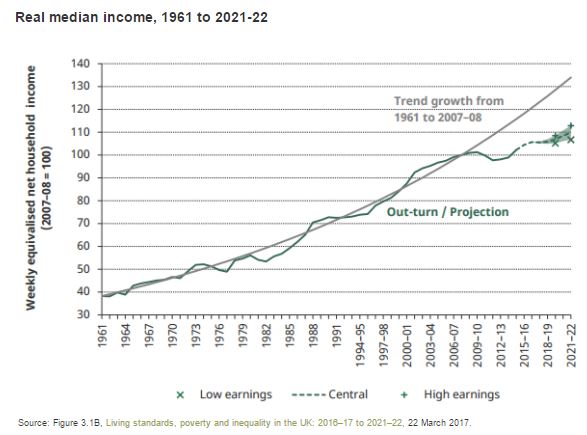
If you think that sounds a ridiculously large number, just compare output or income relative to past trends. Here is a version from the IFS.


Once you see this data, claims that we have a strong economy become laughable. UK median incomes are currently over 15% below previous trends. That is more than enough room to accommodate 4% due to a permanent effect from austerity.

I do not have to argue that such permanent effects are certain to have occurred. The numbers are so large that all I need is to attach a non-negligible probability to this possibility. Once you do that it means we should avoid austerity at all costs. In 2010 austerity was justified by imagined bond market panics, but no one is suggesting that today. The only way to describe current Conservative policy is pre-Keynesian nonsense, and incredibly harmful nonsense at that. That was why I signed the letter.


Sunday, 4 June 2017

What does Labour's poll surge tell us

This isn’t another discussion about whether Labour can ‘win’: I’m far less qualified than others to make predictions of that kind. Nor is it the appropriate point to ask whether the Parliamentary Labour Party (and to a lesser extent myself) were wrong to think a Corbyn leadership would be disastrous: that discussion should be postponed for a week. Instead I want to ask what the Labour surge tells us about the way political information has been disseminated in the UK.

Sir David Butler says “the movement in the polls over this campaign is bigger than in any election I’ve covered since 1945”. (Some data here.) There are three obvious explanations for this surge. A terrible Conservative campaign which led many to think Theresa May had serious failings, a good Labour campaign which led many to think Jeremy Corbyn was not the ogre some said he was, and a Labour manifesto which contained popular policies. The point I want to make is that none of those developments should have come as a surprise. Yet to the parts of the electorate that created the surge they have been a surprise enough to change their vote.

I have talked about Theresa May in an earlier post, and none of the failings that the campaign has exposed were out of character. For example the ‘dementia tax’ U-turn was little different to the U-turn on self-employed tax. One thing that was clear about Jeremy Corbyn is that he runs good campaigns, and the idea that his appeal would be precisely limited to Labour party members was never likely to be true. (Whether it can extend to older Conservative voters we have yet to see.) Finally it was clear to me from the start of his leadership that he would try and adopt policies that were popular, robust and which most MPs could live with. Those that suggest the manifesto marks the end of UK capitalism have no credibility, as an examination of other European countries would demonstrate.

So if May’s weaknesses and Corbyn’s strengths were pretty clear before the campaign began, why have they come as a surprise to those involved in answering the questions of pollsters? The difference between an election campaign and everyday politics is that in a campaign politicians get more time to talk directly to the people. Outside of a campaign, politicians have to rely more on the media to get themselves and their policies across. So part of the story behind the surge is a failure of the media to accurately portray the abilities of politicians. [1]

I’m not talking on this occasion about the bias of the Tory press, because if this was all we would see swings to Labour during every election campaign, and that normally does not happen. More important I think is a failure of centrist and left leaning commentators, who almost all took one side in Labour’s internal divisions. The impression many gave was that Corbyn was hopeless and his policies would be laughed out of court. When neither turned out to be true, his and his party’s popularity improved dramatically

Unfortunately for Labour supporters there is a potential corollary. One idea I have seen put forward is that the polls may be exaggerating the surge because those being polled are paying more attention to the campaign than the average voter. All of the factors I identified above may be having proportionately more impact on voters being polled. (This might explain why many Labour MPs say they do not recognise this surge.) All the more reason to leave retrospectives on Corbyn's leadership until after the vote.

[1] Another factor is Brexit. May emerged as Conservative party leader in chaotic circumstances, without even having to win a contest among Conservative party members. In such chaos, she did not get the scrutiny she deserved. Politics since then has been mainly about Brexit, and while the Conservatives largely united behind May, Labour were more divided. The election was a reminder that other really important issues exist.


Friday, 2 June 2017

GE2017 and the stages of Leaver grief

After the Brexit vote, various people had fun talking about the stages of Remainer grief, going from denial through bargaining (we can still reverse this) to acceptance. But I think there is an analogous process for Leavers, where they begin to regret their decision and realise that they have made a serious mistake. For many of them we are in the bargaining stage, where somehow the situation can be retrieved as long as the negotiations with the EU are handled well. For them this is what the election is about.

We have to start with one interesting fact that should be noted more often. As YouGov’s Brexit tracker shows, the UK remains as divided on the issue of Brexit as it was a year ago. As I have noted before, this is slightly surprising, because over the last year it has become clear to most Leavers that Brexit will involve a cut in their standard of living, whereas before the vote most Leavers did not expect this and furthermore reported that they did not regard a cut in their living standards as a price worth paying to reduce immigration. But voting Leave was about much more than economics, so people are likely to be reluctant to admit they made a mistake that quickly. As Mark Twain said, “It's easier to fool people than to convince them that they have been fooled.”

Hence the stages of grief for Leavers. They have been led to believe, by newspapers and politicians, that as long as the negotiations are played right all will be well: the bargaining stage of grief. Unfortunately for them they are still living in the fantasy world created by the Brexit media and unchallenged by the broadcast media. The fantasy is to view the forthcoming EU negotiations as some great battle of wills. As Stephen Fisher notes, the negotiations are constantly framed in pugilistic terms. This is why the Conservatives are polling at around 45%, despite all the mistakes of the Tory campaign.

Hence, also, the attraction of the ‘no deal is better than a bad deal’ line. Leavers need to believe that walking away is a credible threat that will unlock the benefits of Brexit. But the reality is painfully different. If you want an eloquent explanation of this read Martin Wolf if you can, otherwise here is the short version. The EU knows that No Deal would be a disaster for the UK. It would be painful for the EU too, but not so painful as to make them offer the UK any significant favours. Their overriding objective is to ensure the UK will be worse off under Brexit, not as some punishment but to ensure EU survival. Given that No Deal will be so much worse for the UK than the EU, and as the clock is already ticking, the EU are in a position where they can pretty well dictate terms. To the extent that this is a game, we lost it the moment Article 50 was triggered.

The EU negotiations are still very important, but for the UK it is more a matter of making choices rather than extracting concessions. There are many kinds of Brexit. In thinking about who would be the best negotiator for the UK, the most important question to ask is who would make the right choices. Theresa May, by focusing so much on immigration and the European court, has already made two very bad decisions. She seems to be rather good at bad decisions. Personal qualities matter to a lesser extent, but success involves empathy and trust, not obstinacy. [1]

Unfortunately much of the country is still lost to the fiction that the negotiations are a battle of wills where the UK can emerge victorious if it is stubborn enough. While the ‘strong and stable’ line did not survive inspection, I suspect the ‘coalition of chaos’ mantra will begin to work in the last week of the campaign if the polls tighten. Hugo Dixon makes a strong case that in reality a hung parliament would actually be a good thing in many ways. However it is a case that is very difficult to get across in short soundbites, and the fact that there are a multitude of permutations will sound like chaos to many. In addition, the various possibilities are the stuff political commentators love talking about (see GE2015), so this apparent chaos will get plenty of airtime. That, despite her best efforts, should see May through to a decent majority on 8th June.

But this will not put an end to Leavers grief, but just delay and heighten it. Depression is likely to follow as the reality of the negotiations become clear. In all likelihood the economy and real wages will continue to stagnate, and the improvement in public services promised by the Brexiteers will not materialise. Theresa May once warned that the Conservatives had become known as the nasty party. Her actions now are ensuring that it forever becomes known as the party that embraced a disastrous Brexit.

[1] Her lies are also getting worse. At least ‘I’m calling the election because I need a strong mandate’ sounded plausible until you thought about it, but ‘I’m not joining a debate because I’m busy preparing for the negotiations’ wouldn’t fool a 10 year old.