Winner of the New Statesman SPERI Prize in Political Economy 2016


Showing posts with label letters. Show all posts

Monday, 5 June 2017

Could austerity’s impact be persistent

How Conservative macroeconomic policy may be making us persistently poorer

I was happy to sign a letter from mainly academic economists published in the Observer yesterday, supporting the overall direction of Labour’s macroeconomic policy. I would also have been happy to sign something from the Liberal Democrats, who with a similar macroeconomic stance have the added advantage of being against Brexit, but no such letter exists. As I have said before about letters, it is the overall message that counts. We desperately need more public investment and more current spending to boost demand, which in turn will allow interest rates to come away from their lower bound.

If I could carry just one message into mediamacro to bring it more into line with macro theory, it is that nominal interest at their lower bound represent a policy failure. Unconventional monetary policy is a very unreliable substitute for interest rate changes and fiscal policy as a way of controlling the economy, and a temporary fiscal stimulus can reliably get interest rates off their lower bound. This was the big mistake that most advanced countries made in 2010, and painfully slow recoveries were the result. The UK is currently making the same mistake, which is why the macroeconomic impact of the Labour and LibDem programmes is so much better than the Conservatives’ continuing austerity.

In the textbook macroeconomic models, this policy mistake can have a large but temporary cost in terms of lost output and lower living standards. This is because in these basic models a short term lack of demand does not have an impact on supply. Output in the longer run is determined by the number of those wanting to work, the capital stock and technology, all three of which are assumed to be independent of short term demand shortages. However it looks increasingly like these textbook models can be wrong.

In a new study (pdf), Gustav Horn and colleagues at the IMK institute in Germany looked at how persistent the impact of negative fiscal shocks (higher taxes or lower spending) had been on output. Their analysis is a refinement of earlier studies by of Blanchard and Leigh, and more recently Fatas and Summers. They find that the impact of recent fiscal shocks have been persistent rather than temporary, at least so far.

Although this persistent impact is not part of textbook models, economists have explored effects of this kind (the collective name for which is ‘hysteresis’). There are many theories about why it could happen, such as theories of endogenous growth. I explored the idea of an innovations gap in a recent post. To see why this possibility is so important, take the example of UK austerity in financial years 2010/11 and 2011/12. A few years ago I took the OBR’s (conservative) assessment of its impact on GDP growth in those two years, and assumed that the impact of fiscal consolidation had completely unwound by 2013. That gave you a total cumulated cost of austerity of 5% of GDP (1+2+2), or £4,000 per household.

What happens if instead the impact of austerity is much more persistent? I can no longer use the OBR’s numbers, because they assume impacts die out over time. Instead, let me make the fairly conservative assumption that each 1% reduction in the cyclically adjusted deficit reduces GDP by 0.7%, but these effects are permanent. I’ve chosen 0.7 because that gives a similar answer for the cost of austerity by 2012 as my previous calculation. But rather than disappearing in 2013, these cost persist and grow with each additional act of consolidation. By 2016/17 GDP would be lower by nearly 4%, and a further 1% would be added by the planned additional austerity until 2019/20. If you accumulate those losses, it means that the average household would have lost a staggering £13,000 by 2016/17, rising to £23,000 3 years later.

If you think that sounds a ridiculously large number, just compare output or income relative to past trends. Here is a version from the IFS.
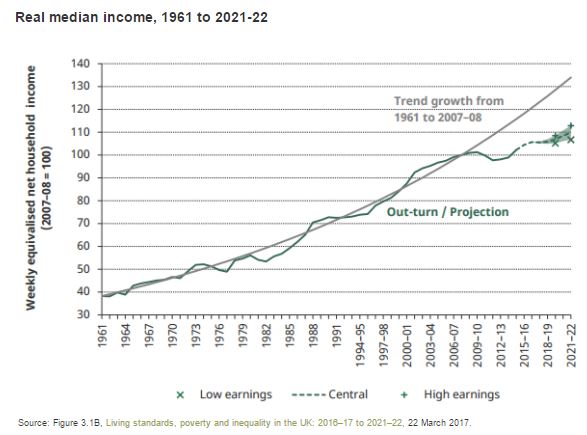

Once you see this data, claims that we have a strong economy become laughable. UK median incomes are currently over 15% below previous trends. That is more than enough room to accommodate 4% due to a permanent effect from austerity.

I do not have to argue that such permanent effects are certain to have occurred. The numbers are so large that all I need is to attach a non-negligible probability to this possibility. Once you do that it means we should avoid austerity at all costs. In 2010 austerity was justified by imagined bond market panics, but no one is suggesting that today. The only way to describe current Conservative policy is pre-Keynesian nonsense, and incredibly harmful nonsense at that. That was why I signed the letter.


Monday, 28 March 2016

Austerity and the mainstream: for the record

When I say that textbook macro, and the macro used by most mainstream macroeconomists, says austerity of the kind implemented in 2010 was a big mistake, I am sometimes told ‘but that was not what economists said at the time’. The names of one or two well known economists are often mentioned, or the letter from 20 economists in the Sunday Times in February 2010.

What is often forgotten is that this letter sparked an immediate response. Over 60 economists wrote in one or other of two letters published in the Financial Times that now was not the time for strong fiscal consolidation. The recovery had to be properly established first. Given that these responses were put together in haste (which probably explains why I did not get the chance to sign either), but still managed to attract over three times as many signatures as the original, I would suggest that shows pretty clearly that a clear majority of UK macroeconomists at the time followed current and textbook analysis on austerity.

Even some of the original 20 later admitted they had made a misjudgement. So why is this letter remembered, but the responses to it are not - particularly as the responders were clearly proved right by subsequent events? Using OBR figures I calculated that Osborne’s austerity has cost each UK household at least £4,000, and probably more. This number has never been seriously challenged, but I also think it is not widely known. When it comes to austerity, the problem is not and never has been mainstream macro theory or mainstream macroeconomists.


Friday, 4 September 2015

Letter wars, and how policy is made

This one is UK focused, although similar points may apply elsewhere

First there was the letter in the Guardian written by economists providing support for Corbyn’s macroeconomic stance, and then there was a letter in the FT written by other economists suggesting Corbyn’s policies are potentially damaging. I was asked to sign both, but declined, so I can be completely impartial and objective! There are two ways to read this letters war, but it also tells us something about how economic policy can actually be made.

The first way to read the letters war is that this is all about which side you are on in the Labour leadership contest. That is the interpretation newspaper headlines give, and it is the case that there are committed Corbynites who signed the first letter and committed ABCs (Anyone But Corbyn) who signed the second. However the first letter explicitly states that not all its signatories support Corbyn, and some of the signatories of the second letter are clearly not Labour supporters.

The second reading is that the letters are about different things. The first letter focuses on austerity: “His opposition to austerity is actually mainstream economics”. The second talks about nationalisation and what should be called Corbyn’s QE. So another possible interpretation is there is no disagreement between the two letters. This reading is supported by the fact that the second letter says “public investment — in many areas much needed — can be financed conventionally”, which appears to be in tune with the first letter which attacks current austerity. As I have noted before, every academic economist I have read thinks now is a good time for higher public investment. (As far as I am aware, there was no letter to counter this attack by economists on Osborne’s new fiscal rules.) Finally the first letter does not explicitly endorse nationalisation or Corbyn’s QE.

So in terms of their texts the two letters could be quite consistent with each other. I am certainly against current and past austerity. I have also been publicly critical of Corbyn’s QE because of the (perhaps unintended) implications for Bank of England independence, and the (perhaps unintended) implicit acceptance of deficit constraints. Which is why I did not sign either letter, but perhaps I could also have signed both! [1]

As many economists signed each letter, I think both readings are correct. It is tempting at this point to lapse into a negative discourse about how hopeless letters are, or how hopeless economists are at writing letters and commenting on policy. In fact the opposite reading is correct. What the letters illustrate is how hopeless actual policy making on macroeconomic issues can be.

I think most people imagine politicians outside government as having at their disposal a huge network of assistants, each of which is plugged into a huge network of advice coming from individuals and think tanks. There is certainly a huge amount of advice out there, but you need some knowledge to filter good from bad, research based ideas from ideological ones etc. And that is the problem: there is no army of experienced assistants doing that job. Politicians instead often have to rely on a few (generally political) contacts and perhaps one or two inexperienced assistants.

It is therefore just inevitable that in something like a party leadership election you might see some poorly thought out policies. Politicians, or those that advise them, will not have the time or resources to filter and consult. That letters may follow should be no surprise. It is what happens next that matters. The danger is that politicians get committed. That is why those who have expertise need to shout loud and soon, by letter or any other means at their disposal.

So before you are tempted to make fun of poorly written letters and fall back on clichés about economists never agreeing, you need to suggest how else policy proposals could be criticised and debated. And before you criticise a politician for changing their minds, recognise the advice they initially get is often imperfect and changing their mind is often the wise thing to do. A culture that penalises ‘flip flopping’ leads to politicians who just follow convention and mouth platitudes, and in this Labour leadership election at least it is clear that is not what a good part of the electorate wants.


[1] Not really. I didn’t sign the first because I had clear misgivings about Corbyn’s QE. The second says things about nationalisation I either do not know about (efficiency), or that appear to accept a false view about the impact of privatisation/nationalisation on the public finances. If the state buys a profitable business at a fair price and keeps it profitable, there is no issue of fiscal space or ‘affordability’, just as privatisation per se does not improve the public finances. Economists of all people should see through this aspect of short term deficit fetishism. The only issue with privatisation/nationalisation should be which method of ownership/control is more efficient.   

Sunday, 23 August 2015

Economic credibility

The UK’s Labour leadership election has become a two horse race: Jeremy Corbyn on the left, versus ABC. I must admit that it took me a bit of time before I realised who ABC was - it is Anyone But Corbyn. It is quite an achievement not only to become the candidate everyone is talking about, but also to be able to define your opponent as well. The last time I can remember that happening was - well, the 2015 UK general election maybe!

Anyway, a constant refrain of ABC is that Labour can only win if it has economic credibility, with the implication that Corbyn’s economics are a bit wacky. As I argued here, some of Corbyn’s macro proposals are misconceived, and if the implication of them is that the Bank of England would lose its independence then they also go against the view of most mainstream macroeconomists. That, by the way, is why I did not sign this letter, even though I agree wholeheartedly that “his opposition to austerity is actually mainstream economics”.

In the last paragraph I played a little trick that I hope most of you would not have noticed, and that is to equate ‘economic credibility’ with ‘mainstream (macro)economics’. If that seems reasonable to you, think about the following. In 2009, most of the world was following mainstream economics in undertaking a fiscal stimulus to combat the impact of the financial crisis. But in the UK a certain politician decided to ignore ‘economic credibility’, and instead proposed doing the opposite: what has subsequently become known as austerity.

What was the intellectual basis of his departure from economic credibility? Could it have been that fiscal contractions were actually expansionary, an idea that certainly qualifies a whacky. Was it the idea that the central bank, by using a completely untried and untested instrument, had everything under control? Or was it something else. The honest answer is we do not know, which is interesting in itself. But what is absolutely clear, based on surveys and other evidence, is that his advocacy of fiscal contraction in 2009 went against what most macroeconomists thought were the implications of their discipline.

You know the rest of the story. By departing from mainstream macroeconomics, George Osborne arguably won not one but two elections. Does his example show that there is nothing wrong with departing from ‘credible economics’ - it could even win you elections? That is perhaps the lesson some in the Corbyn camp would like to draw. It certainly suggests that there is very little relationship between policies that have ‘economic credibility’ and mainstream economics. Economic credibility, as used by politicians and the media, seems to be something rather different. As Chris Dillow suggests, it can mean acceptable to the Westminster-media Bubble, but that in turn may derive from some concoction of views that serve dominant political interests, and in macro the views of the financial sector and central banks.

If you want a non-macro example, consider the minimum wage. Setting the right level for this is a delicate balance, requiring all the empirical knowledge that labour economists have gleaned. In the UK we have an institution, the Low Pay Commission, to get this judgement right. That same George Osborne threw all that aside in his last budget because it was politically convenient to do. Did he get berated from all quarters for not following ‘credible economics’? Of course not.

Unfortunately, I think ABC are right that something called economic credibility matters a great deal when it comes to winning elections. Also unfortunately, I think they do not realise that economic credibility is something that gets defined in a complex social and political process, and can (and currently does) have very little to do with the economics taught in universities. Right now, in the UK and elsewhere, I think the political right understands that, but the political left of whatever variety does not.


Wednesday, 8 July 2015

Austerity is an integral part of the Greek tragedy

Too many people, including many in the Troika, see the Greek struggle as just about transfers from one debtor nation to lots of creditor nations. That is why they perhaps saw the Greek referendum as an unhelpful move, as just inflaming nationalist sentiment. As Dani Rodrik puts it “What the Greeks call democracy comes across in many other – equally democratic – countries as irresponsible unilateralism.”

It is, however, not just about transfers, or what economists call a zero sum game. It is also fundamentally about austerity, as Dani Rodrik, Thomas Picketty, Heiner Flassbeck, Jeffrey Sachs and I say in this letter jointly published in the Guardian, Le Monde, The Nation and Der Tagesspiegel (and thanks to Avaaz for making this happen).

I think many people believe that a debtor country must somehow inevitably suffer large scale unemployment as a result of having to pay back at least some of its debts. But this comes more from a moralistic view than thinking about the macroeconomics. In an open economy, the real exchange rate (competitiveness) will adjust to ensure ‘full employment’ is preserved, whatever primary surplus (taxes less non-interest spending) a government needs to service and pay back its debt.

Under flexible exchange rates this competitiveness adjustment could happen immediately. Things are not quite so simple in a monetary union: competitiveness cannot immediately adjust because of wage and price rigidities. A period of ‘excess unemployment’ will be required to push wages and prices down if the country is uncompetitive in relation to required primary surpluses. However the excess unemployment can be relatively modest. In fact, because of the structure of the standard Phillips curve, it is much more efficient to achieve gains in competitiveness gradually through a measured increase in unemployment than quickly through a rapid rise in unemployment, for reasons I outlined here when talking about Latvia.

To achieve this efficient outcome may well require the government to reduce its primary deficits gradually, because without this fiscal support while competitiveness adjusts output could fall rapidly. This in turn will require more government borrowing, and if the government cannot do this from the markets, the IMF or other governments should step in to ensure this efficient adjustment can take place and avoid the waste and suffering of unnecessary unemployment.

This is what failed to happen in the case of Greece. Whether this was just the result of poor Troika calculations, or a consequence of feeling that creditor bankers were more of a priority (see, for example, Mark Blyth), need not concern us here. Once the mistake became clear, perhaps creditor voter fatigue meant additional loans were not politically possible. But to demand primary surpluses (i.e. to take money out of the country) while unemployment remains so high - as the Troika continues to do - is unforgivable in my view. It clearly makes the unemployment problem worse - see here, footnote [2]. At best it indicates an impatient creditor with no concern for the welfare of the debtor, but given the responsibility the creditor has for the debtor’s current position it is far worse than that.

That is not the only reason Greece’s story is about austerity. Its problems were made worse by the austerity across the Eurozone as a whole, and the deflation which that has brought. Deflation increases the real value of nominal debts. It also makes competitiveness adjustment more difficult because of a well known non-linearity.

Even those that have a great dislike or distrust of Syriza should recognise that Syriza is also a product of acute austerity, a point which the referendum reaffirmed. As economists might say, Syriza is endogenous.

That the Greek economy now lies broken is not the inevitable result of imprudent borrowing a decade ago, or structural weaknesses, or a left wing government elected just a few months ago. It is also the result of the actions of those who effectively ran the economy from 2010 to 2014, and their imposition of draconian austerity. Greece long ago recognised the folly of its borrowing, and has made a start on addressing its structural weaknesses. The Troika has yet to acknowledge its own part in making this tragedy.


Tuesday, 16 June 2015

No basis in economics

That was the claim about George Osborne’s plan to outlaw government deficits in normal times made in the letter signed by 79 economists. It is a strong claim. To see why it is a tenable claim, it is important not just to think about the short term situation and the usual controversies that go with it.

Before I do that, I have a confession. I had until recently assumed that the surplus target would be inserted into the kind of rule he set up when he became Chancellor, which allowed considerable flexibility in how quickly that target was achieved. However while writing this post I realised I may be wrong: he could be planning to replace that kind of flexible rule with legislation that simply outlaws deficits in normal times. That is important, because it would mean one of two things. The first is that the government would attempt to hit some target for a small surplus (say 0.5% of GDP) each and every year. That means that in response to quite normal shocks and forecast errors that hit the public finances, taxes or government spending would be pushed up or down to compensate. [1] The second is that the government would have to aim for surpluses somewhere around 2% of GDP, to provide a sufficient buffer to absorb those shocks and forecasting errors.

The most basic of macroeconomic theories when it comes to thinking about fiscal policy is due to Robert Barro, who is hardly an active supporter of Keynesian stimulus spending. It is called tax smoothing, but it can easily be applied to government spending as well. (It forms the basis of much of what economists call the dynamic optimal taxation literature.) This says it is taxes and spending that matter, not debt or deficits, and it is best to plan such that the path of taxes and spending is smooth. Another way of putting the theory is that the deficit should be a shock absorber, and planned reductions in debt should be slow. (This was the theory behind the recent IMF paper I discussed here.)

So how does the plan to outlaw deficits look in the light of this literature. If the plan involves targeting a small deficit each and every year, that is the complete opposite of tax smoothing. Taxes and spending would become volatile so the deficit could be smooth. That is crazy, because it is taxes and spending that impact on people and not the deficit.

If the plan involves going for a larger surplus on average, that would allow smoother taxes and spending in the short term. However average surpluses of 2% would imply an incredibly rapid reduction in government debt. Coupled with 4% nominal GDP growth they would cut the ratio of debt to GDP from the current 80% to Gordon Brown’s 40% target within a decade. Within two decades government debt will have largely disappeared, which allows taxes to fall or spending to rise. [2] But that will also violate tax smoothing, this time at a frequency involving generations rather than years. You could put this in terms of intergenerational equity: the current young, who suffered most from the Great Recession, will bear the full burden of reducing debt. Future generations will get the benefits of existing public capital while contributing nothing towards it. 

So both versions of outlawing deficits in normal times violate the tax smoothing idea. But it gets worse. If real interest rates and wages vary over time, it is best to invest when borrowing and labour are cheap: that is not just basic economics but common sense. Both borrowing and labour are currently cheap. Yet to meet the surplus target, the government plans to keep public investment on infrastructure lower than at any time over the last twelve years.

So even if you put all the short term Keynesian concerns to one side (which of course I would not), outlawing deficits makes no economic sense. Yet Philip Booth of the IEA takes exception to this claim. But the only theory he can come up with to support the plan is the idea that sometimes it is better for the government to tie its own hands. He says “the 79 seem unaware of these basic ideas”. Of course the 79 are aware of the pros and cons of commitment (for a full discussion applied to fiscal rules see Portes and Wren-Lewis), but what you should never do is commit to rules that make no sense. Following daft rules will always be daft. Outlawing deficits is a daft rule.


[1] The rule then is virtually identical to a policy of always running a balanced budget. Students learn the problems with that rule in their first year studying economics.

[2] The only way you could make sense of this policy is if the surpluses continued even when debt had disappeared, and the government built up a large sovereign wealth fund. Although I have explored this possibility in an academic paper with colleagues, the current government has never mentioned this goal, so I think we can discount it here.  

Saturday, 13 June 2015

Signing letters

The Guardian today publishes a letter from 79 economists, including yours truly, about George Osborne’s plan to outlaw government budget deficits in normal times. I’ve written two recent posts on this, so I will not go through the issues again here, but I thought I’d say a couple of things about the business of signing letters and whether they are worth the effort.

The first is whether the reader or potential signatory should worry about the details of the text of multi-signatory letters. You might think the letter could be better written, and someone asked to sign it might think they could have put it much better themselves. The person asked to sign might agree strongly with the overall message of the letter, but could have some misgivings about particular sentences. The problem of course is that, because the letter is signed by X number of people, where X is large, having all X making their own attempts at redrafting becomes a nightmare in coordination. So these letters should never be read for the details of the text, but instead for their overall message.

The second is whether there is any point in these multi-signatory letters from economists. Alan Manning makes a number of good points here. When these letters involve issues where there is genuine division among economists, then a letter followed by a counter letter just encourages further jokes about economists never agreeing. (But because there is some news value in getting in first, letters on this type of issue keep coming.) The letter format is also too short for making proper arguments: other forms of media are better in that respect.

That argument does not I believe apply to this particular letter, or to the other which I recently signed on the Greece-Troika negotiations. In both cases there is probably a clear majority view among economists. Multi-signatory letters then have an important information value to both readers and political commentators.

This brings us - inevitably - to perhaps the most famous example in the UK of such a letter, from 364 economists protesting at Margaret Thatcher's 1981 deflationary budget. It is also a good example of not worrying too much about the text, as I’m sure many/most who signed that letter would have found at least one sentence objectionable.

If you have previously heard about this letter it may well have been accompanied by a comment on how the letter is now ‘generally regarded’ as reflecting badly on economists. The reasons for this view are in themselves interesting. Ask anyone on the political right, and they will tell you this is because Margaret Thatcher was correct and the economists were wrong. But you can equally well make the opposite claim. The economic strategy at the time was monetary targeting, and that policy in itself failed dismally: monetary targets were hopelessly missed and the policy framework was abandoned shortly after the letter was written. In terms of overall outcomes, it took two decades before UK unemployment returned to pre-1981 levels.

So why is it ‘generally regarded’ as reflecting badly on economists? Essentially because many supporters of Conservative governments - some economists but also many politicos - have gone out of their way to say so. (I go into more detail in this post.) As we have witnessed recently, the political right tends to be much better than the left at rewriting history for its own purposes. But that in itself is a form of flattery. Why bother to spend time and effort rubbishing a letter from 364 economists unless that letter, and any similar letters that might follow it, had some impact? So maybe letters from economists on issues on which most economists agree are important and can have some small influence.