Winner of the New Statesman SPERI Prize in Political Economy 2016


Showing posts with label macroeconomic policy. Show all posts

Tuesday, 23 July 2019

How the lessons from austerity have not been learned


The UK and the Eurozone are both vulnerable to the next recession, but both politicians and central bankers think each other should deal with it.


I don’t want to talk about the likelihood of a recession in the UK, US or Eurozone. Forecasting is a (necessary) mug’s game, where there are just too many variables to make anything like an accurate prediction. It is worth outlining the risk factors, and Grace Blakeley does an excellent job here. Instead my concern is the vulnerability in both the UK and the Eurozone to the impact of a recession if it happens. This vulnerability was clearly illustrated by the mistakes made after the Global Financial Crisis, yet in many ways the lessons of that failure have not been learnt.

Most people know the story of austerity after the Global Financial Crisis (GFC). In the UK the negative impact of the GFC was so severe that even cutting interest rates from around 5% to 0.5% was not sufficient to counteract its impact. As a result the Labour government in 2009 undertook various fiscal stimulus measures. They, together with lower interest rates, succeeded in stopping the fall in output, but by 2010 the signs of a recovery were still fragile. The new Coalition (Conservative and Liberal Democrat) government decided to focus on the rising budget deficit rather than the recovery, and undertook a large fiscal contraction in what became known as austerity.

The consequence of UK austerity was the slowest recovery from a recession in centuries. Here is a nice chart from a recent report by James Smith of the Resolution Foundation, which clearly illustrates the extent of the weak recovery.


Employment eventually recovered, but at the cost of an unprecedented fall in real wages. James Smith gives some evidence to suggest that the reason employment got off comparatively lightly but wages suffered by much more than we might expect was the 2008 sharp depreciation in sterling. This allowed firms to respond to the recession by keeping wages low, whereas in recessions in which sterling did not fall firms resisted nominal wage cuts and so had to resort to cutting jobs.

The idea that austerity was essential to reduce the deficit is simply wrong. It undoubtedly was a large factor in the weakness of the UK recovery. The tightening of fiscal policy has continued until today, with the consequence that interest rates have had to stay low to offset this fiscal tightening. The net result is that instead of rates being near 5% as they were before the GFC, they are below 1%. As James Smith points out, interest rate cuts in previous recessions have ranged from three to ten percent. This means that conventional monetary policy has almost no room to counteract a new economic downturn if one came.

The Eurozone is in an even worse position. Their history is of two recessions since the GFC, the second of which was largely caused by fiscal tightening as a result of the Eurozone crisis of 2010-12. The last time core inflation in the Eurozone touched 2% was in 2008, and it is currently around 1%. (More details from Frances Coppola here.) Interest rates set by the European Central Bank (ECB) remain at their lower bound. If a new recession happened, caused for example by a disruption in trade due to Donald Trump, conventional monetary policy would be unable to do anything about it.

Of course central banks in the UK and Eurozone still have various unconventional monetary policy tools. But the clue to their reliability at ending a recession is in their name. They are unconventional because they have only been used since the GFC, so we have limited evidence on their impact. It is like having an accelerator on a car where how far you have to push your foot down varies from second to second. You will end up driving slowly, which in economic terms means a prolonged recession.

All this is now largely understood by central bankers. All have said in one place or another that they will be relying on fiscal stimulus to help counteract the next recession. The ECB needs fiscal stimulus right now to get out of the last one. Yet fiscal stimulus is in the hands of politicians and not central bankers, and many of the politicians and political parties that were crucial in implementing the austerity that hit the post-GFC recovery are still in power.

There is therefore a danger that the policy of fighting the next recession will fall between two stools. Central bankers will say, in their own quiet and politically sensitive way, that they are not equipped for the task, but politicians may be deaf to these messages and will once again start worrying about deficits that inevitably rise in an economic downturn. To say more, we need to differentiate between the UK and the Eurozone.

In the UK some may think that with a new Prime Minister the problem of austerity has disappeared. In order to get elected both candidates have promised all kinds of tax cuts or spending increases. But as I have argued recently, what we are seeing here is what economists call deficit bias: the tendency to borrow just for political gain. Worse still, if the borrowing is mainly for tax cuts (including tax cuts for the rich), there is a danger that it is part of a strategy called ‘starve the beast’, which involves increasing the deficit with tax cuts and then demanding spending cuts to bring the deficit under control.

The upshot is that a Tory leader wanting to spend and cut taxes to please party members provides no guarantee that they will undertake effective fiscal expansion in any future recession. Neither of the Coalition partners has apologised for the mistake of austerity, and we have no reason to believe that they wouldn’t do it again in any future recession. The only major party that has a fiscal framework that would automatically move to fiscal expansion when interest rates hit their lower bound is Labour.

In the Eurozone there is also too little recognition among senior politicians that fiscal stimulus is required when ECB interest rates are at the lower bound. This is why Eurozone inflation is still below target. The OECD point to a crying need for more fiscal stimulus. Germany in particular has a great need for additional public investment, but is restrained by a fiscal rule that is worthy of an economic stone age. Efforts to create a Eurozone budget that could act in a countercyclical way have also been blocked by politicians, despite support from the ECB.

We can hope for a change of political attitudes in both the UK and Eurozone, but central bankers should not be content with hope. They have been delegated the task of stabilising the economy, and if they fail to complete this task in economic downturn after downturn many will come to believe that delegating monetary policy to central banks was a huge mistake. In addition, it is not the case that all central banks can do when interest rates hit their floor is unreliable types of unconventional monetary policy.

A fail safe way for a central bank to bring a recession to an end when interest rates are at the lower bound is to create money and give it directly to citizens. It could also create money and give it to borrowers by subsidising borrowing rates. The former is called helicopter money, a term due to Milton Friedman, and would require cooperation from government. The latter has been undertaken by the ECB in the past (see Eric Lonergan here), and so could be done to a greater extent without involving government. In essence it involves cutting interest rates on borrowing to well below the lower bound, but keeping rates for savers at the lower bound, and funding the difference by creating money.

Central banks in most of the major economies have been happy to create money during a recession, but nearly always this money has been used by central banks to buy assets. The impact on the economy is then difficult to predict, because no one's income has increased and the interest rate for borrowing has not fallen significantly. Giving the money directy to people rather than buying assets would have a direct and more predictable impact in stimulating the economy, as Frances Coppola argues in her new book.

So why do central banks not do this? There are two major reasons. First, they worry that increasing people's income is the job of elected governments, although I would argue that it is central bank's job to stabilise the economy if the government does not. (See my article with Mark Blyth and Eric Lonergan for more on helicopter money.) Second, if they create money to buy assets, when the economy recovers they can if necessary take money out of the economy by selling those assets. If they give that money away they wil not have those assets to sell. However this problem could be dealt with by governments guaranteeing the supply of assets a central bank needs.

Besides these arguments, I think there is a third argument why most central banks have not proposed doing these types of measures in a major way, and that is conservatism with a small c. The problem is that, if politicians unprepared to undertake fiscal expansion in a recession remain in power, that conservatism may be very costly both to us and to central banks themselves.

Friday, 6 October 2017

The OBR, productivity and policy failures

Chris Giles had an article in the FT yesterday about the UK’s continuing dreadful productivity performance, and the implications this might have for forecasts of the public finances. It has the following chart comparing successive OBR forecasts and actual data.


I want to make two points about this. The first is about the OBR’s forecast. [1] It is easy to say looking at this chart that the OBR has for a long time been foolishly optimistic about UK productivity growth. Too often growth was expected to return to its long run trend shortly after the forecast was published but it failed to do so. Expect lots of articles about how hopeless macro forecasts are in general, or perhaps how hopeless OBR forecasts are in particular. It was obvious, these articles might say, that trend productivity growth in the UK has taken a permanent hit following the financial crisis.

Anyone saying this is ignoring the history of the UK economy for the 50 years before the GFC. After each downturn or recession, labour productivity growth has initially fallen, but it has within a few years recovered to return to its underlying trend of around 2.25% per annum. This means not just returning to growth of 2.25%, but initially exceeding it as productivity caught up with the ground lost in the recession. In a boom sometimes growth exceeded this trend line, but it soon fell back towards it.


This made sense. Productivity growth reflects technical progress and innovation, and they tend to continue despite recessions. A firm may not be able to implement innovations during a recession, but once the recession is over experience suggests they make up for lost ground in terms of putting innovations into practice.

Given this experience, OBR forecasts have always been pretty pessimistic. They have assumed a return to trend growth, but no catch up to make up for lost ground. If they had also forecast, in 2014 say, that given recent experience they expected productivity growth to be almost flat for the next five years that would have been regarded as extreme at the time. Why would UK firms continue to ignore productivity enhancing innovations when the macroeconomic outlook looked reasonable?

And of course in 2014 UK productivity growth was positive. This brings me to my second point, which follows from this quote from the FT article:
“In the Budget, both the OBR and Mr Hammond are likely to stress that the downgraded forecasts do not reflect a new assessment of the damage to the UK economy from Brexit, but a reassessment of likely productivity growth after so many recent disappointments.”

Chris may be right that they will say this, but is it remotely plausible? As my recent post tried to suggest, UK productivity growth can be seen as suffering from three large shocks: the recession following the GFC, the absence of a normal recovery as a result of austerity, and then Brexit. The first two of those shocks led to a period of intense uncertainty, causing UK firms to put on hold any plans to innovate. Just as they thought things had returned to a subdued version of normal they were hit by the third, Brexit. During periods of intense uncertainty, productivity stalls or may even decline a little, as firms meet any increase in demand by increasing employment but not investing in new techniques. [2]

This story involving uncertainty seems to fit the data. Once the recovery (of sorts) finally began in 2013, productivity growth picked up. That sustained growth came to a halt when the Conservatives won the 2015 election, and the possibility of Brexit began to be an important factor for firms. [3]

These two points are related in the following way. The experience of the 50 years before the GFC suggested that you could hit the economy with pretty large hammers, but it would eventually bounce back. However that may have been contingent on a belief by firms that if policymakers were wielding the hammer (using high interest rates for example) they would take it away fairly soon, and replace it by stimulus. That belief was shattered in the UK by the GFC and austerity, where policymakers decided to keep using the hammer. What little confidence remained was destroyed by Brexit.

Discoveries are still be being made in universities around the world, and we know innovations are still being implemented by leading UK firms. It seems completely far fetched to imagine the GFC is still having some mysterious impact on the remainder of UK firms such that they refuse to adopt these innovations. A much more plausible story is that we are seeing what happens when most firms lose confidence in the ability of policymakers to manage the economy.

[1] I am on the OBR’s advisory panel, but as our job when we meet once a year is to be critical of OBR assumptions, and as we have no role in producing their forecasts, I think what I say here can be completely objective.

[2] Productivity can initially fall because new employees are not as productive as those who have been working in the firms for some time, for example.
Postscript (7/10/17) For evidence on the impact of Brexit on productivity, see work by Bloom and Mizen here.

[3] An alternative story is that the UK has settled into a new slow growth ‘equilibrium’, where the majority of firms are so pessimistic they hardly innovate at all.      

Monday, 5 June 2017

Could austerity’s impact be persistent

How Conservative macroeconomic policy may be making us persistently poorer

I was happy to sign a letter from mainly academic economists published in the Observer yesterday, supporting the overall direction of Labour’s macroeconomic policy. I would also have been happy to sign something from the Liberal Democrats, who with a similar macroeconomic stance have the added advantage of being against Brexit, but no such letter exists. As I have said before about letters, it is the overall message that counts. We desperately need more public investment and more current spending to boost demand, which in turn will allow interest rates to come away from their lower bound.

If I could carry just one message into mediamacro to bring it more into line with macro theory, it is that nominal interest at their lower bound represent a policy failure. Unconventional monetary policy is a very unreliable substitute for interest rate changes and fiscal policy as a way of controlling the economy, and a temporary fiscal stimulus can reliably get interest rates off their lower bound. This was the big mistake that most advanced countries made in 2010, and painfully slow recoveries were the result. The UK is currently making the same mistake, which is why the macroeconomic impact of the Labour and LibDem programmes is so much better than the Conservatives’ continuing austerity.

In the textbook macroeconomic models, this policy mistake can have a large but temporary cost in terms of lost output and lower living standards. This is because in these basic models a short term lack of demand does not have an impact on supply. Output in the longer run is determined by the number of those wanting to work, the capital stock and technology, all three of which are assumed to be independent of short term demand shortages. However it looks increasingly like these textbook models can be wrong.

In a new study (pdf), Gustav Horn and colleagues at the IMK institute in Germany looked at how persistent the impact of negative fiscal shocks (higher taxes or lower spending) had been on output. Their analysis is a refinement of earlier studies by of Blanchard and Leigh, and more recently Fatas and Summers. They find that the impact of recent fiscal shocks have been persistent rather than temporary, at least so far.

Although this persistent impact is not part of textbook models, economists have explored effects of this kind (the collective name for which is ‘hysteresis’). There are many theories about why it could happen, such as theories of endogenous growth. I explored the idea of an innovations gap in a recent post. To see why this possibility is so important, take the example of UK austerity in financial years 2010/11 and 2011/12. A few years ago I took the OBR’s (conservative) assessment of its impact on GDP growth in those two years, and assumed that the impact of fiscal consolidation had completely unwound by 2013. That gave you a total cumulated cost of austerity of 5% of GDP (1+2+2), or £4,000 per household.

What happens if instead the impact of austerity is much more persistent? I can no longer use the OBR’s numbers, because they assume impacts die out over time. Instead, let me make the fairly conservative assumption that each 1% reduction in the cyclically adjusted deficit reduces GDP by 0.7%, but these effects are permanent. I’ve chosen 0.7 because that gives a similar answer for the cost of austerity by 2012 as my previous calculation. But rather than disappearing in 2013, these cost persist and grow with each additional act of consolidation. By 2016/17 GDP would be lower by nearly 4%, and a further 1% would be added by the planned additional austerity until 2019/20. If you accumulate those losses, it means that the average household would have lost a staggering £13,000 by 2016/17, rising to £23,000 3 years later.

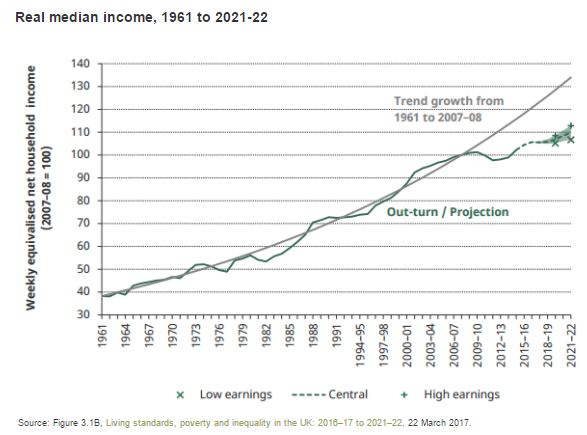
If you think that sounds a ridiculously large number, just compare output or income relative to past trends. Here is a version from the IFS.


Once you see this data, claims that we have a strong economy become laughable. UK median incomes are currently over 15% below previous trends. That is more than enough room to accommodate 4% due to a permanent effect from austerity.

I do not have to argue that such permanent effects are certain to have occurred. The numbers are so large that all I need is to attach a non-negligible probability to this possibility. Once you do that it means we should avoid austerity at all costs. In 2010 austerity was justified by imagined bond market panics, but no one is suggesting that today. The only way to describe current Conservative policy is pre-Keynesian nonsense, and incredibly harmful nonsense at that. That was why I signed the letter.


Friday, 14 August 2015

German Self-Interest

Michael Burda from Berlin’s Humboldt University has an interesting article in the Royal Economic Society newsletter, which is critical of views that I and others have expressed about the ‘problem with German (macro)economics.’ The key argument Michael Burda wants to make is that there is nothing peculiar or unusual about German economics, and what many of the critics interpret as either economic ignorance or distinctiveness is actually self-interest. To quote from his final paragraph: “It is not ordoliberal religion, but a mixture of national self-interest and healthy mistrust informed by experience that guides German economic policy today.”

Often trying to decide whether policies are the result of self-interest or particular ideas is difficult because both explanations fit the facts. What we really need are examples of German economic policy which follow self-interest but not dominant ideas, or vice versa. Now some might suggest ‘bailing out’ Greece and other periphery countries was a clear example, where the idea of European solidarity triumphed over self-interest. Unfortunately that will not work: the fact that Greece in particular did not default in 2010 and had only limited default in 2012 was in part to protect the interest of other EU banks. You could plausibly argue that Greece has suffered precisely because of German and other EU countries' self-interest.

In fact in many ways Germany has done rather well out of the EZ crisis. Henning Meyer points us to a study which suggests that, as a result of the crisis and Germany’s ‘safe haven’ status, the German government has saved more than E100 billion from 2010 to 2015 in debt interest. As Henning notes, this has helped Germany ‘set an example’ on deficits without having to do anything too painful. That is slightly more than its total loss if Greece completely defaults. It has also not done badly as a result of the profits the ECB has made on its lending.

Perhaps the largest benefit Germany has received from the Eurozone has been as a result of undercutting its fellow members around ten years ago. Everyone knows about the ‘excess inflation’ in the periphery during those years, but the story of insufficient wage inflation in Germany at the same time is not often told. This policy - which if it had occurred via exchange rates rather than domestic inflation would be called beggar my neighbour - may well have been accidental, but it is a key reason why Germany is the only Eurozone economy that has not suffered since 2010. Indeed, one interesting explanation of the general lack of interest in using fiscal policy for demand management in Germany is that for some time the country has been part of a fixed exchange rate system in which, with its particular wage bargaining system, it can fairly easily boost demand by changing domestic inflation.

What about the pressure from Germany on the ECB: first not to undertake the OMT programme in September 2012 which ended the non-Greek crisis, and then not to undertake QE? That is generally put down to extreme fears of inflation and fiscal dominance of monetary policy in Germany. Unfortunately it is also been in Germany’s self-interest. For example, if the ECB had been able to keep to its 2% inflation target, the earlier undercutting of its neighbours would have had to result in a subsequent period of German inflation above 2%. However Germany may well avoid this outcome as a result of Eurozone deflation, so that countries outside Germany will bear the cost of correcting the German competitiveness problem.

That self-interest is key to German policy gets important support from 2009 when alongside other counties Germany enacted a form of countercyclical Keynesian policy. Here we have a clear case where self-interest appeared to win out over a prevalent distrust of countercyclical fiscal policy.

In some senses I’m attracted to Michael Burda’s hypothesis. I once believed that the “problem with German macroeconomic policy is not that it is acting in the national interest, or otherwise, but that it is based on a discredited and harmful set of ideas”. But in my recent discussion on why these discredited ideas persisted, while I threw doubt on some popular accounts, I still failed to come up with a convincing story. There may also be an element of false optimism in focusing on belief in poor economic ideas rather than self-interest, if you also think (hope?) that these beliefs can be more easily changed.

For much the same reason I also think it is futile to try and convince Germany that it should embark on fiscal expansion ‘for the sake of the rest of the Eurozone’, partly because it contradicts self-interest, but also because Eurozone deflation means that we need fiscal expansion not just in Germany, but the whole of the Eurozone, so that ECB interest rates can be lifted above their lower bound. The problem over the last few years has not just been austerity in Germany, but austerity in the Eurozone as a whole.

So perhaps it is all just self-interest. But if that means there is nothing unusual about German economics, it does not let German economists off the hook. Germany was central to creating the second Eurozone recession through its insistence on fiscal austerity everywhere, together with unhelpful pressure on the ECB. Germany was also central in imposing harmful debt levels and austerity on Greece. Mainstream economics tells us this, but few German economists have been prepared to say so in public. German Keynesians who are involved in the policy debate that I have talked to tell me the prevailing climate is definitely anti-Keynesian. It is not the job of German academics to stay quiet about what mainstream macroeconomics tells us just because doing so suits the national interest.


Tuesday, 27 January 2015

Post Recession Lessons

If you are familiar with this blog, you will know that I regard 2010 as a fateful year for the advanced economies in their recovery from recession. That was the year that the US, UK and Eurozone switched from fiscal stimulus to fiscal contraction. Because we were at the Zero Lower Bound (ZLB), this policy switch is directly responsible for the weak recovery in all three countries/zones. A huge amount of resources have been needlessly wasted as a result, and much misery prolonged.

This post is not about justifying that statement, but taking at as given and asking what should we conclude as a result. [1] To answer that question, what happened in Greece (in 2010, not two days ago) may be critical. To see why, let me paint a relatively optimistic picture of the recent past. 

Greece had to default because previous governments had been profligate and had hidden that fact from everyone, including the Greek people. Recessions rather than booms tend to be when things like that get exposed. If Greece had been a country with its own exchange rate, then it would have been a footnote in global macroeconomic history: fiscal stimulus that had begun in all three countries/zones in 2009 would have continued (or at least not been reversed), and the recovery would have been robust.

Instead Greece was part of the Eurozone, a monetary union that had been implemented in such a way that it was particularly vulnerable to the threat of default by one of its members. Policy makers in other union countries prevaricated, partly to protect their own banks, partly because they worried about contagion. The ECB refused to act as a lender of last resort - we only got OMT in 2012. So the Greek crisis became a Eurozone periphery crisis. (For more detail, based on an IMF evaluation of their role in this affair, see this post.) This led to panic not just in the Eurozone but in all the advanced economies. Stimulus turned to austerity. By the time some in organisations like the IMF began to realise that this shift to austerity had been a mistake, it was too late. The recovery had been anemic.

Why is that an optimistic account? Because it is basically a story of bad luck, which we have no reason to believe will be repeated again. When the next crisis comes along, the Eurozone will have OMT in place, and hopefully there will be some rational system for deciding when a Eurozone country that gets into difficulties should get ECB help or should be allowed to default. If this was just bad luck, we do not need to rethink how macro policy is made.

Now for the pessimistic version. The political right in all three countries/zones was always set against fiscal stimulus. It is true that during 2009, when no one was sure how bad things might get, Germany enacted a modest (if fairly ineffective [2]) stimulus, but in the US and UK the political right opposed it. Without Greece, we still would have had a Conservative led government taking power in the UK in 2010, and we still would have had Republicans blocking stimulus moves and then forcing fiscal austerity. The right’s strength in the media, together with the ‘commonsense’ idea that governments like individuals need to tighten their belts in bad times, would mean that opposition to austerity within the political elite would be lukewarm, and so austerity was bound to prevail. While we might hope that this right wing opportunism does not happen again during a future crisis, there is no clear reason to believe it will not. Greece may have just voted against austerity, but there is every chance that in the UK the Conservatives will retain power this year on an austerity platform and the Republicans are just the presidency away from complete control in the US.

If the pessimistic account is right, then it has important implications for macroeconomics. Although it may be true that fiscal stimulus is capable of assisting monetary policy when interest rates are at the ZLB, the political economy of the situation will mean it may well not happen, and that instead we get the fiscal instrument moving in the wrong direction. That means that macroeconomists have to start thinking about how to fundamentally change the way policy is done at the ZLB.

When some economists over the last few years began to push the idea of helicopter money, I was initially rather sceptical. The scepticism could be summed up by saying that helicopter money when you have inflation targets is identical to tax cuts plus Quantitative Easing (QE), so why not just argue for an expansionary fiscal policy? (There was also the point that tax cuts might be a rather poor form of stimulus compared to, for example, bringing forward public investment.)

However, if the pessimistic account is correct, then arguing with politicians for better fiscal policy is quite likely to be a waste of time, a lost cause. A more robust response is to argue for institutional changes so that politicians find it much more difficult to embark on austerity at the ZLB, or to allow others to effectively offset this austerity if it happens. Central banks have QE, but helicopter money would be a much more effective instrument. To put it another way, central bank independence was all about taking macroeconomic stabilisation away from politicians, because politicians were not very good at it. The last five years have demonstrated how bad at it they can be. However that move to independence was always incomplete because of the ZLB problem. We now need to make it complete.

This of course raises all kinds of questions. Do we want to give additional powers to the central bank, or should another independent institution be involved? If we do give central banks more power, could this be limited to enforcing a dialogue between central banks and government (along the lines suggested here), or should we go for something like helicopter money? If the latter, what are the knock on consequences to ensure the central bank can always tighten policy as necessary? Going down that road must in my view include thinking about how to make central banks a lot more accountable, so that they do not behave like the ECB. Arguably macroeconomics has been naive in suggesting that the more independent a central bank is the better.

However, we only need to go there if the pessimistic interpretation of the last five years is correct. Should we put the last five years down to bad luck, or to political economy forces that will not go away. I currently think the pessimistic interpretation is more persuasive, but I will be very happy to change my mind.

[1] Many argue that the recovery was weak because the recession was caused by a financial crisis, and it was always going to take a long time before banks would start to want to lend again. Even if you put a lot of weight on this argument, it implies a multiplier of one, not zero. It does not justify reducing public spending and employment i.e. making people unemployed when there was little chance they would find work in the private sector.

[2] The stimulus focused on tax cuts, which are less effective than increased government spending because some of the tax cuts will be saved. See Carare, A, Mody, A and F Ohnsorge (2009) “The German fiscal stimulus package in perspective” VoxEU  23/01/09.