Winner of the New Statesman SPERI Prize in Political Economy 2016


Showing posts with label cost of austerity. Show all posts

Monday, 5 June 2017

Could austerity’s impact be persistent

How Conservative macroeconomic policy may be making us persistently poorer

I was happy to sign a letter from mainly academic economists published in the Observer yesterday, supporting the overall direction of Labour’s macroeconomic policy. I would also have been happy to sign something from the Liberal Democrats, who with a similar macroeconomic stance have the added advantage of being against Brexit, but no such letter exists. As I have said before about letters, it is the overall message that counts. We desperately need more public investment and more current spending to boost demand, which in turn will allow interest rates to come away from their lower bound.

If I could carry just one message into mediamacro to bring it more into line with macro theory, it is that nominal interest at their lower bound represent a policy failure. Unconventional monetary policy is a very unreliable substitute for interest rate changes and fiscal policy as a way of controlling the economy, and a temporary fiscal stimulus can reliably get interest rates off their lower bound. This was the big mistake that most advanced countries made in 2010, and painfully slow recoveries were the result. The UK is currently making the same mistake, which is why the macroeconomic impact of the Labour and LibDem programmes is so much better than the Conservatives’ continuing austerity.

In the textbook macroeconomic models, this policy mistake can have a large but temporary cost in terms of lost output and lower living standards. This is because in these basic models a short term lack of demand does not have an impact on supply. Output in the longer run is determined by the number of those wanting to work, the capital stock and technology, all three of which are assumed to be independent of short term demand shortages. However it looks increasingly like these textbook models can be wrong.

In a new study (pdf), Gustav Horn and colleagues at the IMK institute in Germany looked at how persistent the impact of negative fiscal shocks (higher taxes or lower spending) had been on output. Their analysis is a refinement of earlier studies by of Blanchard and Leigh, and more recently Fatas and Summers. They find that the impact of recent fiscal shocks have been persistent rather than temporary, at least so far.

Although this persistent impact is not part of textbook models, economists have explored effects of this kind (the collective name for which is ‘hysteresis’). There are many theories about why it could happen, such as theories of endogenous growth. I explored the idea of an innovations gap in a recent post. To see why this possibility is so important, take the example of UK austerity in financial years 2010/11 and 2011/12. A few years ago I took the OBR’s (conservative) assessment of its impact on GDP growth in those two years, and assumed that the impact of fiscal consolidation had completely unwound by 2013. That gave you a total cumulated cost of austerity of 5% of GDP (1+2+2), or £4,000 per household.

What happens if instead the impact of austerity is much more persistent? I can no longer use the OBR’s numbers, because they assume impacts die out over time. Instead, let me make the fairly conservative assumption that each 1% reduction in the cyclically adjusted deficit reduces GDP by 0.7%, but these effects are permanent. I’ve chosen 0.7 because that gives a similar answer for the cost of austerity by 2012 as my previous calculation. But rather than disappearing in 2013, these cost persist and grow with each additional act of consolidation. By 2016/17 GDP would be lower by nearly 4%, and a further 1% would be added by the planned additional austerity until 2019/20. If you accumulate those losses, it means that the average household would have lost a staggering £13,000 by 2016/17, rising to £23,000 3 years later.

If you think that sounds a ridiculously large number, just compare output or income relative to past trends. Here is a version from the IFS.
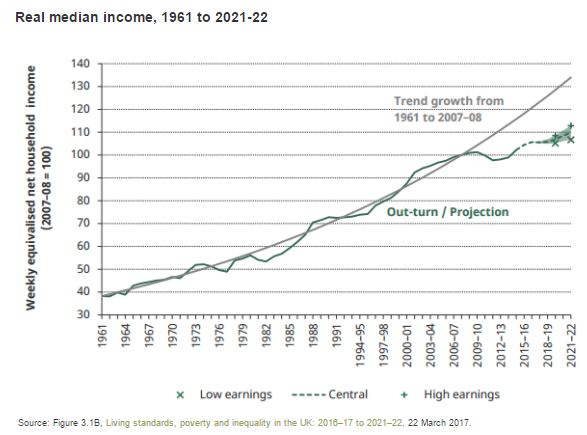

Once you see this data, claims that we have a strong economy become laughable. UK median incomes are currently over 15% below previous trends. That is more than enough room to accommodate 4% due to a permanent effect from austerity.

I do not have to argue that such permanent effects are certain to have occurred. The numbers are so large that all I need is to attach a non-negligible probability to this possibility. Once you do that it means we should avoid austerity at all costs. In 2010 austerity was justified by imagined bond market panics, but no one is suggesting that today. The only way to describe current Conservative policy is pre-Keynesian nonsense, and incredibly harmful nonsense at that. That was why I signed the letter.


Thursday, 12 March 2015

The power of financial markets

You might imagine that the global financial crisis had reduced the power and influence of finance and those involved in financial markets. After all, the excesses shown by participants in those markets had caused the largest recession since WWII. (Not to mention a constant stream of cases of illegality and mis-selling.) However I wondered yesterday if the opposite might be true.

This was during a debate at the Houses of Parliament, in which Jonathan Portes and I were debating austerity with Roger Bootle and Doug McWilliams. A constant refrain from our opponents was that (a) the stock of government debt was very large, (b) you needed the confidence of markets to be able to maintain this level of debt, (c) markets were fragile beasts, so best take no chances, and (d) therefore we needed austerity to reassure those markets.

I immediately thought of one of my better posts, where I suggest too many people view markets like a vengeful god, and those that are ‘close to the markets’ like high priests. (I couldn’t quite believe it when a member of the audience asked our opponents about whether they thought some proposal would ‘pass muster with the markets’.) Now Roger, who is a sensible guy, did agree that default was not really an issue for the UK, but the danger was rather inflation, if the deficit or debt became ‘too large’ and markets refused to fund it, so it had to be monetised. If it seems odd to you that the markets would start worrying about the monetisation of debt because a large recession increased deficits, but be quite unconcerned today about the central bank creating money to buy huge quantities of government debt as part of Quantitative Easing, then your mistake is to think that the markets are always rational. If they are both fragile and febrile, as our opponents and others close to the markets often suggest, it could happen.

Before the financial crisis, it was in the interests of those involved with financial markets to emphasise how rational they were. No need for regulation - these are clever people who knew what they are doing. The crisis blew that argument apart, but instead it created the idea that the markets could be dangerously irrational: irrationally exuberant at one point, and irrationally risk averse the next. It also showed how dependent on these markets the economy had become. Hence the idea of a vengeful god that could suddenly turn on you for no good reason and who therefore had to be appeased at every turn.

This kind of argument has a strong emotional appeal, particularly when the financial crisis is fresh in peoples’ minds. I suspect that attempts to show that markets are actually pretty rational most of the time will not work. Instead I’m afraid we have to focus on the high priests. A truly irrational market could do anything. The problem comes when the high priests declare that, by being close to the markets, they can discern some logic to its tantrums. And by a divine coincidence, this logic just happens to fit macro view of the world that the high priests hold.

For example, we are told that markets worry about large deficits and require austerity immediately. Never mind that there is no sign of worry, and that interest rates are falling: markets are fragile and febrile and could turn at any moment. The high priests, being close to the markets, understand that. Strangely the high priests never detect any concern that a persistent recession brought about by austerity might - through hysteresis effects - permanently damage productive potential, with potentially greater impacts on the tax base and long term solvency. I guess the high priests markets had not read that paper.

We are told that Osborne needed to give a clear demonstration to the markets that he had the political will to bring the deficit under control, which is why deficit reduction had to be front loaded. It does not seemed to have occurred to the high priests markets that, given his desire to reduce the size of the state and win the next election, front loading austerity is exactly what he wanted to do, even if he had no particular concern about the deficit. To show a clear conviction to give top priority to reducing the deficit required him to do something that was politically costly, like raising inheritance tax.

And do not forget that Ireland and Portugal were constantly told by those close to the markets that they needed to embark on acute austerity to ‘regain the trust of the markets’, when in fact what the markets were looking for all the time was for the ECB to act as a lender of last resort. I could see that from my academic ivory tower, but most of those ‘close to the markets’ did not.

The financial crisis may have told us about the power that financial markets have, and how it is important to understand how they behave. But the way to do that and to make good policy in the meanwhile is through economic science, and not to rely on the wisdom of priests. As I said in my little speech at the debate, the cost of UK austerity in 2010 and 2011 was at least 5% and probably more like 10% of GDP, numbers which neither of our opponents challenged. The gods it seems require big sacrifices nowadays. But if the only reason for making this sacrifice is that the high priests tell us that this is what the gods require, then I think the time for enlightenment is well overdue. 

Sunday, 1 March 2015

Eurozone fiscal policy - still not getting it

The impact of fiscal austerity on the Eurozone as a whole has been immense. In my recent Vox piece, I did a back of the envelope calculation which said that GDP in 2013 might be around 4% lower as a result of cuts in government consumption and investment alone. This seemed to accord with some model based exercises of the impact of austerity as a whole, but others gave larger numbers.

We now have another estimate, which can be thought of as a rather more thorough attempt to do what I did in the Vox article. This paper by Sebastian Gechert, Andrew Hughes Hallett and Ansgar Rannenberg uses multipliers and applies them to the fiscal changes that have occurred in the Eurozone from 2011. Apart from the later start date, the first difference compared to my back of the envelope calculation is that they include all fiscal changes, and not just government consumption and investment. As a large part of the fiscal consolidation in the Eurozone has involved reducing fiscal transfers, this is important.

The second, and more interesting, difference is that rather than pluck a multiplier out of the air, as I did, they use a meta analysis of other studies. I have previously mentioned this meta analysis by Gechert: this paper is based on a follow up by Gechert and Rannenberg. [Correction from original post.] The studies on which these meta analyses are based are not ideal from my personal point of view (more on this later), but what this second paper shows is that fiscal multipliers are larger in depressed economies. Applying these ‘meta multipliers’ to the Eurozone fiscal consolidation implies that GDP was 7.7% lower by 2013 as a result. These numbers are more in the ballpark of the Rannenberg et al paper that I have discussed before.

All these estimates point to huge losses, which monetary policy has neither been willing or able to counteract. Yet the speed at which those in charge of the Eurozone begin to realise the mistake that they have made is painfully slow. Take this recent Vox piece by Marco Buti and Nicolas Carnot. Thankfully they ignore all the Eurozone’s tortuous and sometimes contradictory rules, and just look at two numbers: a measure of ‘economic conditions’ (like the output gap), and a measure of the fiscal gap, which is the difference between the actual primary balance and what it needs to be to get debt falling gradually.

They argue that policy needs to balance the need to reduce both gaps. Looking at these two numbers, they conclude that Germany is overachieving on fiscal adjustment and has a need to increase activity, but although France and Spain also need to increase demand they have a long way to go to eliminate the fiscal gap, so this should dominate. The conclusion is that Germany should go for fiscal stimulus, but “moderate consolidation appears warranted in both France and Spain”. Overall “the Eurozone should conduct a close-to-neutral fiscal stance”.

Let’s deal with that last conclusion first. The mistake there is simple. When monetary policy is stuck at the Zero Lower Bound, it is crazy to balance the output gap with what is your main instrument for correcting that gap, which is fiscal policy. Getting the fiscal gap right is important in the longer term, but in the short term it is the means by which you get the output gap to zero. As the studies mentioned at the beginning of this post show, the current recession is the result of trying to correct the fiscal gap at completely the wrong time. The right policy is to get the output gap to zero, so interest rates can rise above the ZLB, and then you deal with the deficit. Readers of this blog and the blogs of others must be sick and tired of seeing us make this same point over and over again, but the logic has yet to get through to where it matters.

The same principles apply to countries within the Eurozone, except with an additional complication of within Eurozone competitiveness. If a country is too competitive relative to the rest of the Eurozone, it needs to run a positive output gap for a time to generate the inflation that will correct that position, and vice versa. For that reason Germany needs a large positive output gap at the moment (compared to an estimated actual negative gap), and therefore a much more expansionary fiscal policy - not because it is overachieving on debt adjustment. France and Spain now look roughly OK in terms of competitiveness relative to the average (see chart below, and assuming that entry rates in 2000 were appropriate), so there we need fiscal expansion to close the output gap.

So at both the aggregate and individual country level, the inappropriate bias towards fiscal contraction that caused huge losses in the Eurozone in the past continues to operate. Which means, unfortunately, that the needless waste of resources caused by austerity continues to get larger by the day.

Relative Unit Labour Costs, 2010=100, from OECD Economic Outlook