Winner of the New Statesman SPERI Prize in Political Economy 2016


Showing posts with label hysteresis. Show all posts

Monday, 5 June 2017

Could austerity’s impact be persistent

How Conservative macroeconomic policy may be making us persistently poorer

I was happy to sign a letter from mainly academic economists published in the Observer yesterday, supporting the overall direction of Labour’s macroeconomic policy. I would also have been happy to sign something from the Liberal Democrats, who with a similar macroeconomic stance have the added advantage of being against Brexit, but no such letter exists. As I have said before about letters, it is the overall message that counts. We desperately need more public investment and more current spending to boost demand, which in turn will allow interest rates to come away from their lower bound.

If I could carry just one message into mediamacro to bring it more into line with macro theory, it is that nominal interest at their lower bound represent a policy failure. Unconventional monetary policy is a very unreliable substitute for interest rate changes and fiscal policy as a way of controlling the economy, and a temporary fiscal stimulus can reliably get interest rates off their lower bound. This was the big mistake that most advanced countries made in 2010, and painfully slow recoveries were the result. The UK is currently making the same mistake, which is why the macroeconomic impact of the Labour and LibDem programmes is so much better than the Conservatives’ continuing austerity.

In the textbook macroeconomic models, this policy mistake can have a large but temporary cost in terms of lost output and lower living standards. This is because in these basic models a short term lack of demand does not have an impact on supply. Output in the longer run is determined by the number of those wanting to work, the capital stock and technology, all three of which are assumed to be independent of short term demand shortages. However it looks increasingly like these textbook models can be wrong.

In a new study (pdf), Gustav Horn and colleagues at the IMK institute in Germany looked at how persistent the impact of negative fiscal shocks (higher taxes or lower spending) had been on output. Their analysis is a refinement of earlier studies by of Blanchard and Leigh, and more recently Fatas and Summers. They find that the impact of recent fiscal shocks have been persistent rather than temporary, at least so far.

Although this persistent impact is not part of textbook models, economists have explored effects of this kind (the collective name for which is ‘hysteresis’). There are many theories about why it could happen, such as theories of endogenous growth. I explored the idea of an innovations gap in a recent post. To see why this possibility is so important, take the example of UK austerity in financial years 2010/11 and 2011/12. A few years ago I took the OBR’s (conservative) assessment of its impact on GDP growth in those two years, and assumed that the impact of fiscal consolidation had completely unwound by 2013. That gave you a total cumulated cost of austerity of 5% of GDP (1+2+2), or £4,000 per household.

What happens if instead the impact of austerity is much more persistent? I can no longer use the OBR’s numbers, because they assume impacts die out over time. Instead, let me make the fairly conservative assumption that each 1% reduction in the cyclically adjusted deficit reduces GDP by 0.7%, but these effects are permanent. I’ve chosen 0.7 because that gives a similar answer for the cost of austerity by 2012 as my previous calculation. But rather than disappearing in 2013, these cost persist and grow with each additional act of consolidation. By 2016/17 GDP would be lower by nearly 4%, and a further 1% would be added by the planned additional austerity until 2019/20. If you accumulate those losses, it means that the average household would have lost a staggering £13,000 by 2016/17, rising to £23,000 3 years later.

If you think that sounds a ridiculously large number, just compare output or income relative to past trends. Here is a version from the IFS.
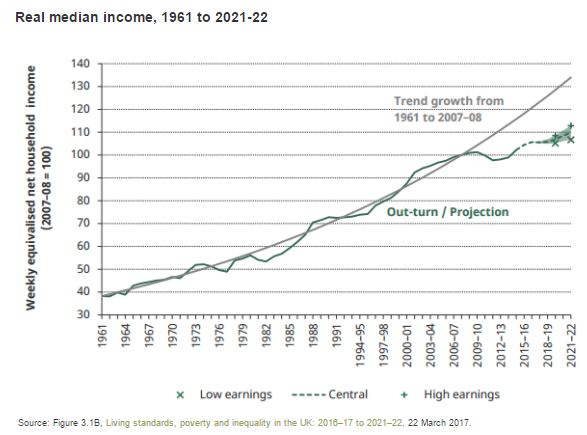

Once you see this data, claims that we have a strong economy become laughable. UK median incomes are currently over 15% below previous trends. That is more than enough room to accommodate 4% due to a permanent effect from austerity.

I do not have to argue that such permanent effects are certain to have occurred. The numbers are so large that all I need is to attach a non-negligible probability to this possibility. Once you do that it means we should avoid austerity at all costs. In 2010 austerity was justified by imagined bond market panics, but no one is suggesting that today. The only way to describe current Conservative policy is pre-Keynesian nonsense, and incredibly harmful nonsense at that. That was why I signed the letter.


Thursday, 21 April 2016

Explaining the last ten years

The Great Recession was larger than any previous post WWII recession. But that is not what it will be mainly remembered for. Unlike previous recessions, it appears to have led to, or coincided with, a permanent reduction in the productive potential [1] of the economy relative to previous trends. As unemployment today in the US and UK is not very different from pre-recession levels, then another way of saying the same thing is that growth in labour productivity and real wages over the last seven years has been much lower than pre-recession trends. (As employment has not yet recovered in Europe, I will focus on the US and UK here.)


I have posted charts showing this for the UK many times, so here is something similar for the US. It plots the log of real GDP (green) against the CBO’s (Congressional Budget Office) estimate of potential output (yellow). Unlike the UK, potential growth in the US does not appear constant from 1955, but the CBO has potential output growth between 3 to 3.5% in most years between 1970 and the early 2000s. The break created by the Great Recession is clear: potential growth fell to as low as 1% immediately after the recession, is currently running at 1.5%, and the CBO hopes it will recover to 2% by 2020.


US Actual (green) and Potential (yellow, source CBO) Output, logged. Source: FRED.


There seem to be two ways of thinking about this decline in potential output growth. One is that the slowdown in productivity growth was happening anyway, and has nothing to do with the global financial crisis and recession. This seems unlikely to be the major story. For the UK we have to rewrite the immediate pre-recession years as boom periods (a large positive output gap), even though most indicators suggests they were not. A global synchronised slowdown in productivity growth seems improbable, as some countries are at the technological frontier and others are catching up. As Ball notes, “in the countries hit hardest by the recession, the growth rate of potential output is much lower today than it was before 2008.” However the coincidence story is the one that both the OECD and IMF assume when they calculate output gaps or cyclically adjusted budget deficits. The CBO numbers for the US shown above adopt the coincidence theory to some extent, reducing potential growth from 3.5% in 2002 to 2.0% by the end of 2007.


If we stick to the more plausible idea that this is all somehow the result of the financial crisis and recession, we can again split explanations into two types: those that focus on the financial crisis and argue that crises of this type (rather than other types of recession) impact on potential output, and those that look at the impact of the recession itself. The distinction is important in understanding the impact of austerity. If the length and depth of the recession has permanently hit potential output, as Fatas and Summers suggest, then the cost of austerity is much greater than we could have imagined.


Looking at previous financial crises in individual countries, as Nick Oulton has done for example, does suggest a permanent hit to potential, but I have noted before that this result leans heavily on experience in Latin American countries, and Sweden’s recovery from its 1990 crisis suggests a more optimistic story. Estimates based on OECD countries alone suggest more modest impacts on potential output, of around only 2%.


What about the impact of the recession itself? Here it is helpful to go through the textbook story of how a large negative demand shock should impact the global economy. Lower demand lowers output and employment. Workers cut wages, and firms follow with price cuts. The fall in inflation leads the central bank to cut real interest rates, which restores demand, employment and output to its pre-recession trend.


We know why this time was different: monetary policy hit the zero lower bound (ZLB) and fiscal policy in 2010 went in the wrong direction. Yet employment has recovered to a considerable extent (although less so in the US than the UK). A recovery in employment but not output (relative to pre-recession trends) means by definition a decline in labour productivity growth. How could this happen?


The table below shows the rate of growth of real and nominal wages in the UK and US in pre and post recession periods.

US
2002-7
2008-15
Annual wage growth (1)
3.8%
2.1%
Annual price growth (2)
2.5%
1.5%
Difference
1.3%
0.6%
UK


Annual wage growth
4.5%
1.7%
Annual price growth
2.8%
2.1%
Difference
1.7%
-0.4%
  1. Compensation per employee, source OECD Economic Outlook
  2. GDP deflator, source OECD Economic Outlook


Nominal wage growth followed the textbook story. But price inflation did not fall to match, implying steadily falling real wages, particularly in the UK. This could just reflect the decline in productivity, which occurred either coincidentally or as a result of the financial crisis and recession.


The financial crisis could have reduced productivity growth if a ‘broken’ financial sector had stopped financing high productivity investment projects, or kept inefficient firms going through ‘pretend and extend’ lending. The recession could have reduced productivity growth by reducing investment, and therefore embodied [2] technical progress. Perhaps this loss of embodied technical progress occurs in all recessions, but we do not notice it because recoveries are quick and complete.


However the causality could be the other way around. Falling real wages led firms to switch production techniques such that they employed more labour per unit of capital. Workers priced themselves into jobs. The big question then becomes why did firms let this happen? Why did firms not take advantage of lower wage increases to reduce their own prices, and choose instead to raise their profit margins?


One story involves a secular increase in firms’ profit margins (Paul Krugman’s robber barons idea), either because of a reduction in goods market competition (profit margins are sometimes called the degree of monopoly), or a rise in rent seeking as Bob Solow suggests (HT DeLong). [3] However it is not obvious why this should be connected to the recession. If it is not, it is like the coincident and exogenous productivity decline. We will not get back to the earlier productivity growth path without reversing whatever caused this secular rise in profit margins.


Another, in some ways more optimistic, story involves different degrees of nominal rigidity: nominal wages are less sticky than nominal prices. As a result nominal wages led prices in reacting to the recession, but now prices are ‘catching up’ and profit margins will fall back. That would fit nicely with inflation continuing below target for some time, and real wages and productivity recovering. It is an optimistic story, because an additional demand stimulus would increase wage but not price inflation, and we would see rapid growth in labour productivity as firms reversed their earlier labour for capital substitution.


Unfortunately recent data suggests this is not happening. Instead core inflation is now above target in the US and rising to target in the UK.    


So is there some other way that a large recession in itself can cause a large reduction in potential output? Macroeconomists group such explanations under a general heading called ‘hysteresis mechanisms’: mechanisms whereby recent history can have permanent effects. Ball summarises the three main types of mechanism that economists have identified: “it appears that recessions sharply reduce capital accumulation, have long-term effects on employment (largely through lower labour force participation), and may slow the growth of total factor productivity.” If technical progress is embodied, we can link the first and last. That will be the subject of a later post.  


[1] For those not familiar with the term, a traditional way of thinking about potential output is that it is what output and incomes could have been if we had avoided booms and recessions, or equivalently if we had avoided domestically induced variations in inflation. Potential output can increase either because the labour force increases, or because labour productivity increases due to either technical progress and investment.

[2] Embodied technical progress is greater labour productivity brought about through new machinery i.e. it needs investment for it to happen.


[3] Postscript (just): Here is Martin Sandbu on the same issue   

Sunday, 28 February 2016

When to be optimistic on growth

I’m afraid I did not respond to requests to talk directly about the debate over Gerald Friedman’s numbers. I think I can only cope with that kind of thing one country at a time, and there were better people on the case. But I suspect a key to seeing your way through the wider debate is to know when to be optimistic about economic growth, and when not to be.

Martin Sandbu, channeling Narayana Kocherlakota, is quite right that we should not discount the possibility that economic growth could be unusually strong over the next decade or two. There is a significant chance that some of the slowdown that has appeared to have occurred to trend growth since the Great Recession might be reversible, partly because many hysteresis effects are also reversible. Inflation may not respond positively to strong growth as it has done in the past.

That possibility is high enough that it should have a big influence on monetary policy, for reasons I and others have outlined many times. The cost of needlessly throwing away potential resources is much higher than the cost of small overshoots of an inflation target. For that and other reasons the Fed’s decision to raise rates - and the MPC's decision not to cut them - was a mistake, as is continuing austerity.

Does that mean we should hard wire this optimistic view into budget projections? Essentially no, because budget projections should be based on your central guess of what is going to happen rather than any best case scenario. Almost every politician thinks they have the magic ingredient that will lead to strong growth. There is nothing wrong in that, but they should hope for the best and plan for the ordinary.

Doing this imposes a discipline on the electoral process that is essential to stop some politicians pulling the wool over voters eyes. If a politician or party wants to go with optimistic numbers, then the debate should be about how reasonable those numbers are, so voters can see what is going on. A world where these things are not debated is a world where everyone promises the moon and no one is any the wiser.

Where the discussion can get confused is if we put these two things together, and note also that fiscal stimulus involving additional investment would be good for the world right now. But that should and is argued for without pretending that it can all be paid for with the taxes that will come rolling in as it happens. There is a rock solid case for paying for extra investment - investment in its widest sense including human capital - by borrowing, because future generations benefit from that investment. When real interest rates are as low as they currently are, you have to be ignorant, duplicitous or slightly mad to say otherwise.


Thursday, 22 October 2015

The last 7 years are an argument against inflation targeting

The big controversy since the Great Recession began has been about fiscal policy: government spending, taxes and the budget deficit. In contrast monetary policy has not hit the headlines so much. This is understandable: while fiscal policy has oscillated from fiscal stimulus in 2009 to fiscal austerity in 2010, once the recession became clear (to some earlier than others) monetary policy in the UK, US and Japan appears to have been unambiguously expansionary, with interest rates staying at historical lows. The ECB is the exception, raising rates just before a second Eurozone recession.

Look a little closer however and we find something rather more worrying. Most people who base their view on economics rather than politics would regard the recovery from the Great Recession as disappointing. We have got particularly good reasons to be disappointed in the UK, but many economists think the US and Japan could also have done better at reducing unemployment more rapidly. More worrying still, the recession and the slow recovery may have caused permanent damage. (See Antonio Fatás here on his work with Larry Summers.) In the UK in particular we appear to have permanently lost a massive 15% of income during the recession. That kind of loss over a 7 year period is totally unprecedented in peacetime.

There are well known mechanisms by which short term output losses could lead to a permanent reduction in output capacity, known collectively by economists as hysteresis mechanisms. They include deskilling of the unemployed, less capital and less capital embodied technical progress. Just how permanent they are varies by type, but they all involve real costs in terms of lost output. One that worries me a lot is how expectations about trend output get downgraded, which can become self-fulfilling for quite some time.

The people whose job it is to make sure recessions are short-lived and these kinds of mechanisms do not take hold are in central banks. Yet if you ask monetary policy makers what they think about the last 7 years, they will not hang their heads in shame. They will not say it has been a disaster, but what more could we do? They will not say that, with interest rates near zero, they were powerless to do much, because unconventional policies like Quantitative Easing were poor instruments and government fiscal policy was moving in the wrong direction. Instead they will probably say that overall the last 7 years have not been too bad. This very different view seems both odd and worrying.

The reason however is straightforward. Monetary policy makers either regard their primary target as inflation, or are explicitly told that inflation should be their primary target. While below target now, inflation was above target in 2011 and 2012, so on balance maybe the record is not too bad. So looking at what they were asked to do, monetary policy makers feel little remorse.

In the UK we can put this in a rather startling way. Imagine someone in 2011 discovered a magical new policy instrument that was guaranteed to stimulate the economy, and gifted it to the Bank of England. In all probability they would not have used it. For four months in 2011 three members of the MPC voted to raise rates. We were just two MPC members away from following the ECB’s disastrous course. Just because we avoided that calamity by a whisker does not mean we should pretend it didn’t happen.

This all comes down to what economists have called the divine coincidence. This is the idea that you do not need to target both output and inflation. Ensuring that inflation is on target in a considered way (by for example looking at inflation two years ahead) will stabilise output as well. While the US central bank has a dual mandate (essentially both inflation and output), central banks that were made independent later (like the Bank of England) have inflation as their primary target. One of the main reasons for this was a growing belief before the Great Recession that the divine coincidence would hold. Target forecast inflation and output will look after itself.

The idea of the divine coincidence has not had a good recession! As I explained in one of my better posts, if the divine coincidence worked a central bank in a parallel universe that targeted the output gap rather than inflation should feel exactly the same way about the last 7 years as our inflation targeters. Yet as I explained there and above they would instead feel ashamed and frustrated. We know there are good empirical reasons why the divine coincidence might break down when inflation is low: resistance to nominal wage cuts will mean that monetary policy makers targeting inflation in a recession will overreact to positive inflation shocks like oil price increases and underreact to below target inflation. Add hysteresis, and you can get lasting damage.

So one lesson of the last 7 years must be that relying on the divine coincidence is a mistake. A primary goal of the central bank is to end recessions quickly, and giving it a single primary target of inflation can detract from that. One obvious improvement is to give the central bank a dual mandate, although the best way to specify that is not clear. Another possibility is to combine output and inflation into a single target, and yet another is to raise the inflation target to a level where the divine coincidence might still hold. Luckily for me I have thought quite a bit about these questions already, but in the next few months I may need to come off any fences that remain.


Tuesday, 3 April 2012

Framing fiscal stimulus arguments

                It struck me reading DeLong and Summers that Keynesians like myself often inadvertently provoke opposition. When we discuss temporary increases in government spending, we typically assume it is debt financed. Furthermore, as the interest on higher debt has to be paid for, we generally assume taxes increase to do that. So even though our increase in government spending is temporary, both taxes and debt end up being permanently higher. At a rather basic and non-intellectual level, I think this puts many people off from the start.
                Instead we could start with a temporary balanced budget increase in spending. That way neither taxes nor debt are higher in the long run. In addition, for anyone who has done their post graduate training in the last twenty years that is the natural way to start thinking about what is going on. Or if we want to avoid tax increases altogether, why not finance any increase in debt by reducing government spending rather than raising taxes? If raising debt in the long run is a problem (and I think there are good reasons why it might be), then why not use lower government spending after the stimulus not just to pay the interest on debt, but to pay off all the additional debt incurred by the stimulus. When you think about all these possibilities, the standard choice of debt finance paid for by permanently higher taxes is really the least likely to win friends.
                Now you could say that Keynesians do this because this policy choice is the most effective form of stimulus. In that case, why do we nearly always choose an increase in government consumption, rather than public investment? Additional public investment will have some positive impact on the supply of output, which will raise future taxes in much the same way as the hysteresis effects that DeLong and Summers analyse.
                So if I was trying to convince John Cochrane (or less ambitiously Tyler Cowen) of the efficacy of fiscal stimulus, how would I do it? I think I would use a two period model. The first period is Keynesian with interest rates stuck at the zero lower bound, and is the period in which we undertake a debt financed increase in government spending. The second period is classical, but where supply is influenced either by the additional infrastructure investment in period 1, or by hysteresis effects. All debt is paid off by the end of period 2 through lower government spending, but lower government spending does not influence output because this period is classical. (We could add a final third period which is the steady state and is uninfluenced by anything that happens in periods 1 and 2, just to show that we do not believe hysteresis or infrastructure effects last forever.)
                So what is there not to like about this policy? Output is higher in period 1 because demand is higher, and is higher in period 2 because supply is higher on average. There is no long run increase in debt. There is no increase in tax rates at any point. As period 2 is probably longer than period 1, we even have more time in which government spending is reduced rather than increased relative to base. However  because output and therefore tax receipts are higher in both periods, the reduction in government spending required to pay off the debt might not need to be that large: this is how the DeLong and Summers argument would be translated in this set-up. The framework focuses on the essential reason why stimulus works. We shift demand into a period in which it matters - because monetary policy is ineffective at the zero lower bound in period 1 - and out of a period in which it does not - because monetary policy works in period 2.