Winner of the New Statesman SPERI Prize in Political Economy 2016


Showing posts with label Martin Sandbu. Show all posts

Tuesday, 26 March 2019

Left behind movements do not just reflect deindustrialisation, but also geography, inequality and lack of representation.


There was extensive analysis after the UK EU referendum of the characteristics of those who voted for Brexit and those who didn’t. A robust finding was that those who voted for Brexit tended to be older and had less years of education. But some noted a link between a tendency to vote Leave and areas of deindustrialisation. The idea of the ‘left behind’ was born. It gained force when rest-belt states in the US swung to Trump in the same year.

This characterisation of the left behind was attractive to many on the left, who have been critical of the globalisation they saw as the cause. Yet as Martin Sandbu points out, the period of what is often called hyper-globalisation is the 1990s, and much deindustrialisation occurred before then. Some of that was a result of automation rather than globalisation, and in the UK 1980s deindustrialisation was hastened by a large appreciation of sterling caused by a combination of discovering North Sea Oil and monetarism. Why the 30 year delay for the left behind to finally find its political voice?

If we look at the geography of the Brexit vote, areas of deindustrialisation is not the only thing that strikes you. Much more obvious is that people in large cities voted against Brexit, and those in smaller cities or towns or the countryside voted for Brexit. The same was true for Trump, and Trumps core support comes from rural areas. Is this simply a consequence of differences in age and education already discussed?

It could well be. As the Centre for Towns showed, UK villages and towns have been getting older and cities have been getting younger. Jobs that attract the university educated tend to be in cities rather than in towns and villages.The old tend to be more socially conservative, and so are attracted to the anti-immigration message that was a key part of the Leave and Trump campaigns.

There is no doubt these factors are important, but do they explain all the the geographical nature of the support for Brexit and Trump, or is there more to it? I think the gilet jaunes from France can shed some light on this question. As John Lichfield outlines, the gilet jaunes come from peripheral France: the outer suburbs and countryside. That may include some areas of deindustrialisation but it goes well beyond that. Their protests are self-organised and remarkably persistent. They do not fit any clear left/right categorisation. Immigration, or race, are not high up among their concerns, which is why they do not feel represented by the far right party of Marine Le Pen.

What do the gilet jaunes want? Specific demands are varied and often contradictory. But a dominant theme is that they want to be valued and represented. They feel that the centres of power in France, the government but also other organisations, do not speak for or even respect them. They think the major cities are getting all the benefits of growth while they are falling behind.

The gilet jaunes tend to be working or lower middle class, sometimes self-employed, sometimes retired. Initially their protests were sympathetically viewed by most French voters, which was one reason why Macron responded with tax breaks for pensioners and low income workers. As time goes on and the violence has continued their popularity among French voters has waned. Whether they have a future as a coherent force may depend on whether they can transform themselves into a conventional political group that wins seats in the forthcoming European elections, a process which has already led to some fragmentation along traditional left/right lines.

Macron’s election as President of France had led many to think that the wave of populism influencing democracies around the world could be held back or even beaten. What the gilet jaunes show is that this cannot be done just by electing a charismatic President. Indeed the character of Macron, clearly part of an affluent city elite, may even have been a provocation.

Can the gilet jaunes tell us anything about those who voted for Brexit or Trump? All three movements come from outside of the main cities, so perhaps geography is more than just an incidental factor. What is unique about the gilet jaunes has been self-organisation, made possible through social media, and the variety of their political demands. In contrast Trump is a Republican, and Brexit is a very specific cause. But perhaps this difference just reflects the ability of some politicians and parts of the media to capture the discontent of the geographical areas that feel left behind?

The EU was not considered an important issue among most voters until the referendum. Immigration was, but a good part of that was because the government and press had managed to deflect anger at declining public services and wages on to immigrants rather than their own policies. Whereas the gilet jaunes had to organise themselves using social media, Brexit and to some extent Trump had sections of the conventional media to do that job. While many gilet jaunes want to overturn the government, Brexit supporters succeeded because they had the help of politicians and the media.

Underlying causes in all three cases include geographical and financial inequality, and a feeling of being ignored by conventional politics. In the UK, looking mainly at the first decade of the century, a NEF report found that nearly all of the 20 fastest growing constituencies were in cities. Often the prosperity of towns depends on the success or otherwise of a nearby city. Those in the periphery see money going to projects like crossrail or HS2 while local bus services are cut.

People look at others to measure their own prosperity but they also look at their own past. In the UK real wages are still below levels before the financial crisis, and in the last year the disparity between the incomes of most people and those at the top of the income distribution has started to increase again. (It is one reason why the Chancellor is getting more tax receipts than he expected.) In the US most of the proceeds of growth have for some time been going to the top of the income distribution.

We can see the same thing, although to a lesser degree, in France. Here is a revealing graph from a study by Thomas Piketty and colleagues. It shows how average annual growth rates of pre-tax income has varied by where people are in the income distribution over three time periods. To the right we have the richer income deciles, including at the end the top 1%, 0.1% and 0.01% respectively. In the two periods before the 1980s incomes at the top grew less rapidly than all other groups. From 1983 to 2014 the opposite has been true: growth rates of top incomes have been up to three times those of everyone else. In addition the growth rate of incomes of the non-rich have been historically low.


Low average growth in most incomes together with much faster growth in incomes at the top is provocative, particularly if you are in parts of the country that are stagnating with few prospects. I do not think it is any coincidence that a week ago we saw the gilet jaunes targeting the exclusive shops and restaurants of the Champs-Élysées.

Inequality based on incomes or geography is not enough to get the gilet jaunes on to the streets, to get UK voters to want to take back control, or Trump voters to vote for the worst President in a century. This also requires a feeling that your voice is not heard in the political process. In the UK a feeling of powerlessness was hijacked by politicians and the press who pretended it was a result of the EU, or in the US by Trump who pretended to speak for ‘real America’.

Speaking up for those left behind should naturally be something parties on the left do. Yet in the UK, as the NEF report shows, Labour have been increasing their vote share in dynamic cities and the Conservatives from areas in decline. This may be part of a longer term trend in both the UK, US and France, where the left party that once represented the less educated now is the party of the educated. The chart below taken from another study by Piketty shows this trend, which he calls it the emergence of the “Brahmin Left”.


Yet I think this alone is an incomplete explanation. To explain recent developments we should add the adoption by traditional left parties of a neoliberal framework which discouraged regional, industrial and redisributive policies that might have transferred more of the benefits of city dynamism to the periphery. That created a left behind that went beyond areas of deindustrialisation, that felt unrepresented and deprived, and which in the UK and US was open to capture by a populist right.


Wednesday, 5 December 2018

Helping the left behind: its (economic) geography, stupid


In our national conversation we are familiar with talking about regional divides (most famously north/south), and nowadays that tends to amount to London versus the rest. This conversation has in the past talked about the countryside and the towns (remember the countryside alliance and their march on London). But the political divide that has become clear since the Brexit vote (and which is also clear in US support for Trump) is between towns and cities (see Will Jennings here (pdf), for example).

This political divide has economic roots. Martin Sandbu points us to a report from the Brookings Institution which looks at similar trends in the US. The report says
“For much of the 20th century, market forces had reduced job, wage, investment, and business formation disparities between more- and less-developed regions. By closing the divides between regions, the economy ensured a welcome convergence among the nation’s communities.”

But from the 1980s onwards, they argue that digital technologies increased the reward to talent-laden clusters of skills and firms. The big cities started growing faster than the small cities, and the small cities grew faster than the large towns etc. This trend has continued following the GFC, as this chart clearly illustrates. (For some UK evidence on regional disparities, see here.)


This reminded me of a passage in Paul Krugman’s account in 2010 of 20 years of what has been called the New Economic Geography.
“... a fairly eminent economist challenged some of us, in belligerent tones, for any evidence that increasing returns and positive external economies actually play any important economic role. I think I replied “Cities” – to be greeted with a stare of incomprehension.”

What the New Economic Geography that Krugman helped found shows is that increasing returns and positive external economies make cities a great place to set up a new business, and rural backwaters a place where businesses stagnate. To relate back to the Brookings report, digital technologies have greatly increased the importance of increasing returns and positive external economies. This is why most big cities thrive, and many small cities and most towns fall behind.  

If that all seems terribly fatalistic, it is important to remember that something else happened around 1980. Some of us can remember before the advent of neoliberalism the effort the UK government put into industrial and regional policy. No doubt some of that effort was misdirected, but it probably had some effect at leveling out economic development. One of the key assumptions of neoliberalism is that state activity of that kind is just unhelpful messing with the market mechanism, and that messing just holds back growth.

However one of the lessons of the new economic geography is that initial conditions matter: trees from acorns grow, and the state can have a huge role in nurturing acorns. A well thought out industrial and regional economic policy, that works with rather than fights against dynamic economic forces, can make a big difference. As the Brookings report suggests (see a second article from Martin) we have successful examples to show us how it can be done.

To see how much our current economic environment in the UK is going in the wrong direction, think about post-school education. Universities are essential, and can play a key part in helping innovation, but they produce students most of whom have already become detached from their home and can easily migrate to the dynamic cities. The further education sector, by contrast, tends to provide essential skills to a local workforce. Yet this sector has lost a third of its income since 2010 thanks to austerity. What better way to turn small cities or large towns into places where the workforce is only equipped to host another distribution centre?

One final point. Brexit contributes nothing to helping small cities and towns. If you make the UK a less attractive place to set up a business by making exporting harder, and skilled labour more difficult to find, that business will move from a UK city to a city in another EU country, rather than some declining town in the UK. That is already happening, and the process will continue if Brexit is not stopped. Brexit is not only a damaging exercise which will make the lives of people in the UK harder, it distracts us from doing something positive for those left behind. 


Friday, 16 November 2018

Brexit. Of course everyone hates a compromise, but like much else its the best option, isn't it?


This is the argument put forward by May and her supporters, but rather more significantly it is also the case argued by Martin Sandbu here and other very rational and realistic people. When you have two sides implacably opposed, compromise is often the way forward. No one likes the compromise, but that is the nature of compromises. It a mature democracy where we don’t want to be at our throats all the time, compromise is inevitable.

Labour are actually arguing the same thing. They just think they can get a better compromise, and they have a good case because they will not have to constantly try and appease a large group of Brexiters. But they can only do this when in power, and so if they do not get the General Election they want then all options are open, including arguing for Remain in a second referendum. This too can make sense. If May’s compromise is worse than Remaining, and Labour cannot implement their better compromise, then it makes sense for Labour to campaign for Remain. It is a sensible case that I have yet to hear Labour leaders make, but give them time say supporters.

I want to argue something very different. Let me start with an analogy. You have been feeling unwell for some time. Someone suggests you take some snake oil that they say will make you feel much better. Another person, who happens to be a doctor, says snake oil will do you harm and your ills have other causes that cannot be fixed quickly. You really want your problems cured soon. A third, wise person tells you to compromise: try the snake oil but with half the recommended dose. A compromise seems sensible, so that is what you do. Your temperature soars to 104 and you end up in A&E.

I think this analogy is more accurate than the traditional two sides and compromise idea proposed by May, Labour and Martin Sandbu. The snake oil was sold with the big lie that we could leave the EU, gain sovereignty, reduce immigration but keep the economic benefits of being in the EU. That lie was believed by Leavers. Behind that was a second, more pervasive lie, which is that reducing EU immigration would improve access to public services and increase real take-home pay. In terms of the first lie, the deal May has done  keeps a few of the economic benefits of the EU but with a substantial loss of sovereignty. (The deal Labour wants to do keeps even more of the economic benefits but loses more sovereignty.) In terms of the economic dimension (public services, incomes) and sovereignty, a Brexit deal is either worse in one of these dimensions or both. It is difficult to know in what dimension people will be better off or feel happier.

But surely people were voting to leave the EU, and we would have at least done that. But the evidence suggests the EU was of little concern to voters until 2016. According to IPSOS Mori, only a few percent of people thought the EU was an important issue in 2010. In 2015 it only occasionally reached double figures. This strongly suggests that people voted Leave not because they wanted to leave the EU for its own sake, but for what they believed would be a consequence of leaving in some other dimension. This is the key to understanding why a compromise does not work.

Most Brexit voters will not be moderately happy with a deal that makes them worse off: they will not be happy at all. Most Brexit voters will not be moderately happy with a deal that gives the UK less say in the rules the UK has to obey than when in the EU: they will not be happy at all. A true compromise is something that gives each side something, but the incredible thing about Brexit is that what most Leavers want from Brexit is not possible, yet most politicians and much of the media refuse to tell them that.

The curse of Brexit is that anyone enacting it will be unpopular, not because most Leave voters do not get all they want but because they do not get anything they want. In fact, like the snake oil analogy, they will probably be worse off or have less say. Brexit was always a fantasy, and anyone who makes Brexit concrete will fail to deliver that fantasy. As most politicians have not had the courage to call Brexit out as the fantasy it is, voters are likely to blame the politicians who fail to produce their fantasy rather than blaming themselves.

May will keep telling lies, in the tradition of Brexit, to try and get her deal passed. She claimed outside Downing Street that she had secured our departure from Freedom of Movement. She has done no such thing. The final trade deal is still to be negotiated, and will not be known until after it is too late to change our mind. As pointed out here, the proposed Customs Union for mainland Britain is seriously incomplete. Once we have left the EU, we have no options left so we are in an even weaker position than we are now.

To say, as Philippe Legrain does here, that those arguing for Remain are playing Russian roulette with the UK economy are wrong. A majority of MPs asking for a referendum between May’s deal and staying in the EU is called democracy, and clearly if there was not a majority for such a referendum May’s deal is better than No Deal. The whole ‘taking a risk’ story is the result of deliberate choices by a Prime Minister that wants her deal passed on the basis of fear. MPs have to decide what deal is least worse for the UK, and that is clearly staying in the EU. 

In June 2016 we narrowly voted to Leave, when the Leave campaign claimed Turkey was about to join the EU and we would have more spending on public services if we left, in a campaign that used money that exceeded election rules the origins of which are still unclear. We now know that Turkey joining the EU is not on the horizon, according to the OBR there will be less money available for public services after we leave, and we will have to end up paying and obeying with no say over the rules. Our best estimates are that the UK economy is already 2.5% poorer as a result of Brexit, and on top of that the Brexit collapse in sterling has cut real wages. According to the lastest large poll two thirds of people want a say on the withdrawal agreement and there is a clear majority to Remain. Here is a similar YouGov poll. This is despite neither main political party arguing for the Remain option. It is time parliament respected the views of the people, not their hope 2 years ago when they were promised the moon but today when those promises have not been delivered.


Saturday, 22 September 2018

Theresa May has qualities, but negotiation skill is not one of them


One of the important criteria I used in selecting posts for my new book out this November, The Lies we were Told, is that each chapter (collection of posts) must tell a coherent story. (It can be ordered at a 20% discount here, rising to 35% if you join the publisher’s mailing list.) So, for example, the chapter on austerity had to contain at least one post that covered each of the mistaken arguments made for rapid deficit reduction, as well as discussing the real reasons the government pursued this policy long after it was obviously damaging the economy.

Those criteria, plus the need to avoid writing too large a book, inevitably meant that I had to end my discussion of Brexit with the EU referendum. It is still impossible to say which of the many things I have written on Brexit after the referendum will be part of a coherent story and which will be tangential. But if I ever do have to select which posts were important, this talking about the qualities of Theresa May as a person would be one. The reason is largely because it contains this quote from a discussion by David Runciman in LRB of Rosa Prince’s biography of May.
“May didn’t do negotiation; in the words of Eric Pickles, one of her cabinet colleagues, she is not a ‘transactional’ politician. She takes a position and then she sticks to it, seeing it as a matter of principle that she delivers on what she has committed to. This doesn’t mean that she is a conviction politician. Often she arrives at a position reluctantly after much agonising – as home secretary she became notorious for being painfully slow to decide on matters over which she had personal authority. Many of the positions she adopts are ones she has inherited, seeing no option but to make good on other people’s promises. This has frequently brought her into conflict with the politicians from whom she inherited these commitments. By making fixed what her colleagues regarded as lines in the sand, she drove some of them mad.”
If you want to know why the Salzburg meeting was such a failure for her, you need only read this paragraph. May invests far too much in whatever plan she puts forward, and presents it as the only possible way forward. She is in that sense the embodiment of Thatcher’s TINA (There Is No Alternative). She did that with her Chequers plan at Salzburg, and yet she is surprised that the EU showed no inclination to offer anything new as a counter proposal. Maybe the EU never will offer anything new, but you will never find out if you give no hint of flexibility yourself.

If being a hopeless negotiator is not bad enough, the last two years have also shown that whatever political knowledge she has does not extend beyond understanding how the Conservative party works. Her closest advisers, who she relies on a lot, may be little different. After she became Prime Minister she made a series of terrible decisions that have turned a bad situation for the UK into a terrible position. The most important of course was invoking Article 50 without any plan about what might happen next, for no better reason than the Brexiters were anxious people might change their minds. As I wrote in November 2016
“Anyone who actually wants a good deal from the EU when we leave should realise that the UK’s negotiating position becomes instantly weaker once Article 50 is triggered.”
There are plenty of other blunders: choosing a prominent Brexiter as her chief negotiator, fighting the need for parliamentary approval for triggering A50 in the courts, forcing Ivan Rogers out, her red lines and so on. Her focus on keeping the Conservative party together meant that she failed to understand and continues to fail to understand how the EU works. Above all else she has failed to see that the A50 process is less a negotiation and more like agreeing a terms of surrender.

Does this mean, as Stephen Bush among others suggest, that No Deal is a more likely outcome? In reality all Salzburg and May’s subsequent ‘statement to the people’ mean is more time has been lost. (The statement could mean nothing more than she has a party conference coming up.) As Martin Sandbu explains, there is concession the EU could make that is worth playing for, and that is extending the NI arrangement (in CU and SM for goods) to the rest of the UK. At the very least, she needs the EU to say in the Withdrawal Agreement that they would entertain some trade arrangement that negated the need for a border in the Irish Sea but fell short of staying in the complete single market. Unfortunately May’s lack of negotiating skills and knowledge means she is less likely to get either.

If she does not get those things, will she take the UK out with No Deal? As the quote from David Runciman suggests, many of the positions May adopts with apparent rigidity are inherited, and the EU referendum result is one of that type. She is not a conviction politician, and her primary interest is always going to be her survival. We can also take comfort in her knowledge of her own party, which means she must know her future lies with MPs who are not Brexiters. Enough of this group knows, to use Corbyn’s words, that no deal is not an option. They might tolerate May pretending it is as part of the negotiations, but they will do everything they can to stop her actually going through with it. May is useful, or indeed essential, to that group only so long as she does not give the Brexiters what they want, which is No Deal. All these things point to May being prepared, at the end of the day, to accept the backstop with just warm words from the EU on future arrangements.

If you still think May has recently drawn a line in the sand so deep that she couldn’t possibly cross it without falling, a good exercise would be to list all the other red lines she has drawn but then crossed over. If you doubt her capacity to survive come what may think of the 2017 election. But of course I may be mistaken. One of the nice things about the book was being able to look back at what I got right and got wrong using the device of postscripts. If I ever write up my best posts on events after the referendum two of my mistakes stand out: not understanding the key role Ireland would play until September 2017, and not seeing how May’s inevitable split with the Brexiters could change the dynamics on voting over any final deal. I hope a third mistake will not be in misjudging May’s character.


Friday, 14 September 2018

Another lesson of the GFC unlearnt: the Consensus Assignment is dead


Martin Sandbu recently responded to critics of an earlier piece of his arguing that central bankers could and should have done more to tackle the aftermath of the Global Financial Crisis. I stress aftermath here, because I have no doubt that central banks (including the Bank of England) were culpable in both ignoring warning signs before the crisis, and in the UK and Eurozone not reacting quickly enough to the consequent recession. (It is extraordinary that on the MPC only Danny Blanchflower understood what was going on, and I would argue that part of the reason for this was the primacy of the inflation target.)

It is also obvious that the ECB were wrong to raise rates in 2011 and not to introduce QE much earlier. That the UK almost raised rates in 2011 is not reassuring, and suggests they did take their foot off the peddle over that period. I would also argue that the ECB were very wrong to wait until September 2012 to introduce OMT.

In the UK and US I do not buy the argument that no further stimulus was needed.

UK unemployment rose from around 5% to around 8% in 2008/9, and stayed at that level until it began coming down in 2013. US unemployment was also above 8% until 2013. Both economies needed more stimulus in 2009, and in its absence in 2010 and so on. To think otherwise means you are placing too high a weight on temporary changes in inflation and too low a weight on the costs of the recession. 

Where I think I might disagree with Martin is that this stimulus could have reliably come from monetary policy. A good policy instrument is one that has a reliable impact on demand, and the only reliable monetary policy instrument that fulfills that criteria is short interest rates. Central banks could have done more QE, or they could have reduced rates below the Effective Lower Bound (ELB), but they wouldn’t have known how much to do. They might have got there in the end, but extra years of unemployment and probably a permanent hit to output through hysteresis were an avoidable cost.

The biggest mistake central banks made was not to recognise this and be honest with the public. They should have said, clearly and repeatedly, that once rates hit the ELB monetary policy was no longer the most reliable instrument to stabilise the economy, and fiscal policy should be used. This does not break any implicit concordat about not commenting on fiscal policy (which most central banks break anyway), because the statement is about a delegated authority being honest with the public about whether it can reliably do its job..

The fact that central banks in the UK and Eurozone didn’t do that may reflect dishonesty or it may reflect negligent ignorance. The fact that options like QE existed may have allowed central banks to convince themselves that they could still do the job assigned to them, and it discouraged them from being honest with the public. I say negligent ignorance, because instrument reliability is pretty basic stuff.

Martin writes
“Besides, there was broadly shared understanding among macroeconomists and central bankers of the best division of labour. Fiscal and budgetary policy should be set to achieve microeconomic and distributive goals, and the desired share of the state in the economy; while monetary policy should take care of stabilising aggregate demand.”

This is what I call the Consensus Assignment, and as the name implies it was certainly the consensus among mainstream macroeconomists before the 1990s. But the experience of Japan’s lost decade where they also had interest rates stuck at the ELB began a process of rethinking. By the time the GFC came around many macroeconomists had realised that there was an Achilles Heel in the Consensus Assignment. Fiscal stabilisation was still required when interest rates hit their ELB. That is why we had fiscal stimulus in 2009.

The importance of this cannot be overstated. The policy consensus in 2009 was that fiscal stimulus was required, because monetary policy was not enough. This consensus didn’t evaporate in 2010. What overrode it was mainly politics - what I call deficit deceit. There was also a bit of panic in some quarters caused by the Eurozone crisis. However a majority of academic macroeconomists continued to believe that further fiscal stimulus was required, and that majority got steadily larger as time went on.

Which means that the Consensus Assignment that Martin talks about is dead, or at least dead until monetary policy makers can agree some form of fiscal delegation (e.g. helicopter money) with governments. As this paper from the Boston Fed points out, downturns where interest rates hit their ELB are likely to become the new normal, but policymakers have not adjusted to this. (The exception is Labour’s fiscal credibility rule.) Quite simply, most policymakers have not learnt a major lesson of the Global Financial Crisis.

Saturday, 9 December 2017

First Stage Reality and Brexiters

Now for the hard part, pronounced various media commentators after the first stage Brexit deal had been signed. The chances of No Deal have diminished, said others. It is strange watching the MSM sometimes. On political issues that involve expertise, like austerity and Brexit, it is generally an expert free zone. With Brexit you have to turn to the Financial Times and Economist who understand what is really going on, or other knowledgeable bloggers like Chris Grey. [1]

It is not difficult to discover how things really work in these strange days. You just need to see what the important facts are, and continue to apply them relentlessly despite what politicians say. The latest important fact that tells you all you need to know is that a Single Market and Customs Union needs a border to, as Martin Sandbu sets out, not just collect tariffs but also check compliance with rules of origin and standards. Therefore to avoid a border in Ireland, you need Northern Ireland to comply with all the tariffs, standards and regulations of the Single Market. The UK has now agreed, as I thought it would, that this must also apply to the UK as a whole.

This logic leads you inevitably to the conclusion that, after Brexit, the UK will to the first approximation [2] continue to obey all the rules of the Single Market and Customs Union. So it will be as if we are still in the EU, with the only difference being that we no longer have any say on what those rules are. Fintan O’Toole quotes Sherlock Holmes: eliminate the impossible and whatever remains, however improbable, must be the solution.

But, you may respond, all the UK have signed up to is that this is a default position, if they fail to find a technological fix for the border, or if they fail to conclude a trade agreement with the EU in stage 2, and what does alignment mean anyway? Here you need a second fact: there are no technological fixes that remove the need for some form of hard border. We also know two things from this first stage agreement: the UK desperately want a trade agreement with the EU and the EU will not allow any agreement that implies a hard border in Ireland. It therefore logically follows that, to a first approximation, any trade agreement will have to involve the UK staying in the Single Market and Customs Union.

Why then are the Brexiters not up in arms? It is partly because the agreement plays on their lack of realism, as I suggested two days ago. The UK government and Brexiters still pretend that they can, through some magical means, avoid a hard border. Given that belief, how can they object to this fall back position? And that will be the line that the UK takes from now into the indefinite future, and because the broadcast media mainly talks to politicians rather than experts that is the line the media will take as well, with some honorable exceptions like those noted above. In may come apart as the cabinet finally discusses what the trade deal might look like, which is why the threat of No Deal has not gone away. Or Brexiters like Gove may decide instead that as May will not be making these trade agreements, it is politically wiser to maintain unity and instead try to win the ultimate prize from Conservative party members.

Why is it important that this deceit continues? Because if everyone was honest, and respected the reality of the border issue, people would rightly ask whether our final destination (obeying the rules but with no say on the rules) is worth having. They would note that being to all intents and purposes part of the Customs Union means Mr. Fox cannot make new trade agreements. People might start asking MPs why are we doing this, and the line that we have to do this because the people voted for it would sound increasingly dumb.

Unless something amazing happens and the MSM do not allow this deceit to continue, we will end up with the softest of soft Brexits. If that is where the UK stays [3] there is a huge irony about all this. The Brexiters’ dream was to rid the UK of the shackles of the EU so it could become great again, but it is a legacy of empire that has brought this dream to an end. All the stuff about bringing back the glory of a once great trading nation will not happen. Instead we will still be acting under the rules of the EU, but because we are not part of it the UK will be largely ignored on the world stage. A rather large country, which nevertheless gets other countries (like Ireland!) to set its trade and associated rules for it, and which it is therefore not worth bothering with in the international arena. A Britain that can no longer pretend to be a world power, not as a result of the actions of some left wing government, but because of the delusions of Brexiters.

[1] To be fair to the broadcast media (as I always am), yesterday I did see interviews with ministers which raised the issue of what the implications of the border agreement are. But for whatever reason these interviewers allowed those ministers to bat away the question with waffle, and I strongly suspect the point will be forgotten in the days ahead.

[2] What do I mean by first approximation? For a start, we will not be part of the Customs Union and Single Market, but instead be part of bespoke versions of both. That may allow wiggle room, which in turn might just possibly allow something that could be called a deal on free movement, although this will probably just mean Free Movement to a first approximation. So a bit like Norway or Switzerland, but with rather less room for maneuver than those countries because both have borders with the EU. For more details see here.

[3] It will not be where it stays. First, there is the question of who May’s successor will be, and what they will do. If a soft Brexit goes ahead, the Brexiters will choose the right time (for them) to cry betrayal. It will only be a matter of time before they make a new attack, arguing that the UK should strike out for true independence. As I argue here, bigger things than just one failure have to happen before the UK rids itself of this particularly British form of plutocracy.  

Tuesday, 17 October 2017

The lesson monetary policy needs to learn

It seemed obvious to write a post about the Peterson Institute’s recent conference on ‘Rethinking Macroeconomic Policy’, but nowadays I find it more efficient to let Martin Sandbu do the job. We agree most of the time, and he does these things better than I do. It allows me to write something only in the unlikely event that I disagree, or if I want to take the discussion further.

I only have one quibble with Martin’s column yesterday. I think Bernanke’s suggestion that following a large recession (where interest rates hit their lower bound) central banks revert to a temporary price level target is rather more than the tweak he suggests. In addition, as Tony Yates pointed out, level of NGDP targets do not resolve the asymmetry problem that Bernanke’s suggestion is designed to address.

I also thought I could illustrate Martin’s final point that “admitting one has got things badly wrong is a prerequisite for doing better” by looking at some numbers. If we look at consumer prices, average inflation between 2009 and 2016 was 1.1% in the Euro area, 1.4% in the US and 2.2% in the UK. The UK was a failure too: average consumer price inflation should have been higher than 2.2%, because we had a large VAT hike and depreciation that monetary policy rightly saw through. If we look at GDP deflators we get a clearer picture, with 1.0%, 1.5% and 1.6% for the EZ, US and UK respectively.

You might think errors of that size are not too bad, and anyway what is wrong with inflation being too low. You would be wrong because in a recovery period these errors represent lost resources that, as the Phillips curve appears to be currently so flat, could be considerable. Or in other words the recovery could have been a lot faster, and interest rates could now be well off the lower bound everywhere, if policy had been more expansionary.

What I really wanted to add to Martin’s discussion was to suggest the main problem with monetary policy over this period, particularly in the UK and the Eurozone. It is not, in my view, the failure to adopt a levels target, or even the ECB raising rates in 2011 (although that was a serious and costly mistake). In 2009, when central banks would have liked to stimulate further but felt that interest rates were at their lower bound, they should have issued a statement that went something like this:
“We have lost our main instrument for controlling the economy. There are other instruments we could use, but their impact is largely unknown, so they are completely unreliable. There is a much superior way of stimulating the economy in this situation, and that is fiscal policy, but of course it remains the government’s prerogative whether it wishes to use that instrument. Until we think the economy has recovered sufficiently to raise interest rates, the economy is no longer under our control.”

I am not suggesting QE did not have a significant positive impact on the economy. But its use allowed governments to imagine that ending the recession was not their responsibility, and that what I call the Consensus Assignment was still working. It was not: QE was one of the most unreliable policy instruments imaginable.

The criticism that this would involve the central bank exceeding its remit and telling politicians what to do is misplaced. Members of the ECB spent much of the time telling politicians the opposite, Mervyn King did the same in a more discreet way, while Ben Bernanke eventually said in essence something milder than the above. Under the Consensus Assignment we have invested central banks with the task of managing the economy because we think interest rates are a better tool than fiscal policy. As such it is beholden on them to tell us when they can no longer do the job better than government.

A better criticism is that a statement of that kind would not have made any difference, and we could spend hours discussing that. But this is about the future, and who knows what the political circumstances will be then. It is important that governments acknowledge that the Consensus Assignment no longer works if central banks believe there is a lower bound for interest rates, and this has to start by central banks admitting this. Economists like Paul Krugman, Brad DeLong and myself have been saying these things for so long and so often, but I think central banks still have problems fully accepting what this means for them.       

Friday, 14 July 2017

Why German wages need to rise

An interesting disagreement occurred this week between Martin Sandbu and the Economist, which prompted a subsequent letter from Philippe Legrain (see also Martin again here). The key issue is whether the German current account surplus, which has steadily risen from a small deficit in 2000 to a large surplus of over 8% of GDP, is a problem or more particularly a drag on global growth.

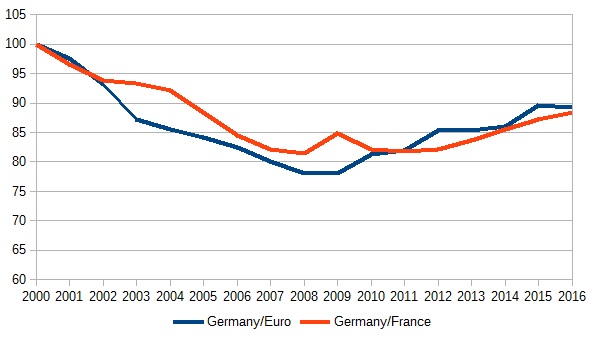
To assess whether the surplus is a problem, it is helpful to discuss a key reason why it arose. I have talked about this in detail many times before, and a similar story has been told by one of the five members of Germany’s Council of Economic Experts, Peter Bofinger. A short summary is that from the moment the Eurozone was born Germany allowed wages to increase at a level that was inconsistent with the EZ inflation target of ‘just below 2%’. We can see this clearly in the following chart.

Relative unit labour costs, source OECD Economic Outlook, 2000=100

The blue line shows German unit labour costs relative to its competitors compared to the same for the Euro area average. Obviously Germany is part of that average, so this line reduces the extent of any competitiveness divergence between Germany and other union partners. By keeping wage inflation low from 2000 to 2009, Germany steadily gained a competitive advantage over other Eurozone countries.

At the time most people focused on the excessive inflation in the periphery. But as the red line shows, this was only half the story, because wage inflation was too low in Germany compared to everyone else. This growing competitive advantage was bound to lead to growing current account surpluses.

However that in itself is not enough to say there is a problem, for two related reasons. First, perhaps Germany entered the Eurozone at an uncompetitive exchange rate, so the chart above just shows a correction to that. Second, perhaps Germany needs to be this competitive because the private sector wants to save more than it invests and therefore to buy foreign assets.

There are good reasons, mainly to do with an ageing population, why the second point might be true. (If it was also true in 2000, the first point could also be true.) It makes sense on demographic grounds for Germany to run a current account surplus. The key issue is how big a surplus. Over 8% of GDP is huge, and I have always thought that it was much too big to simply represent the underlying preferences of German savers.

I’m glad to see the IMF agrees. It suggests that a current account surplus of between 2.5% to 5.5% represents a medium term equilibrium. That would suggest that the competitiveness correction that started in 2009 has still got some way to go. Why is it taking so long? This confuses some into believing that the 8% surplus must represent some kind of medium term equilibrium, because surely disequilibrium caused by price and wage rigidities should have unwound by now. The answer to that can also be found in an argument that I and others put forward a few years ago.

For this competitiveness imbalance to unwind, we need either high wage growth in Germany, low wage growth in the rest of the Eurozone, or both. Given how low inflation is on average in the Eurozone, getting below average wage inflation outside Germany is very difficult. The reluctance of firms to impose wage cuts, or workers to accept them, is well known. As a result, the unwinding of competitiveness imbalances in the Eurozone was always going to be slow if the Eurozone was still recovering from its fiscal and monetary policy induced recession and therefore Eurozone average inflation was low. [1]

In that sense German current account surpluses on their current scale are a symptom of two underlying problems: a successful attempt by Germany to undercut other Eurozone members before the GFC, and current low inflation in the Eurozone. To the extent that Germany can make up for their past mistakes by encouraging higher German wages (either directly, or indirectly through an expansionary fiscal policy) they should. Not only would that speed adjustment, but it would also discourage a culture within Germany that says it is generally legitimate to undercut other Eurozone members through low wage increases. [2]

From this perspective, does that mean that the current excess surpluses in Germany are a drag on global growth? Only in a very indirect way. If higher German wages, or the means used to achieve them, boosted demand and output in Germany then this would help global growth. (Remember that ECB interest rates are stuck at their lower bound, so there will be little monetary offset to any demand boost.) The important point is that this demand boost is not so that Germany can help out the world or other union members, but because Germany should do what it can to correct a problem of its own making.

[1] Resistance to nominal wage cuts becomes a much more powerful argument for a higher inflation target in a monetary union where asymmetries mean equilibrium exchange rates are likely to change over time.

[2] The rule in a currency union is very simple. Once we have achieved a competitiveness equilibrium, nominal wages should rise by 2% (the inflation target) more than underlying national productivity. I frequently get comments along the lines that setting wages lower than this improves the competitiveness of the Eurozone as a whole. This is incorrect, because if all union members moderate their wages in a similar fashion EZ inflation would fall, prompting a monetary stimulus to bring inflation back to 2% and wage inflation back to 2% plus productivity growth.    

Sunday, 7 May 2017

Underestimating the impact of austerity

There have been many ideas put forward to explain the low growth in UK productivity, but among mainstream accounts the impact of austerity is not usually high up on the list of possibilities. I have talked before about what I call an ‘innovations gap’, and how the UK is currently suffering a particularly large innovations gap. The idea of an innovations gap can link inadequate demand, like austerity, to low productivity growth.

Let me use a very simple example to explain how an innovations gap can arise after a deep recession followed by austerity. Assume that improvements in technology and production techniques are constantly taking place, or being learnt from other firms/countries, but they need new investment to put them in place. This is what economists call embodied technical progress.

Imagine a firm where demand is not increasing. Will that firm invest to become more productive? Only if the additional profits it can make as a result of investing (suitably discounted) is greater than the cost of the investment. For this firm we therefore need quite a big innovation gap before it is worth its while to undertake investment and before its productivity increases.

Now imagine that demand increases. The firm now has to undertake some additional investment to increase its output. It makes sense to invest in techniques that embody the latest technology. The increase in demand leads to both higher investment (what economists call the ‘accelerator’) and higher productivity.

In a normal recovery from a recession, demand recovers rapidly (growth easily exceeds past trends), leading firms to invest in the latest technology. Any innovations gap that might have opened up in the recession is quickly closed. In contrast, a very slow recovery caused by austerity will reduce the need for investment, allowing a large innovations gap to open up.

This idea fits in with some recent work which suggests that productivity growth in ‘frontier’ firms (firms that already have relatively high productivity) has not slowed, and a gap has opened up between these frontier firms and laggards. (See also here.) This would make sense if the frontier firms are growing (because they are the most productive) but the laggard firms are not. Growing firms need to invest to expand, but stagnant firms are not expanding.

The same model could also suggest how wage led productivity growth could occur (see Ben Chu here for example). As most innovations are likely to be labour saving, then higher wages can increase the profits that come from any particular investment, without necessarily increasing the cost of that investment. So an increase in wages caused by an increase in the minimum wage, for example, could increase investment and therefore increase productivity. The other side of that coin is that the period of stagnant wage growth we have had since the recession provided no incentive for firms to invest in higher productivity techniques.

I doubt that this story explains more than a part of the UK’s productivity gap. In the UK investment in plant and machinery fell sharply in the recession, and has not yet recovered to pre-recession levels, but its decline is unlikely to be enough to explain a productivity standstill. (For an account of some other key factors that could explain the UK productivity puzzle, see here.) But if it explains even a little, it makes austerity a lot more costly.

One way of describing what I’m saying is that austerity influences supply as well as demand. You could say austerity ignores the accelerator as well as the multiplier, which is cute but does not capture the idea of embodied technical progress which is crucial to this argument. It is why it is always best to run a high pressure economy (see Martin Sandbu here who links to an interview between Jared Bernstein and Josh Bivens).

As I explain here, I do not use austerity as just another name for any fiscal consolidation, or fiscal consolidation involving cuts to spending. Fiscal consolidation need not reduce output for the aggregate economy if monetary policy is able to offset its impact. But if interest rates are at their lower bound, as they are once again in the UK [1], fiscal consolidation will reduce output and lead to another needless waste of resources. Since Brexit we have a second period of UK austerity. In assessing how costly this will be, we need to look not just at whether it creates a negative output gap, but also how it creates an innovations gap that reduces productivity.

[1] We know this, because the Bank is increasing the amount of QE.