Winner of the New Statesman SPERI Prize in Political Economy 2016


Showing posts with label equilibrium exchange rates. Show all posts

Friday, 14 July 2017

Why German wages need to rise

An interesting disagreement occurred this week between Martin Sandbu and the Economist, which prompted a subsequent letter from Philippe Legrain (see also Martin again here). The key issue is whether the German current account surplus, which has steadily risen from a small deficit in 2000 to a large surplus of over 8% of GDP, is a problem or more particularly a drag on global growth.

To assess whether the surplus is a problem, it is helpful to discuss a key reason why it arose. I have talked about this in detail many times before, and a similar story has been told by one of the five members of Germany’s Council of Economic Experts, Peter Bofinger. A short summary is that from the moment the Eurozone was born Germany allowed wages to increase at a level that was inconsistent with the EZ inflation target of ‘just below 2%’. We can see this clearly in the following chart.

Relative unit labour costs, source OECD Economic Outlook, 2000=100
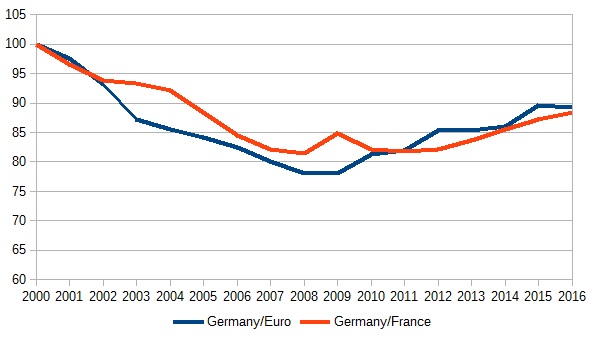
The blue line shows German unit labour costs relative to its competitors compared to the same for the Euro area average. Obviously Germany is part of that average, so this line reduces the extent of any competitiveness divergence between Germany and other union partners. By keeping wage inflation low from 2000 to 2009, Germany steadily gained a competitive advantage over other Eurozone countries.

At the time most people focused on the excessive inflation in the periphery. But as the red line shows, this was only half the story, because wage inflation was too low in Germany compared to everyone else. This growing competitive advantage was bound to lead to growing current account surpluses.

However that in itself is not enough to say there is a problem, for two related reasons. First, perhaps Germany entered the Eurozone at an uncompetitive exchange rate, so the chart above just shows a correction to that. Second, perhaps Germany needs to be this competitive because the private sector wants to save more than it invests and therefore to buy foreign assets.

There are good reasons, mainly to do with an ageing population, why the second point might be true. (If it was also true in 2000, the first point could also be true.) It makes sense on demographic grounds for Germany to run a current account surplus. The key issue is how big a surplus. Over 8% of GDP is huge, and I have always thought that it was much too big to simply represent the underlying preferences of German savers.

I’m glad to see the IMF agrees. It suggests that a current account surplus of between 2.5% to 5.5% represents a medium term equilibrium. That would suggest that the competitiveness correction that started in 2009 has still got some way to go. Why is it taking so long? This confuses some into believing that the 8% surplus must represent some kind of medium term equilibrium, because surely disequilibrium caused by price and wage rigidities should have unwound by now. The answer to that can also be found in an argument that I and others put forward a few years ago.

For this competitiveness imbalance to unwind, we need either high wage growth in Germany, low wage growth in the rest of the Eurozone, or both. Given how low inflation is on average in the Eurozone, getting below average wage inflation outside Germany is very difficult. The reluctance of firms to impose wage cuts, or workers to accept them, is well known. As a result, the unwinding of competitiveness imbalances in the Eurozone was always going to be slow if the Eurozone was still recovering from its fiscal and monetary policy induced recession and therefore Eurozone average inflation was low. [1]

In that sense German current account surpluses on their current scale are a symptom of two underlying problems: a successful attempt by Germany to undercut other Eurozone members before the GFC, and current low inflation in the Eurozone. To the extent that Germany can make up for their past mistakes by encouraging higher German wages (either directly, or indirectly through an expansionary fiscal policy) they should. Not only would that speed adjustment, but it would also discourage a culture within Germany that says it is generally legitimate to undercut other Eurozone members through low wage increases. [2]

From this perspective, does that mean that the current excess surpluses in Germany are a drag on global growth? Only in a very indirect way. If higher German wages, or the means used to achieve them, boosted demand and output in Germany then this would help global growth. (Remember that ECB interest rates are stuck at their lower bound, so there will be little monetary offset to any demand boost.) The important point is that this demand boost is not so that Germany can help out the world or other union members, but because Germany should do what it can to correct a problem of its own making.

[1] Resistance to nominal wage cuts becomes a much more powerful argument for a higher inflation target in a monetary union where asymmetries mean equilibrium exchange rates are likely to change over time.

[2] The rule in a currency union is very simple. Once we have achieved a competitiveness equilibrium, nominal wages should rise by 2% (the inflation target) more than underlying national productivity. I frequently get comments along the lines that setting wages lower than this improves the competitiveness of the Eurozone as a whole. This is incorrect, because if all union members moderate their wages in a similar fashion EZ inflation would fall, prompting a monetary stimulus to bring inflation back to 2% and wage inflation back to 2% plus productivity growth.    

Tuesday, 10 November 2015

More on UK interest and exchange rates

A lot of stuff written on UK interest rates reasons as follows. Many estimates of the UK’s output gap - the difference between actual output and the level of output that is consistent with steady (domestically generated) inflation - suggest it is almost zero. That cannot be consistent with nominal short term interest rates as low as 0.5%. Therefore a rise in interest rates is long overdue.

This ignores the rest of the world. Although the OECD estimate that the UK output gap in 2015 is zero, they also estimate it is nearly -2% for the OECD as a whole and nearly 3% for the Euro area. That means the UK is selling less goods abroad. For the UK output gap to be zero, we therefore need some other element of UK aggregate demand to take up the slack created by low exports. It is not government spending, which is going in the opposite direction. So it is consumers and firms that have to be encouraged to borrow more and save less. To put it another way, they need to be encouraged to shift spending from the future to the present. That means lower than normal UK real interest rates.

It is still true that monetary policy should be easier in the Eurozone than in the UK, but with active QE it already is. The fact that markets expect UK interest rates to rise well before those in the Eurozone intensifies the exports problem, because it means that exports are being hit not just by low demand but also by becoming less competitive as sterling appreciates against the Euro. [1]

The problem of low demand for UK exports would be made worse still if, as I suspect, sterling is overvalued even after you allow for differences in expected interest rates. Philip Lane, soon to become governor of the Irish central bank, has produced an interesting analysis of the recent deterioration in the UK current account. He concludes that “financial engineering may have played some role”. I suspect he is right, mainly because he is a renowned expert on these matters. However I wanted to stress that my arguments about overvaluation owed nothing to this recent deterioration.

The UK’s trade balance deficit has remained large and fairly constant for many years, despite the depreciation around 2008. That was not offset by investment income, even before the recent deterioration, which is why we have been running current account deficits for over 15 years. There may be good reasons why some countries run deficits for a long period of time, but it is not obvious whether any of these reasons apply to the UK, and those deficits in themselves mean that the equilibrium exchange rate will be depreciating alongside those deficits.

So we should not expect UK real interest rates to return to their ‘normal’ level until output gaps are closed in the rest of the world. We should also note that the Bank thinks that the normal or natural level of real interest rates is much less than it has been in the past (secular stagnation). Finally with inflation currently low, low real interest rates imply low nominal rates. All this would be true even if you were certain that the current UK output gap was zero, which I am not.

[1] Using UIP, the current real exchange rate is determined by the medium term equilibrium rate (calculated at zero output gaps everywhere) plus expected real interest rate differentials.

Wednesday, 28 October 2015

Is sterling overvalued?

One of the reasons that steel plants have been closing in the UK rather than Germany or France, and that UK manufacturing output has fallen for the last two quarters, is the strength of sterling and the weakness of the Euro. The weakness of the euro relative to the dollar could be explained (at least qualitatively) by interest rate expectations: whenever interest rates do rise in the US, they will surely rise well before they do in the Eurozone. When domestic interest rates are expected to rise relative to overseas rates, a currency should appreciate.

The same logic could be applied to sterling. Indeed some still believe interest rates could rise in the UK before they rise in the US. If the UK looks like the US, you would expect on these grounds for the pound relative to the dollar to be roughly stable, but sterling to follow the dollar in appreciating against the Euro. To a first approximation that is what has happened.

The only problem comes if you look at the UK’s external performance. The current account deficit as a percentage of GDP has wobbled around 2% for most of this century, but in the last few years it has increased sharply, coming in at over 5% of GDP in 2014. All these deficits are taking their toll on the UK’s net financial position: twenty years ago we owned about as many overseas assets as there were UK assets owned overseas, but we are now a net debtor by an amount that will just get larger if we continue to run large current account deficits. (For more on this, see Felix Martin in the FT.)

When I calculated an equilibrium sterling euro rate in 2003, my estimate was 1.365 E/£. As current rates are close to that, and given the point about expected interest rates, what is the problem? Unfortunately there are three. First, that calculation was based on an assumption that the sustainable UK current account was balance. In other words, if the rate had stayed at 1.365 E/£, then over time and on average the current account should have been in balance. Instead we have had persistent deficits. In the early 2000s that might have been partly explicable because sterling was a little stronger than my estimate, but since the beginning of 2008 quite the reverse has been true, but we have still run deficits. That either suggests my estimate was wrong (the equilibrium E/£ rate should have been lower), or the equilibrium rate has depreciated since 2003.

Second, persistent current account deficits that weaken our net foreign asset position will in any case imply a gradual depreciation in the equilibrium exchange rate. The worse our net asset position gets, the greater the trade surplus we need to pay interest on that net debt. Third, and perhaps more speculatively, if the recent stagnation in productivity also represents a stagnation in innovation in the variety and quality of goods produced in the UK, that will also mean a depreciation in the equilibrium exchange rate.


All this suggests to me that sterling may currently be overvalued. How can I say this when there are a huge number of people in that market trying to make money from getting the ‘right’ rate? Quite simply from experience. The market is totally focused on very short term movements, and pays very little attention to estimates of equilibrium rates. When I did my equilibrium rate calculation in 2002, the actual rate was wandering around 1.6 E/£, and there was no clear reason why it should be so much higher than the equilibrium rate. So, even allowing for expectations about interest rates, it would be quite possible for sterling to be currently overvalued.          

Saturday, 17 January 2015

What does the end of the Swiss Peg tell us about central banks?

A lot of the discussion in blogs about the end of the Swiss exchange rate peg has focused on whether the original peg, which started in September 2011, was a good idea in the first place. [1] This post asks a rather different question, which has wider relevance.

First some facts, which you can skip if you have already read some of those posts. The safe haven status of the Swiss Franc meant that during the Eurozone crisis people wanted to buy the Swiss currency, and the resulting appreciation was in danger of driving some Swiss producers out of business. [2] The chart below plots competitiveness, measured as relative consumer prices, in Switzerland and in the UK. [4]

      
The appreciation problem in 2011 was real and the exchange rate cap fixed that, but to prevent the exchange rate appreciating beyond the 1.2 Swiss Francs (CHF) per Euro mark the central bank had to create lots of money to buy Euros. You can think of it as Quantitative Easing (QE) that buys foreign currency rather than domestic government debt. [3]

The interesting question is why the central bank ended the cap. Perhaps the cap was always meant to be a transitional measure, to allow firms time to adjust to a loss in competitiveness. (Here is the official explanation.) This is not that convincing. If the central bank was worried that its producers were becoming too competitive, it could have changed the cap from, say, 1.2 CHF per Euro to 1.1 CHF per Euro. Removing the cap completely would only make sense if you thought your safe haven status had reached some kind of equilibrium, and with the Greek elections and other things currently happening that seems unlikely. Even if you did think this, caution might suggest testing the market with a more appropriate cap and seeing how much defending you had to do.

As a result of ending the peg, the Swiss Franc has appreciated substantially, from 1.2 CHF per Euro to around 1 CHF per Euro, even though the central bank has lowered the interest rate on sight deposit account balances that exceed a threshold to −0.75%. There seem to be two alternative interpretations.

The first is that the central bank simply made a serious mistake. For some, the mistake was to impose the cap in the first place. If you do not take that view, and assuming the market’s immediate move is not a very temporary overreaction, the large appreciation partly undoes the benefits of the original peg. Either way, a major mistake has been made at some point. This can be added to what is now a seriously long list of recent major central bank mistakes: see in particular Sweden and the Eurozone. Does the fact that central banks in the UK and US seem rather less error prone have something to do with the greater influence of economists (inside and outside) on those banks? [5]

The second interpretation is that the open ended money creation that the policy implied just became too much for the central bank. In theory the central bank could go on creating money and buying Euros forever. As long as the exchange rate peg was reasonable this policy could be consistent with its inflation target (the target is ‘below 2%’, while actual inflation is currently negative). If it ever decided it was not and there was too much Swiss money around, the policy could be reversed by selling Euros. The central bank might make a loss when this was done, but economists generally dismiss this as a non-problem (a central bank is not like a commercial bank), just as they dismiss the same problem with conventional QE. But perhaps central banks do not see things this way (HT MT), because they worry about the political consequences of such losses. If this is the case, then this is something that economists need to respond to in one way or another.  


[1] The discussion in the media, as often with mediamacro, is obsessed with the markets. The Guardian had a link entitled “Swiss franc - what the economists say”. What you got were 6 City economists, who wrote the kind of thing City economists write. Now I’m sure the Guardian will say they needed something fast, and academics - even academic bloggers - are unreliable in that respect. But please label this properly: you are getting the reactions of City economists, whose primary concern is what this all means for the markets, and not what it means for ordinary people.

[2] Economists have a theory, Uncovered Interest Parity (UIP), which says that short term capital flows like this should not influence exchange rates, because the market will keep rates close to fundamentals. It does not work too well, partly I suspect because the market has little idea what the fundamentals are, and partly because no one in the market is prepared to take bets that last years rather than days.

[3] Switzerland has a really large current account surplus, which since 1997 has averaged 10% of GDP. The reason for this surplus is complex, but it suggests that there is scope for a gradual real exchange rate appreciation over time.

[4] Source: OECD Economic Outlook. The level is arbitrary, at 2010=100. A rise is an appreciation, which means a loss of competitiveness. The average level of this measure of Swiss competitiveness was around 96.5 from 1998 to 2004.

[5] However the suggestion by Tony Yates that every blogger should be given a job at the SNB seems to be going too far.


Friday, 7 November 2014

Germany and pre-recession cost cutting

In a recent post I argued that many of the Eurozone’s current problems stem from low nominal wage inflation in Germany before 2008. In that post I also noted that this could be justified if Germany had entered the Eurozone at an uncompetitive real exchange rate, but that I thought there was little evidence for this. I want here to expand on that point.

One area that I have worked on extensively in the past is what might be called the empirical analysis of equilibrium exchange rates. The term equilibrium is short for where the real exchange rate is heading over a five year or so time horizon. While predicting exchange rate movements from day to day is impossible, this is not the case over the longer term. It was for this reason that the UK Treasury asked me to analyse what an appropriate entry rate for Sterling might be if we had joined the Euro in 2003.

There are two ways of describing the approach I take in this analysis. The first is to calculate the exchange rate that will achieve ‘external balance’. As John Williamson repeatedly points out, external balance does not mean current account balance, but the current account that is consistent with medium term trends in domestic supply and demand. This is why the approach is equivalent to a second way of describing it, which is to apply the ideas of the ‘new open economy’ literature that now dominates open economy macro.

In a 1998 study with Rebecca Driver for the (now called) Peterson Institute (which contained a key contribution from John Williamson and Molly Mahar) we calculated equilibrium rates for 2000 for France in the range of 3.06-3.74 Fr/DM, and Italy 927-1133 Lire/DM. The actual entry cross rates were 3.35 Fr/DM and 990 Lire/DM, which is pretty close to the middle of those ranges. In other words, according to our analysis Germany did not enter at a significantly uncompetitive rate compared to these two major economies.

A crude way of doing exactly the same analysis is simply to look at the current account balance. Here it is for Germany, as a percentage of their GDP. The problem with this simple approach is that the current account is a noisy signal, and it is exactly this problem that the analysis described above tries to deal with. But for the sake of argument let’s say that, because of well known lags, the current account in 2001 reflected the competitive position of Germany when the Euro was created.


Germany’s current account in 2001 was in balance, and according to the OECD its output gap that year was a positive 0.7%. So Germany could only be uncompetitive on entry to the Eurozone if that current account balance was unduly influenced by one off factors, or that it really should have been running a structural surplus because of relative demographics or some other reason. But such structural surpluses are normally of the order of 1% or 2% of GDP. Looking at the current surplus of over 7% of GDP, you just have to conclude that Germany currently has a hugely undervalued real exchange rate, which is just another way of saying that it is too competitive compared to its Euro partners. It achieved that competitive advantage from 2000 to 2007.

So where did this idea that Germany entered at an overvalued (uncompetitive) exchange rate come from? I suspect it derives its force from what happened to German GDP growth after the Eurozone was created. As the chart below shows, Germany entered a recession in 2003. In addition, in 2003 foreign trade subtracted from growth. However in terms of the contribution of trade to growth this was a blip: both before and after export volumes grew faster than import volumes, reflecting the growing competitive advantage it was gaining through low nominal wage growth. (A ‘sustainable’ pattern would have domestic demand growing at the same rate as GDP, with a foreign contribution averaging zero.) So if we consider the period 2002 to 2004, for example, the recession was despite a positive contribution from trade, so trade can hardly have been a cause of it. The real reason for the depressed German economy was a decline in domestic demand, coming from both consumption and investment.


Whatever the reason for depressed domestic demand growth, it was not permanent, with healthy growth in 2006 and 2007. By that time, however, Germany had through low nominal wage growth gained a large competitive advantage compared to its Eurozone partners, which was the subject of my earlier post.

Germany’s undervalued real exchange rate - its competitive advantage compared to the rest of the Eurozone - cannot persist. It will be eroded by faster inflation in Germany relative to other Eurozone countries. The only question is whether this happens through a boom in Germany, or continued depression in the rest of the Eurozone. Yet failure to see the source of the problem as coming from Germany continues to mire the debate. There is endless discussion of the need for structural reform outside Germany that ‘must be part’ of any solution to the Eurozone’s current problem. Structural reform may or may not be desirable in many countries, and perhaps even Germany, but it has nothing to do with the need to raise the level of aggregate demand in the Eurozone as a whole. As far as competitiveness imbalances within the Eurozone are concerned, the problem is a result of a negative inflation shock in Germany. The natural place to look for a solution is not structural reform outside Germany, but a period of above target inflation within Germany, and it is in the interests of pretty well every Eurozone country other than Germany that this should happen.


Saturday, 22 March 2014

What place do applied middlebrow models have?

Mainly for economists, although the jargon I cannot help using is not critical to the message

Paul Krugman writes that “the effect of the insistence that everything involve intertemporal optimization has been to drive out middlebrow economic modeling.” I like the term middlebrow. A ‘highbrow’ is ‘One who possesses or affects a high degree of culture or learning’, and I think that has a nice ambiguity to it.

Paul gives a couple of examples where middlebrow research is getting squeezed out. I want to add an applied example of my own which I believe shows clearly that there is a problem, but also why there is no simple answer. The story is a little on the long side, but telling it provides evidence of a pattern which is my main point.

I first started working on the calculation of equilibrium exchange rates with Ray Barrell in the late 1980s. The partial equilibrium model we constructed, looking at the G7 currencies, was based on an approach pioneered by John Williamson, which he called the FEER. This essentially uses trade equations to estimate the exchange rate which would produce an off-model guess at a ‘sustainable’ current account. If you want to think of it in terms of a two dimensional diagram, think about a supply and demand curve in real exchange rate/output space (sometimes called the Swan diagram: see this post for example.) It is a good example of a well used middlebrow model. What FEER analysis effectively does is estimate the demand curve, conditional on off-model assumptions about asset accumulation.

Our paper attracted a lot of interest, and we did send it to a couple of journals. However the response was consistent: the model was rather traditional, partial equilibrium, not microfounded, and therefore of not enough interest for a major journal. All this was true, so we gave up on publication. However the UK was about to enter the ERM, so we used the model as part of a comprehensive analysis of an optimal entry rate. Our analysis, published by the Manchester school as part of a conference volume, suggested that the rate we did join the ERM at - 2.95 DM/£ - was too high and would intensify the recession. Subsequent events did not prove us wrong. [1]

In the late 1990s John Williamson asked me to update the analysis, which I did with Rebecca Driver. It was published as a monograph, and neither of us thought it worth the effort to go for what we knew would be a minor journal publication. 

In 2003 the UK government had to decide whether to join the Euro. It undertook a number of background studies to help it make that decision, but it also needed to know what rate to enter at if they decided to join. Initially they asked me to review existing studies on what the equilibrium Euro/Sterling rate might be. There were no papers (microfounded or not) published in top journals. I focused on three studies: my earlier work with Driver, one available as an IMF working paper, and one published in a policy oriented journal. They then asked me (in 2002) to update my own earlier estimates, which I did with a new model of the yen, dollar, euro and sterling. At the time the exchange rate had been around 1.6 Euro/£ for over 2 years - I calculated that the equilibrium rate was a little below 1.4 E/£. By the time the study was published in 2003 the rate had fallen to around 1.45 E/£, and it stayed near that level until 2007.

There is a lot to say about that work, including a rather amusing incident that happened just after the study was published, but that is for another day. The point I want to make here is that I did not even try to publish this 2002 exercise. I feel rather guilty about this now, because the study is so hard to find. [2] Yet as an academic the incentives for me to publish in a minor policy orientated journal were zero.

John Williamson’s FEER framework anticipated aspects of the New Open Economy approach. In the mid 2000s Obstfeld and Rogoff applied (without as far as I know acknowledging Williamson) a similar approach to an analysis of the US exchange rate and current account, at a time when many people thought the financial crisis would be all about the dollar. The best known example of this work was published as a Brookings paper. Their analysis is microfounded in the sense that it includes deep parameters like demand elasticities, but it remains partial equilibrium and there is nothing intertemporal. Their microfoundations focus is elegant, but its output is more limited: they only calculate the impact of a given US current account change on equilibrium exchange rates, and do not try and estimate what equilibrium rates actually are. However the point I want to make here is that this was analysis of key interest, undertaken by two of the best international macroeconomists in the world, but it was not published in one of the top six journals. [3] [4] [5]

It is not difficult to see why. There is little here to interest either a theorist or an econometrician. The theory is well known, and models are either calibrated or involve very simple estimation. Yet constructing a model (microfounded or middlebrow), and taking it to the data, is a non-trivial task, and there are plenty of ways to get nonsense out. I use a lot of skill and experience in this work. (You could say they are the skills and experience of an engineer or experimental scientist, rather than those of a theorist.) More importantly, the output is of considerable interest to policymakers and others. Every time someone says a currency is under or overvalued they are making a judgement about equilibrium exchange rates.

Now I suspect a lot of academic macroeconomists would say that this is the kind of work that should be done in policymaking institutions, and not by academics. Yet I kept being asked to update my work, and I guess Obstfeld and Rogoff did theirs, because policymaking institutions - with the important exception of the IMF - typically do not have the resources to maintain and develop models of this kind. Indeed increasingly I suspect that because it will not be published in good journals they infer that it is somehow not worth doing. [6]

I cannot help feel that there is some kind of ‘knowledge failure’ here, and that it is fairly specific to macro because macro involves models. This is not frontiers of research stuff, so you can see why you would not find it in the journals that leading theorists or econometricians would routinely read. My work was an empirical application of a middlebrow model, but still in my view the most reliable method we have at calculating equilibrium rates. It is quite consistent with a microfounded approach, but the microfoundations themselves are not terribly interesting. It can be very important (suppose we had joined the Euro in 2003), yet I did not have the incentive to even try and publish what I had done. Isn’t that rather strange?


[1] We published our analysis before we joined the ERM. A well known FT journalist told me at the time that he thought we had won the intellectual argument, but he still felt instinctively that 2.95 was the right rate to enter at. The UK government also followed their instincts, with disastrous results.

[2]  It recently took me 30 minutes to find a ‘snapshot’ from the Treasury website hosted in the national archives where the links worked - thanks HMT!

[3] This update of my Treasury analysis (published as a book chapter) has an appendix which goes through the microfoundations of the FEER approach. I could talk about the relative merits of a microfoundations centred approach and my more data based FEER approach, but that is not the key point I want to make here.

[4] Why not make the model general equilibrium using intertemporal theory to model the current account, for example? Unfortunately the standard intertemporal model is hopeless at describing trends in the data, yet matching trends in the data is vital in calculating equilibrium exchange rates. I essentially make the same point here when discussing the US savings ratio. There have been empirical studies of medium term current accounts (I discuss a recent one here), but these are reduced form and pretty ‘ad hoc’ by today’s standards. Again you will not typically find these studies in the top journals.

[5] Why is publication in top journals important? Because that gives the best economists the incentive to try and improve or develop work, and therefore to get even better answers. Policymakers asking economists like me to do occasional work is fine, but you really want a forum where others can – uninvited – critique and improve on that work, and which provides a memory so that new work does not ignore what has gone before.  

[6] You might be tempted to say that if this analysis was any good, those involved in the FOREX market could make money from it. I have been in a number of meetings with people like that, and they are interested until they ask how long an exchange rate might typically take to get to its equilibrium rate. When I say around 5 years, they nearly always lose interest! For those who think all you need at this horizon is PPP, read this.


Saturday, 9 November 2013

Medium term exchange rates and current accounts

For teachers and students of macroeconomics

This is about how real exchange rates are determined in the medium term. So we abstract from the complications caused by sticky prices and monetary policy. However as anyone who understands uncovered interest parity knows, exchange rates in the short run depend crucially on expectations about medium term exchange rates, so the determination of medium term exchange rates is important whatever your time horizon.

The framework I use when teaching at masters level is the ‘new open economy’ (NOEM) approach, associated with Obstfeld and Rogoff in particular. A classic survey is by Philip Lane. If this framework could be summed up in one sentence, it would be this. In a world where most international trade takes place in goods sold in imperfectly competitive markets, the real exchange rate moves to equate the demand and supply for domestically produced output. [1] What follows is not about whether that framework is empirically useful, but why teaching it can avoid some confusions and pitfalls.

This concept was not of course invented by NOEM. John Williamson’s approach to determining equilibrium exchange rates, later taken up by the IMF and others, is based on the same idea. (See this earlier post for references. Williamson's work can in turn be seen as a development of the 'Swan diagram'.) Indeed I sometimes get annoyed that the NOEM literature typically ignores its antecedents. However one source for confusion is that the essentially empirical literature associated with Williamson focuses on the current account, rather than the supply and demand for domestic output. It does this because the current account is a readily available indicator of this supply and demand balance much of the time. But not always, as the following classic example shows.

Suppose an economy discovers a finite natural resource, like oil, which takes a negligible amount of labour to extract.[2] It takes a few years before the discovery leads to the resource being extracted, but the extent of the resource is common knowledge. This is a standard exercise in consumption smoothing. Consumption rises the moment the resource is discovered, anticipating higher future income. This leads to a current account deficit until the resource is extracted. Once it starts being extracted, consumers are now consuming less than their income, first to pay off their borrowing, and then to save for the day the resource runs out. So while the resource is extracted we get a current account surplus.

What happens to the real exchange rate? If we focus on the current account, we might be tempted to say that it first depreciates, and then appreciates when we have a surplus. This would be wrong. We could start with a special and highly unrealistic case, where there are no non-traded goods, the economy is so small that only a negligible amount of the additional consumption is spent on home produced goods, and labour supply is fixed. In that case nothing would happen to the real exchange rate at any time. More realistically, transport costs will mean there is some ‘home bias’ in consumption, and also some of the consumption will go on domestically produced non-traded goods. Both imply a domestic real appreciation, which begins while the current account is in deficit, and which stays the same as the current account switches to surplus.[3] In addition, if consumers want to match higher consumption with more leisure, labour supply will decrease, and we get an appreciation to choke off demand for domestically produced goods. Again this happens throughout, and not just when the resource is extracted.

The reason why looking at the current account is misleading is that we are ignoring the capital account. Before the resource is extracted, consumption rises through borrowing from abroad. If all the extra consumption is on overseas goods, those lending to consumers require no domestic currency (they can lend in dollars). But if some of the additional consumption is spent domestically, some of the lending must also be in domestic currency, so we get an appreciation. Once the resource begins to be sold (for dollars), it is as if all the extra income is used to buy overseas assets. So the size of the appreciation remains unchanged.

Thinking about both current and capital accounts in this situation is tricky, but thinking about the supply and demand for the domestically produced tradable goods gives us the same answer much more easily.


[1] In a simple model without capital, supply is just labour supply and productivity. For a small open economy where there are no non-traded goods or home bias, demand for domestically produced goods just depends on world output and competitiveness=real exchange rate. In this simple set-up a consumer price based real exchange rate is constant (PPP holds), but once we introduce realistic features like home bias or non-traded goods competitiveness influences a consumer price based real exchange rate, and PPP no longer holds.

[2] For simplicity ignore the capital required to extract the resource, and we assume all the income from the resource goes to domestic consumers.

[3] The two mechanisms work in different ways, however. The additional demand for non-traded goods takes labour away from traded goods production, so reduced traded goods supply leads to an appreciation. With home bias we get an appreciation because of the additional demand for domestically produced traded goods.