Winner of the New Statesman SPERI Prize in Political Economy 2016


Tuesday, 26 April 2022

Is the UK heading for a recession?


My guess is probably, but what do I know? What I do know is that unconditional [1] macroeconomic forecasting is a mug’s game, and the only reason some people do these forecasts is that they are generally better than an informed guess, but only a little better. What I can do in this post is make some I hope helpful points about annual versus quarterly growth, look at some of the evidence and some key behaviour that will decide whether a UK recession is on the cards.


As Duncan Weldon reminds us, most established economic forecasters are terrible at forecasting recessions. One reason has little to do with economics, and a lot to do with human nature. I learnt this very early. My first job was helping to forecast the world economy in the Treasury, and it was after the first oil shock of 1973/4. Our initial forecast showed a collapse in world trade. Our boss was not happy - nothing like that had happened since WWII. As a result of his unhappiness we revised our forecast up, but our initial forecast was nearer what actually happened than our revised forecast. Established forecasters are always looking over their shoulder at other previous forecasts (by themselves and others) and hate being too extreme. As a result, they tend to miss booms and recessions.


A second reason that domestic forecasters miss recessions is that they fail to recognise that what they are seeing domestically is often also happening in the rest of the world. That is true today with a global cost of living crunch. Indeed that psychology of forecasting can allow non-forecasters or ex-forecasters like myself a slight advantage. In this post I tell the story of the 2009 recession, where in No.11 Downing Street I at least held my own among more professional forecasters simply because I applied these two observations about forecasting the extent of that recession.


It should not come as a surprise, therefore, that no major forecaster has predicted negative annual growth this year or next, despite what is expected to be the biggest fall in living standards in any single financial year since ONS records began in 1956-57. Instead consumers are expected to dramatically reduce their savings, as this chart from the latest OBR forecast shows (look at blue line).


So, sticking with this OBR forecast, we have real household disposable income falling by 1.5% this year and 0.2% next year, but aggregate consumption is forecast to increase by 5.4% and 1.0% respectively. At first sight this looks very implausible.


It looks even more implausible if we look at surveys of consumer confidence. To quote from Duncan’s piece: “The GfK Consumer Confidence Index fell for the fourth month in a row to -31 from -26 in February, its lowest since November 2020, deep in the coronavirus pandemic. Readings of -30 and below have presaged recession on four out of five occasions since the survey started in 1974.” Since then the March data is available, and it’s at -38!


David Blanchflower talks about this data and similar for the US here, and is in little doubt that a recession is on the cards. So how would economic forecasters, and the OBR in particular, defend their forecast of strong growth in consumption this year, and positive growth next year, despite falling incomes? The answer also comes from the chart above. The pandemic led to unprecedented increases in household savings, because most maintained their incomes but the pandemic led to sharp falls in ‘social consumption’. So most consumers will have plenty of scope to run down their savings as their incomes fall.


Furthermore, standard theory suggests that consumers who have the ability to do so will try to smooth out fluctuations in real income, if they think the fall in their income is temporary. Indeed, after social consumption has been suppressed during the pandemic, there may be some bounce back as consumers try to partially recoup the spending they had missed out on. (For a similar reason, consumers switched spending from services to goods during the pandemic, which partly explains some of the supply side inflation we have seen). To set against that the pandemic is not over, despite what some politicians might say, so that will inhibit consumption.


Rapid consumption growth is what we saw at the end of last year during the vaccine led recovery from the pandemic. The level of consumption in the fourth quarter of 2021 was over 8% higher than a year earlier. Crucially, that means that even if quarterly consumption in 2022 was flat at the 2021Q4 level, annual growth this year would be very high. The lesson here is that for this year, look at quarterly growth through the year rather than year on year numbers.


Does the recent fall in retail sales also suggest a recession? Again we have to be careful. As many people are starting to behave as if the pandemic is over, we would expect to see a switch from goods you buy in shops or online to social consumption which are services like travel or eating out. As James Smith notes, online sales are also falling back to more normal levels. This doesn’t necessarily imply a fall in total consumption.


So where does that leave us? While many consumers are in a position to use savings to finance consumption growth, they will only do so if they are sure the cost of living crunch is temporary rather than permanent. Many will not be so sure, and together with those who can only maintain consumption through borrowing, it seems likely that the aggregate level of consumption will fall through this year. That in turn means it’s likely that we will see falls in the monthly path of GDP through this year, and indeed that is something the OBR are expecting to happen (p.42). [2] In that sense the OBR is forecasting a recession during this year, but not in the annual figures that everyone focuses on.


For reasons already explained, that quarterly path could still leave a relatively healthy year on year growth rate for this year because of strong growth due to the vaccine based recovery through 2021. The big unknown is what happens in 2023. Looking at the OBR’s forecast savings ratio chart above, what looks implausible is the very slow recovery in savings from 2023 onwards. If annual growth is going to be negative at any point, it is likely to happen next year rather than this, because the inflation we are currently seeing keeps incomes low and consumers try and get back to more normal levels of saving.


[1] By unconditional, I mean forecasts of what will happen to a macroeconomic variable in a year or two’s time. In contrast a conditional forecast asks how that variable will change if policy changes, for example. Conditional forecasts are much more focused, and therefore more reliable. Politicians and some journalists often do not, or pretend to not, know the difference between these two types of forecast. For example Brexiters during the 2016 referendum used the unreliability of unconditional forecasts to cast doubt on conditional forecasts like Brexit will lower GDP, which was a simple error.


[2] That in turn makes a technical recession in the UK (two consecutive falls in quarter on quarter GDP) possible, but it’s wrong to get hung up on this technical definition. A quarterly path of GDP growth that goes +2.0, -0.1, -0.1, +2.4, +2.4 is a technical recession, while a path that goes +0.2, -1.0, +0.1, -2.0, +0.1 is not, but that latter is much worse than the former. I tend to use the term recession in a much less precise way, to mean an economic downturn that is particularly severe.




Wednesday, 20 April 2022

Is sending UK asylum seekers to Rwanda an example of Brexit overreach?


Boris Johnson is the first UK Prime Minister to be convicted of lawbreaking while in office. Not any old law, but a law he himself imposed on UK citizens, and a law which caused many of those citizens great hardship to uphold at some of the most stressful times in their life. Yet his MPs have collectively decided not to remove him from office on this account, and one minister has described his lawbreaking as ‘fluff’. In these circumstances it is totally understandable that many will wonder how the UK government got itself in such an unprincipled position. [1]


This despair is not helped when the same MPs claim we should overlook his partying during lockdowns because of the great things their leader has done, at a time when household incomes are being squeezed like never before because of government decisions, when more than a thousand die a week as a result of Covid in a NHS on its knees from a pandemic, a pandemic Johnson has declared at an end and over which he says he made all the right calls, where his signature policy has left this country poorer through trade and labour shortages, under an agreement that he previously signed which he now says is unworkable. Just this last week the government announced its answer to people traffickers sending asylum seekers across the channel in small boats is to traffic some of them by force to Rwanda. With all this, it is inevitable that many will wonder what planet our rulers are on.


In 2017 I wrote a post about what I called neoliberal overreach. The idea in that post was as follows. Neoliberalism, the ideological framework introduced by Thatcher and Reagan, has dominated the thinking parts of the political right ever since. A belief set that includes an aversion to state intervention in economic affairs, a desire for ever lower taxes, a ‘flexible’ labour force that isn’t unionised and so on. To the ideology’s devotees it appeared to bring mostly benefits in Thatcher and Reagan’s time, and they wanted to emulate and move forward that political project when their time to rule came.


Yet to do so was overreach, because neoliberalism as a project was only sustainable if it limited itself to a few well defined goals, like reducing union power and opening up markets. The truth was that a successful economy, with ongoing innovation and economic growth, was only possible with significant cooperation between the state and the private sector. (That is the message of Mariana Mazzucato’s The Entrepreneurial State.) In addition neoliberalism would only remain popular if citizens were adequately protected from the ups and downs of their health, of individual firms and the economy as a whole. This is Blair’s third way, or neoliberalism with a human face. To instead insist that neither state intervention or protection was required was overreach in the first instance because it would cause considerable harm, and in the second instance because it could end the dominance of neoliberalism.


While Conservative politicians in the 1950s were reconciled to running an economy with much more state intervention than this, the devotees of neoliberalism were not. They wanted more or what Thatcher had started, which meant a smaller state, less regulation and so on. So when the Global Financial Crisis (GFC) showed why deregulation could be disastrous, and a depression was only avoided by massive state intervention, one of neoliberalism’s devotees in the UK, George Osborne, only saw a chance to shrink the state. What I call deficit deceit was born in 2008, and implemented in 2010.


Other devotees, including crucially the owners of the right wing press, had another project in mind. They believed that their ideologically nirvana, which included not just deregulation but their ability to influence governments, was threatened by the European Union. They took their inspiration from Thatcher’s Bruges speech, and started to work towards bringing about Brexit. This group faced two problems. First, EU membership was not a salient issue for most voters, and second, MPs would never collectively choose to leave the EU because to do so would be harmful in both political and economic terms. As a result, their strategy was to link the EU in voters’ minds to uncontrolled immigration, and to bypass parliament using a referendum. The 2010 and 2015 Cameron governments through its actions gave this group their chance to implement their strategy: through the threat of UKIP, through failed immigration targets and through an economy depressed by austerity generating (as it generally does) resentment about immigration.


There was also a more indirect route through which austerity helped Brexit. Austerity was justified by two big lies: first that Labour profligacy rather than the GFC had led to record government deficits and second that these deficits had to be reduced quickly to avoid another financial crisis. Cameron and Osborne, with crucially the help of the right wing press, their coalition partners and a tame broadcast media, were able to convince enough of the population that these lies were true, such that more people blamed the last Labour government than the Coalition for austerity. That lesson was not lost on the Brexiters, who in the 2016 referendum lied about almost everything, and continued to do so when they took over the leadership of the ruling Conservative party in 2019. It helped that doing this came naturally to Boris Johnson.


Of course not all Brexiters were neoliberal devotees, including Johnson himself. For a fuller list just read the exquisite penultimate paragraph of this post from Chris Grey. In addition, and unlike austerity, Brexit has sacrificed some policies generally associated with neoliberalism in order to (maybe) achieve others. It is a policy of hedge fund managers or business owners disgruntled by EU regulations or billionaires fearful about EU tax rules, and was definitely not a policy favoured by a majority of UK business involved in overseas trade. It was overreach not just because it brought great harm to the country, but because it ended neoliberal hegemony in the UK. The neoliberal overreach of first Cameron/Osborne and then Johnson has changed the UK from a country dominated by Thatcher’s neoliberalism to a country governed by an authoritarian populist leading a selective plutocracy. As this regime shares some characteristics with a dictatorship, it soon takes on the character of its leader, which is why politics in the UK currently appears unprincipled.


Many of the ingredients of what made Brexit possible are involved in the Rwanda policy. It was announced while MPs were on holiday in a memorandum of understanding (bypassing parliament), it aims to shore up the anti-immigration vote, and it involved big lies. The first lie was that asylum seekers were just being sent to Rwanda for ‘processing’, rather than the reality that they will be applying for asylum in Rwanda. The second lie is that the policy would deter people trafficking, whereas not only does it involve the UK government administering forced trafficking, but also experience from Israel suggests it will open up a new trafficking route from Rwanda to Europe. A third big lie is that there is no alternative.


Ministers and MPs like to call asylum seekers who cross the Channel on small boats illegal, and disgracefully BBC News has sometimes parroted that language. Asylum seekers from most countries to the UK face a catch 22. There is no way they can apply for asylum unless they are in the UK, and the government has ensured asylum seekers cannot use official routes into the country, so they are forced to risk their lives travelling on small boats. The obvious solution, which the French government has suggested, is for the UK to set up its asylum processing in France, but the government refuses to do this because its ideal policy is to prevent entry for all asylum seekers.


It is also a very Brexit policy in another sense. Ministers and MPs often imply that because asylum seekers have come from another safe European country (most obviously France) they should have claimed asylum in that country. There is nothing in international law that says asylum seekers have to claim asylum in the first safe country they arrive at, let alone the one they were last in. There used to be the EU’s Dublin convention, but that just applied to EU countries, so it’s a classic case of Brexiters wanting their EU cake after leaving. It is also a classic case of English exceptionalism, in the sense that Bexiters believe other countries should be taking asylum seekers but not us.


The Rwanda deportation policy is in part designed to show that the government rather than the opposition are still on their side of the self-pitying “suburban curtain-twitchers who ‘aren’t allowed to say what we think’” and the “blue-blazered golf club bores who can’t forget the war they don’t actually remember”, to quote from the Chris Grey paragraph referenced above. The more ‘lefty-liberals’ like the Pope or the Archbishop protest the better from this point of view. [2]


Will these old tricks still work? The policy might lead some liberal well-off Tories to vote LibDem in by-elections, but how many will revert back to voting Tory in a general election? More critical is how salient immigration will be as an issue in the next general election. From the Conservatives' point of view it needs to be much more salient than it is right now. While migrants can always be blamed for putting pressure on scarce public services, after Brexit most voters are aware that our NHS and many other essential occupations depend in good part on migrants to keep them going. In addition the war in Ukraine has shown many the human face of asylum seekers. Overall it is possible that the obvious inhumanity of the scheme may galvanise more liberals to effectively oppose the government (by voting tactically in particular) than it does to turn out the xenophobic vote for the Tories.


What do I mean by Brexit overreach? After all, Brexit is hardly an ideology like neoliberalism. Here Brexit is UK-limited shorthand for a plutocratic regime headed by a populist leader that sustains itself in power within a democracy through authoritarian policies that appeal to social conservatives. Hungary's Orban is one example of this type of regime, and Johnson is another. Overreach is where that leader goes too far, and thereby brings about their own downfall in or outside of an election. Going too far can involve pursuing policies that are too authoritarian or inhumane for some social conservatives (as the Rwanda policy might be), actions that expose the regime’s plutocratic nature (corruption), or behaviour that robs the populist of their popularity (lockdown parties).


Which, if any, of these forms of Brexit overreach will bring about the downfall of Boris Johnson? Conservative MPs may have decided to sit on their letters for now, hoping that in time Johnson’s old magic can wipe away memories of overreach. Many MPs think that if the magic no longer works they still retain the option of changing leader before the General Election. However there are two big dangers in the option of waiting. The first is that, with good reason, the failings of Johnson and his government start being associated in voters’ minds with all Conservative MPs including Johnson’s successor. The more time various MPs spend defending the unprincipled actions of their leader the more that will happen. The second is that Johnson preempts MPs by disposing of potential rivals before MPs can act, as they have already done with Sunak. A problem with having a Prime Minister whose only loyalty is to himself is that when his ship finally sinks he will think nothing of taking down all his crew with him.


[1] Johnson either intentionally misled parliament, which even one of his ministers agrees requires his resignation, or he is so incompetent that he had forgotten the law he had himself imposed, and announced to the public, that gatherings of more than two people inside were not allowed unless that was necessary for work. If the latter he is hardly fit to be Prime Minister. If he still claims he was advised the parties that he went to were within the rules, he should tell us who advised him of this, because they too are clearly not fit to be at the top of government. Of course the ‘didn’t think it was against the rules’ defence is too incredible to believe, and the more obvious explanation is that he assumed no one would find out.


[2] Of course neither are lefty-liberals, but for some in the groups the policy appeals to, and increasingly government MPs and supporters, anyone who questions what the government is doing is a lefty liberal. Thus when the BBC in particular occasionally does its job in holding the government to account it is so described by this group. This is classic populism, where 'the people' are just those who agree with the government, and anyone else does not count or, to use another favourite phrase, 'hates Britain'. 


Monday, 11 April 2022

The vulnerability of democracy in bad times


It’s a depressing time for democrats. Russia, run by dictator Putin, is attacking the fledgling democracy of Ukraine. Orban, who destroyed the pluralist democracy of Hungary, was reelected. In the UK the government is in the process of rigging elections in its favour, and giving itself powers to lock up anyone who demonstrates for up to 10 years. The mid-terms in the US seem set to see the advance of a Republican party that shows little respect for democracy when it loses. Those that chart these things (e.g. here or here) find more countries moving in an authoritarian direction than in a democratic direction.


Alongside the global movement towards authoritarian regimes is a growing dissatisfaction with democracy by people in democratic states. This is clearly tracked in this report from the Bennett Institute for Public Policy at Cambridge. As the charts in the report clearly show, globally this rise in dissatisfaction began during the Global Financial Crisis (GFC), and is clearest in established democracies rather than developing democracies. The United States shows this pattern clearly:


Perhaps surprisingly, the UK does not follow this pattern, in that satisfaction recovered from the dip during the GFC, but has increased substantially during the Brexit implementation period.


Of course there are many ways of interpreting these results. It could simply represent a reaction to bad times (as the rise since the GFC suggests), a reaction to the particular democratic system in place (e,g, first past the post), or a preference for some non-democratic alternative. Here a 2017 Pew survey is interesting.


The support for representative democracy is strong, and far outweighs rule by a strong leader or by the military. Reported dissatisfaction with democracy seems in part to be expressing a dislike or distrust of current politicians rather than democracy itself. For example a very recent YouGov poll showed that among every age group, when people responding to a question of whether “democracy in Britain as a whole addresses the interests of people like you” either well as badly, more thought badly rather than well, although it was close for the 65+ group.


Questions about how satisfied people are about democracy, or how they feel about politicians, may do little more than tell you how they feel about the political party in power, rather than the democratic system itself. Another 2019 Pew analysis found that in France, 85% of those who support President Emmanuel Macron’s En Marche party are satisfied with democracy, compared with 34% of those who do not support it. How people feel about the political party in power may in turn depend on major events, like the GFC.


Which brings us to the French presidential elections, and the rise in popularity of the far right. Latest results suggest Le Pen won 23.4% of the vote in the first round, compared to Macron’s 27.6%. That means that Macron and Le Pen will compete in the final poll on 24th April. Opinion polls conducted before the first round suggest that, unlike last time when Macron beat Le Pen easily, this time it will be a close race, although Macron’s first round showing is a little better than pollssuggested.


At first sight, Putin’s war against Ukraine should have dealt Le Pen a fatal blow. In the past she has been an admirer of Putin, and has taken money from Russian banks. She took Putin’s side over the annexation of Crimea and the fate of Russian opposition leader Alexei Navalny. Yet she was quick to condemn Russia over Ukraine, and has instead focused on bread and butter issues like the cost of living. She has effectively managed to detoxify her campaign.


In part this has been possible because in the first round there was another candidate, Zemmour, who took up even more right wing positions on immigration and Islam. It is Zemmour who has taken most of the criticism over admiration of Putin’s Russia. This could play to Macron’s advantage in the final vote, and it may yet be the case that the polls change as the second round vote approaches. In 2017 in the first round Macron got 24% compared to 21.3% for Le Pen, while in the final round Macron won easily, 66% to 34%.


The more worrying alternative view is that the French electorate is now much more open to a far right populist candidate than it was five years ago, particularly if it pretends to be something else. The first important point is that Macron is no longer a novelty, but the incumbent who can get the blame for how things are. Second, in 2017 Le Pen was the only far right candidate. Putting the Le Pen and Zemmour vote together (assuming the exit poll above is correct) you get that over 30%. Finally, despite a different policy on fuel costs to the UK, France is not immune to cost of living pressures caused by the pandemic and Ukraine war. 


But the big story of the first round voting is the further collapse of what were once the established parties of left and right. The collapse of party loyalty in established democracies generally goes together with growing disenchantment with democracy, and reflects a steady fall in the number of voters who closely identify with a political party. Voting has become much more like consumer choice, where voters are often willing to try something new instead of established brands. (In two party systems, such as in the UK and US, that desire for change is frustrated, perhaps increasing disenchantment.) Choices are often based on low information. 


This is an environment that allows right wing populists to thrive. Someone like Le Pen is able to detoxify her brand in just five years, and gain more votes as a result.  In difficult times these populists can pitch themselves as outsiders against the existing political elite, and can promise the unattainable and be believed (as happened in the UK with Brexit). Most voters who vote for far right populists are not deliberately choosing authoritarian leaders who could, like Orban and perhaps Johnson, end up destroying pluralist democracy, but that is where their disenchantment with democracy in bad times can sometimes lead.    


Tuesday, 5 April 2022

Why the Conservatives cannot be the tax cutting party


“Former Tory cabinet minister David Davis said on Saturday that if the Conservatives were to become known as the party of high taxes, the damage to their economic reputation would be as deep and lasting as that inflicted on John Major’s government by the disaster of Black Wednesday in September 1992.” according to the Guardian. Is he right to be worried? As I pointed out after Sunak’s Spring Statement, for the average worker most of the fall in real wages after tax over the next two years is down to higher taxes. By next financial year compared to last year, the average pre-tax wage is expected to fall by 1%, but by 3% after tax as Sunak's tax rises take hold.


The reason is partly higher national insurance contributions, but also Sunak’s decision last Autumn to freeze income tax allowances over a number of years, which at a time of high inflation brings in a lot of money because it takes a lot of money off taxpayers. We can see the impact that both of these tax increases have on the government’s overall tax take by looking at the OBR’s series for national account taxes.


As many have pointed out, the share of total taxes in GDP is now expected to be higher than at any time since WWII.


It was partly Conservative MPs’ unhappiness with this prospect that led Sunak to focus on tax cutting in his Spring Statement rather than helping the poor cope with rising prices. Unfortunately, because of these numbers from the OBR, cutting taxes a bit after you had raised them a lot just six months earlier didn’t really cut it with public opinion. Partly as a result, Sunak is reported to be furious with the OBR, making the OBR yet another part of the UK’s pluralist democracy (after the courts and the civil service) that Tory ministers are furious with. (In Hungary, whose government is so admired by some on the right, the independent fiscal institution was the first to go.)


Sunak’s political failure of a few weeks ago will not stop him trying the same trick again, shortly before the next general election. He has already pledged to cut the basic rate of income tax by 1 percentage cent point, and if things go to plan he has scope to do more than that yet still claim debt as a share of GDP is falling. However, unless he is very lucky, the share of taxes in GDP will remain higher than it has ever been.


So how did Sunak find himself raising taxes as Chancellor for a political party that likes to see itself as the tax cutting party? As I have argued on a number of occasions, it is not because either the Chancellor or Prime Minister is more left wing than earlier Conservative holders of that office. Instead it is the result of two factors: health spending and austerity.


The reality that is outlined in all the OBR’s long term fiscal projections is that, as the UK population grows older and for other reasons, the share of spending in GDP on health and social care is bound to rise over time, just as it has since WWII (see the third chart here, for example). As health care is provided by the state in the UK, that means that taxes must rise (or borrowing must increase by more and more each year).


That is why there is an underlying upward trend in the share of taxes in national income, which is clear from the Chart above. The one sustained exception to this inevitability of higher taxes was over the Thatcher period, but that was both short-lived (reversed while the Conservatives were still in power) and the result of two one-off factors: North Sea Oil (see here) and privatisation. Of course good macroeconomics implies that neither should have been used to cut taxes, but that is another issue.


This upward trend in taxes would be even more evident if it wasn’t for two other things: falling defence spending after the end of the cold war (the ‘peace dividend’) and 2010 austerity. The former is over (and there is no obvious candidate to take its place), and the latter cannot be repeated because most areas of public spending have been cut back to levels that risk political costs for those in power. This includes the NHS, where waiting lists are now longer than at any other time.


On NHS spending the Chancellor in particular, and this government more generally, have made two big mistakes which will mean the extra spending they have provided for the NHS and social care will do little to improve health services. The first mistake was to declare the pandemic over before it was, which intensified the pressure of Covid on the NHS and is likely to mean waiting lists will continue to rise for some time. The second was not to treat any ‘catching up’ from operations delayed by the pandemic as a cost to be paid for by higher borrowing (like the furlough scheme) rather than by higher taxes. Sunak was too quick to try and demonstrate his deficit cutting prowess, rather than accepting that the pandemic would have fiscal costs even after it had actually ended.


Another potential mistake may be to allow higher inflation to raise taxes, but to leave short term nominal spending plans unchanged. The immediate difficulty this will cause is to squeeze even further (relative to the private sector) public sector pay. Public sector workers will of course try and avoid this squeeze, and it’s unclear whether any disruption that follows will be more politically costly to the government or opposition. The longer term difficulty is that this represents a further squeeze to real levels of public spending, which austerity had already cut to the bone.  


As 2010-17 austerity has squeezed the public sector as far as politics will allow, and pressure from an ageing population means that public spending is bound to rise over time, that means that any Chancellor, of whatever colour, is likely to have to raise taxes as a share of GDP over their period of office, unless that period is very short. A Conservative Chancellor may raise taxes and public spending by less than a Labour Chancellor, but ‘raising taxes by less’ does not have the same electoral appeal as ‘tax cutting’ for Conservative MPs.


Is there any way out of this arithmetic for Conservative MPs? Ending the NHS, and replacing it by some kind of insurance scheme, is an alternative that has attracted some ministers in the past, but it faces a political obstacle that will be very hard to avoid. Beside the goodwill most voters have for the NHS, any insurance scheme will be particularly expensive for older voters, who of course tend to vote heavily Conservative.


Privatisation, which is ongoing, is not immediately costly in political terms (because it is hidden from most voters), but it is likely to make the NHS more rather than less expensive and therefore will increase the pressure to raise taxation. This is because the NHS, even though it is heavily under-resourced, is pretty efficient. Thus if it remains free at the point of use, provision in private hands will end up being more costly for the government to pay for, because private provision, even if it is equally efficient, needs to divert some profit to shareholders. So NHS privatisation, while it may be pursued for other reasons, does not get the Conservatives out of their need to raise taxes.


So Conservative MPs who think their party can once again become one that reduces the overall tax burden are living a fantasy. Of course the party and its Chancellor can, and will, raise taxes to cut them by less later and hope some people do not notice the trick being played. In addition the party and its Chancellor can, and will, raise some taxes so that others can be cut and hope some people do not notice the trick being played. But the wish to be a tax cutting party will mean that most public services including the NHS will, under a Conservative government, be permanently and chronically underfunded because the party, and its Chancellor, still has the dream of cutting taxes.


Tuesday, 29 March 2022

Pretending the pandemic is over has been the disaster most experts said it would be


As I wrote over a month ago Boris Johnson, in an attempt to gain support among at least half of his MPs, the newspaper oligarchs and his party donors, threw science to the wind and all but declared the pandemic was over. No more compulsory masks in public spaces, no more free testing, no more having to self isolate, and a cut back in how we monitor Covid. It was a decision of utmost stupidity, and that stupidity has now become clear.


We knew about the BA.2 variant at the time Johnson made his decision, but he ignored it. The media, and the broadcasters are as much to blame here as the right wing press, translated Johnson’s politically motivated edict as a proclamation that the pandemic was over. Most people stopped wearing masks and acted as if the pandemic really was over. No doubt BA.2 would have led to another wave of infections anyway, but people acting on the signals the government and media gave them have undoubtedly made it more severe than it needed to be..


You don’t have to believe me or the experts to believe that. Our health minister has also said that recent increases were “primarily down to the increased social mixing we are seeing, as our country has opened up”. So cases and hospital admissions now look like they are similar to the previous Omicron peak. 1 in 16 is infected with Covid in the England, and it’s even higher in Scotland.


Some firms have tried to avoid the impact this is having on absences by requiring workers to ignore they have Covid and come in to work anyway, but many in the public eye have had to retract after adverse publicity. The more serious impact has been on schools and hospitals. 202,000 children were away from state schools on 17th March because of Covid, a rise from 58,000 just two weeks earlier. 1 in 10 teachers are also absent from school. Does the government think 'living with Covid' means more periodic disruption in many children’s education?


Hospital admissions have now been rising steadily for over a month, and in England are close to the peak levels seen in the first Omicron wave. Every bed taken up by a Covid patient means one less bed that could be used to start reducing the backlog of other cases that has built up over earlier waves. That effect is amplified if staff become sick from Covid. Does the government think 'living with Covid' means more periodic crises for the NHS?


But don’t worry. Our Health Secretary, Sajid Javid, says there is no cause for concern. He says this was all expected. In other words, more kids off school with Covid and more strain on the NHS is all part of the plan. But what exactly is the benefit of allowing another Covid wave to go unchecked? Does having more people off work ‘open up the economy’? Does having more kids off school help their education? Does having hospital beds fill up with Covid patients, and doctors and nurses off sick, make us more free? With no good answers to these questions, he has become the first UK Secretary of State for Health to champion a health policy  deliberately designed to make groups in society more sick.


Such is the determination of this government to pretend that the pandemic is over that their policy will probably survive the current BA2 wave, which may be nearing its peak fairly soon. After that the warmer weather will also probably keep any new variants at low levels until next autumn. It is only then that we will see the true cost of the government’s indifference to our collective health. Allowing a high level of infection at home, and doing too little about cases in countries that cannot afford mass vaccination, is the best policy for encouraging the development of new variants.  


To be fair, this government is not alone in using the fact that Omicron is milder than Delta, coupled with repeated vaccination being fairly effective against it, as an excuse to relax Covid protections. Politicians around the world have jumped on the combination of a milder (but very infectious) dominant variant and vaccination to tell people what they want to hear, which is that life can begin to go back to something more like normal. The UK is just at the extreme end of this movement, doing things like charging nurses for Covid tests.


That people would like to go back to normal is not hard to understand. For the majority of the healthy, fully vaccinated population, Covid in the form of Omicron is not the major threat it once was. So measures like wearing a mask for most people is about protecting others rather than protecting themselves. Apart from a small minority (that appears to include most Tory MPs), most people are happy to make the small sacrifice that mask wearing involves to help the more vulnerable, especially when they have vulnerable relations themselves or hear about fatal cases in the media. Equally most people do not have the time or inclination to follow Covid data themselves. So when the government says in effect that the pandemic is over, and the media act as if this is true, then most people will happily stop doing things like wearing masks.


There are also plenty of myths that make people comfortable with not wearing a mask. Some say ‘we are all bound to get it’, whereas the real question is how often do people get it (the new variants are great at reinfection), with each infection damaging the brain and increasing the risk of heart attacks, as well as increasing the chances of getting Long Covid. Some say ‘as long as you are fully vaccinated you are safe’, whereas the truth is that you are safer but not safe, and you get less safe the longer ago your last vaccination was. Some say Covid is now less deadly than flu, because it said so in their newspaper. The reality is that Omicron has a similar intrinsic severity as the original strains of Covid, but what has changed is immunity and vaccination. (So much for the virus variants getting milder.) The reality is also that my chances of getting Covid in the UK today are higher than my chances of getting flu.


These are myths propagated by parts of the press and not countered by a broadcast media divorced from expertise. The problem is not Covid fatigue. The problem is with both those who feed false information to the public and a broadcast media that no longer fulfils it’s public information role. While it may be an unusual experience for the medical community to find both government and media working against rather than with it, this is a pattern that has become increasingly common in recent years.


Most recently we had Brexit. We will become Global Britain, Brexiters told us, trading with fast growing nations rather than a moribund EU. The reality is that UK exports have stagnated while in the rest of the world they have grown, a reality that will come as no surprise to the experts on the economics of trade who predicted this result. It happened in 2010 when we were told that all the government needed to do was control its deficit and the economy would look after itself. The media went along with that, while most experts warned austerity would harm the economy and its growth that matters, not the deficit. The result of both fantasy-led policies is that GDP per head has grown on average by less than 0.4% a year since before the financial crisis. What is new with Covid is that the experts being ignored are doctors and medics rather than economists, but the government is the same colour and the BBC remains obsessed with providing balance rather than providing knowledge.


It is difficult to overstate the harm fantasy-based governments and a supine media can do. With Covid the cost can be measured in lives lost, in operations delayed, in lost education and (initially) delayed, more prolonged lockdowns. With Brexit the immediate costs are reduced trade and UK productivity, output and incomes, but that means less resources available to the NHS and other public services. Austerity hit both directly, and we just don’t know how many died as a result of those cuts.


It really isn’t hard to understand why in the years before the financial crisis we had a successful economy where productivity was growing at least as fast as other major economies, yet since that crisis we have had a moribund economy falling behind other major economies. Before 2010 we had a (mainly) evidence-based government that took seriously the role of the State in enhancing investment, productivity and innovation. Since 2010 we have had governments that thought the best thing to do with the State was to shrink it and get it out of the way of the private sector, and whose flagship policies have caused severe damage to the economy, discouraging private investment and innovation. Champions of the ideology that has failed us since 2010 may try to pretend otherwise, but a combination of austerity, Brexit and now an ego-libertarian approach to our health are easily enough to explain the UK’s lost decade and the prospect of another to come.


Tuesday, 22 March 2022

Energy Prices in the UK and France: nationalisation or regulation, and Sunak's spring statement


A comparison of the extent of energy price increases for consumers in the UK and France has attracted a lot of attention. The French government, in a presidential election year, has been quick to limit the extent of any increase for the consumer resulting from massive increases in wholesale prices following the recovery from the pandemic and, more recently, Putin’s invasion of Ukraine. In contrast in the UK the regulator, Ofgem, has set a very large increase in its price cap, which will be painful for all UK consumers from this Spring. (On the origins of the price cap see Giles Wilkes here.)


This in turn has reopened the debate between two different styles of relationship between the government and parts of the energy industry: nationalisation (EDF is largely owned by the French government) or regulation of privately owned companies (as in the UK). Many consumers will naturally see the ability of the government to directly limit energy prices as an advantage of the nationalisation model. In addition much has been made of the large increase in profits of many energy companies.


Any discussion on this issue can easily get bogged down in details. It is important to distinguish between energy supply (e.g. BP and Shell) and distribution (in the UK, dominated by the Big 6). The profits of the former are bound to rise when prices rise by far more than the cost of extracting energy. In the UK Ofgem regulates energy distribution, and when energy market prices rise this increases the costs these companies have to pay. This is the reason for the rise in Ofgem's price cap, although that seems to be consistent with a recent large increase in profits of the Big 6.


I want to abstract from this detail by thinking about a single ('vertically integrated') energy company that both supplies and distributes. The reason is that I want to focus on the distinction between prices and profits (or who benefits from higher prices). It is possible for the government to allow higher prices, but to tax the profits those higher prices bring to companies, and use these ‘windfall taxes’ to transfer money to consumers or for some other socially useful purpose. I want to argue here that this is exactly what should be happening right now.


Prices send out signals to both consumers and firms. Higher prices imply a commodity has seen a reduction in supply or a rise in demand, which encourages consumers to economise on using the commodity where they can. Equally the higher profits that tend to come with higher prices encourage firms to invest more to produce more of the commodity. The price signal is doing a useful job on both accounts.


However with energy, which at the margin is produced by burning carbon, it is also vital that we think about climate change, which is proceeding largely unchecked in an alarming way. Global warming is sometimes described by economists as the world’s biggest externality, by which they mean that the need to reduce climate change by consuming less carbon is not reflected in prices.


From the point of view of reducing carbon usage the higher prices for gas and electricity are beneficial. It is good to encourage less use of energy because that helps reduce climate change. By widening the gap between carbon based energy production and renewables, higher prices also encourage green energy supply. However higher energy prices also encourage additional extraction of oil and gas, and national governments typically don't stop energy firms doing this (some may indeed encourage it).


It is in this context that we need to consider a recent proposal from the European Commission. They suggest member countries tax the profits energy companies made from recent energy price spikes and invest the revenue in renewable energy and energy-saving renovations. In doing this, the proposal suggests, EU governments would not be falling foul of EU rules.


The important point is that ‘excess’ profits are taxed, rather than what the money is spent on. Tax increases are not normally directly linked to how that money is spent (they are not hypothecated). In the UK more money is desperately needed by the poorest to help pay higher food and energy bills, and that is best provided by raising levels of Universal Credit. Whether the government does that from general taxation, some other means or from a windfall tax is incidental beyond media announcements.


The purpose of a windfall tax on energy companies is to ensure that the high profits made by these firms do not end up as paying for investment in non-green energy production, or as dividends or capital gains (from share buy-backs) to owners of the shares of those firms, but are directed to a more socially useful end. 


What are the arguments against taxing the profits generated by high market prices? Let’s look at an FT editorial entitled “Windfall taxes on energy companies are a bad idea”. Among many paragraphs, the only substantive argument appears to be this:


“Stability is key to promoting both investment and spending — both of which drive economic growth. Predictable and constant regulations are identifiers of a society governed by the rule of law.”


Stability, the ultimate last resort of the conservative, is a non-argument in this case, as I would be quite happy to enshrine in the rule of law a tax schedule for these companies that taxes very high profits at a high marginal rate. Redirecting high profits to either green investment or higher benefits to the poor would also drive economic growth, with rather more drive than if the profits end up with shareholders. The editorial has all the hallmarks of some poor junior scribe being told to write something about why windfall taxes are a bad idea, and having to scrape the barrel to find any decent argument. I’m glad to see that Chris Giles, senior FT economics editor, has recently written in favour of windfall taxes on energy companies in the FT here. (More bogus arguments are debunked by Michael Jacobs here.)


One argument against nationalisation is that politicians come under huge pressure to keep prices low, as consumers (who are also voters) see the immediate benefit of lower prices, while the higher taxes, lower spending or whatever that is the counterpart of subsidizing energy is more opaque. A regulator is not under similar electoral pressure, and can ensure prices send appropriate signals. However such an argument against nationalisation can only be made if the government is prepared to implement windfall taxes on energy companies when their profits are very high, and that is something the UK government has not so far been prepared to do.


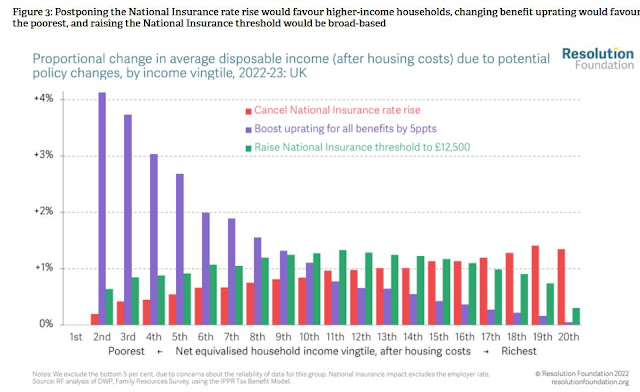
This argument is also central to the Chancellor's Spring Statement tomorrow. The Resolution Foundation sets out some of his options here. A cut in fuel duty, though widely expected, just subsidises CO2 emissions at a significant cost to the public. Hardly surprising from successive Conservative Chancellors who keep promising to put up fuel duty and keep failing to do so, making nonsense of claims this is a green government. On other measures, Sunak should focus on a large uprating in universal benefit which provides most help to those who need it, as the Resolution Foundation shows.


But there are few votes for him in helping the poor, so that outcome seems less likely to happen.


Postscript (24/03/22): Sunak's Spring Statement shows that Sunak has not given up hope of soon replacing Johnson as Prime Minister. He announced a set of measures that did little to tackle the cost of living crisis most people face, did little to help the economy, but was designed to appeal to a majority of Conservative MPs that Sunak needs to become Prime Minister. So what does his package tell us about the average Tory MP?


First, their ideology has not progressed much from Thatcherism. They want tax cuts and a smaller state, and Sunak used the cost of living crisis to give them both. With government spending plans already fixed in nominal terms, higher inflation produced a squeeze on spending but higher taxes, and Sunak used that additional revenue to produce some modest tax cuts. This ideology is completely unsuited to the times, as both Johnson and Sunak had acknowledged by raising health spending and taxes by far more in the Autumn, but it remains what Conservative MPs are comfortable with. Neoliberalism may be dying, but it lives on in the minds of many Conservative MPs. 


Second, most Conservative MPs still regard tackling climate change as 'green crap' that they have to make a token of supporting but will not let get in the way of their ideology or electoral fortunes. So we had some VAT relief for insulation and heat pumps (the token), but there was no windfall tax on energy companies (see above) but instead a cut in fuel duty to encourage more car use. The words net zero did not appear in his speech, perhaps because it didn't occur to Sunak that it should, but more likely because he wants to have those MPs that want to scrap the net zero commitment on board.


Third, Conservative MPs are landlords rather than tenants, so he promised to cut income tax rates before the election while at the same time putting up national insurance contributions. This is almost giving with one hand while taking with the other, except that national insurance contributions are not paid by anyone who gets their income from sources other than working, like landlords or that favorite Tory voting group, pensioners. A sure way of appealing to Conservative MPs is to appeal to their pockets. Overall, if we combine this statement with decisions taken last Autumn, the Chancellor is not helping working people deal with the cost of living crisis, but making that crisis much worse, as this OBR chart shows. The average wage is expected to fall by 1% before tax compared to last year, but by 3% after tax by next year as Sunak's tax rises take hold. 


The UK's cost of living crisis is in large part the Chancellor's choice as he puts deficit targets above the needs of working people.  


Fourth and worst of all, your typical Conservative MP does not care one jot about the poor or disabled, and indeed is quite happy to stigmatize those on benefits if that brings electoral advantage. Whereas the Conservative party pretends to be green, it doesn't even pretend to care about poverty. As I note above, the single most effective measure to help those who need it most to weather the cost of living crisis - to keep food on their plates and houses warm - was an increase in universal credit, but that was not part of Sunak's plan. Indeed the whole budget was designed to help middle earners at the expense of the poor, whose in and out of work benefits will be uprated by past inflation while current inflation is more than double this. The reason for this indifference has very little to do with Sunak's personal wealth, and rather more to do with who votes Conservative. The best way to appeal to a Conservative MP is to appeal to those likely to vote for them.


So we got a Spring Statement that Conservative MPs can cheer, but will allow an estimated 1.3 million in the UK to fall into absolute poverty. We got a Spring Statement that, combined with earlier decisions, will make the cost of living crisis far worse for the average worker, but is good for landlords, pensioners and those with unearned income. A Spring Statement that ignores the opportunity to divert record energy company profits into helping the poor and greening the economy. A Spring Statement that reflects one man's desire for power, and how unrepresentative and out of touch with working people most Conservative MPs are.