Winner of the New Statesman SPERI Prize in Political Economy 2016


Showing posts with label Saez. Show all posts

Tuesday, 28 January 2020

How business lost its influence on right wing parties


This covers ground which others may be more knowledgeable about, so please let me know of any references or sources that I really should read that cover issues central to the discussion below.

When Trump threatens governments that want to tax tech giants, most of which are based in the US, it seems like the familiar story of governments acting in the interest of business. But when Trump imposes tariffs on imports he may be favouring particular firms, but he is also acting against the interests of US trading firms in general.

Brexit is a much more potent example. Brexit is clearly not in the interests of firms that trade. Because Brexit makes the economy as a whole poorer there are not many firms who support it. Boris Johnson, when asked about concerns from business about a hard Brexit, is reported as saying “f*** business”, and following some comments by the new Chancellor, Chris Grey speculates whether “f*** business” is now government policy.

It wasn’t always like this. David Edgerton writes that
“After the second world war, such captains of industry avoided the Commons, but the Conservative party was without question the party of capital and property, one which stood against the party of organised labour.”

That changed after Thatcher, as she reduced the power of trade unions, and Labour began distancing itself from them. Another development that I think began with Thatcher, and is particularly evident in the UK, is a lack of concern about who owns large firms. The importance of this should not be overstated: the ONS estimated that in 2012 just 1% of non-financial firms were foreign-owned, but these firms were large so around a third of value-added was accounted for by foreign owner firms. I suspect the proportion is higher still in the traded sector. But that still leaves plenty of important UK owned firms.

Another important point, and a difference from the US, is that joining the EU meant the UK was no longer in charge of trade negotiations. This ended the extensive and direct contacts between the UK traded goods sector and government that you find in countries not part of the EU. However links between the financial sector and the UK government are strong and effective. In contrast as the financial sector expanded, its links with domestic businesses became less important.

Finally another important development that followed from the Thatcher period was the reduction in taxation of top incomes. This particularly benefited high earners in the financial sector, but it also spread to most CEOs of large companies. According to Piketty, Saez and Stantcheva, this encouraged in the UK and US an explosion in executive pay, distancing the 0.01% or 0.001% of extremely rich individuals from everyone else. This involves the managers of business extracting rent from the business itself. Although this explosion happened in the 1980/90s, the cash increase in remuneration (including bonuses etc) for the median FTSE 100 CEO between 2009 and 2017 increased by 76% to £3.9 million. There are no signs of it ending. 

This meant that CEOs spoke in the interests of both the companies they ran, but also in the interests of very rich individuals like themselves. Before the 2015 UK general election, one of the main concerns of business about a possible Labour government was a potential tax on expensive homes! This helps dilute the pressure business can exert on right wing governments, if those governments make it clear that they will always stand up for the very rich. In 2017 Labour’s campaign slogan was ‘for the many not the few’, so of course the few will always support the Tory party, even when it was making life much more difficult for business. Tax cuts for the wealthy are now a key part of any Republican programme.

In these senses neoliberalism (aka what happened during and after Thatcher and Reagan) created the conditions that helped diminish the direct influence of business on the dominant right wing party in the UK and US, and therefore for much of the time the UK and US state. This was my thinking when I wrote
Rent extractors naturally seek political defences to preserve their wealth, and the mechanisms that sets in place may not embody any sense of morality, leading to the grotesque spectacle of Republican lawmakers depriving huge numbers of health insurance to be able to cut taxes for those at the top.”

It also means that the finance any party of the right needs can come from money and those that manage business (and extract rent from it), and that can be divorced from the interests of business. This was part of my thinking in talking of a governing plutocracy, and writing:
It is also a mistake to see this plutocracy as designed to support capital. This should again be obvious from Brexit and Trump. It is in capital’s interest to have borders open to goods and people rather than creating barriers and erecting walls.”

Could a more vocal attack on Brexit by businesses have influenced the vote? It is not clear, because everything is mediated through a largely partisan press and an 'opinions differ' broadcast media. However I think the distinction between the interests of the wealthy and domestic business is important, and goes well beyond an opposition between financial and non-financial firms.


Thursday, 24 January 2019

The key arguments for high top rates of income tax are political as well as pecuniary


When people complain that neoliberalism is a meaningless concept, I should point them to what has happened to the top rate of income tax since around 1980, not just in the US and UK but elsewhere. (Source HT Marcel Fratzscher)


Here is a chart of the United States top tax rate over the last century (HT Martin Sandbu). Eisenhower had top earners paying a 91 percent marginal rate.


No doubt there are complex reasons for these reductions, but key among them has to be a neoliberal belief that cutting top rates would lead to more dynamic CEOs who would produce more dynamic companies, and the benefits of this would trickle down to the economy as a whole. Low top tax rates would encourage entrepreneurs to take more risks that were socially beneficial and so on. The argument is so familiar, trotted out routinely by right wing think tanks, it hardly needs elaborating. It is a classic example of neoliberals using a bit of simple economics to justify policy that is advantageous to themselves or their paymasters.

Yet the evidence for such an effect is weak, at best. The intuition for why it should be weak is straightforward. Above a certain level of income, other incentives beyond the purely pecuniary become important. Top CEOs, like top footballers, want to be successful at what they do, and more successful than others. They will want success whatever the overall financial rewards of being successful.

Another bit of basic economics that neoliberals hardly ever mention is the diminishing marginal utility of consumption. This implies quite the opposite of low tax rates at the top. It is socially much more beneficial to tax those to whom one dollar is not worth the effort of picking off the sidewalk and transfer it to those who are poorer. A well known paper by Diamond and Saez found that, after allowing for disincentive and avoidance effects, the optimal top rate of income tax in the US should be 73%. [1] [2]

There are two reasons why even 73% might be an underestimate. Piketty, Saez and Stantcheva have argued that giving CEOs lots of money can have negative incentive effects. The CEOs start putting effort into increasing their salary rather than improving their firm. Part of your status comes from what you can afford. When all CEOs are taxed a lot at the margin the size of your salary has little impact on that, but when your salary is not taxed so much you can increase your salary and theefore status by extracting more from your own firm. To use some economics jargon, a low marginal tax rate on top incomes can be a good example of an incentive for rent extraction rather than an incentive for increasing social output. .

But while an extra dollar for a CEO is not going to incentivise them in a positive way very much, you could argue that it incentivises those with talent to aspire to be CEOs. CEOs are always going to be among the richest in society, because a lot of their income will be taxed at lower rates. A paper by Lockwood, Nathanson and Weyl turns that argument on its head. High salaries are associated with activities, like finance and law, that have what economists would call negative externalities, which means that they do much less good for society than the size of the salaries they pay might suggest. A lot of finance, for example, is about trying to take money off other people rather than growing the size of the overall pie. If high post-tax salaries incentivise talented people into those professions, that is negative for society, which would benefit if they worked in different jobs. You can reduce this misallocation of talent by having higher tax rates on top incomes.

Neoliberals have one last line of defence against raising top tax rates in a single country, and that is migration. The argument is that talent, which could be quite mobile, will move to where talent is most rewarded. There is clear evidence that this is true, to an extent. This concern does not mean we leave top tax rates where they currently are or even reduce them, but simply that we might not put them up as high as they should otherwise go while some countries that are attractive to talent continue to have low tax rates on top incomes. Sweden seems to do pretty well with a 70% effective top tax rate.

This danger of a race to the bottom with top tax rates makes it all the more important that the United States raises it’s top marginal tax rate, along the lines recently suggested by Democrat Alexandria Ocasio-Cortez. For various fairly obvious reasons the US does not need to worry too much about a talent drain if it raised top tax rates.

In my view the arguments for higher top tax rates are at least as much non-pecuniary, by which I mean they do not depend on the points raised so far. The evidence that social welfare is higher in more equal societies seems compelling to me. In other words we should increase top tax rates just because that helps produce a more equal society. I have seen a few attempts to debunk the evidence for this in The Spirit Level, but they are not convincing as a collective, while there is even more evidence to support the idea that people are happier in more equal societies..

There is a final argument for high tax rates at the top which seems particularly relevant to the US and UK at the moment. If you have a political system like the US where money easily buys political influence, you will find some of those who earn very high salaries trying to do exactly that (some references here). You can create the kind of plutocracy I discuss here. Because money can also help to buy votes, that plutocracy may also be able to continue with democratic elections without in any way threatening the plutocracy. Even when you have laws limiting the amount that can be spent on elections, the UK shows there are ways for the rich to get around that, particularly if they control large sections of the press.

This is the argument made in this excellent NYT op-ed by Emmanuel Saez and Gabriel Zucman. They write
“An extreme concentration of wealth means an extreme concentration of economic and political power. Although many policies can help address it, progressive income taxation is the fairest and most potent of them all, because it restrains all exorbitant incomes equally, whether they derive from exploiting monopoly power, new financial products, sheer luck or anything else.”

The economist Greg Mankiw, in a short response to this op-ed, says
“most rich people I know would have been happy to spend vast sums of money to keep Mr Trump out of the White House. And many tried. The Trump phenomenon is not an argument that the moneyed elites have too much influence on politics. If anything, it is an argument that they have too little.”

But this misunderstands (as some on the left do) the nature of the plutocracy that super incomes and wealth create. It does not, as I make clear here, create a kind of committee of the very rich that between them decide who rules. It is much more erratic than this. Instead it allows small groups among the very wealthy, who may be quite unrepresentative, to hijack a democratic system. Trump and Brexit are clear examples. Mankiw is right that one way to avoid that would be to create a more representative kind of plutocracy, but a far better way of avoiding disasters of this kind is to deal with the problem at its source, by reinstating high rates of tax on top incomes.

[1] Some intuition on this number. If disincentive and avoidance effects were so large that an increase in tax rates led to no additional income, then there is no pecuniary advantage from doing so. If these effects did not exist, the optimal marginal rate at the top would be 100%. The paper estimates these effects are somewhere between these two extremes, so the optimum tax rate at the top will be between zero and 100%.

[2] For a discussion of these issues in a UK context, see https://www.ifs.org.uk/publications/9678. Note that HMRC calculations that the short-lived raising of the UK top tax rate to 50% did not raise any revenue involve debatable assumptions, and much of the avoidance only worked because the hike was temporary.    


Wednesday, 2 May 2018

Why was economics so insular?


Noah Smith has a good piece on what seems like the never ending stream of popular articles in the UK slagging off economics (or economists). Here I outlined three potential reasons for this epidemic: people do not understand unconditional macro forecasts, politicians from the right do not like economists spoiling their pet schemes (e.g. Brexit), and many heterodox economists from the left wage endless war against the mainstream. All these complaints get airtime when the economy is bad.

The UK economy, right now, is perhaps in a worse state than at any time in the last eighty years. As John Lewis shows in this Bank blog, productivity growth has perhaps never been as bad as it is now: we have to go back to before 1800 to find anything comparable.


The natural reaction when the economy is bad is to criticise economists. That was what happened after the Global Financial Crisis, with some justification. But what is happening in the UK right now is mainly a result of first austerity and then Brexit. As I explained in detail in my earlier post, if we had followed the advice of mainstream economics austerity and Brexit would not have happened. [1] I have as yet not read a single critique of economics that has pointed that fact out, which if you think about it is extraordinary.

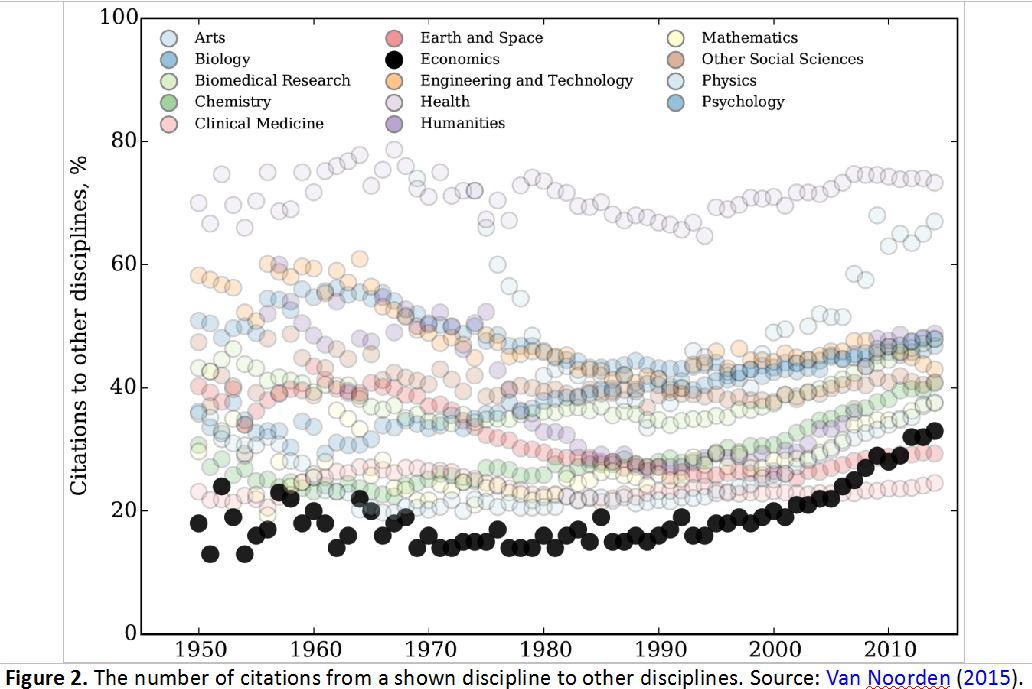
There is a little more to say about why economics is an easy target. Historically it has been very insular, and in this respect quite unlike other social sciences. I have already discussed the paper by Haldane and Turrell in the OXREP Rebuilding Macroeconomic Theory volume on Agent Based Models, but I did not have space to show an interesting chart from the introduction to that paper.


It tracks citations in papers to those in other disciplines. Until around 2000, there was no doubt which was the most insular discipline: economics. This is no surprise to me and I suspect most social scientists.

The paper does not explore the reasons why economics is so self-referential: their aim is simply to suggest that it needs to look to other disciplines to see what methods they use. Here I want to sketch why I think mainstream economics (and here the qualification mainstream is required) is so insular.

I once gave a lecture course on the methodology of economics, and in one lecture I used a large blackboard to describe how nearly all economics can be derived from the basic axioms of rational choice. For example the modern macroeconomics of consumption is just the choice between buying apples or pears transformed to the choice between consumption at different times. In that sense economic theory is like an immense tree, where every branch deductively builds on this core. Sometimes large branches grow by adding new elements, like asymmetric information, which then becomes part of the tree and can be used by other branches. This deductive tree of economic theory did not grow all by itself: its growth was and is influenced by the real world problems it wanted to address.

In using the idea of explaining decisions by optimising welfare under constraints economists have created a whole series of widely applicable tools. Economists naturally think about opportunity costs, adverse selection, moral hazard, incentives etc. There is something distinctive about thinking like an economist. To say, as Tom Clark does here, that sometimes this is just formalising common knowledge may be true (see also Cahal Moran here), but in many cases it is not. Try persuading someone who has invested in what is now a sub-optimal project about sunk costs.

This body of theory includes the neoclassical economics that heterodox economists and others love to hate, but it also includes game theory that has applications well beyond economics, and more. In my first year of studying economics I was told in some lectures that this whole endeavour was a huge ideologically driven misstep, but I began to see it differently after reading this famous 1963 paper by Arrow. It shows why (asymmetric) uncertainty in the health service means that the standard competitive model just cannot work for medical care. That may be obvious to us in the UK but it appears otherwise to many in the US. To be fair Clark also acknowledges that this economic theory has produced positive successes: he mentions auction theory but there are many more.

As to ideology, if you want an effective critique of neoliberalism you have to use economics (see, for example Colin Crouch’s book on neoliberalism or this by Dani Rodrik). So many critiques of economics use a kind of bastardised version that insists that workers are always paid their marginal products that the political right also employs. But monopoly and monopsony power are also part of the deductive tree. A paper I like to refer to in this context is by Piketty, Saez and Stantcheva (discussed here) which uses a simple bargaining model to show how cutting the top rate of tax can increase pre-tax CEO pay.

There is nothing like this deductive tree in other social sciences, and I think it at least partly explains why economics used to be so insular. As non-economists academics seemed to add little to building on this theory, there seemed little point in collaborating or even citing them. But, from the point of view of other disciplines, it was worse than that. Economics could also be imperialistic. Its methods, both theoretical and empirical, could be applied to other fields (with varying degrees of success): here is David Hendry applying his econometric methods to climate change, for example. So not only did economists not talk much to other social sciences, they trod on toes as well.

But although there may still be important branches to be added [2], the limitations of what you can do with a few axioms about rational choice have led in recent years to economics becoming much more empirical, and much less tied to this deductive theory. (See the article by Noah Smith which began this post. Unfortunately in my view an exception to this trend so far is macroeconomics.). We can see this in the citations data above, and the most obvious manifestation is behavioural economics. But a more immediate example of a data rather than theory based idea is the gravity model in international trade, which lies at the heart of why Brexit is such a bad idea. It is irony indeed that just at the point at which we have all these articles attacking economics, a large number of people who believe the UK is committing a large act of self harm are seeing the virtue of just one small part of what economists do.

Having said all this, I think there is an unfortunate hangover from this insularity. As a discipline economics shows little interest in communicating its core knowledge to others [3]. This can be true both within academia and with the outside world. Within academia publishing in top economics journals still has far higher status than top journals in other disciplines. When it comes to policy and the public, there is a belief among many that when either requires our wisdom, they will seek out the best of us for advice. In part this epidemic of articles about the failings of economics reflects this communication failure. More importantly, both Brexit and Trump should be a wake up call that economists as a collective has to get better at communicating the core insights of economics.

[1] There are of course more underlying problems behind the UK productivity crisis beyond the negative shocks of austerity and Brexit. But economists overwhelmingly argue for more R&D spending and more public investment. In short if you want someone to blame for why the UK economy is currently in such a dire state, blame those who have ignored the advice of economists.

[2] Most of the good criticisms that I see of economics amount to requests to add to the tree. But economics is so rich that most things are possible. In part (but only in part) what is done follows the money: you will find it relatively easy to get money for work on free trade compared to work on rent seeking. To blame economists for that is just bad economics. As economists found out after the financial crisis, they had many tools to understand what had happened, but had just not applied them before the crisis.   

[3] I say as a discipline because I mean economists as a collective, not as individuals. There is no equivalent institutional infrastructure in economics to that built by the hard sciences. Of course many individual economists do their best, but there are also others who ignore the consensus to plug their own personal ideas or to further some political or ideological cause.


Friday, 27 May 2016

Bonus culture

Diane Coyle has an excellent article in the FT about an apparent puzzle. Why do executives get incentive bonuses (extra pay on meeting some target), but most workers do not? Her article is based around a classic paper by Bengt Holmstrom and Paul Milgrom. Their basic argument is that incentive pay linked to specific targets works (it increases effort) when tasks are simple and effort can be easily measured. However if tasks are complex, and only some aspects of performance can be accurately measured, incentive pay can distort the allocation of effort between those tasks, leading to undesirable outcomes. As Diane says “pay structures not only incentivise effort and direct risk-taking, they also determine the worker’s allocation of effort between different tasks.”

So target related bonuses make sense for workers conducting simple tasks where effort can be easily measured, but are a bad idea for workers undertaking complex tasks where only some aspects of performance can be measured. To quote Diane:
“Indeed, the best arrangement would seem to be the opposite of the pattern we observe now. Corporate executives and senior bankers doing complex jobs involving many impossible-to-monitor activities are the last people who ought to be paid via an incentive scheme; while bonuses for fast-food workers or shop-floor employees make more sense.”
The implication she draws is straightforward: the bonus culture for corporate executives and senior bankers should end. But this leaves us with a puzzle: why did this bonus culture arise in the first place? Perhaps bonuses created something beneficial that we are missing.

Here is a simple conjecture, based on another paper by Piketty, Saez and Stantcheva which I discussed here. They note that increases in executive pay are strongly correlated with reductions in the top rate of income tax. Their explanation notes that executive pay is the result of bargaining between the executive and the firm. The executive has a lot of bargaining power (what successful firm wants their CEO to quit), but whether they choose to use it depends on the reward from doing so. If top tax rates are low, the rewards are high.

The executive still has to convince their firm to pay them more. What better way to do this than to suggest they get paid a lot more only if the company is successful. In the climate of the 1980s and 1990s in the UK and US (when the income share of the 1% took off) that argument would have seemed pretty convincing. My conjecture therefore is that bonus pay became endemic among executives and senior bankers not because it was more efficient for the firm, but because it was a useful tool in a bargaining game. [1]

This argument completely reinforces Diane’s conclusion. Executive bonuses are a way for senior management to extract rent from their firms, which is a quick way of saying that these high salaries redistribute money from everyone else to themselves. A consequence was that they reduced efficiency by diverting the executive’s attention to just hitting specific targets. One final thought, as we in the UK are obsessed with Brexit right now. It was the EU that passed laws limiting bonuses in the financial sector, and it was George Osborne that spent the UK public’s money trying to stop that law coming into effect.

[1] Bonuses can play a useful role in small firms where revenues are volatile, as Chris Dillow notes. That argument hardly applies to the CEO of a large multinational.  

Friday, 22 August 2014

Types of unemployment

For economists

This post completes a discussion of a new paper by Pascal Michaillat and Emmanuel Saez. My earlier post outlined their initial model that just had a goods market with yeoman farmers, but with search costs in finding goods to consume. Here I want to look at their main model where there are firms, and a labour market as well as a goods market.

The labour market has an identical search structure to the goods market. We can move straight to the equivalent diagram to the one I reproduced in my previous post.


The firm needs ‘recruiters’ to hire productive workers (n). As labour market tightness (theta) increases, any vacancy is less likely to result in a hire. In the yeoman farmer model capacity k was exogenous. Here it is endogenous, and linked to n using a simple production function. Labour demand is given by profit maximisation. Employing one extra producer has a cost that depends on the real wage w, but also the cost of recruiting and hence labour market tightness theta. They generate revenue equal to the sales they enable, but only because by raising capacity they make a visit more likely to result in a sale. The difference between a firm’s output (y) and their capacity (k, now given by the production function and n) the paper calls ‘idle time’ for workers. As y<k, workers are always idle some of the time. So, crucially, profit maximisation determines capacity, not output. Output is influenced by capacity, but it is also influenced by aggregate demand.

Now consider an increase in the aggregate demand for goods, caused by - for example - a reduction in the price level. That results in more visits to producers, which will lead to more sales (trades=output). This leads firms to want to increase their capacity, which means increasing employment. (More employment reduces x, but the net effect of an increase in aggregate demand is higher x, so workers’ idle time falls.) This increases labour market tightness and reduces unemployment.

Here I think the discussion in the paper (bottom of page 28) might be a little confusing. It notes that in fixed price models like Barro and Grossman, in a regime that is goods demand constrained, an increase in demand will raise employment by exactly the amount required to meet demand (providing we stay within that regime). It then says that in their model the mechanism is different, because aggregate demand determines idle time, which in turn affects labour demand and hence unemployment. I would prefer to put it differently. In this model a firm responds to an increase in aggregate demand in two ways: by increasing employment (as in fix price models) but also by reducing worker idle time. The advantage of adding the second mechanism is that, as aggregate demand varies, it generates pro-cyclical movements in productivity. (There are of course other means of doing this, like employment adjustment costs.)

There are additional interesting comparisons with this earlier fixed price literature. In this model unemployment can be of three ‘types’: classical (w too high), Keynesian (aggregate demand too low), but also frictional. This model can also generate four ‘regimes’, each corresponding to some combination of real wage and price. However, unlike the fixed price models, these regimes are all determined by the same set of equations (there are no discontinuities), and are relative to the efficient level of goods and labour market tightness.

For me, this is one of the neat aspects of the model. We do not need to ask whether demand is greater or less than ‘supply’, but equally we do not presume that output is always independent of ‘supply’. Instead output is always less than capacity, just as unemployment (workers actually looking for work) is always positive. One way to think about this is that actual output is always a combination of ‘supply’ (capacity) and demand (visits), a combination determined by the matching function. This is what matching allows you to do. What this also means is that increases in supply in either the goods market (technical progress) or labour market will increase both output and employment, even if prices remain fixed. In Keynesian models additional supply will only increase output if something boosts aggregate demand, but that is not the case here. However, if the equilibrium was efficient before this supply shock, output will be inefficiently low after it unless something happens to increase aggregate demand (e.g. prices fall).

The aggregate demand framework in the model, borrowed from fixed price models, is rather old fashioned, but there is no barrier to replacing it with a more modern dynamic analysis of a New Keynesian type. Indeed, this is exactly what the authors have done in a companion paper

The paper ends with an empirical analysis of the sources of fluctuations in unemployment. It suggests that unemployment fluctuations are driven mostly by aggregate demand shocks. (This is also well covered in their Vox post.) This ties in with the message of Michaillat’s earlier AER paper, where he argued that in recessions, frictional unemployment is low and most unemployment is caused by depressed labour demand. What this paper adds is a goods market where changes in aggregate demand can be the source of depressed labour demand, and therefore movements in unemployment.    


Saturday, 16 August 2014

Search in the goods market?

For economists

Imagine an economy made up of independent producers, who individually produce some good. Producers each have a fixed ‘capacity’ k of the output they produce. Producers are also consumers, but cannot consume their own good. Instead they search for other goods by visiting other producers. Agents as consumers have a certain demand for goods, which will depend on how much of their own good they sell, as well as some initial endowment of money and the price of goods in terms of money.

Traditionally we ignore the costs for consumers of visiting producers, and we assume that any visit will result in a purchase. As a result, for a given price level, we can have three situations. In the first, aggregate consumption demand is below aggregate capacity (the sum of all k), and producers end up with either unsold goods or idle capacity. In the second, aggregate demand is equal to supply. In the third, aggregate demand is above capacity. In this case we must have rationing of goods.

In this framework output is not always determined by aggregate demand, but only up to some limit. This is not how macroeconomic models typically work - they generally assume output is always equal to aggregate demand. The way New Keynesian models justify this is by assuming that producers can produce above ‘capacity’ (or that they prefer to always have some spare capacity), and that they will be happy to produce above capacity at a given price because they are monopolistic.

A recent paper by Pascal Michaillat and Emmanuel Saez applies the framework of search to the goods market. First, each visit by the consumer is costly (visiting costs) - some of the produced good is ‘lost’ (does not increase utility) as a result. So output (y, the sum of all trades) is greater than consumption (c) because of these visiting costs. Second, a visit may not lead to a trade. Whether it does depends on a matching function, which depends on the ‘tightness’ of the goods market = x, defined as the ratio of visits to capacity. Here is a diagram from their paper.


The consumption demand line is downward sloping, because a larger number of visits raises the effective price of the produced good. The output line is upward sloping, because more visits result in more trade, but the matching function is such that it gets steeper with more visits. However if visiting costs are linear in visits, that implies what the paper calls ‘consumption supply’ has this rather odd shape. (Think about the constant capital line in the Ramsey model.) For a given price, the intersection of the consumption demand and supply lines defines equilibrium tightness. Perhaps a simpler way of putting it is that consumers plan the number of visits they need to make given their consumption demand schedule.

Now shift the consumption demand line outwards, by reducing the price. (In a New Keynesian framework, think about the price as the real interest rate.) The line pivots about the xm point, but output always stays below k. As tightness (number of visits) increases, more resources are used up in failed endeavours to make a trade, and consumption starts falling. Output is always ‘demand determined’, and there is no rationing.

It is still possible to think about different ‘regimes’, because the efficient level of tightness is where consumption is at a maximum. If tightness is below that point, we can say that demand is too low (the price level is too high), and vice versa.

Those familiar with matching models in the labour market will see the connections. Visits are equivalent to vacancies, for example. The key question is whether this transposition to the goods market makes sense, and what it achieves. To quote the authors: “casual observation suggests that a significant share of visits do not generate a trade. At a restaurant, a consumer sometimes need[s] to walk away because no tables are available or the queue is too long.” (What is it with economists and restaurants?!) We could add that this rarely means that consumption is rationed - instead the consumer attempts to make a similar trade at another restaurant. However this does have an opportunity cost, which this model captures.

In a subsequent post, I will look at their full model which has separate goods and labour markets, and the various types of unemployment that this can generate. Those that cannot wait can read their own account on Vox.