Winner of the New Statesman SPERI Prize in Political Economy 2016


Showing posts with label Haldane. Show all posts

Wednesday, 2 May 2018

Why was economics so insular?


Noah Smith has a good piece on what seems like the never ending stream of popular articles in the UK slagging off economics (or economists). Here I outlined three potential reasons for this epidemic: people do not understand unconditional macro forecasts, politicians from the right do not like economists spoiling their pet schemes (e.g. Brexit), and many heterodox economists from the left wage endless war against the mainstream. All these complaints get airtime when the economy is bad.

The UK economy, right now, is perhaps in a worse state than at any time in the last eighty years. As John Lewis shows in this Bank blog, productivity growth has perhaps never been as bad as it is now: we have to go back to before 1800 to find anything comparable.


The natural reaction when the economy is bad is to criticise economists. That was what happened after the Global Financial Crisis, with some justification. But what is happening in the UK right now is mainly a result of first austerity and then Brexit. As I explained in detail in my earlier post, if we had followed the advice of mainstream economics austerity and Brexit would not have happened. [1] I have as yet not read a single critique of economics that has pointed that fact out, which if you think about it is extraordinary.

There is a little more to say about why economics is an easy target. Historically it has been very insular, and in this respect quite unlike other social sciences. I have already discussed the paper by Haldane and Turrell in the OXREP Rebuilding Macroeconomic Theory volume on Agent Based Models, but I did not have space to show an interesting chart from the introduction to that paper.
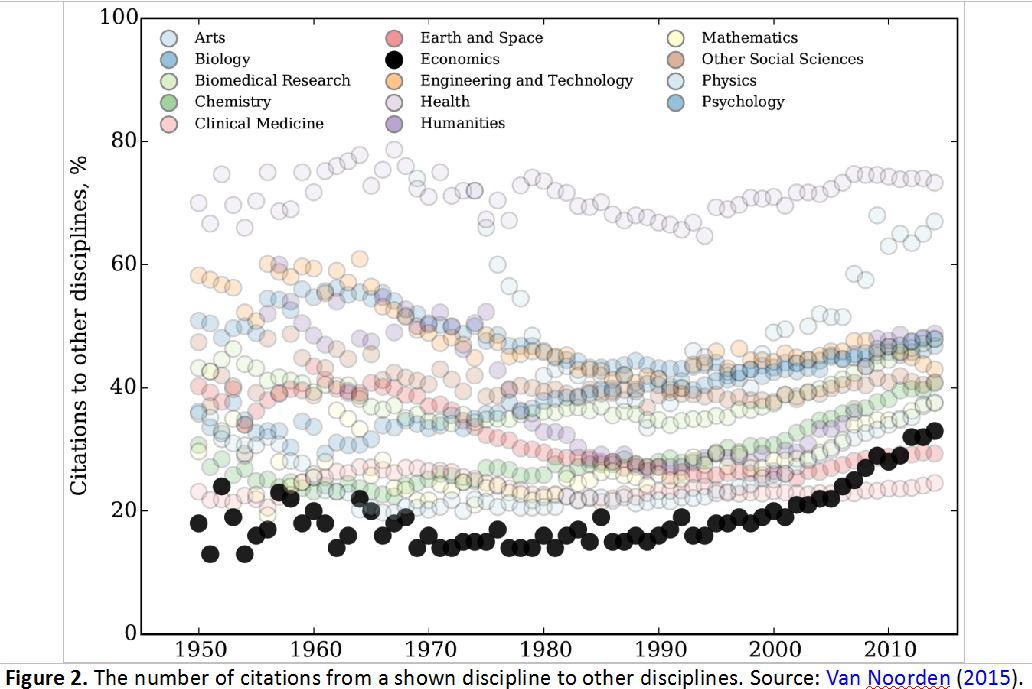

It tracks citations in papers to those in other disciplines. Until around 2000, there was no doubt which was the most insular discipline: economics. This is no surprise to me and I suspect most social scientists.

The paper does not explore the reasons why economics is so self-referential: their aim is simply to suggest that it needs to look to other disciplines to see what methods they use. Here I want to sketch why I think mainstream economics (and here the qualification mainstream is required) is so insular.

I once gave a lecture course on the methodology of economics, and in one lecture I used a large blackboard to describe how nearly all economics can be derived from the basic axioms of rational choice. For example the modern macroeconomics of consumption is just the choice between buying apples or pears transformed to the choice between consumption at different times. In that sense economic theory is like an immense tree, where every branch deductively builds on this core. Sometimes large branches grow by adding new elements, like asymmetric information, which then becomes part of the tree and can be used by other branches. This deductive tree of economic theory did not grow all by itself: its growth was and is influenced by the real world problems it wanted to address.

In using the idea of explaining decisions by optimising welfare under constraints economists have created a whole series of widely applicable tools. Economists naturally think about opportunity costs, adverse selection, moral hazard, incentives etc. There is something distinctive about thinking like an economist. To say, as Tom Clark does here, that sometimes this is just formalising common knowledge may be true (see also Cahal Moran here), but in many cases it is not. Try persuading someone who has invested in what is now a sub-optimal project about sunk costs.

This body of theory includes the neoclassical economics that heterodox economists and others love to hate, but it also includes game theory that has applications well beyond economics, and more. In my first year of studying economics I was told in some lectures that this whole endeavour was a huge ideologically driven misstep, but I began to see it differently after reading this famous 1963 paper by Arrow. It shows why (asymmetric) uncertainty in the health service means that the standard competitive model just cannot work for medical care. That may be obvious to us in the UK but it appears otherwise to many in the US. To be fair Clark also acknowledges that this economic theory has produced positive successes: he mentions auction theory but there are many more.

As to ideology, if you want an effective critique of neoliberalism you have to use economics (see, for example Colin Crouch’s book on neoliberalism or this by Dani Rodrik). So many critiques of economics use a kind of bastardised version that insists that workers are always paid their marginal products that the political right also employs. But monopoly and monopsony power are also part of the deductive tree. A paper I like to refer to in this context is by Piketty, Saez and Stantcheva (discussed here) which uses a simple bargaining model to show how cutting the top rate of tax can increase pre-tax CEO pay.

There is nothing like this deductive tree in other social sciences, and I think it at least partly explains why economics used to be so insular. As non-economists academics seemed to add little to building on this theory, there seemed little point in collaborating or even citing them. But, from the point of view of other disciplines, it was worse than that. Economics could also be imperialistic. Its methods, both theoretical and empirical, could be applied to other fields (with varying degrees of success): here is David Hendry applying his econometric methods to climate change, for example. So not only did economists not talk much to other social sciences, they trod on toes as well.

But although there may still be important branches to be added [2], the limitations of what you can do with a few axioms about rational choice have led in recent years to economics becoming much more empirical, and much less tied to this deductive theory. (See the article by Noah Smith which began this post. Unfortunately in my view an exception to this trend so far is macroeconomics.). We can see this in the citations data above, and the most obvious manifestation is behavioural economics. But a more immediate example of a data rather than theory based idea is the gravity model in international trade, which lies at the heart of why Brexit is such a bad idea. It is irony indeed that just at the point at which we have all these articles attacking economics, a large number of people who believe the UK is committing a large act of self harm are seeing the virtue of just one small part of what economists do.

Having said all this, I think there is an unfortunate hangover from this insularity. As a discipline economics shows little interest in communicating its core knowledge to others [3]. This can be true both within academia and with the outside world. Within academia publishing in top economics journals still has far higher status than top journals in other disciplines. When it comes to policy and the public, there is a belief among many that when either requires our wisdom, they will seek out the best of us for advice. In part this epidemic of articles about the failings of economics reflects this communication failure. More importantly, both Brexit and Trump should be a wake up call that economists as a collective has to get better at communicating the core insights of economics.

[1] There are of course more underlying problems behind the UK productivity crisis beyond the negative shocks of austerity and Brexit. But economists overwhelmingly argue for more R&D spending and more public investment. In short if you want someone to blame for why the UK economy is currently in such a dire state, blame those who have ignored the advice of economists.

[2] Most of the good criticisms that I see of economics amount to requests to add to the tree. But economics is so rich that most things are possible. In part (but only in part) what is done follows the money: you will find it relatively easy to get money for work on free trade compared to work on rent seeking. To blame economists for that is just bad economics. As economists found out after the financial crisis, they had many tools to understand what had happened, but had just not applied them before the crisis.   

[3] I say as a discipline because I mean economists as a collective, not as individuals. There is no equivalent institutional infrastructure in economics to that built by the hard sciences. Of course many individual economists do their best, but there are also others who ignore the consensus to plug their own personal ideas or to further some political or ideological cause.


Saturday, 3 February 2018

Large models, small models and Brexit

Non-economists with no interest in modelling techniques can skip to paragraph starting 'How is this all related to Brexit'.

I promised to look at some of the other papers in the OxREP volume “Rebuilding macroeconomic theory” besides my own, but as usual other things - including Brexit - got in the way. In this post I want to talk about the paper by Haldane and Turrell, which is about Agent Based Models, or ABMs. Right at the end of this post, however, I will come back to Brexit.

As a result of the microfoundations hegemony, any paper talking about a different modelling strategy often feels it must start by describing some drawbacks of that hegemony, and this paper is no exception. I might talk about that some other time, but instead I want to recommend what I think is one of the most realistic discussions of what ABM can or cannot do I have read.

As you might guess from the name, ABMs model the economy as a collection of a large number of different agents, each of which behaves in a specified way. The authors generalise the idea of a choice between internal and external consistency that I talk about in my paper to also include a degree of heterogeneity.


As you can see, ABMs are all about allowing as much heterogeneity as you wish. This is not to say that other methods cannot do heterogeneity (they can), but ABMs major in this dimension, and in practice often keep the behaviour of agents relatively simple compared to a DSGE. (A slight quibble: I would argue that as DSGEs are internally consistent by definition, the orange square representing them should be a slimmer and perhaps taller rectangle.) ABMs (within the bounds of tractability) owe no allegiance to any school of thought: the paper has a nice table of the many different types of consumption function used in a range of ABM studies.

As the macroeconomy is indeed made up of many different types of agents who may be doing different things, and whose interaction may produce unexpected results, it seems like ABMs can only be a good thing. But this additional freedom brings a large cost. Because, and unlike some hard sciences, there is a large amount of uncertainty about how people actually behave, we cannot treat any model as a black box, the output from which has to be accepted without question. No civil servant or central bank economist can go to politicians or governors and simply say it is what the model said.

Exactly the same problem can arise with SEMs, simply because of their complexity or disaggregation. It could also arise from a complex DSGE. The first question any economist asks when seeing an output from any large and complex model is does the result make sense given the smaller theoretical models they carry around in their head. It is why I proposed for SEMs the process I called theoretical deconstruction, where model properties were either reduced to familiar results from simpler models, or show the limitations of those simpler models. Again, as the paper notes, a similar process needs to, and in some cases has, happened with results from ABMs.

How is this all related to Brexit? The results showing how different degrees of Brexit would do the economy damage to different extents that I talked about in my last post were produced by trade theory’s equivalent of ABMs, called computable general equilibrium (CGE) models. These allow for considerable heterogeneity (across sectors and countries) in modelling trade. As Chris Giles recounts in this excellent piece, the model is more complex than anything the Treasury had before Brexit, and was built specifically to help with Brexit.

As Chris writes
“It must have come as a bit of a shock to government economists that the moment some results of this new model were leaked this week, ministers rushed to deny the usefulness of the tools they commissioned. Such models are “always wrong”, declared Steve Baker, a junior Brexit minister, on Tuesday.”

As I note in a postscript to my last post, he went further on Thursday to suggest that civil servants had deliberately cooked the model to sabotage Brexit.

How do we know that this didn’t happen, apart from the implausibility that so many civil servants could concoct such a conspiracy. Precisely because in this case the results from a highly disaggregated model broadly agrees with most other studies, and also common sense: the more difficult you make trade, the less there will be and the more costly that will be for UK output. Chris ends with some words that should be sent to every journalist in the country.
“Ministers now have a choice. They can opt for an honest Brexit in which they argue in public that people should pay an economic price for their policies. Or they can opt for a dishonest Brexit, pretending they have a secret plan for economic nirvana and trashing their own internal economic evidence. Ministers’ initial reaction in disowning the analysis suggests deception is the government’s central Brexit strategy. People talk about a crisis in economics. After this episode, it is the crisis in politics that should really concern us.”


Thursday, 21 September 2017

Productivity and monetary policy

The Bank are warning of imminent rises in interest rates. As Chris Giles points out, we have been here before, and before that, but that shouldn’t mean we should dismiss this talk, because one day it will happen. [1] They (the MPC) certainly sound serious. But why when current growth is so slow are they even contemplating it? Here is a clue from Mark Carney’s latest speech (my italics).
“On the supply side, the process of leaving the EU is beginning to be felt. Brexit-related uncertainties are causing some companies to delay decisions about building capacity and entering new markets. Prolonged low investment will restrain growth in the capital stock and increases in productivity. Indeed, if the MPC’s current forecast comes to pass, the level of investment in 2020 is expected to be 20% below the level which the MPC had projected just before the referendum. Net migration has also fallen by 25% since the Referendum.

As a result of these factors and the general weakness in UK productivity growth since the global financial crisis, the supply capacity of the UK economy is likely to expand at only modest rates in coming years.”

When people, like me, say how can the Bank be thinking of raising rates when demand is so weak, the response from the Bank would be that supply has been at least as weak.

This pessimism about the supply side comes straight from the data. If I hear people talking about the UK being a ‘strong economy’, I know they either have not seen this chart or are just lying.

UK Output per hour, whole economy (ONS)
The red line is a trend that pretty well matches the trend in the data until the end of 2007, with the amount you can produce with an hours worth of labour increasing by 2.2% a year. Since the global financial crisis (GFC) there has been almost no growth at all. If you want to know the main reason real wages have stopped increasing, this is it. [2]

I hear some people say this is just oil and financial services. It is not, as this table from a recent Andy Haldane speech shows.


Start at the bottom: total average growth has been non-existent since the crisis. The rest of the table looks at the contribution of each sector to that total. To see what productivity growth would be excluding financial services, just add that figure to the total: 1.8% 1998-2008, 0.4% 2009-2016. That table makes it clear that the productivity crisis is economy wide.

It is worth looking at aggregate productivity since the GFC period in more detail (same data). I often hear people say the productivity slowdown started before the GFC. From the chart below, it clearly did not. (We have just seen the tenth anniversary of Northern Rock going bust, and the UK productivity slowdown started shortly after that event.)


We could describe this data as five phases. 1) Productivity in the recession fell, as it often does in a recession for various reasons. 2) As the economy begins to grow again, so did productivity growth. 3) As it becomes clear, in 2011, that the ‘recovery’ is going to be very weak because of austerity, productivity growth stops growing. 4) By the end of 2013, with stronger growth under way (although still no catch up to previous trends, so not a true recovery) productivity starts growing again, although rather slowly. 5) Since the 2015 election, with the prospect and then the reality of Brexit, even that modest growth disappears. (My data does not include 2017Q2, which saw a very slight fall.) I could shorten the description as follows: recession, modest optimism, pessimism, even more modest optimism, uncertainty.

That is my gloss on the numbers, but I’ve done it to make a point. Productivity growth invariably requires an investment of some kind. It may not be physical investment, but just training someone up to be able to use some new software. Whether a firm incurs that cost will depend, in part, on their expectations about the future. There is a regrettable tendency in macro (I blame RBC theory) to treat productivity growth as manna from heaven. But the idea that potential improvements in technology stopped after the GFC, and just in the UK, is simply ridiculous. The problem is that firms are not investing in new technology. What I call the ‘innovations gap’ has emerged in the UK because of weak growth and the consequent pessimistic expectations of most firms. [3]

The idea that the economy could get itself in a low growth expectations trap is increasingly being put forward by economists: here is George Evans, for example. The UK has got itself into that trap because on the two occasions that a recovery of sorts appeared to be under way, the economy has been hit with terrible policy errors (austerity and Brexit). But the idea that UK firms are incapable of upgrading their production techniques is nonsense. They will do so initially if they can be confident that the demand for their products will increase, or subsequently when the innovation pays for itself even though demand is flat.

Which is why an increase in interest rates right now would be very bad news. It would confirm the pessimistic expectations of most firms that demand is not going to grow fast enough to make innovation worthwhile. Formally, the job of the MPC is not to worry about productivity but to control inflation. But elsewhere, where the same process may be happening to a lesser extent (the productivity slowdown is worldwide, just most acute in the UK), central banks are puzzled at why inflation just refuses to rise. 

The concept of an innovations gap is one solution to that puzzle. Expanding demand allows firms to invest in more productive techniques, and so there is less incentive to choke of demand by raising prices. I suspect in an alternative world where Brexit had not happened the Bank of England would also be puzzling over why prices were not rising. As a result, if the MPC do finally raise interest rates this year, it would be one more mistake to add to the growing list under the heading Brexit.

[1] On each occasion I also wrote a post saying that they should not raise rates, starting I think at the beginning of 2014.

[2] I discussed in earlier posts why real wages are falling by even more than output per head.

[3] Or perhaps the pessimism of the bank manager lending money to those firms. The Haldane speech shows that productivity growth has remained strong among the top, frontier companies. Why? Because these companies, given their position, will be seeing growth relative to the average, and have got to the frontier through a culture of innovation.

Friday, 13 January 2017

Miles on Haldane on Economics in Crises

Anything that says economics is in crisis always gets a lot of attention, particularly after Brexit (because economists are so pessimistic about its outcome), and Andy Haldane’s public comments were no exception. But former Monetary Policy Committee colleague David Miles has hit back, saying Haldane is wrong and economics is not in crisis. David is right, but (perhaps inevitably) he slightly overstates his case.

First an obvious point that is beyond dispute. Economics is much more than macroeconomics and finance. Look at an economics department, and you will typically find less than 20% are macroeconomists, and in some departments there can be just a single macroeconomist. Those working on labour economics, experimental economics, behavioural economics, public economics, microeconomic theory and applied microeconomics, econometric theory, industrial economics and so on would not have felt their sub-discipline was remotely challenged by the financial crisis.

David Miles is also right that economists have not found it difficult to explain the basic story of the financial crisis from the tools that they already had at their disposal. Here I will tell again a story about an ESRC seminar held at the Bank of England about whether other subjects like the physical sciences could tell economists anything useful post-crisis. It was by invitation only, Andy Haldane was there throughout, and for some reason I was there and asked to give my impressions at the end. In the background document there was a picture a bit like this.
UK Bank leverage: ratio of total assets to shareholder claims. (Source Bank of England Financial Stability Report June 2012) Added by popular request 17/1/17 [3]

I made what I hope is a correct observation. Show most economists a version of this chart just before the crisis, and they would have become very concerned. Some might have had their concern reduced by assurances and stories about how new risk management techniques made the huge increase in leverage seen in the years just before the crisis perfectly safe, but I think most would not. In particular, many macroeconomists would have said what about systemic risk?

The problem before the financial crisis was that hardly anyone looked at this data. There is one institution that surely would have looked at this like this data, and that was the Bank of England. As Peter Doyle writes:

“ .. it was not “economics” that missed the GFC, but, dare I say it (and amongst some others), the Bank of England.”

If there is a discussion of the increase in bank leverage and the consequent risks to the economy in any Inflation Reports in 2006 and 2007 I missed it. I do not think we have been given a real account of why the Bank missed what was going on: who looked at the data, who discussed it etc. I think we should know, if only for history’s sake.

What I think David Miles could have said but didn’t is that macroeconomists were at fault in taking the financial sector for granted, and therefore typically not including key finance to real interactions in their models. [1] As a result, the crisis has inspired a wave of new research that tries to make up for that, but this involves using existing ideas and applying them to macroeconomic models. There has also been new work using new techniques that has tried to look at network effects, which Andy Haldane mentions here. Whether this work could be usefully applied much more widely, as he suggests, is not yet clear, and to say that until that happens there is a crisis in economics is just silly.

The failure to forecast that consumers after the Brexit vote would reduce their savings ratio is a typical kind of forecasting error. Would they have done this anyway, and if not what about the Brexit vote and its aftermath inspired it, we will probably never know for sure. This kind of mistake happens all the time in macro forecasting, which is why comparisons to weather forecasting and Michael Fish are not really apt. [2] That is what David Miles means by saying it is a non-event.

What is hardly ever said, so I make no apologies for doing so once more, is that macroeconomic theory has in some ways ‘had a good crisis’. Basic Keynesian macroeconomic theory says you don’t worry about borrowing in a recession because interest rates will not rise, and they have not. New Keynesian theory says creating loads of new money will not lead to runaway inflation and it has not. Above all else, macroeconomic theory and most evidence said that the turn to austerity in 2010 would delay or weaken the recovery and that is exactly what happened. As Paul Krugman often says, it is quite rare for macroeconomics to be so fundamentally tested, and it passed that test. We should be talking not about a phoney crisis in economics, but why policy makers today have ignored economics, and thereby lost their citizens' the equivalent of a lot of money.

[1] In the COMPACT model I built in the early 1990s, credit conditions played an important role in consumption decisions, reflecting the work of John Muellbauer. But as I set out here, proposals to continue the model and develop further financial/real linkages were rejected by economists and the ESRC because it was not a DSGE model.

[2] Weather forecasts for the next few days are more accurate than macro forecasts, although perhaps longer term forecasts are more comparable. But more fundamentally, while the weather is a highly complex system like the economy. It is made up of physical processes that are predictable in a way human behaviour will never be. As a result, I doubt that simply having more data will have much impact on the ability to forecast the economy.

[3] Total asset are the size of the bank's balance sheet. Shareholder claims are the part of those assets that belong to shareholder, and which therefore represent a cushion that can absorb losses without the bank facing bankruptcy. So at the peak of the financial crisis, banks had over 60 times as many assets as that cushion. That makes a bank very vulnerable to loss on those assets.

Sunday, 20 September 2015

Haldane on alternatives to QE, and what he missed out

Andrew Haldane, Chief Economist at the Bank of England, gave a typically well researched and thoughtful talk recently. The main subject matter was the problem of the Zero Lower Bound (ZLB): why we may hit it much more often than we would like, and why QE is not a great instrument for dealing with it. To quote:
“QE’s effectiveness as a monetary instrument seems likely to be highly state-contingent, and hence uncertain, at least relative to interest rates. This uncertainty is not just the result of the more limited evidence base on QE than on interest rates. Rather, it is an intrinsic feature of the transmission mechanism of QE.”

In the past I have emphasised the point about lack of evidence simply because it is obvious. But as Haldane’s discussion shows, the problems are more basic than that. Some people argue that we can always get the result we want with enough QE. Yet if the central bank and the public never know how effective any amount of QE will be, then lags make it a poor instrument. It is refreshing to see a senior member of the Bank finally acknowledge its limitations.

Haldane considers two alternative ways of dealing with, or avoiding, the ZLB: a higher inflation target and getting rid of cash so that negative interest rates of whatever size become possible. The first is obviously welfare reducing, but as Eric Lonergan argues the second is likely to be as well. (See also Tony Yates.) But what is really strange about Haldane’s analysis is what is missing from his discussion.

One omission is a discussion of the possibility that targeting something other than inflation might help. The other omission is any discussion of helicopter money. There are some basic contradictions in the Bank of England’s views on helicopter money, but because central bankers tend to talk to each other I suspect they remain concealed. One argument is that helicopter money will somehow reduce confidence in the currency, but then the Bank seems happy to research getting rid of cash and imposing negative rates on money as if this is all about technicalities. [Postscript - meant to link to John Cochrane's discussion, and here is a reply by Miles Kimball.] I should have referenced  Another argument is that helicopter money will threaten the Bank’s independence because it will have to rely on government to (if necessary) recapitalise it, when at the same time the Bank has already obtained an underwriting guarantee for losses on QE. Also strange is the argument that independence will be threatened once the Bank does a 'helicopter drop' because governments will want the money for themselves, as if politicians had not noticed the amount of money being created under QE. After all Jeremy Corbyn's proposal was a response to the reality of QE, not the possibility of helicopter money.

The really ironic argument is that helicopter money is too like fiscal policy, and that there should be democratic control over fiscal policy. This is what central bankers mean when they talk about blurring the lines between monetary and fiscal policy. The argument is ironic because I am sure that if you actually asked most people which they would prefer - being charged to hold money, 4% average inflation, or occasionally getting a cheque from the Bank - the answer would be emphatic. So we rule out helicopter money because its undemocratic, but we rule out a discussion of helicopter money because ordinary people might like the idea.

There is also an element of hypocrisy. It is sometimes argued that helicopter money is unnecessary because it has a very similar impact to conventional fiscal policy. This is true, but it deliberately ignores the fact that governments around the world have gone for fiscal contraction because of worries about the immediate prospects for debt. It is not as if the possibility of helicopter money restricts the abilities of governments in any way. If governments undertake fiscal stimulus in a recession such that helicopter money is no longer necessary, it will not happen.

So it is good that some people at the Bank are thinking about alternatives to QE, which is a lousy instrument with unfortunate, and potentially permanent, distributional consequences. It is a shame that the Bank is not even acknowledging that there is a straightforward and cost free solution to this problem. My last two posts have involved defending central bank independence, but with independence comes a responsibility not to exclude discussion of particular policy options simply because they break some kind of taboo.      

Thursday, 27 August 2015

The day macroeconomics changed

It is of course ludicrous, but who cares. The day of the Boston Fed conference in 1978 is fast taking on a symbolic significance. It is the day that Lucas and Sargent changed how macroeconomics was done. Or, if you are Paul Romer, it is the day that the old guard spurned the ideas of the newcomers, and ensured we had a New Classical revolution in macro rather than a New Classical evolution. Or if you are Ray Fair (HT Mark Thoma), who was at the conference, it is the day that macroeconomics started to go wrong.

Ray Fair is a bit of a hero of mine. When I left the National Institute to become a formal academic, I had the goal (with the essential help of two excellent and courageous colleagues) of constructing a new econometric model of the UK economy, which would incorporate the latest theory: in essence, it would be New Keynesian, but with additional features like allowing variable credit conditions to influence consumption. Unlike a DSGE it would as far as possible involve econometric estimation. I had previously worked with the Treasury’s model, and then set up what is now NIGEM at the National Institute by adapting a global model used by the Treasury, and finally I had been in charge of developing the Institute’s domestic model. But creating a new model from scratch within two years was something else, and although the academics on the ESRC board gave me the money to do it, I could sense that some of them thought it could not be done. In believing (correctly) that it could, Ray Fair was one of the people who inspired me.

I agree with Ray Fair that what he calls Cowles Commission (CC) type models, and I call Structural Econometric Model (SEM) type models, together with the single equation econometric estimation that lies behind them, still have a lot to offer, and that academic macro should not have turned its back on them. Having spent the last fifteen years working with DSGE models, I am more positive about their role than Fair is. Unlike Fair, I wantmore bells and whistles on DSGE models”. I also disagree about rational expectations: the UK model I built had rational expectations in all the key relationships.

Three years ago, when Andy Haldane suggested that DSGE models were partly to blame for the financial crisis, I wrote a post that was critical of Haldane. What I thought then, and continue to believe, is that the Bank had the information and resources to know what was happening to bank leverage, and it should not be using DSGE models as an excuse for not being more public about their concerns at the time.

However, if we broaden this out from the Bank to the wider academic community, I think he has a legitimate point. I have talked before about the work that Carroll and Muellbauer have done which shows that you have to think about credit conditions if you want to explain the pre-crisis time series for UK or US consumption. DSGE models could avoid this problem, but more traditional structural econometric (aka CC) models would find it harder to do so. So perhaps if academic macro had given greater priority to explaining these time series, it would have been better prepared for understanding the impact of the financial crisis.

What about the claim that only internally consistent DSGE models can give reliable policy advice? For another project, I have been rereading an AEJ Macro paper written in 2008 by Chari et al, where they argue that New Keynesian models are not yet useful for policy analysis because they are not properly microfounded. They write “One tradition, which we prefer, is to keep the model very simple, keep the number of parameters small and well-motivated by micro facts, and put up with the reality that such a model neither can nor should fit most aspects of the data. Such a model can still be very useful in clarifying how to think about policy.” That is where you end up if you take a purist view about internal consistency, the Lucas critique and all that. It in essence amounts to the following approach: if I cannot understand something, it is best to assume it does not exist.


Monday, 27 July 2015

Should central bankers stick to talking about monetary policy?

Few disagree that the recent remarks on corporate governance and investment made by Andy Haldane (Chief Economist at the Bank of England) are interesting, and that if they start a debate on short-termism that would be a good thing. As Will Hutton notes, Hillary Clinton has been saying similar things in the US. The problem Tony Yates has (and which Duncan Weldon, the interviewer, alluded to in his follow-up question) is that this is not obviously part of the monetary policy remit.

Haldane gave an answer to that, which Tony correctly points out is somewhat strained. Perhaps I could illustrate the same issue by going down a better route that Haldane could have used. He could say that the causes of low UK productivity growth are clearly under his remit, and one factor in this that few dispute is low investment. If he was then asked by an interviewer what might be the fundamental cause of this low investment, Tony would argue that his reply should be that he couldn’t really comment, because some of those reasons might be too political.

I have in the past said very similar things to Tony when talking about the ECB, and their frequent advice to policymakers on fiscal rectitude and structural reforms. My main complaint is that the advice is wrong, and I puzzle over “how the ECB can continue to encourage governments to take fiscal or other actions that their own models tell them will reduce output and inflation at a time when the ECB is failing so miserably to control both.” But I have also said that in situations where fiscal actions have no impact on the ability of monetary policy to do its job (which is not the case at the moment), comments on fiscal policy are “crossing a line which it is very dangerous to cross”.

However I am beginning to have second thoughts about my own and Tony’s views on this. First, it all seems a bit British in tone. Tony worked at the Bank, and I have been involved with both the Bank and Treasury on and off, so we are both steeped in a British culture of secrecy. I do not think either of us are suggesting that senior Bank officials should never give advice to politicians, so what are the virtues of keeping this private? In trying to analyse how policy was made in 2010, it is useful to have a pretty good idea of what advice the Bank’s governor gave politicians because of what he said in public, rather than having to guess. (Of course private advice to politicians is never truly private, but this hardly helps, because with secrecy it allows politicians to hint that advice of a particular kind was given when it might not have been.)

The issues of MPC external member selection that Tony worries about are real enough, but perhaps that illustrates problems with the selection process. My guess is that the Treasury would be inhibited about choosing an MPC member who had previously been strongly critical of the government on other issues anyway. As I said my main complaint about the ECB is the nature and context of the advice they give, and at least by making it public we know about this problem.

It is often said that central bankers need to keep quiet about policy matters that are not within their remit as part of an implicit quid pro quo with politicians, so that politicians will refrain from making public their views about monetary policy. Putting aside the fact that the ECB never got this memo, I wonder whether this is just a fiction so that politicians can inhibit central bankers from saying things politicians might find awkward (like fiscal austerity is making our life difficult). In a country like the UK with a well established independent central bank, it is not that clear what the central bank is getting out of this quid pro quo. And if it stops someone with the wide ranging vision of Haldane from raising issues just because they could be deemed political, you have to wonder whether this mutual public inhibition serves the social good.


Wednesday, 27 May 2015

UK monetary policy is too complacent

Economists at the Bank of England and members of the Monetary Policy Committee spend a huge amount of time poring over the details of our current macroeconomic position. There is a danger in all this. The danger is a version of not ‘seeing the wood for the trees’. By focusing in great detail about what you see as the most likely scenario for the UK economy, you begin to think that something similar is the only possible future, and therefore give too little weight to the risks that this scenario is seriously wrong. That is the only way I can explain to myself why the MPC have not yet cut interest rates below 0.5%

The Bank’s central projection is that current deflation is a temporary phenomenon. We all know about oil prices, but this projection also involves a view that core inflation will rise from its current level of 0.8%. Today’s low core inflation may have a lot to do with an appreciation of sterling, which should be temporary. In addition actual deflation means that real wages have begun to rise, which should provide a boost to consumption. This could be enough to offset the impact of any renewed austerity, the impact of sterling’s recent appreciation on the demand for UK produced goods, and any delays in investment caused by the possibility of the UK leaving the EU. I could be convinced that this is the most likely outcome, and that inflation will be back at 2% within two years.

But good policy is not about just focusing on the most likely outcome. It is also about allowing for risks. So step back from the trees and just look at the wood. The most basic thing we know about the UK economy is that output is now something like 15% below where it should be if pre-recession trends had continued. For the UK that pre-recession trend had been remarkably stable. There may be reasons why the last recession should be so different from all other pre-war recessions, but we all know the dangers of convincing ourselves that this time is different. So it is possible that the scope for additional expansion is large. This is real uncertainty, but it is also one sided uncertainty. No one is seriously suggesting the economy is running at 5% above trend, let alone 15%!

Of course we get a rather different picture if we look at employment or unemployment. That is because productivity has stalled since the recession. Again quite unprecedented, and somewhat unbelievable if we are thinking about technical progress - have firms collectively thought of no ways that their production processes could be improved since 2009? Productivity growth in other countries has not been great, but are UK firms (some of which are multinational) incapable of learning from the improvements that have been made by others? We have yet to find a convincing explanation for this ‘productivity puzzle’. There is a serious possibility that, due to falling real wages, firms have simply put off making labour productivity improvements for the moment, but such improvements would come quickly if demand picked up enough (and labour became scarce). Again the risks here seem one-sided.

So there are perfectly sensible reasons to believe that the negative output gap might be much larger than currently estimated. There is no offsetting reasons to believe the output gap is large and positive. If the negative output gap is much larger than currently estimated, the social losses being currently made are huge, even if we forget about the deflation dangers ahead.

One final point. Andy Haldane has published some Bank model simulations which suggest that cutting interest rates now would be optimal, assuming that the Bank’s central projection is correct. So even if we ignore everything above about one sided risks, there is a clear case for cutting rates now. [1]

In these circumstances, the obvious thing to do, as well as the cautious and prudent thing to do, is to cut rates now to cover for the possibility that the output gap is actually much larger than estimated and inflation will therefore not return to target as hoped. The worst that can happen if this is done is that rates might have to rise a little more rapidly than otherwise in the future, and inflation might slightly overshoot the 2% target. If it is not done, there is a non-trivial probability that in 3 years time we will all be asking why on earth the MPC were so complacent. 

[1] I’m not sure if this optimisation exercise takes account of the point made here by Brad DeLong, which is that the existence of the lower bound means that you want to skew policy to avoid hitting that lower bound in the future. This is a rather different asymmetry to the one I explore in this post, but it also points to cutting UK rates now.


Thursday, 19 March 2015

Sticky wages both sides of the Atlantic

At the beginning of last year, there were many who were predicting a rise in UK interest rates in 2014. By then UK unemployment had been falling for many months, and we had had four quarters of solid growth. However I said that if rates did rise in 2014 it would be extraordinary. One of the reasons I gave was that there was absolutely no sign of any increase in nominal wage inflation. I thought it would be particularly odd if UK rates rose before US rates, given that the UK’s recovery was lagging a few years.

Unemployment continued to fall rapidly. By June 2014 even the Bank’s governor, Mark Carney, was giving indications that rates might rise sooner than some were expecting. US monetary policymakers showed no signs that they were about to raise rates, and I still thought they should be the first to move, but I was worried that the MPC was sounding too itchy. Sure enough in August two MPC members voted to raise rates. But wage inflation showed no signs of increasing.

Move forward to March 2015, and the prospect of rate increases seem to be receding on both sides of the Atlantic. On Wednesday the FOMC revised down their forecasts for inflation, and also revised down their estimate for the natural rate of unemployment. The reason is straightforward: despite continuing falls in unemployment, wage inflation refuses to budge. John Komlos argues that this state of affairs is unlikely to change anytime soon.

Much the same seems to be true in the UK, as this excellent account from Andy Haldane makes clear. In the UK there is an additional twist. To quote Haldane: “Back in 2009, the MPC’s judgement was that the benefits of cutting rates below 0.5% were probably outweighed by their costs, in terms of the negative impact on financial sector resilience and lending. With the financial sector now stronger, the MPC judges there may be greater scope to cut rates below 0.5%.” It now looks like the Zero Lower Bound (ZLB) may actually be zero.

Haldane goes through in great detail the possible reasons why wage inflation seems so sticky. Moving to the monetary policy implications, he talks about asymmetries, and many of the issues that I raised here he also raises. However he ends with something that I think is even more telling. The chart below shows an optimal interest rate path, using the Bank’s COMPASS model, and assuming a ZLB of zero.


What it does is confirm a suspicion that both Tony Yates and I had about the MPC’s current stance. The policy of doing nothing, and waiting for the inflation rate to gradually converge towards 2%, does not look optimal even if the Bank’s forecast is completely correct. 


Thursday, 4 October 2012

Was the financial crisis the fault of DSGE modelling?


I am, like many, in awe of Bank of England director and economist Andy Haldane. However I did wince a bit at his recent Vox piece. He looks at the extent economists are to blame for the financial crisis, and he makes two interrelated claims. Having noted that central banks have traditionally been concerned with the “interplay of bank money and credit and the wider economy”, he suggests that this changed in the decade or so before the crisis. He then says

“Two developments – one academic, one policy-related – appear to have been responsible for this surprising memory loss. The first was the emergence of micro-founded dynamic stochastic general equilibrium (DGSE) models in economics. Because these models were built on real-business-cycle foundations, financial factors (asset prices, money and credit) played distinctly second fiddle, if they played a role at all. 
The second was an accompanying neglect for aggregate money and credit conditions in the construction of public policy frameworks. Inflation targeting assumed primacy as a monetary policy framework, with little role for commercial banks' balance sheets as either an end or an intermediate objective. And regulation of financial firms was in many cases taken out of the hands of central banks and delegated to separate supervisory agencies with an institution-specific, non-monetary focus.”

There is obviously some truth in this, but are these really major factors behind the financial crisis? Imagine looking at the following chart in 2005 or 2006. The increase in leverage that began in 2000 is both dramatic and unprecedented. (Much the same is true for the US.) Was this ignored because central bankers said this variable is not in their DSGE models? In my experience those involved in monetary policy look at a vast amount of information, particularly on the financial side, even though none of it appears in standard DSGE models, and even though their ultimate target might be inflation. For some reason monetary policy makers discounted the risks this explosion in leverage posed, or felt for some reason unable to warn others about it, but I very much doubt these reasons had anything to do with DSGE models.

UK Bank Leverage. Source: Bank of England Financial Stability Report June 2012
           
I say this because to place too much weight on the culpability of DSGE models and inflation targeting can lead to overreaction, and may sideline more fundamental issues. (I don’t, by the way, think Haldane himself falls into either trap: see this interview for example.) Let me take overreaction first. It is one thing to claim, as I have, that the microfoundations approach embodied in DSGE models encouraged macroeconomists to avoid modelling difficult (from that perspective) issues like the role of financial institutions in credit provision. It is quite another to suggest, as some do, that DSGE models are incapable of doing this. This second claim was false before the crisis (e.g. Bernanke, Gertler & Gilchrist, 1999), and has clearly been shown to be false by the post crisis explosion of DSGE work on financial frictions. Forming a rough consensus around a reasonably simple and tractable model of the crisis that can also assess the subsequent policy response will not happen overnight (it never does), and I suspect it will involve tricks which microfoundation purists will complain about, but I’m pretty certain it will happen.

Andy Haldane talks about the need to model the interconnections (networks) of actors and institutions in order to understand how sudden crises can emerge. This must be right, and recent work[1] that begins to do this looks very interesting. However what seems to me critical in avoiding future crises is to understand why leverage increased (and was allowed to increase) in the first place, rather than the specifics of how it unravelled. As I suggested here, we may find more revealing answers by thinking about the political economy of how banks influenced regulations and regulators, rather than by thinking about the dynamics of networks. We should also look at the incentives within banks, and why short term behaviour in the financial sector may be increasing, as Haldane himself has suggested. Investigating networks is clearly interesting, important and should be pursued, but other avenues involving perhaps more conventional economics and political economy may turn out to be at least as informative in understanding how the crisis was allowed to develop.

Postscript

I wrote this before reading this from Diane Coyle, which is well worth reading if you think all microeconomists must be in favour of DSGE. We both went to the conference she mentions, and my own rather different reactions to it partly inspired my post. I'd like to say more about this quite soon.


[1] See, for example P Gai, A Haldane and S Kapadia, Journal of Monetary Economics, Vol. 58, Issue 5, pages 453-470, 2011, and other recent work by Kapadia.