Winner of the New Statesman SPERI Prize in Political Economy 2016


Showing posts with label Noah Smith. Show all posts

Wednesday, 2 May 2018

Why was economics so insular?


Noah Smith has a good piece on what seems like the never ending stream of popular articles in the UK slagging off economics (or economists). Here I outlined three potential reasons for this epidemic: people do not understand unconditional macro forecasts, politicians from the right do not like economists spoiling their pet schemes (e.g. Brexit), and many heterodox economists from the left wage endless war against the mainstream. All these complaints get airtime when the economy is bad.

The UK economy, right now, is perhaps in a worse state than at any time in the last eighty years. As John Lewis shows in this Bank blog, productivity growth has perhaps never been as bad as it is now: we have to go back to before 1800 to find anything comparable.


The natural reaction when the economy is bad is to criticise economists. That was what happened after the Global Financial Crisis, with some justification. But what is happening in the UK right now is mainly a result of first austerity and then Brexit. As I explained in detail in my earlier post, if we had followed the advice of mainstream economics austerity and Brexit would not have happened. [1] I have as yet not read a single critique of economics that has pointed that fact out, which if you think about it is extraordinary.

There is a little more to say about why economics is an easy target. Historically it has been very insular, and in this respect quite unlike other social sciences. I have already discussed the paper by Haldane and Turrell in the OXREP Rebuilding Macroeconomic Theory volume on Agent Based Models, but I did not have space to show an interesting chart from the introduction to that paper.
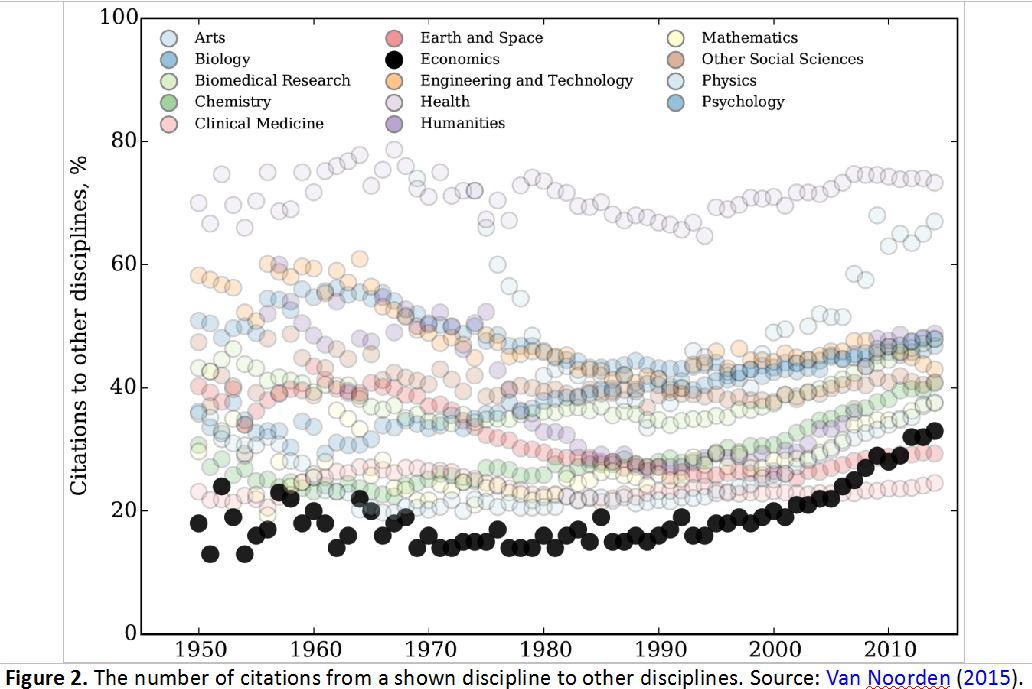

It tracks citations in papers to those in other disciplines. Until around 2000, there was no doubt which was the most insular discipline: economics. This is no surprise to me and I suspect most social scientists.

The paper does not explore the reasons why economics is so self-referential: their aim is simply to suggest that it needs to look to other disciplines to see what methods they use. Here I want to sketch why I think mainstream economics (and here the qualification mainstream is required) is so insular.

I once gave a lecture course on the methodology of economics, and in one lecture I used a large blackboard to describe how nearly all economics can be derived from the basic axioms of rational choice. For example the modern macroeconomics of consumption is just the choice between buying apples or pears transformed to the choice between consumption at different times. In that sense economic theory is like an immense tree, where every branch deductively builds on this core. Sometimes large branches grow by adding new elements, like asymmetric information, which then becomes part of the tree and can be used by other branches. This deductive tree of economic theory did not grow all by itself: its growth was and is influenced by the real world problems it wanted to address.

In using the idea of explaining decisions by optimising welfare under constraints economists have created a whole series of widely applicable tools. Economists naturally think about opportunity costs, adverse selection, moral hazard, incentives etc. There is something distinctive about thinking like an economist. To say, as Tom Clark does here, that sometimes this is just formalising common knowledge may be true (see also Cahal Moran here), but in many cases it is not. Try persuading someone who has invested in what is now a sub-optimal project about sunk costs.

This body of theory includes the neoclassical economics that heterodox economists and others love to hate, but it also includes game theory that has applications well beyond economics, and more. In my first year of studying economics I was told in some lectures that this whole endeavour was a huge ideologically driven misstep, but I began to see it differently after reading this famous 1963 paper by Arrow. It shows why (asymmetric) uncertainty in the health service means that the standard competitive model just cannot work for medical care. That may be obvious to us in the UK but it appears otherwise to many in the US. To be fair Clark also acknowledges that this economic theory has produced positive successes: he mentions auction theory but there are many more.

As to ideology, if you want an effective critique of neoliberalism you have to use economics (see, for example Colin Crouch’s book on neoliberalism or this by Dani Rodrik). So many critiques of economics use a kind of bastardised version that insists that workers are always paid their marginal products that the political right also employs. But monopoly and monopsony power are also part of the deductive tree. A paper I like to refer to in this context is by Piketty, Saez and Stantcheva (discussed here) which uses a simple bargaining model to show how cutting the top rate of tax can increase pre-tax CEO pay.

There is nothing like this deductive tree in other social sciences, and I think it at least partly explains why economics used to be so insular. As non-economists academics seemed to add little to building on this theory, there seemed little point in collaborating or even citing them. But, from the point of view of other disciplines, it was worse than that. Economics could also be imperialistic. Its methods, both theoretical and empirical, could be applied to other fields (with varying degrees of success): here is David Hendry applying his econometric methods to climate change, for example. So not only did economists not talk much to other social sciences, they trod on toes as well.

But although there may still be important branches to be added [2], the limitations of what you can do with a few axioms about rational choice have led in recent years to economics becoming much more empirical, and much less tied to this deductive theory. (See the article by Noah Smith which began this post. Unfortunately in my view an exception to this trend so far is macroeconomics.). We can see this in the citations data above, and the most obvious manifestation is behavioural economics. But a more immediate example of a data rather than theory based idea is the gravity model in international trade, which lies at the heart of why Brexit is such a bad idea. It is irony indeed that just at the point at which we have all these articles attacking economics, a large number of people who believe the UK is committing a large act of self harm are seeing the virtue of just one small part of what economists do.

Having said all this, I think there is an unfortunate hangover from this insularity. As a discipline economics shows little interest in communicating its core knowledge to others [3]. This can be true both within academia and with the outside world. Within academia publishing in top economics journals still has far higher status than top journals in other disciplines. When it comes to policy and the public, there is a belief among many that when either requires our wisdom, they will seek out the best of us for advice. In part this epidemic of articles about the failings of economics reflects this communication failure. More importantly, both Brexit and Trump should be a wake up call that economists as a collective has to get better at communicating the core insights of economics.

[1] There are of course more underlying problems behind the UK productivity crisis beyond the negative shocks of austerity and Brexit. But economists overwhelmingly argue for more R&D spending and more public investment. In short if you want someone to blame for why the UK economy is currently in such a dire state, blame those who have ignored the advice of economists.

[2] Most of the good criticisms that I see of economics amount to requests to add to the tree. But economics is so rich that most things are possible. In part (but only in part) what is done follows the money: you will find it relatively easy to get money for work on free trade compared to work on rent seeking. To blame economists for that is just bad economics. As economists found out after the financial crisis, they had many tools to understand what had happened, but had just not applied them before the crisis.   

[3] I say as a discipline because I mean economists as a collective, not as individuals. There is no equivalent institutional infrastructure in economics to that built by the hard sciences. Of course many individual economists do their best, but there are also others who ignore the consensus to plug their own personal ideas or to further some political or ideological cause.


Friday, 18 August 2017

Japan and the burden of government debt

I don’t write enough about Japan, and now that some of my posts are very kindly being translated into Japanese I should try to remedy that. In fact there is currently a very good reason to write about the Japanese economy, and that is a very strong 2017 Q2 performance. Annualised growth was 4%, compared to 1.2% in the UK. What is particularly heartening about recent Japanese growth is that it is led by domestic demand rather than trade. In the past Japan seemed to have the opposite of the UK’s problem: growth was often led by trade, while domestic demand was weak.

This recent growth is not just making up for poor past performance compared to other countries. Comparisons of GDP growth are misleading for Japan because (unlike the UK and US) it has relatively little inward migration, so it is better to use GDP per head for such comparisons. (As Noah Smith points out, even this my bias comparisons against Japan because its population is aging.) Between 2006 and 2016, Japan increased GDP per head by a total of about 5.5%, compared to around 5% in the US and about 3% for the UK. Good compared to other countries, but all these countries should have had stronger recoveries from the recession.

Strong growth is good news because inflation is so low (around 0.5%): way below the 2% inflation target. The government is trying to stimulate growth using a modest fiscal stimulus and large scale quantitative easing (short and long interest rates are exactly zero) as well as implementing various structural reforms. But the striking thing about all this is that their net government debt to GDP ratio is 125% and rising (OECD Economic Outlook measure). This is higher than any other OECD country except Greece and Italy.

Does the conjunction of relatively strong growth and high government debt confound economic theory, as Bill Mitchell suggests? Like high powered money and inflation, any relationship between government debt and growth just does not work when interest rates are stuck at zero. High government debt could crowd out private investment (although some dispute this), but not when real long term rates are zero and inflation is near zero. Servicing high debt could discourage labour supply, but again not when interest rates are zero. Nor is debt a burden on future generations when the real rate of interest is well below the growth rate.

Of course most people think such high debt levels are a real concern because of ‘the markets’. But the markets will only stop buying this debt if they expect default or rampant inflation, and there is no way a government with its own currency can be forced to default. There is also no way it will choose to default with interest rates so low. This is the basic truth that our leaders in the UK choose not to tell us (and pretend otherwise).

But what happens when growth finally raises inflation, and interest rates rise. Will debt not be a problem then? Maybe, but only in the long term, so the government will have plenty of time to fix that roof when the sun shines. [1] Right now Japan does worry about its high levels of government debt, but it rightly worries about the combination of low growth and low inflation much more. In that sense it sets a good example to other countries.


[1] Fixing the roof while the sun shines is one of the Cameron/Osborne little homilies I approve of. The problem when they used it was the UK economy was actually in pretty poor shape, as we could tell because interest rates were so low.    

Wednesday, 12 April 2017

Economics is an inexact science

When I wrote about why the BBC should treat a clear consensus in economics the same way as it now treated climate science, I got a number of comments about why economics is not a science. A common theme was that economics couldn’t prove theories ‘beyond doubt’ the same way as the hard sciences could. A more sophisticated version of this complaint is that most economic theories cannot be disproved in the same way that Popper thought scientific theories could be disproved.

All this ignores a key feature of any social science, which is their inexact nature. Instead we have accumulations of evidence that confirm the applicability of some theories and reject the applicability of others. Economists’ views about what models are applicable change as this evidence accumulates.

A good example involves the minimum wage, as Noah Smith suggests. The basic economic model suggested even a modest minimum wage should significantly reduce employment, but economists discovered that the evidence did not show this. As this evidence accumulated, alternative theories and models (monopsony and search) were thought to be more relevant. It is this response to evidence that makes economics a science.

Jo Michell writes “The scientific method of forming a hypothesis and then testing that hypothesis against reality can never be the final arbiter of knowledge, as it can in the physical sciences.” He is right that no single experiment or regression can kill a theory, but wrong that the accumulation of evidence is not the final arbiter, because no other arbiter is available. He links to a post by Noah Smith which talks about the failures of forecasting. But as that post makes clear, this is not about data rejecting models, but the inability of models to predict the future. We would never dream of condemning medics because they cannot predict the exact time of our death, still less suggest that this failure indicates they are not doing science.

Of course economics involves cases where economists appear too reluctant to give up their favoured models. You can find similar stories in the hard sciences. There will be more such stories in economics because the inexact nature of economics makes it easier to discount any single piece of evidence. What I cannot understand is what leads someone like Russ Roberts to argue against the use of evidence, and instead that “economics is primarily a way of organizing one’s thinking”. Astrology is also a way of organising one’s thinking, but it fails because evidence does not back it up.

That comparison is slightly unfair, because while the theory behind astrology is obviously implausible, the basic principles of microeconomics are not. In a class on economic methodology I once drew a huge tree that showed how most of economics could be derived from principles of rational choice. But go beyond the basics, and add in complications involving information and transactions costs (to name but two) and you very quickly derive competing models. There is no single model that comes from thinking like an economist, so for that reason alone we need data to tell us which models are more applicable.

So thinking like an economist does not tell me at what point raising the minimum wage will reduce employment. But why would anyone want to keep their models from being proved relevant or otherwise by data? The only reason I can think of is that some models give answers that are ideologically convenient. Of course allowing data to establish the relevance of some models over others does not make economics ideology proof. For example people can always select the one study that suggests that fiscal policy does not influence output and ignore the hundreds that show otherwise. That is why the accumulation of evidence, which includes its replicability, is so important. If you think economics has problems in that respect, have a look at psychology.

This is why economists views about the long term impact of Brexit should be treated as knowledge rather than just an opinion. Here knowledge is shorthand for the accumulation of evidence consistent with plausible theory. Sometimes the theories are common sense, like making trade more difficult will reduce trade. Estimates of the size of trade reduction based on evidence are uncertain, but they are better than estimates based on wishful thinking. Empirical gravity equations consistently show that geography still matters a lot in determining how much is traded. Finally there is clear evidence that trade is positively associated with productivity growth. To say that all this has no more worth than some politicians opinion is ultimately to degrade evidence and the science which interprets it.


Thursday, 6 April 2017

Economists as medics

I got some stick on twitter the other day for my (longstanding) view that economics is in many respects like medicine. It is of course not exactly like medicine: as the man said, economics is an inexact and separate science. But think about what most doctors spend their time doing. They are in the business of problem solving in a highly uncertain environment in which they only have a limited number of clues to go on. They have solutions to a subset of problems that work with varying degrees of reliability.

If you read Dani Rodrik’s book Economics Rules (which if you have not you should, and can the person who borrowed my copy return it please!), you will see that economists have a large number of distinct models, and the problem that many economists spend their time solving is which model is most applicable to the problem they have been asked to solve. Where doctors have biology as the underlying science behind what they do, they also rely on historical correlations to see if the science is appropriate. Think about solving the problem of why there had been an increase in lung cancer in the middle of the last century.

The science for economists is microeconomic theory, now enriched by behavioural economics. Most of the models economists use are derived from this theory. But as Rodrik emphasises, the trick is to know which model is applicable to the problem you have been asked to solve. To help solve that problem, economists, like doctors, want data. Many have observed how journal articles are now more likely to be about investigating data than establishing theoretical results. Economists have recently started adopting the terminology of medicine in economic studies, talking about treatment effects for example. We both do controlled trials (for economists, mainly in development economics).

Sometimes the paths of the two disciplines cross (as they do all the time, of course, in health economics). One of the big empirical discoveries of recent years has been by Case and Deaton, looking at mortality rates of the US white population. Here is a key figure from their 2015 study.


Mortality has been falling steadily almost everywhere, except since just before 2000 among US whites. Focusing just on the US, the problem seems to be mainly for non-college educated whites (this graphic comes from here).


As with anything to do with race and class in the US, this work has been controversial, but some excellent analysis from Noah Smith shows that the problem suggested by the data is real enough.

Case and Deaton have a new study which tries to understand why this is happening. They describe it as evidence of ‘deaths of despair’. In each age cohort among this group, deaths from suicide, drug overdose or alcohol have been steadily rising. Some useful data is shown here. The interpretation the authors give for the despair is the decline in economic circumstances and status of the white working class in the US.

One of the factors that they describe as an ‘accelerant’ in this development has been the overprescription of opioids drugs that provide short term pain relief, but which have negative consequences in the longer term. US policy over the last 20 years has led to what some describe as the
“worst drug epidemic in U.S. history. Enough opioids are prescribed in the United States each year to keep every man, woman and child on them around the clock for one month.”

They go on
“It is hard to believe that medicine, which prides itself on empiricism, could have taken such a wrong turn.”

Of course individual doctors make mistakes all the time, but the profession as a whole can make major mistakes. It is of course subject to pressures from individuals and large organisations (drug companies). In this, again, it is like economics.

Consider this chart, taken from Alan M. Taylor, ‘The Great Leveraging’, NBER WP 18290.


The blue line shows the percentage of high income countries experiencing a financial crisis each year. Crises were endemic until after WWII, when it appeared for two decades or more that they were a thing of the past. In the 1980s they returned, but without any major impact on high income countries. Then there was Japan’s lost decade, and plenty of papers were written about how that was a particularly Japanese problem. The 2000s seemed quiet, and some called it the Great Moderation, until the global financial crisis arrived.

Looking at this chart, it is hard to believe that economics, that prides itself on its empiricism, could have made the mistake of believing that now things were different. But economics, like medicine, can make big as well as small mistakes. The point I want to make here is the different nature of the response to these mistakes from outside these disciplines. No one says that medicine has failed us, and we need to find fresh voices. No one will say that ‘mainstream medicine’ is in crisis, and we need to look at alternatives.

They do not say that because it would be stupid to do so. With the opioid epidemic something has gone very wrong and it needs to be corrected, and the same is true for economics and the financial crisis. So why the overreaction when it comes to academic economics? One reason is that doctors are not generally asked how long people will live, and even when they do their forecasts are not published almost every day in the press. Most economists are as honest as doctors would be about that kind of unconditional forecasting, but it suits the media to appear shocked and surprised when things go wrong. Another reason is that ordinary people can see doctors doing good things all the time to themselves, their friends and families, but the work of economists is felt less directly. It also seems intuitive that medics are in some sense better than economists, although how you could measure that I do not know. Both factors may explain why medicine is internally policed to a large degree (doctors can be stopped from practicing), whereas economics is not.

Another big difference involves politics. Economists bring unwelcome news to both left and right, so it suits both sides to occasionally bash the discipline that brings the message. We have seen a great deal of that from the right over Brexit. For the left more than the right there are also non-mainstream economists who have an interest in arguing that the mainstream has been corrupted by ideology. Quite why so many on the left choose to attack mainstream economics rather than use the mainstream to attack the right I do not know. All I do know is that they have been doing it for 40+ years, as I remember being told by many economists that the mainstream was fatally flawed back in Cambridge in the early 1970s, which was before Thatcher and Reagan.

But these differences should not obscure the similarities between economics and medicine. We both deal with people, and their mind and body can be pretty complicated whether as individuals, or as a society. In some areas we have developed quite detailed degrees of quantitative understanding that allow us to make successful interventions (more so than in other social sciences I suspect). In other areas we do things that work most of the time but sometimes fail, but there are many important areas where if we are honest we do not have any real idea of what is going on. So we make mistakes, which can sometimes be extremely costly for huge numbers of people, but we also learn from these mistakes.


Wednesday, 26 October 2016

Being honest about ideological influence in economics

Noah Smith has an article that talks about Paul Romer’s recent critique of macroeconomics. In my view he gets it broadly right, but with one important exception that I want to pursue here. He says the fundamental problem with macroeconomics is lack of data, which is why disputes seem to take so long to resolve. That is not in my view the whole story.

If we look at the rise of Real Business Cycle (RBC) research a few decades ago, that was only made possible because economists chose to ignore evidence about the nature of unemployment in recessions. There is overwhelming evidence that in a recession employment declines because workers are fired rather than choosing not to work, and that the resulting increase in unemployment is involuntary (those fired would have rather retained their job at their previous wage). Both facts are incompatible with the RBC model.

In the RBC model there is no problem with recessions, and no role for policy to attempt to prevent them or bring them to an end. The business cycle fluctuations in employment they generate are entirely voluntary. RBC researchers wanted to build models of business cycles that had nothing to do with sticky prices. Yet here again the evidence was quite clear: for example data on real and nominal exchange rates shows that aggregate prices are slow to adjust. It is true that it took the development of New Keynesian theory to establish robust reasons why prices might be sticky enough to generate business cycles, but normally you do not ignore evidence (that prices are sticky) until you have a good explanation for that evidence.

Why would researchers try to build models of business cycles where these cycles required no policy intervention, and ignore key evidence in doing so? The obvious explanation is ideological. I cannot prove it was ideological, but it is difficult to understand why - in an area which as Noah says suffers from a lack of data - you would choose to develop theories that ignore some of the evidence you have. The fact that, as I argue here, this bias may have expressed itself in the insistence on following a particular methodology at the expense of others does not negate the importance of that bias.

I do not think this is just a problem in macroeconomics. David Card is a very well respected labour economist, who was the first to present detailed empirical evidence that imposing a minimum wage might not reduce employment (as the standard supply and demand model would predict). He gave an interview some time ago (2006), where he said this about the reaction to this work:

“I've subsequently stayed away from the minimum wage literature for a number of reasons. First, it cost me a lot of friends. People that I had known for many years, for instance, some of the ones I met at my first job at the University of Chicago, became very angry or disappointed. They thought that in publishing our work we were being traitors to the cause of economics as a whole.”

As Card points out in the interview his research involved no advocacy, but was simply about examining empirical evidence. So the friends that he lost objected not to the policy position he was taking, but to him uncovering and publishing evidence. Suppressing or distorting evidence because it does not give the answer you want is almost a definition of an illegitimate science.

These ex-friends of David Card are not typical of academic economists. After all, his research was published and became seminal in subsequent work. Theory has evolved (see again his interview) to make sense of his findings, but unlike the case of macro the findings were not ignored until this happened. Even in the case of macro, as Noah says, it was New Keynesian theory that became the consensus theory of business cycles rather than RBC models.

Yet I suspect there is a reluctance among the majority of economists to admit that some among them may not be following the scientific method but may instead be making choices on ideological grounds. This is the essence of Romer’s critique, first in his own area of growth economics and then for business cycle analysis. Denying or marginalising the problem simply invites critics to apply to the whole profession a criticism that only applies to a minority.


Sunday, 4 September 2016

More on Stock-Flow Consistent models

This is a follow-up to this post, but which is prompted by this Bank of England paper, which builds a stock-flow consistent model for the UK. If you are not familiar with the term ‘stock-flow consistent’ (SFC) then read on, because in a sense this post is all about why I think the way the authors and others define this class of models is misleading.

SFC models are popular with Post-Keynesians, and the definition you find on Wikipedia is “a family of macroeconomic models based on a rigorous accounting framework, which guarantees a correct and comprehensive integration of all the flows and the stocks of an economy.” Now I suspect any mainstream macroeconomists would immediately respond that any DSGE model is also stock-flow consistent in this sense. This point is made in a post by Noah Smith, and it is completely valid, although otherwise I think his account of the weaknesses of SFC models is wide of the mark.

If you think this is a trivial debate about titles, take this description of the pros and cons of SFC compared to DSGE models taken from the paper:


Take the cons (merits of DSGE compared to SFC) first. Number one is almost definitional: DSGE models have to be microfounded, but SFC models start with aggregate relationships. But that is not a defining feature of SFC models, because there is a long tradition of macro modelling that is not microfounded but starts with aggregates, a tradition that begins well before DSGEs with the simultaneous creation of national accounts data, econometrics and Keynesian economics. This tradition goes by many names: ‘Structural Econometric Models’ (SEMs), ‘Cowles Commission’ (favoured by Ray Fair) or most recently ‘policy models’ (see Blanchard). I’ll just call them aggregate models here.
A key question, therefore, is what marks SFC models out from other aggregate models? The authors obviously think there is something, because of their second ‘con’. The third and fourth ‘cons’ are common to many large SEMs. (I once wrote a paper on how to mitigate the first of these problems.) The fifth ‘con’ just follows from the first.

At first sight the sixth ‘con’ does the same, but I would argue that if there is anything that characterises SFCs among aggregate models it is this. Aggregate models would generally involve an extensive discussion of the theoretical origins of the relationships they used, but if this paper is anything to go by that is less true for SFCs. If you think this last point is unfair, look at the discussion of the consumption function (before equation 4).

This failure to acknowledge the existence of other aggregate models is even more apparent among the ‘pros’. The first and second can be true for any model, including a DSGE model, but the third is critical. It is true, but again it is also true for many aggregate and some DSGE models. As I argue in my previous post, the key point about the archetypal DSGE model is that it does not need to track household wealth, because there is no attempt by consumers (given the theory) to achieve some target value of wealth.

The fourth is true for any model, including DSGE models. The fifth is true for any aggregate model as long as expections variables are explicitly identified. The sixth is also almost bound to be true of any aggregate model, because starting with aggregates and being eclectic (and potentially internally inconsistent) with theory allows you to more closely match the data than DSGEs.

To summarise, if you were to ask how this model compares to other aggregate (non-microfounded) models, the answer would probably be that it takes theory less seriously and it has a rather elaborate financial side.

The New Classical counter revolution had many good and bad consequences, but one of the undesirable consequences was, it seems, to define the equivalent of a year zero in macroeconomics, where nothing that was not in the New Classical tradition created before (or even after) this revolution is deemed to exist. The same should not be true for heterodox economists. If you are going to effectively return to a pre-DSGE tradition, please do not pretend that tradition did not exist.

There is a well known UK professor of econometrics who was very fond of admonishing authors who failed to cite work that they were either extending or just copying. The intention here is not just to do the same. One of the big dangers with any kind of elaborate aggregate model is that you can get bizarre model properties from not thinking enough about the theory, or imposing enough because of the theory. Knowing some of the authors I doubt that has happened in this case. But it would be a mistake for others to believe that the properties of their model show the importance of accounting rather than the theory they have used.