Winner of the New Statesman SPERI Prize in Political Economy 2016


Showing posts with label Eurozone. Show all posts

Tuesday, 23 July 2019

How the lessons from austerity have not been learned


The UK and the Eurozone are both vulnerable to the next recession, but both politicians and central bankers think each other should deal with it.


I don’t want to talk about the likelihood of a recession in the UK, US or Eurozone. Forecasting is a (necessary) mug’s game, where there are just too many variables to make anything like an accurate prediction. It is worth outlining the risk factors, and Grace Blakeley does an excellent job here. Instead my concern is the vulnerability in both the UK and the Eurozone to the impact of a recession if it happens. This vulnerability was clearly illustrated by the mistakes made after the Global Financial Crisis, yet in many ways the lessons of that failure have not been learnt.

Most people know the story of austerity after the Global Financial Crisis (GFC). In the UK the negative impact of the GFC was so severe that even cutting interest rates from around 5% to 0.5% was not sufficient to counteract its impact. As a result the Labour government in 2009 undertook various fiscal stimulus measures. They, together with lower interest rates, succeeded in stopping the fall in output, but by 2010 the signs of a recovery were still fragile. The new Coalition (Conservative and Liberal Democrat) government decided to focus on the rising budget deficit rather than the recovery, and undertook a large fiscal contraction in what became known as austerity.

The consequence of UK austerity was the slowest recovery from a recession in centuries. Here is a nice chart from a recent report by James Smith of the Resolution Foundation, which clearly illustrates the extent of the weak recovery.


Employment eventually recovered, but at the cost of an unprecedented fall in real wages. James Smith gives some evidence to suggest that the reason employment got off comparatively lightly but wages suffered by much more than we might expect was the 2008 sharp depreciation in sterling. This allowed firms to respond to the recession by keeping wages low, whereas in recessions in which sterling did not fall firms resisted nominal wage cuts and so had to resort to cutting jobs.

The idea that austerity was essential to reduce the deficit is simply wrong. It undoubtedly was a large factor in the weakness of the UK recovery. The tightening of fiscal policy has continued until today, with the consequence that interest rates have had to stay low to offset this fiscal tightening. The net result is that instead of rates being near 5% as they were before the GFC, they are below 1%. As James Smith points out, interest rate cuts in previous recessions have ranged from three to ten percent. This means that conventional monetary policy has almost no room to counteract a new economic downturn if one came.

The Eurozone is in an even worse position. Their history is of two recessions since the GFC, the second of which was largely caused by fiscal tightening as a result of the Eurozone crisis of 2010-12. The last time core inflation in the Eurozone touched 2% was in 2008, and it is currently around 1%. (More details from Frances Coppola here.) Interest rates set by the European Central Bank (ECB) remain at their lower bound. If a new recession happened, caused for example by a disruption in trade due to Donald Trump, conventional monetary policy would be unable to do anything about it.

Of course central banks in the UK and Eurozone still have various unconventional monetary policy tools. But the clue to their reliability at ending a recession is in their name. They are unconventional because they have only been used since the GFC, so we have limited evidence on their impact. It is like having an accelerator on a car where how far you have to push your foot down varies from second to second. You will end up driving slowly, which in economic terms means a prolonged recession.

All this is now largely understood by central bankers. All have said in one place or another that they will be relying on fiscal stimulus to help counteract the next recession. The ECB needs fiscal stimulus right now to get out of the last one. Yet fiscal stimulus is in the hands of politicians and not central bankers, and many of the politicians and political parties that were crucial in implementing the austerity that hit the post-GFC recovery are still in power.

There is therefore a danger that the policy of fighting the next recession will fall between two stools. Central bankers will say, in their own quiet and politically sensitive way, that they are not equipped for the task, but politicians may be deaf to these messages and will once again start worrying about deficits that inevitably rise in an economic downturn. To say more, we need to differentiate between the UK and the Eurozone.

In the UK some may think that with a new Prime Minister the problem of austerity has disappeared. In order to get elected both candidates have promised all kinds of tax cuts or spending increases. But as I have argued recently, what we are seeing here is what economists call deficit bias: the tendency to borrow just for political gain. Worse still, if the borrowing is mainly for tax cuts (including tax cuts for the rich), there is a danger that it is part of a strategy called ‘starve the beast’, which involves increasing the deficit with tax cuts and then demanding spending cuts to bring the deficit under control.

The upshot is that a Tory leader wanting to spend and cut taxes to please party members provides no guarantee that they will undertake effective fiscal expansion in any future recession. Neither of the Coalition partners has apologised for the mistake of austerity, and we have no reason to believe that they wouldn’t do it again in any future recession. The only major party that has a fiscal framework that would automatically move to fiscal expansion when interest rates hit their lower bound is Labour.

In the Eurozone there is also too little recognition among senior politicians that fiscal stimulus is required when ECB interest rates are at the lower bound. This is why Eurozone inflation is still below target. The OECD point to a crying need for more fiscal stimulus. Germany in particular has a great need for additional public investment, but is restrained by a fiscal rule that is worthy of an economic stone age. Efforts to create a Eurozone budget that could act in a countercyclical way have also been blocked by politicians, despite support from the ECB.

We can hope for a change of political attitudes in both the UK and Eurozone, but central bankers should not be content with hope. They have been delegated the task of stabilising the economy, and if they fail to complete this task in economic downturn after downturn many will come to believe that delegating monetary policy to central banks was a huge mistake. In addition, it is not the case that all central banks can do when interest rates hit their floor is unreliable types of unconventional monetary policy.

A fail safe way for a central bank to bring a recession to an end when interest rates are at the lower bound is to create money and give it directly to citizens. It could also create money and give it to borrowers by subsidising borrowing rates. The former is called helicopter money, a term due to Milton Friedman, and would require cooperation from government. The latter has been undertaken by the ECB in the past (see Eric Lonergan here), and so could be done to a greater extent without involving government. In essence it involves cutting interest rates on borrowing to well below the lower bound, but keeping rates for savers at the lower bound, and funding the difference by creating money.

Central banks in most of the major economies have been happy to create money during a recession, but nearly always this money has been used by central banks to buy assets. The impact on the economy is then difficult to predict, because no one's income has increased and the interest rate for borrowing has not fallen significantly. Giving the money directy to people rather than buying assets would have a direct and more predictable impact in stimulating the economy, as Frances Coppola argues in her new book.

So why do central banks not do this? There are two major reasons. First, they worry that increasing people's income is the job of elected governments, although I would argue that it is central bank's job to stabilise the economy if the government does not. (See my article with Mark Blyth and Eric Lonergan for more on helicopter money.) Second, if they create money to buy assets, when the economy recovers they can if necessary take money out of the economy by selling those assets. If they give that money away they wil not have those assets to sell. However this problem could be dealt with by governments guaranteeing the supply of assets a central bank needs.

Besides these arguments, I think there is a third argument why most central banks have not proposed doing these types of measures in a major way, and that is conservatism with a small c. The problem is that, if politicians unprepared to undertake fiscal expansion in a recession remain in power, that conservatism may be very costly both to us and to central banks themselves.

Thursday, 10 May 2018

Fiscal policy remains in the stone age


Or maybe the middle ages, but certainly not anything more recent than the 1920s. Keynes advocated using fiscal expansion in what he called a liquidity trap in the 1930s. Nowadays we use a different terminology, and talk about the need for fiscal expansion when nominal interest rates are stuck at the Zero Lower Bound or Effective Lower Bound. (I slightly prefer the latter terminology because it is up to central banks to decide at what point reducing nominal interest rates further would be risky or counterproductive.) The logic is the same today as it was in the 1930s. When monetary policy loses its reliable and effective instrument to manage the economy, you need to bring in the next best reliable and effective instrument: fiscal policy.

The Eurozone as a whole is currently at the effective lower bound. Rates are just below zero and the ECB is creating money for large scale purchases of assets: a monetary policy instrument whose impact is much more uncertain than interest rate changes or fiscal policy changes (but certainly better than nothing). The reason monetary policy is at maximum stimulus setting is that Eurozone core inflation seems stuck at 1% or below. Time, clearly, for fiscal policy to start lending a hand with some fiscal stimulus.

Yet the goal of the new German Finance minister, from the supposedly left wing Social Democrats, is to achieve a budget surplus of 1%. To achieve that he is cutting public investment from 37.9 billion euros in the coming year to 33.5 billion euros by 2020. Yet German infrastructure, once world renowned, is falling apart. Its broadband connectivity could be greatly improved.

The macroeconomic case for a more expansionary German fiscal policy is overwhelming. Germany has a current account surplus of around 8% of GDP. There are some structural reasons why you might expect some current account surplus in Germany, but the IMF estimates that these structural factors account for less than half of the current surplus. It estimates that a third of the excess surplus is a result of an overly tight fiscal policy. As Guntram Wolff points out, the main counterpart to the surplus is saving by the corporate sector. Perhaps more public investment might encourage additional private investment.

But this is not another article about how Germany needs to expand to help the rest of the Eurozone. The problem, as Matthew Klein points out, is that the whole of the Eurozone is doing the same. In the area as a whole, the fiscal position is as tight as it was in the pre-crisis boom. Unemployment in the Eurozone is still too high. And the reason fiscal policy is too tight is that key Eurozone policymakers think that is the right thing to do. “The right deficit is zero” says the French finance minister. He goes on: “ Since France is not in an economic crisis, we need to have a balanced budget, so that we can afford a deficit in tougher times.” You hear the same in Germany: the economy is booming so we must have budget surpluses.

A booming economy is not one that is growing fast, but is one where the level of output and employment is above the level compatible with staying at target inflation. Measures of the output gap are only estimates of what that level is: underlying inflation is the ultimate guide. Core inflation is well below target right now, which is why interest rates are at their effective lower bound. This is why the actions and rhetoric of most European (and UK) finance ministers are simply wrong.

You would think that causing a second recession after the one following the GFC would have been a wake up call for European finance ministers to learn some macroeconomics. (Yes, I know that the ECB raising rates in 2011 did not help, but I expect most macro models will tell you the collective fiscal contraction did most of the harm.) Yet what little learning there has been is not to make huge mistakes but only large ones: we should balance the budget when there is no crisis.

This is not a dispute between left and right as it is now in the UK, but a problem with the policy consensus in Europe. What we are seeing I suspect is a potent combination of two forces: a German obsession with balancing the budget which has it roots in currently dominant ordoliberal/neoliberal ideology, and Keynes famous practical men: advisers who learnt what economics they have in an era of the great moderation where the worst economic problem we had was relatively benign deficit bias. Fighting the last war and all that.

Wednesday, 25 October 2017

A European Monetary Fund

Sapir and Schoenmaker at Bruegel have a discussion of what a European version of the IMF might look like and do. Here are my thoughts on the sovereign debt (not banking) side, which I am sure will be regarded once again as radical and will therefore be ignored.

I think some new Eurozone institution is necessary, but not for the reason that most people might think. The idea that the Eurozone might have a common fund that lends to Eurozone countries in fiscal difficulties with associated conditionality, as the IMF does, is a terrible idea. We know it is a terrible idea because of Greece.

Think of the following scenario. A country getting into difficulties is lent some money by the EMF. That sum increases as existing private investors take fright. For whatever reason the ‘recovery plan’ imposed by the EMF goes wrong, and it becomes clear to all neutral observers that the country needs to default on its debts, including those to the EMF. As the EMF loan is regarded as ‘our money’ by a good part of the EZ electorate, this default is resisted and punitive austerity is imposed on the country so that the EMF can get its money back. This does not happen to the IMF because the electorate in any individual country do not think of their loans as ‘their money’, but it is naive to believe that wouldn’t happen with an EMF. It is exactly what happened in Greece, and it is also why moves to a political union are far too premature..

This raises an obvious question: why have an EMF, when we have an IMF? The wrong way of thinking about that question is that the Eurozone needed to supplement the IMF during the last crisis. The last crisis is not a good example because the ECB did not operate OMT until September 2012. The right way to think about the past is what would have happened if OMT had been operating from the start.

The ECB is (rightly) only prepared to operate OMT for a country that is returning its financing to some sustainable level. For some countries that may not be possible, or desirable, without default. That was the case for Greece. For others that will be possible without default, as Ireland and Portugal have shown. You need somebody, or some institution, to decide which category a country finds itself in. But whether default is needed or not, a recovery plan (austerity) has to be put in place to return the public finances to sustainability and once that plan is in place OMT then operates.

Once that happens, I think any lending should be done by the IMF for the reason I have already given [1]. However it may well be that as long as the austerity is sensibly mild and drawn out [2], private sector lending will resume because of OMT.

I think a new institution to do both the job of initially deciding about default and to create the recovery plan would be a good idea. But both decisions have to be kept as far away from politicians as possible. The reason again comes from history: the loans to the government that may require default are likely to be from banks or institutions in other EZ countries. That creates a serious bias towards ‘lend and pretend’, as we saw with Greece. 

How can you achieve such independence in the EMF? In addition, how do you justify giving an institution staff and resources when it hopefully will be hardly ever needed? One answer could be to use the IMF, although at the moment the IMF is not sufficiently independent of EZ politicians. Another is to utilise the network of independent fiscal institutions or fiscal councils that every EZ country now has. If those institutions live up to their name, they should be independent of politicians. In addition, they have exactly the expertise to decide on any default and to put together a recovery plan.

Now the great thing about this set-up is that it allows fiscal autonomy in countries that have not got into fiscal difficulties. Fiscal discipline through the market is restored, because there is a clear default risk (but not the self-fulfilling default risk that operated before OMT). There would be less of a feeling in countries like Germany that they had to worry about fiscal policy in other EZ countries because they will pick up the tab because there will not be any tab to pick up. In that sense the no bail out rule is restored. 

What would the Brussels machinery that currently monitors each EZ country do? Am I proposing to put some Brussels bureaucrats out of a job? Not necessarily. A potential problem with the system I suggest is that fiscal councils will be captured by their governments. Brussels could ensure that the fiscal councils are independent, which would involve checking their assessments and forecasts (or even supplying them with forecasts).

I can predict with almost certainty that some comments will be that I am taking crucial decisions away from democratically elected politicians and giving them to technocrats. We have enough of that in the Eurozone as it is they will say. There are two simple responses. First, in the absence of the Eurozone, governments that were no longer able to borrow would face the technocrats at the IMF. Second, we have tried the democratic route and it has failed spectacularly for reasons that will not go away in a hurry. 

There you have it. A feasible plan to increase sovereignty in the Eurozone and mitigate another Eurozone crisis and avoid another Greece. Now tell me why we have to move to fiscal and political union.

[1] Obviously in that case the IMF would also have to approve the recovery plan.

[2] A short sharp shock will almost inevitably lead to damaging negative feedback on output, perhaps creating another Greece.

Monday, 24 July 2017

Lexit

I often find that arguments for Lexit have many structural similarities to right wing arguments for Brexit. Take Larry Elliott’s latest piece for example. This includes
  1. Sweeping exaggerations that seem designed to trigger nationalist sentiments. We are told that “under Tony Blair, the feeling was that globalisation had made the nation state redundant.”

  2. Confusing the EU with the Eurozone. Larry talks about the problems with the ECB, the SGP, and mass unemployment, but these are all valid criticisms of the Eurozone. There is no attempt to say why that has any impact on the UK as part of the EU.

  3. Inferring that all the UK’s problems are somehow down to the EU, without providing any evidence that they are.

  4. Asserting that the EU prevents the UK doing what it needs to do to tackle (c) in ways that are economical with the truth (see more below).

But I also have complaints that I think are unique to Lexit arguments. When some people mock the use of the term neoliberalism, they should use the Lexit debate as ammunition. When I use the term, it is to signal a project that in various ways subordinates the state to the market. Yet we are told that the EU had neoliberalism hardwired into it. The EU is fundamentally about trade liberalisation, not about the role of the state. It is trade liberalism that is hardwired into the EU, not neoliberalism. (The Lexit advocacy here is more honest about that.)

Is levying a huge fine on Google because its search engine gives preference to its own shopping comparison site an example of neoliberalism? Is a maximum working week? Are their environmental standards? [1] These are all examples of a collective of states interfering with firms and the market. One of the strong and left wing arguments for the EU is that only at this level can you avoid large multinational corporations blackmailing states that attempted to challenge them in similar ways. I am sure there are many examples where the EU could do this more effectively, but at least they are trying.

The argument for Lexit is therefore similar to the argument against globalisation. The problems that a combination of globalisation and technical change has created for many communities are real enough. But Lexit arguments typically ignore two key points. First, globalisation has brought huge gains for many poorer countries. That applies as much to the poorer states of the EU as it does to China and India. Of course what is being done to Greece is appalling (and I have not hesitated to say so on many occasions), but this once again is a result of a common currency, not trade liberalisation under the EU. Indeed, one of the reasons the Eurozone’s blackmail of Greece worked is that a majority of Greeks want to stay in the EU.

Second, the gains for the UK that have followed most trade liberalisation are real enough, which is why there are large costs to leaving the Single Market or customs union. Larry spins this by saying the “left needs to be very careful about running with the idea that business should be able to veto decisions made by the electorate.” This is a line that shows the left at its worst. The costs of Brexit do not necessarily fall on business (which is often mobile) but on ordinary UK citizens. What proponents of Lexit have to show is that the benefits of the policy freedom Brexit gives you outweigh these costs.

The most promising way to help the losers from trade liberalisation (and technical progress) is through an active industrial and regional policy. Proponents of Lexit argue that the EU would prevent such a strategy. If we are talking about giving aid to declining uncompetitive sectors, then many would argue that it is a good thing that the EU does stop that happening. But to suggest that the EU is opposed to any kind of regional aid seems to conflict with the existence of the EU’s Cohesion Policy, that has benefited many areas in the UK. For a more general discussion of the justifications the EU gives for intervening in the market, see William Davies here. The set of policies that the EU prevents but which any reasonable trade deal with the EU would allow are pretty small, with the key exception of controlling immigration.

Larry says that freedom of movement has not benefited workers. I think he would find plenty of EU workers in the UK who would disagree (at least before Brexit). Just as the movement of goods across borders benefits all, so can the movement of people. Most of the analysis I have seen has shown that recent immigration into the UK has been beneficial to UK workers once you take everything into account. Ignoring all that by talking about the ‘lived experience of ordinary people’ (from here) suggests an attitude to knowledge and evidence worthy of UKIP. Which brings me full circle.


[1] The first of these interventions could reflect an ordoliberal rather than neoliberal view, but the second two not so much.   

Friday, 14 July 2017

Why German wages need to rise

An interesting disagreement occurred this week between Martin Sandbu and the Economist, which prompted a subsequent letter from Philippe Legrain (see also Martin again here). The key issue is whether the German current account surplus, which has steadily risen from a small deficit in 2000 to a large surplus of over 8% of GDP, is a problem or more particularly a drag on global growth.

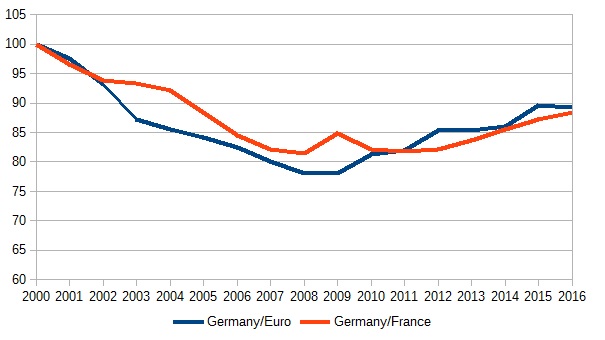
To assess whether the surplus is a problem, it is helpful to discuss a key reason why it arose. I have talked about this in detail many times before, and a similar story has been told by one of the five members of Germany’s Council of Economic Experts, Peter Bofinger. A short summary is that from the moment the Eurozone was born Germany allowed wages to increase at a level that was inconsistent with the EZ inflation target of ‘just below 2%’. We can see this clearly in the following chart.

Relative unit labour costs, source OECD Economic Outlook, 2000=100

The blue line shows German unit labour costs relative to its competitors compared to the same for the Euro area average. Obviously Germany is part of that average, so this line reduces the extent of any competitiveness divergence between Germany and other union partners. By keeping wage inflation low from 2000 to 2009, Germany steadily gained a competitive advantage over other Eurozone countries.

At the time most people focused on the excessive inflation in the periphery. But as the red line shows, this was only half the story, because wage inflation was too low in Germany compared to everyone else. This growing competitive advantage was bound to lead to growing current account surpluses.

However that in itself is not enough to say there is a problem, for two related reasons. First, perhaps Germany entered the Eurozone at an uncompetitive exchange rate, so the chart above just shows a correction to that. Second, perhaps Germany needs to be this competitive because the private sector wants to save more than it invests and therefore to buy foreign assets.

There are good reasons, mainly to do with an ageing population, why the second point might be true. (If it was also true in 2000, the first point could also be true.) It makes sense on demographic grounds for Germany to run a current account surplus. The key issue is how big a surplus. Over 8% of GDP is huge, and I have always thought that it was much too big to simply represent the underlying preferences of German savers.

I’m glad to see the IMF agrees. It suggests that a current account surplus of between 2.5% to 5.5% represents a medium term equilibrium. That would suggest that the competitiveness correction that started in 2009 has still got some way to go. Why is it taking so long? This confuses some into believing that the 8% surplus must represent some kind of medium term equilibrium, because surely disequilibrium caused by price and wage rigidities should have unwound by now. The answer to that can also be found in an argument that I and others put forward a few years ago.

For this competitiveness imbalance to unwind, we need either high wage growth in Germany, low wage growth in the rest of the Eurozone, or both. Given how low inflation is on average in the Eurozone, getting below average wage inflation outside Germany is very difficult. The reluctance of firms to impose wage cuts, or workers to accept them, is well known. As a result, the unwinding of competitiveness imbalances in the Eurozone was always going to be slow if the Eurozone was still recovering from its fiscal and monetary policy induced recession and therefore Eurozone average inflation was low. [1]

In that sense German current account surpluses on their current scale are a symptom of two underlying problems: a successful attempt by Germany to undercut other Eurozone members before the GFC, and current low inflation in the Eurozone. To the extent that Germany can make up for their past mistakes by encouraging higher German wages (either directly, or indirectly through an expansionary fiscal policy) they should. Not only would that speed adjustment, but it would also discourage a culture within Germany that says it is generally legitimate to undercut other Eurozone members through low wage increases. [2]

From this perspective, does that mean that the current excess surpluses in Germany are a drag on global growth? Only in a very indirect way. If higher German wages, or the means used to achieve them, boosted demand and output in Germany then this would help global growth. (Remember that ECB interest rates are stuck at their lower bound, so there will be little monetary offset to any demand boost.) The important point is that this demand boost is not so that Germany can help out the world or other union members, but because Germany should do what it can to correct a problem of its own making.

[1] Resistance to nominal wage cuts becomes a much more powerful argument for a higher inflation target in a monetary union where asymmetries mean equilibrium exchange rates are likely to change over time.

[2] The rule in a currency union is very simple. Once we have achieved a competitiveness equilibrium, nominal wages should rise by 2% (the inflation target) more than underlying national productivity. I frequently get comments along the lines that setting wages lower than this improves the competitiveness of the Eurozone as a whole. This is incorrect, because if all union members moderate their wages in a similar fashion EZ inflation would fall, prompting a monetary stimulus to bring inflation back to 2% and wage inflation back to 2% plus productivity growth.