Winner of the New Statesman SPERI Prize in Political Economy 2016


Tuesday, 16 November 2021

Why have Conservative Chancellors since Osborne been bad for households?


Here is a chart from the resolution foundation


It shows how growth in real disposable income has been well below the post war average since the Global Financial Crisis (GFC). However trend growth rates have been falling in many major economies for some time. What this chart doesn't show is something else has happened, which a chart of levels rather than growth rates reveals. Below I’ve added GDP per head as this is the main determinant of household income.


I have shown previously that before the GFC, real GDP per head grew at a remarkably constant trend growth rate of 2.25% a year from 1955 to before the GFC, although with perhaps a slight dip in the 2000s. It collapsed during the GFC. The key point this illustrates is that while previous recessions were followed by a bounce back that returned the economy to its underlying trend, that didn’t happen after the GFC. Instead the path of GDP and household income shifted to a lower level and then grew at a slower rate.


According to the OBR, a similar although more modest pattern will be seen after the pandemic: a permanent downward shift and thereafter permanently lower growth, the latter largely as a result of Brexit.


The two main reasons that real household income will differ from real GDP per head is changes in tax policy and the real exchange rate. In the immediate aftermath of the GFC the Labour government stimulated incomes by cutting VAT, but that was more than reversed subsequently. Incomes benefited from falling commodity prices during 2015 and an appreciation in sterling, but that was quickly reversed after the sterling collapse following the Brexit referendum. Finally the furlough scheme protected incomes during the pandemic. But these are fluctuations around an underlying trend set by GDP per head.


The big question we need to ask is why, for the first time since WWII, GDP per head didn’t return to its pre-recession trend after 2010, and why it will not completely recover from the pandemic. I think the answer lies in this chart.


UK bank rate


Why? Because before the GFC recession, interest rates were used to stabilise the economy. Since the GFC they have not been higher than 0.75%, and most of the time they have been as low as the Bank of England dare push them. Unconventional monetary policies are no substitute. As a result, when interest rates are at their lower bound you know the economy is not being stimulated enough.


Although the Labour government did use fiscal stimulus during the recession, this policy was quickly reversed by George Osborne as deficit reduction rather than macroeconomic stabilisation became the central goal of fiscal policy. In my view this was a key reason why the slump in GDP caused by the recession became permanent. Equally Rishi Sunak is now squeezing fiscal policy before the recovery is complete.


Few economists dispute that 2010 austerity was a disaster for the UK’s recovery from recession, and today organisations like the IFS or NIESR have argued that Sunak is making a similar mistake. What economists find harder to explain is why the lack of fiscal stimulus led to a permanent loss in UK incomes, rather than just a delayed recovery. The standard macromodels assume the economy always recovers after a recession, although theory has always been very weak on how that happens without policy intervention [1]


But as the 1930s showed, without help from monetary (interest rates) or fiscal policy recovery may not happen. With interest rates stuck at the lower bound, and no fiscal stimulus, there is no reason why the recovery will come from consumption. The UK savings ratio, which rose sharply during the 2009 recession, stayed high until the year of the Brexit referendum. With austerity in Europe as well there was no boost to exports. So any recovery in private sector demand had to begin with investment.


UK investment collapsed in 2009, and although its growth rate bounced back to average over 3% in the next six years, that was only enough to help offset the deflationary effect of austerity, implying the economy as a whole showed average growth at best, and did not recover the ground lost from the recession. The most robust determinant of investment is GDP growth, because growing demand forces firms to invest more to meet it. Since the second world war governments have ensured that after economic downturns it took the lead in stimulating the economy. That ended in 2010.


Why isn’t this talked about more? Why doesn’t the media talk about how recent Conservative governments have, and perhaps currently are, permanently cut our living standards? This is a question I have asked many times on this blog since it started almost 10 years ago, but following the pandemic and seeing the coverage of COP26 I think this problem isn’t peculiar to economics. With economics, pandemic management and dealing with climate change we have a common theme in the broadcast media, which is that expertise either isn’t referenced, or is devalued compared to party political discourse. [2]


[1] After the GFC, there have been some papers that have looked at why recovery may not happen, and the economy shifts to a worse equilibrium.

[2] This is something I hope to return to in a subsequent post


Monday, 8 November 2021

The malversation of this government is not a surprise. The U turn tells us more.


Malversation is corrupt behaviour in a position of trust, especially in public office. That this government is corrupt in that sense should not be a surprise. In September 2019 I talked about the government then led by Johnson as rogue, and the most dangerous government we have seen in our lifetimes. This didn’t take any special insight. The man had just shut down parliament for his own convenience (and lied to the queen to do so), and this action was in turn unsurprising given his past deeds. Others need to explain why they missed all that, or thought Johnson would change, or indeed why they saw Corbyn as a greater danger than both Johnson and Brexit.


So Johnson’s attempt to use sympathy for Patterson in some Tory circles to get rid of a potential embarrassment to him is unsurprising. His standard reaction to any institution that holds him or his government accountable is to abolish that threat. What tells us more is his dramatic U turn a day later. I think it is worth asking why he did the U turn to analyse the limits to Johnson’s power. It tells us why, even in its timid state, the BBC is worth preserving, why corruption could be this government’s Achilles Heel, and why the lack of opposition cooperation will nevertheless save Johnson.


Johnson’s attempt to remove the commissioner and committee for standards is hardly the first act of malversation committed by Johnson. Priti Patel breached the Ministerial Code, but Johnson overruled the Independent Advisor on Ministerial Standards, who then had no choice but to resign. When an independent panel failed to choose former Daily Mail editor Paul Dacre for the chair of Ofcom, Johnson simply appointed another panel. There are many more examples, like the pay off from public money to the senior civil servant who resigned after Patel bullied his staff, the COVID contracts, Jennifer Arcuri and many more.


In each of these cases Johnson got his way, and got away with it. No doubt this encouraged him to think he could get away with saving Paterson, ousting the standards commissioner and remodelling the committee so it would have a Tory majority. So why was this case different from the others? Why did Johnson feel he had to backtrack in such a visible way?


It is tempting to say this issue broke through with voters because Brexit is long done (sort of) and Brexit voters and newspapers are beginning to view the government more critically. That is certainly possible, but I think there are other factors that help explain why Johnson felt he had to U turn. After all, some items in the corruption list have happened or emerged since the Brexit deal was agreed, and in addition Brexit is hardly over with the UK threatening to renege on that deal.


For a more structural answer I think we have to start with the BBC. In the News at 10 that I watched, the narrow vote in parliament was the lead item. Although the headline was ‘MPs vote’ to overturn Paterson’s suspension, it was quickly obvious from the subsequent narrative that it was Tory MPs and that there was a three line whip imposed by Johnson. What made it more newsworthy than previous examples of corruption? I suspect it was because you had the drama of a vote in parliament, with many Tory MPs rebelling combined with a simple story to tell. In addition Johnson was unlucky there was not a more important news item that day.


Why was this so important? Because many people watch the BBC’s main news programmes, including those that also read the Tory press. That had two outcomes. First, MPs would have heard directly from supporters (and others) who were unhappy with this episode. Secondly, editors of the right wing press would know that many of their readers would be angered by the story and expect their newspaper to reflect that.


This had no effect on the Express and Telegraph: the latter chose to go with Patterson’s own account of his ‘2 years of hell’ story. The Sun didn’t put it on the front page, but their editorial did describe it as a mistake by Johnson. The Mail put it on the front page. They too had a headline that talked about MPs rather than Tory MPs (‘MPs sink back into sleaze’), but for those that read further the facts became clear quickly.


Johnson fears two things: his own MPs or the electorate turning against him. The two are closely related. Johnson became Conservative party leader not because most MPs like or admire him but because so many voters like him, so he helps win elections. If that popularity goes, so does he. So the combination of many Tory MPs being angry anyway and reporting widespread public disquiet, and the Mail coming out against his position, was enough to generate a very embarrassing U turn.


What are the lessons of this episode for those who oppose this government? The first is that the BBC, even in its current timid state, is still important. It is why the government continues to attack it. The second is that this government’s corruption may well be its Achilles Heel. It will not be nearly enough on its own to lead to Johnson’s defeat, but it will be an important weapon.


But if that is good news for those, like me, who want to see this government fall at the next general election, the bad news is Labour’s continuing resistance to any kind of cooperation with other opposition parties. After a brief discussion, the opposition parties decided not to cooperate in the forthcoming byelection for Paterson’s old seat. I think the idea of putting forward a non-party political anti-corruption candidate was not a viable plan, but doing nothing will mean the anti-climax of an easy Conservative win. Worse still, in true blue seats Conservative voters that want to protest about government corruption are likely to vote LibDem. It is possible that Labour could be embarrassed by coming third in a seat where they were second last time, and that rather than corruption will be the headline.


As I argued here, it is virtually impossible for Labour to win enough seats to form a government at the next election. Not only is the opposition split between three parties in England, but Labour’s socially liberal core electorate are also concentrated in cities, both of which work against Labour under FPTP. As a result, Labour has to try not to antagonise socially conservative voters, but that gets it into trouble with social liberals who may defect to the Greens or Liberal Democrats. If everyone voted tactically to get the Tories out this wouldn’t be a problem, but in reality too many voters think voting expresses their identity, even under FPTP.


There are various forms that cooperation among opposition parties could take, but these all require a will to do something from the Labour leadership. So far the Labour leadership shows no such will. There are some, on the left and right of Labour, who see Starmer as simply a placeholder until one of their own can take over after the next election. But accepting that a government whose inactions have left around 100,000 to die from COVID, who seem intent on plundering the NHS and other parts of the state, and whose corruption steadily weakens UK democracy, should have another five years in office seems far too high a price to pay.


Tuesday, 2 November 2021

The danger of imprecise exceptions from fiscal rules


If you think fiscal rules are a waste of time, tell me how you would conduct fiscal policy. Your answer is an implicit fiscal rule. Fiscal rules are a useful way of talking about good and bad fiscal policy in this very imperfect world.  


The Chancellor’s new fiscal rule contains a statement that the rule will no longer apply after “significant negative shocks”. In a twitter thread I called this ‘dangerously imprecise’, and in this short post I will explain why it is imprecise and why the Autumn Statement is an example of why it is dangerous.


I fear too many non-economists think this kind of exception from a fiscal rules is because a large negative shock will blow any fiscal rule out of the water as a result of the automatic stabilisers operating in a severe recession [1]. A far more important reason is that in a significant recession monetary policy will quickly become unreliable and ineffective because interest rates will hit the lower bound.


Macroeconomists and policymakers generally prefer using interest rate changes set by an independent central bank (usually following some form of inflation target) as the primary method of macroeconomic stabilisation. This is why hitting the lower bound for interest rates is so significant.


Quantitative Easing, or other forms of unconventional monetary policy, are not a substitute for interest rate changes for a number of unavoidable reasons, including the lack of an extensive evidence base for evaluating them. Fiscal policy is far more effective and reliable than unconventional monetary policy as a method of stimulating the economy in a recession.


It follows automatically that once interest rates look like they may hit their lower bound, deficit based fiscal rules should be replaced by whatever fiscal stimulus is required to quickly end the recession, whatever this means for government debt and deficits. Moreover that policy of stimulus rather than hitting some deficit target should remain as long as interest rates remain at their lower bound.


Saying that a deficit based fiscal rule should be suspended following a significant negative shock is entirely passive. Unlike normal fiscal rules, it doesn’t tell policy makers what they should do. By contrast, ‘fiscal stimulus once interest rates are likely to hit their lower bound’ is an active instruction to policy makers. The former is dangerous because it does not specify what the policy maker should do after a large negative shock, or how long the exception should last.


We can see that danger being realised in the recent Autumn Statement. Interest rates are still at their lower bound, and economic activity is not forecast to reach its previous trend. [2] So a good fiscal rule would prescribe some form of fiscal stimulus. Instead Sunak is giving us a fiscal contraction over the next few years. Bad fiscal rules (including those that are dangerously imprecise) lead to bad outcomes.


The worst thing a Chancellor can do is to facilitate, or be passive to, permanent losses in average incomes. Chancellors since WWII have strived to avoid such outcomes, until a decade ago. A permanent loss happened to a large extent after the Global Financial Crisis because of austerity, it happened through Brexit, and it looks like happening in a more minor but still significant way after the pandemic. Bad fiscal rules can enable such disasters, and a good fiscal rule can help stop it happening.


[1] Here I’m using ‘recession’ to mean a significant downturn, rather than two quarters of negative growth.

[2] The OBR says that the pandemic has permanently reduced the level of sustainable activity in the UK. For the reasons I gave here, I don’t believe this is inevitable. Creating a strong economy would over a few years make up for what had been lost in the pandemic. We see no such fatalism in the US, and I don’t see why the UK should be different.

Tuesday, 26 October 2021

Will Sunak bring about an end to the recovery?


We are looking after grandchildren this week, so there may some delay before the next post. That is also the week of Sunak’s Autumn Statement, so no immediate reaction from me I’m afraid. Instead I want to set the scene for the statement, and suggest what I expect he will get wrong.


A good place to start is the latest IMF forecast. As Chris Giles notes in the FT, the UK is expected to have the worst recovery from the pandemic in the G7.


The question everyone should ask Sunak is why. Why should the UK expected to suffer a permanent blow to output and incomes as a result of the pandemic, while the United States is not. I expect the OBR forecast for the UK released with the Statement to maintain this broad ordering, so he cannot brush it off by saying it’s just a forecast. After all, the US recovery already far stronger than in the UK.


I think there are three reasonable answers, all of which are too embarrassing for the Chancellor to admit.


  1. Brexit. This was always expected to cut the UK’s growth rate, but the mechanism most economists focused on was reduced trade and foreign investment. These are slowly evolving processes which are unlikely to make headline news. What we have seen in the last few months are widespread shortages, many of which are the result of the government’s immigration policy that accompanied their hard Brexit. That policy was designed to discourage ‘low skilled’ immigration, which in practice means low paid workers. As I examined here, these shortages might be good for the workers currently working in those sectors, but they will do nothing for the economy as a whole (at best it’s a redistribution), and it has scope to do the economy considerable harm.

  2. Pandemic. The toll of the pandemic in terms of deaths and long covid has been worse in the UK than most other countries because of incompetent handling by this government. This might produce more economic scarring than other countries. I’m a little skeptical about this, for reasons outlined below. More immediately, cases in the UK are running at a much higher level than other countries, and if this continues I expect it to reduce the amount of social consumption undertaken by consumers. As the Chancellor appears not to recognise this link between cases and economic activity, I doubt he will mention this problem.

  3. Fiscal. It is no coincidence that the largest fiscal stimulus package to boost the recovery after the pandemic has been in the US, whereas both in the Eurozone and particularly the UK the fiscal stimulus has been much more modest. Here looking at aggregate numbers misses the point, because they are confused by furlough and other factors. (Attempts to look at underlying or structural balances are heroic in the circumstances.)

    It makes more sense just to look at the stimulus measures in each case. In the US we have had a huge lump sum transfer of income which helped the poorest, and the prospect of an extensive boost to government spending. This is a demand rich stimulus. In the UK we have a tax giveaway to companies for investment, most of which will just bring forward investment and end up in company profits. In addition we have a cut to universal credit, and an increase in national insurance payments. True the latter is going to finance additional public spending in health, but the Autumn Statement is likely to announce cuts in other areas of public spending. While the US is undertaking a substantial stimulus, the UK is doing nothing like this.


As I suggested, I don’t think you will hear any of the above from Sunak next week. Instead he will talk about record growth of GDP as if the pandemic had never happened. The OBR will talk about the extent of long term scarring caused by the pandemic, but the question they should address is why no such scarring appears to be happening in the US. I’m highly sceptical of assuming a permanent hit to GDP from a pandemic the worst of which is now over. Sunak, and I fear much of the media, will mostly talk about the importance of hitting his targets for the deficit and debt.


As I outlined here, I also think the evidence is clear that currently rising inflation is caused by temporary factors (including some overseas), and there is no indication of generalised excess demand. Raising UK interest rates will not reduce world commodity prices, or solve labour shortages caused by Brexit. For this reason, Sunak and others cannot hide behind rising inflation to justify deflationary measures. There are some similarities to 2011, which saw a big rise in inflation while the economy remained profoundly depressed.


The focus on the public finances, rather than the state of the economy, is the same mistake as happened in 2010 with austerity. True, back then the government worried about the deficit before the recovery had begun, while now at least most of the recovery from the pandemic has occurred. But it is shocking that Sunak is playing the deficit card before the recovery is complete. Holding back on stimulus because of some arbitrary target for debt or deficit makes no macroeconomic sense according to any theory I know, and almost all the empirical evidence suggests its a major mistake. Even the crude political reasons for doing this far ahead of an election are unclear.


It is time to substantially strengthen the fiscal stimulus, by for example reversing the cut in universal credit and increasing public investment (and certainly not cutting back on areas like criminal justice or local authority spending). Many economists agree. The IFS also agrees, saying “we think policy should err on the side of providing more rather than less support”. The lesson of austerity is that if you start to worry about the deficit before the recovery is complete, you are likely to permanently lower the level of UK GDP, and thus reduce average incomes.


Short note on fiscal rules


The Chancellor is likely to unveil a new fiscal rule in this Autumn Statement. People are very cynical about fiscal rules, but that is because in practice they tend to be very bad rules. A fiscal rule is just a guide to good macro fiscal policy, for a Chancellor or a fiscal council. Any good rule has to recognise the need for fiscal stimulus when interest rates can no longer give a monetary stimulus. Jonathan Portes and I suggested that a fiscal rule should have an automatic switch in it when interest rates are at or may be about to hit their lower bound. Any rule that does not do this or something very similar is a bad fiscal rule.


I don’t share the IFS’s pessimism about fiscal rules. All the half decent rules that have been proposed or enacted (like those of Gordon Brown) blew up because they failed to incorporate some form of lower bound knock out. Once you include some form of recognition that fiscal policy has to provide a ‘whatever it takes’ stimulus once interest rates hit their lower bound, there is no reason why a good fiscal rule should not last.


The government has also operated a cap on public investment of 3% of GDP. That is far too small in the age of climate change, plus the need to level up. You will not hear it in the budget speech, but I fear the Chancellor may cut back on green investment and transport spending in the north to meet this arbitrary target (and have debt falling). What you will get from the OBR is a projection of future public investment, and if it stays at or below 3% of GDP you will know the Chancellor is impoverishing future generations.


The biggest challenge to fiscal rules is not MMT. I don’t see any countries telling their central banks to stop trying to stabilise their economies, and as I explain here that means good fiscal rules are worth having. The real challenge to fiscal rules is climate change. Because of the size of public investment required to green our economy, we shouldn’t expect to start reducing debt to GDP ratios for some time. But more fundamentally, pricing carbon properly will and should hit personal incomes, and those that cannot afford for this to happen need help. That may make the idea of balancing current spending with taxes politically impossible.


On this issue, Sunak is still in the stone age, insisting climate change is not a reason to allow debt to rise (even for green investment!). In the Treasury’s submission on climate change, they point to the polluter pays principle, which is fine if you are prepared to raise taxes to pay for measures to tackle climate change today. As Sunak is not prepared to do this (Conservative Chancellors have each year cancelled the increase in fuel duty for example), then the polluter pays principle cannot apply. While he invokes fairness on future generations, ask yourself if we meet debt targets by not doing enough to tackle climate change, will future generations thank us?


From this leak, it appears even modest green public investment is being resisted by the Treasury. Unless spending on green expenditure and tax changes can be separated out to allow fiscal rules still to apply on non-green taxes and spending, then fiscal rules may just not be worth having if we are serious about tackling climate change.


Tuesday, 19 October 2021

Who is really to blame for the UK’s terrible pandemic performance?


In September the right wing press began a campaign to get GPs to see more patients face to face. All the right wing papers joined in, with the Mail having a five-point manifesto for GPs which included calls for the Government to “act to ensure a greater proportion of GP appointments are in person”. It might seem odd that the Mail should launch this campaign at a time that COVID is still widespread in the population, and GPs are already overworked from both this and also vaccinating a large number of their patients.


In mid October, the new Health minister Sajid Javid offered GPs new money, but only if they increased the number of patients they saw face to face. League tables giving data on how many people have seen their GP face to face will be published. The 2 metre rule in surgeries will be scrapped to allow more patients to attend surgery. Javid clearly thinks, like the rest of the government, that the pandemic in England is over, even though the data thinks otherwise.


Although over time the number of GPs has grown faster than the population, the demand for GP services has grown faster still. As the pandemic began the UK had 2.8 doctors per 1,000 people, compared with an average of 3.5 doctors across the OECD, so the UK has one of the lowest number of GPs among similar countries in Europe. Furthermore the number of GP appointments has increased, not fallen: practices in England delivered 31.1 million appointments in June 2021, of which 4.2 million were for covid vaccinations, which was 7.3 million more appointments than in June 2019 (23.8). Doctors in England need to be efficient in how they interact with patients, particularly during a pandemic.


Given all this, and the recent failure of Conservative governments to increase the number of GPs (0.46 fully qualified GPs per 1000 patients in England, down from 0.52 in 2015), it seems a crazy time for the Health minister to be trying to impose more face to face visits on GPs. It may well be that the existing pattern of visits is optimal for GPs during a pandemic or more generally. So why is Javid introducing this measure at this time. It brings back memories of another government’s attempts to force a ‘7 days a week’ policy on an already weak NHS without spending the necessary money. It also echoes calls by various Tory MPs for workers to go back into offices, rather than work from home.


However the main point I want to make is about timing. The right wing press run a campaign, and the minister for Health responds. Of course it is possible that the government encouraged the papers to run the campaign, but we cannot possibly know that, so I have no alternative to assume the timing is as it appeared to be. It could be that a big factor in why Javid has introduced his measures is so he can get a good press among the newspapers that matter on the right. This will not be the first time a minister, from either party, has responded to a newspaper campaign. If it was an occasional event, over relatively minor issues, it might not be too big a deal. But it isn’t occasional.


The background to the Mail’s campaign has been the view of all the right wing papers on the pandemic. They have hosted opinion writers that have been against pretty well any government intervention besides vaccines to keep cases in check. They have taken a crude libertarian view, which is that people should be encouraged to do what they like, including infecting other people. This may or may not have something to do with the pandemic hitting newspaper sales.


Now it is easy to say that Johnson’s terrible decisions about the pandemic were all his own. He, after all, also holds crude libertarian views. But there can be no doubt that the opposition of the right wing press to lockdowns (before a vaccine became available) influenced at least some MPs, and those MPs mattered to the PM. However, according to Dominic Cummings, the link was much more direct. The right wing press view, including the Telegraph who Cummings says Johnson would sometimes call his real boss, weighed heavily on Johnson such that he thought he had made a mistake in following scientific advice to lockdown in March. It is therefore not surprising that the lockdowns in the Autumn and around Christmas came far too late.


Last but not least we should consider Brexit. Just suppose that the right wing press had been solidly in favour of staying in the EU, would Johnson (or Gove) have stepped up to lead the Brexit campaign? In reality I doubt they thought that they would win, but by gaining favour with the right wing media, and the Tory members who are influenced by it, they would do their careers no harm. In addition it was the propaganda campaign of these right wing newspapers that got the slender majority for Brexit.


If this makes sense, then the answer to the question in the title is, in part, the owners of the Telegraph, Sun and Mail. I am of course not suggesting that our current set of politicians don’t govern. Most of the time they do, and nearly all of the time these newspapers give them loyal backing. However it appears that some of the time, often on very important issues, the newspapers call the tune.


One reaction to this is that newspapers just reflect reader opinion, rather than newspapers influencing readers. If that is what you think, you need to explain the now substantial empirical evidence that the media does indeed influence opinions. After all, why do politicians spend so much time talking to newspaper owners and editors if they could get better information from polling?


Another reaction may be that this is just conspiracy thinking. Conspiracies tend either to be fanciful in the extreme or easily refuted. What I’m suggesting here is neither. In fact I would suggest that if there is any conspiracy, it is to downplay the influence of the press within the media and among politicians.


A more considered view is that it is best to view the Conservative press and the Conservative party as one. Under this view, everything the right wing press advocates the Conservative party would do anyway, so the agency of the press is irrelevant. I must admit it is very difficult to show this view is clearly wrong, because few politicians are prepared to say in public that parts of the media pushed them to do things. All I have been able to do above is provide hints that it is otherwise.


If I’m right that the right wing press influences what, in particular, right wing governments sometimes do, is this a problem? You don’t need to believe that newspapers only represent their readers to think that sometimes their campaigns reflect the views of a large part of their readership. Maybe it’s a good idea that sometimes governments are challenged by newspapers expressing their reader’s views.


Let’s look at the second of my examples above, controlling the pandemic. As I pointed out here, most polls suggest the public are by and large in favour of lockdowns and other restrictions to control the pandemic when case numbers get out of control and not many were vaccinated. Here the newspapers’ view was quite different from public opinion, and it seems highly unlikely that those who were against lockdowns represented a majority of newspaper readers.


The truth is that newspaper editors and owners decide what issues newspapers campaign on. These editors and owners are not elected, and they remain almost totally unaccountable for what they do, yet their power and influence is immense. A free press is meant to hold the government to account, but if the Conservatives are in power this right wing press acts not just as a state media, but a state media with considerable power of its own. If you combine this with a public service broadcaster which, for its own survival, is inclined to not ask difficult questions, and you have the ability to continually distort the information a section of the electorate receive, a section large enough to keep the Conservatives in power indefinitely. 


The recently published Select Committee report of the pandemic is biased in a number of ways. In particular it downplayed the mistakes Johnson made in September and before Christmas, and that he made in July this year. But an equally important omission from the committee's text, as far as I could see, was any mention of the influence of the right wing press. The first rule of the Conservative party is you never mention the power of the Conservative press.


Tuesday, 12 October 2021

How many people is Johnson allowing to die as a result of abolishing all COVID restrictions in July?


Of course it is impossible to know for sure. However the following graph is suggestive.


Since Johnson abolished all English COVID restrictions, including mask wearing on 19th July, UK cases have oscillated around a number like 500 per million. In contrast, Spain (which had a similar Delta peak to the UK) has seen cases gradually falling to around 50 per million, and has also kept compulsory mask wearing in various situations along with other restrictions.. France’s Delta wave was a little later and smaller than the UK’s, but since that ended, cases have also come down steadily, and they too have kept some COVID restrictions including mask wearing in risky situations. [1]


Have I chosen France and Spain because it fits this pattern? Other European countries of a similar size, like Germany and Italy, didn’t have a large Delta peak like the UK, and have remained low at or under 100 cases per million. High cases matter for three reasons besides the small proportion who die. First the more cases the more long covid, second more cases means more people off work, and third it stops the economy getting back to normal because many people still minimise social interaction, which reduces social consumption.


What does that mean in terms of deaths?


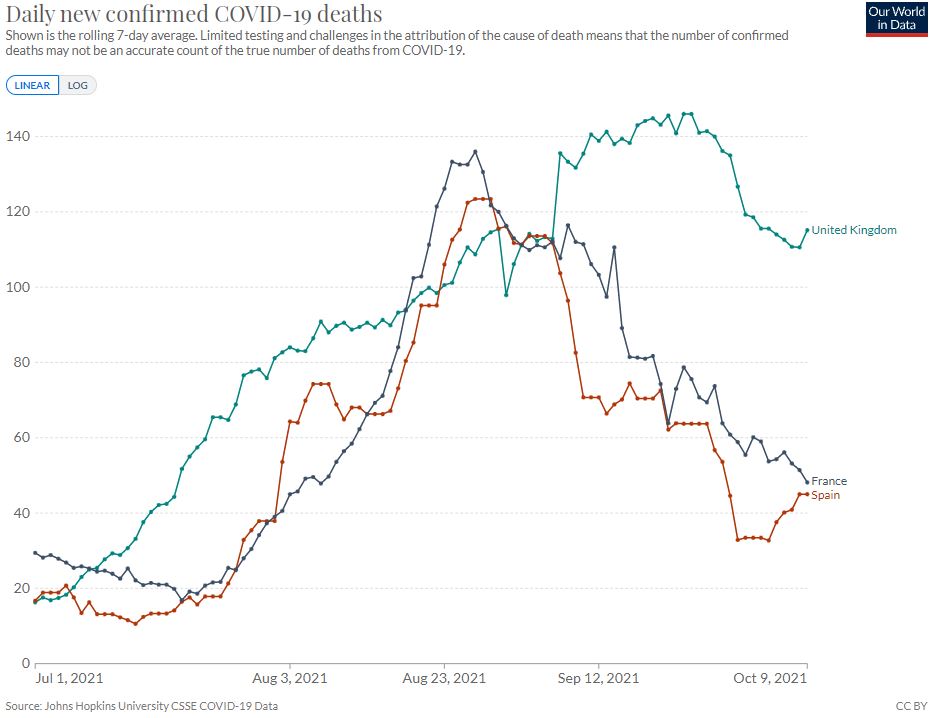
We see deaths following cases with the expected lag. Whereas we saw cases in Spain fall at the beginning of August and France towards the end, deaths in Spain started falling at the beginning of September and in France a few weeks later. To see what that means in terms of the actual number of deaths, let’s look at the same chart in terms of actual numbers of people.


Currently in the UK just under 120 people are dying of COVID each day, while in France and Spain the number is less than half that. So to answer the question of the title, it is likely that around 70 people are currently dying each day as a result of Johnson’s decision to remove all COVID restrictions. That is about 1,700 extra deaths (comparing UK to France) and rising since the beginning of September. Were those extra deaths worth it in terms of freeing many people from wearing a mask and from other modest inconveniences?


For those who are tempted to say 1,700 deaths are small compared to the pandemic total of 137,000 we have already seen, I would say you are not comparing like with like. That huge total was mainly a result of poor use of lockdowns before most people were vaccinated. What we have seen since September, and is likely to continue for some months to come, are deaths when most but not all people were vaccinated, and could have been avoided with modest preventative measures enforced while vaccine coverage was extended to everyone willing. Allowing those people to die when the end (complete as possible coverage) is in sight because he and his MPs didn’t like wearing masks reflects the values of our Prime Minister and his party.


Complicit in all this are those who are supposed to hold our politicians to account, but many of whom instead act more like cheerleaders. Summary numbers appear on news bulletins in a way that makes them meaningless. There is rarely any attempt to place them in context by comparing them with other countries, or to give them a human face. When the BBC finally did the international comparison, as I was writing this blog (but see here), they had the gall to say it had “gone almost unnoticed”. Our leader has declared that we now live with COVID, and our media has by and large decided it is therefore yesterday’s news.


[1] Of course it’s not just about ending compulsory mask wearing that led to these extra deaths. There is an indifference to children getting COVID, starting with abolishing mask wearing before adults, and continuing with no programme to increase school ventilation, and ending with a much slower extension of vaccination to teenagers than in other countries, like Scotland, which is ultimately under the government’s control. It’s about not imposing vaccine passports for certain events, something France has done which has encouraged vaccine take-up. Basically while nearly all other countries continued with personal restrictions designed to bring down cases and continued the drive to vaccinate, Johnson’s government effectively declared in July that the pandemic was over.

Tuesday, 5 October 2021

Are there good reasons why Starmer preferred fighting the left to Biden’s unity approach?


The Democratic primaries for the 2020 presidential election turned into a two horse race between the candidate of the left, Sanders, and the candidate of the centre, former Vice President Biden. Their political style and positions were very different, with Sanders being a bit like Jeremy Corbyn and Biden a bit like Kier Starmer. But when Biden won, he united the party under a common platform, and his government in some areas has been surprisingly left wing.


Starmer too won against a candidate from the left, and he did so on a unity ticket. In reality Starmer has followed a very different path. I don’t want to examine whether Starmer always planned to confront the left, or whether he wanted to try unity but was persuaded or pushed to do otherwise, because I doubt anyone really knows. Instead I want to look at whether the unity approach that Biden had followed could have succeeded in the UK?


The reasons for asking that question are fairly obvious. Biden was successful, and although differences remain sharp the Democratic party has so far avoided any major schisms, in part because in some areas Democratic policy has shifted to the left. In contrast the template for Starmer today is the divisions of the 1980s, and it took two election defeats (under Kinnock) before Labour regained power. For these and many other reasons, the unity approach would seem more attractive.


I can think of two broad classes of explanation for why the Biden approach cannot be replicated here. The first relates to the Labour party itself, and the second relates to the media. Please remember that in setting these arguments out I’m trying to test if they hold water rather than advocating them.


In the US having politicians who call themselves socialists is something of a novelty. In contrast the left and centre in Labour go back a long way, to the battles of the 1980s. The general feeling among many party centrists is that Labour were only able to win in 1997 by ‘taking on’ the left in the 1980s.


To this group, the election of Jeremy Corbyn in 2015 was a total disaster, and many did their best to undermine his leadership. The 2017 result, rather than leading this group to revise its view that the left can never win, is put down to a poor Tory campaign. Any unity campaign would have to overcome such views.


On the left, too often principles far outweigh the need to win elections. Too often the last Labour government is derided for its failures and its successes ignored. There is a danger that any leader who tried a unity path would find the left gradually peeling themselves away as red line after red line (for them) was crossed. It is much easier in the US political structure to hold a diversity of views and not feel personally compromised by the compromises of others.


The right wing media is more powerful in the UK than in the US. The reach of the right wing press as a proportion of the population is greater than Fox News, and crucially it also has a strong influence on what the BBC shows in its flagship news programmes. Their default story about Labour is battles between left and centre, so they are likely to highlight any differences as part of a never ending war. They would constantly try to derail a unity ticket.


Perhaps the clearest example of that was after the EHRC report on antisemitism within the Labour party. In Starmer’s response to the report he warned that he would not tolerate anyone seeking to downplay the problem. He added that the Labour Party would not “tolerate the argument that denies or minimises antisemitism on the basis that it’s been exaggerated”. When Corbyn in his response to the report claimed that the problem had been “dramatically overstated for political reasons by our opponents inside and outside the party, as well as by much of the media”, he was suspended by Starmer.


As I said at the time, to say that anyone claiming the media exaggerates the extent of antisemitism within Labour is minimising actual antisemitism is not only factually false, but also gives the media license to claim what they like with no possible comeback from the Labour leadership. But in ruling that any claim of media exaggeration was minimising the problem, Starmer was only following the media itself.


So if Starmer had not reacted to Corbyn’s response, I would have no doubt that the media (including much of the Jewish press) would have said he wasn’t taking the problem seriously. The presence of Corbyn in the Labour party is a problem for some Jewish voters. Starmer clearly wanted to stop the antisemitism issue hanging over Labour, and he would have found that much more difficult if he had ignored Corbyn’s response. On the other hand, by taking the stand he did, he started a war with the left which probably contributed to a decline in his poll ratings.


To the right wing press, and therefore BBC journalists as well, Starmer would have been constantly associated with the 2019 failure and the Corbyn left if he had attempted to unite the party. Every statement by left wing MPs that the right wing press could portray in a bad light would be thrown at Starmer to condemn. It is for reasons like this that every new Labour leader likes to draw a line between themselves and an unsuccessful past.


If those arguments seem compelling, you have to acknowledge the problems with the path Starmer has chosen. To much of the public, being tough on the left of the party just looks to them like a reminder of internal divisions. Indeed that is one reason why the right wing media encourages that approach. You also lose a large number of Labour members, and the income that goes with those members, and a good part of your activist army to deploy during elections. You also lose many voters to either not voting, or voting Green, which is a serious problem if (as at present) there are no attempts at cooperation.


Ironically the split between the Labour leadership and the Labour left is not fundamentally about policy, unless you believe (as some on the left do) that any departure from Corbyn’s agenda or Starmer’s 10 pledges is a betrayal. As Andrew Fisher notes, many of the policies that Starmer has already announced are from the 2019 manifesto. The pledge on Green Investment is substantial, and abolishing VAT relief on private school fees is a significant attack on privilege. Labour’s appeal to the electorate has to be radical on economics to attract the socially conservative voters that put Johnson in power. This could have been the basis of a Biden style united left, if only Labour’s centre could tolerate the left, compromise was more acceptable to the left, and Starmer could have ignored constant media attempts to divide the party. That was not the path Starmer chose, and if he fails badly at the next election (and I hope he does not) he may regret not choosing it.


Anyone on the left or centre whose plan involves a loss in the next election, because they are playing a long game, has to ask themselves whether there will still be a game by then. As Jonathan Freedland notes, at the next we will have a rigged electorate and no independent electoral commission (although I argued in 2019 that it was obvious that Johnson would do things like this after he suspended parliament). If he wins another five years in power, Johnson could try and make it completely impossible for Labour, or even a progressive alliance, to ever win again.