Noah Smith has a
good piece
on what seems like the never ending stream of popular articles in the
UK slagging off economics (or economists). Here
I outlined three potential reasons for this epidemic: people do not
understand unconditional macro forecasts, politicians from the right
do not like economists spoiling their pet schemes (e.g. Brexit), and
many heterodox economists from the left wage endless war against the
mainstream. All these complaints get airtime when the economy is bad.
The UK economy,
right now, is perhaps in a worse state than at any time in the last
eighty years. As John Lewis shows in this Bank blog, productivity
growth has perhaps never been as bad as it is now: we have to go back
to before 1800 to find anything comparable.

The natural reaction when the economy is bad is to criticise economists. That was what happened after the Global Financial Crisis, with some justification. But what is happening in the UK right now is mainly a result of first austerity and then Brexit. As I explained in detail in my earlier post, if we had followed the advice of mainstream economics austerity and Brexit would not have happened. [1] I have as yet not read a single critique of economics that has pointed that fact out, which if you think about it is extraordinary.
There is a little
more to say about why economics is an easy target. Historically it
has been very insular, and in this respect quite unlike other social
sciences. I have already discussed the paper
by Haldane and Turrell in the OXREP Rebuilding Macroeconomic Theory
volume on Agent Based Models, but I did not have space to show an
interesting chart from the introduction to that paper.
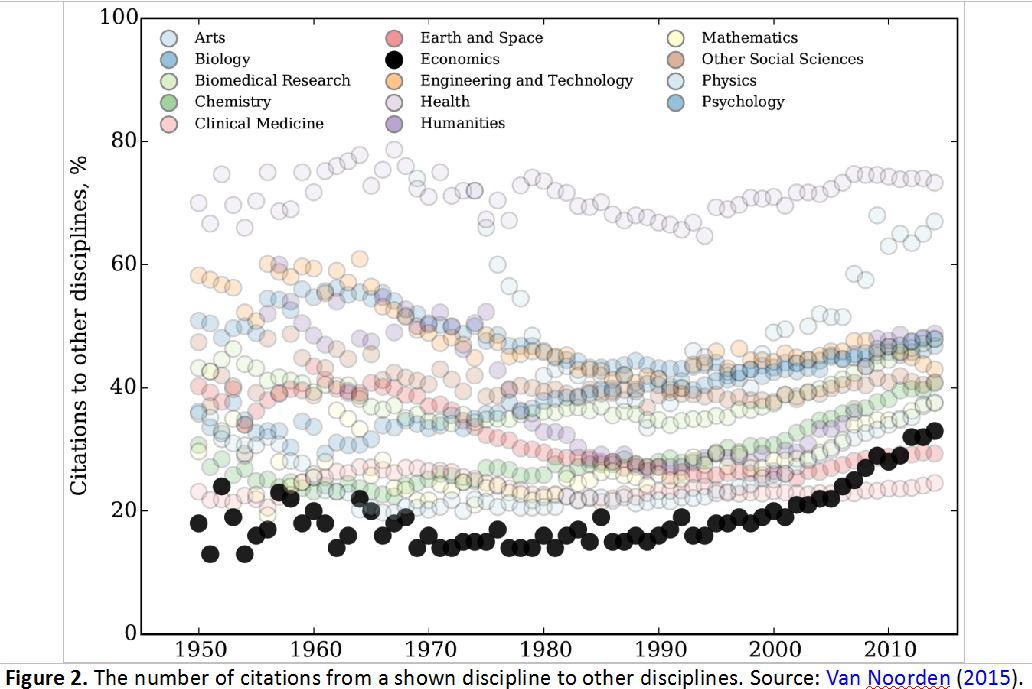
It tracks citations
in papers to those in other disciplines. Until around 2000, there
was no doubt which was the most insular discipline: economics. This
is no surprise to me and I suspect most social scientists.
The paper does not
explore the reasons why economics is so self-referential: their aim
is simply to suggest that it needs to look to other disciplines to
see what methods they use. Here I want to sketch why I think
mainstream economics (and here the qualification mainstream is
required) is so insular.
I once gave a
lecture course on the methodology of economics, and in one lecture I
used a large blackboard to describe how nearly all economics can be
derived from the basic axioms of rational choice. For example the
modern macroeconomics of consumption is just the choice between
buying apples or pears transformed to the choice between consumption
at different times. In that sense economic theory is like an immense
tree, where every branch deductively builds on this core. Sometimes
large branches grow by adding new elements, like asymmetric
information, which then becomes part of the tree and can be used by
other branches. This deductive tree of economic theory did not grow
all by itself: its growth was and is influenced by the real world
problems it wanted to address.
In using the idea of explaining decisions by optimising welfare under constraints economists have created a whole
series of widely applicable tools. Economists naturally think about
opportunity costs, adverse selection, moral hazard, incentives etc. There is something distinctive about thinking like an economist. To say, as Tom Clark does here,
that sometimes this is just formalising common knowledge may be true
(see also Cahal Moran here),
but in many cases it is not. Try persuading someone who has invested
in what is now a sub-optimal project about sunk costs.
This body of theory
includes the neoclassical economics that heterodox economists and
others love to hate, but it also includes game theory that has
applications well beyond economics, and more. In my first year of studying
economics I was told in some lectures that this whole endeavour was a huge
ideologically driven misstep, but I began to see it differently after
reading this famous 1963 paper
by Arrow. It shows why (asymmetric) uncertainty in the health service
means that the standard competitive model just cannot work for
medical care. That may be obvious to us in the UK but it appears otherwise to many in the US. To be fair Clark also acknowledges that this economic theory has
produced positive successes: he mentions auction theory but there are
many
more.
As to ideology, if
you want an effective critique of neoliberalism you have to use
economics (see, for example Colin Crouch’s book
on neoliberalism or this
by Dani Rodrik). So many critiques of economics use a kind of
bastardised version that insists that workers are always paid their
marginal products that the political right also employs. But monopoly
and monopsony power are also part of the deductive tree. A paper I
like to refer to in this context is by Piketty, Saez and Stantcheva (discussed here) which uses a simple bargaining model to show how cutting the top rate
of tax can increase pre-tax CEO pay.
There is nothing
like this deductive tree in other social sciences, and I think it at
least partly explains why economics used to be so insular. As
non-economists academics seemed to add little to building on this
theory, there seemed little point in collaborating or even citing
them. But, from the point of view of other disciplines, it was worse
than that. Economics could also be imperialistic. Its methods, both
theoretical and empirical, could be applied to other fields (with
varying degrees of success): here
is David Hendry applying his econometric methods to climate change,
for example. So not only did economists not talk much to other social
sciences, they trod on toes as well.
But although there
may still be important branches to be added [2], the limitations of what
you can do with a few axioms about rational choice have led in recent
years to economics becoming much more empirical, and much less tied
to this deductive theory. (See the article
by Noah Smith which began this post. Unfortunately in my view an
exception to this trend so far is macroeconomics.). We can see this
in the citations data above, and the most obvious manifestation is
behavioural economics. But a more immediate example of a data rather than theory based idea is the gravity
model in international trade, which lies at the heart of why Brexit is such a bad idea. It
is irony indeed that just at the point at which we have all these
articles attacking economics, a large number of people who believe the UK is committing a large act of self harm are seeing the
virtue of just one small part of what economists do.
Having said all
this, I think there is an unfortunate hangover from this insularity.
As a discipline economics shows little interest in
communicating its core knowledge to others [3]. This can be true both
within academia and with the outside world. Within academia
publishing in top economics journals still has far higher status than
top journals in other disciplines. When it comes to policy and the
public, there is a belief among many that when either requires our
wisdom, they will seek out the best of us for advice. In part this
epidemic of articles about the failings of economics reflects this
communication failure. More importantly, both Brexit and Trump should
be a wake up call that economists as a collective has to get better
at communicating the core insights of economics.
[1] There are of
course more underlying problems
behind the UK productivity crisis beyond the negative shocks of
austerity and Brexit. But economists overwhelmingly argue for more
R&D spending and more public investment. In short if you want
someone to blame for why the UK economy is currently in such a dire
state, blame those who have ignored the advice of economists.
[2] Most of the good criticisms that I see of economics amount to requests to add to the tree. But economics is so rich that most things are possible. In part (but only in part) what is done follows the money: you will find it relatively easy to get money for work on free trade compared to work on rent seeking. To blame economists for that is just bad economics. As economists found out after the financial crisis, they had many tools to understand what had happened, but had just not applied them before the crisis.
[3] I say as a discipline because I mean economists as a collective, not as individuals. There is no equivalent institutional infrastructure in economics to that built by the hard sciences. Of course many individual economists do their best, but there are also others who ignore the consensus to plug their own personal ideas or to further some political or ideological cause.


