Winner of the New Statesman SPERI Prize in Political Economy 2016


Showing posts with label methodology. Show all posts

Wednesday, 10 October 2018

Talk on where macroeconomics went wrong


I gave a short talk yesterday with this title, which takes some of the main points from my paper in the  OXREP 'Rebuilding Macro' volume  It is mainly of interest to economists, or those interested in economic methodology or the history of macroeconomic thought. When I talk about macroeconomics and macroeconomists below I mean mainstream academic economists.  

I want to talk today about where macroeconomics went wrong. Now it seems that this is a topic where everyone has a view. But most of those views have a common theme, and that is a dislike of DSGE models. Yet DSGE models are firmly entrenched in academic macroeconomics, and in pretty well every economist that has done a PhD, which is why the Bank of England’s core model is DSGE. To understand why DSGE is so entrenched, I need to tell the story of the New Classical Counter Revolution (NCCR).

If you had to pick a paper that epitomised the NCCR it would be “After Keynesian Macroeconomics” by Lucas and Sargent. Now from the title you would think this was an attack on Keynesian Economics, and in part it was. But we know that revolution failed. Very soon after the NCCR we had the birth of New Keynesian economics that recast key aspects of Keynesian economics within a microfoundations [1] framework, and is now the way nearly all central banks think about stabilisation policy. But if you read the text of Lucas and Sargent it is mainly a manifesto about how to do macroeconomics, or what I think we can reasonably call the methodology of macroeconomics.And on that their revolution was successful, and it is why nearly all academic macro is DSGE.

Before Lucas and Sargent complete macroeconomic models, of both a theoretical and empirical kind, had justified their aggregate equation using an eclectic mix of theory and econometrics. Microfoundations were used as a guide to aggregate equation specification, but if this equation fell apart in statistical terms when confronted with data in would not become part of an empirical model, and would be shunned for inclusion in theoretical models. Off course ‘falling apart ‘ is a very subjective criteria, and every effort would be made to try and make an equation consistent with microfoundations, but typically a lot of the dynamics in these models were what we would now call ad hoc, which in this case meant data based. .

Lucas famously showed that models of this kind were subject to what we call the Lucas critique [2], and that forms an important part of Lucas and Sargent paper. They argue that the only certain way to get round that critique is to build the model from internally consistent microfoundations. But they also ask why wouldn’t you want to build any macroeconomic model that way? Why wouldn’t you want a model where you could be sure that aggregate outcomes were the result of agents behaving in a consistent manner

If you want to crystallise why this was a methodological revolution, think about what we might call admissibility criteria for macro models. In pre-NCCR models equations were selected through an eclectic mixture of theory-fit and evidence-fit. In the RBC and later DSGE models internal theoretical consistency is an admissibility criteria. Or to put it another way, a DSGE model never got rejected because one of its equations didn’t fit the data, but if one equation had a theoretical foundation that was inconsistent with the others it would certainly not be published in the better journals.

Have a look at almost any macro paper in a top journal today, and compare it to a similar paper before the NCCR, and you can see we have been through a methodological revolution. Unfortunately many economists who have only been taught and who only known DSGE just think of this as progress. But it is not just progress, because DSGE models involve a shift away from the data. This is inevitable if you change the admissibility criteria away from the data. It inevitably means macroeconomists start focusing on models where it is easy to ensure internal theoretical consistency, and away from macroeconomic phenomenon that are clear in the data but more difficult to microfound.

If you are expecting me at this point to say that DSGE models where were macroeconomics went wrong, you will be disappointed. I spent the last 15 years of my research career building and analysing DSGE models, and I learnt a lot as a result. The mistake was the revolution part. In the US, DSGE models replaced traditional modelling within almost a decade [3]. In my view DSGE models should have coexisted with more traditional modelling, each tolerating the other.

To get a glimpse of how that can happen look at the UK, where a traditional macromodelling scene remained active until the end of the millenium. Traditional models didn’t stand sill, but changed by adopting many of the ideas from DSGE such as rational expectations. Here the account gets a little personal, because before I did DSGE I built one of those models, called COMPACT. There are not many macroeconomists who have built and operated both traditional and DSGE models, which I think gives me some insight of the merits of both.

COMPACT was a rational expectations New Keynesian model with explicit credit constraints in a Blanchard-Yaari type consumption function, a vintage production model, and variety effects on trade. So in terms of theoretical ideas it was far richer than any DSGE model I subsequently worked with. Most of COMPACT’s behavioural equations were econometrically estimated, but it was not an internally consistent model like DSGE.

COMPACT had an explicit but exogenous credit constraint variable in the model because in our view it was impossible to model consumption behaviour over time without it. Our work was based heavily on work in the UK by John Muellbauer, and Chris Carroll was coming to similar conclusions for the US. But DSGE models never faced that issue because they worked with de-trended data. Let me spell out why that was important. Empirical work was establishing that you could not begin to understand consumption behaviour over a 20/30 year time horizon without seeing how the financial sector had changed over time, and at least one traditional macroeconomic model was incorporating that finding before the end of the last millennium.. Extensive work on exactly that issue did not begin using DSGE models until after the financial crisis, where changes in the financial sector had a critical impact on the real economy. DSGE was behind the curve, but more traditional macroeconomics was not. .

Now I don’t think it is fanciful to think that if at least some macroeconomists had continued working with more traditional data-based models alongside those doing DSGE, at least one of those models would have thought to endogenise the financial sector which was determining those varying credit constraints.

So the claim I want to make is rather a big one. If DSGE models had continued alongside more traditional, data-based modelling, economists would have been much better prepared for the financial crisis when it came. If these two methodologies had learnt from each other, DSGE models might have started focusing on the financial sector before the crisis. Of course I would never suggest that macroeconomics could have predicted that crisis, but macroeconomists would have certainly had much more useful things to say about the impact on the economy when it happened.

Just being able to imagine this being true illustrates that moving to DSGE involved losses as well as gains. It inevitably made models less rich and moved them further away from the data in areas that were difficult but not impossible to model in a theoretically consistent way. The DSGE methodological revolution set out so clearly in Lucas and Sargent's paper changed the focus of macroeconomics away from things we now know were of critical importance.

I’ve been talking about this since I started writing a blog at the end of 2011, but recently we have seen similar messages from Paul Romer and Olivier Blanchard in this OxREP volume. What I have called here traditional models, and in the paper I call Structural Econometric Models, Blanchard calls provocatively policy models. It was provocative because most academic macroeconomists think DSGE models are the only models that can do policy analysis ‘properly’, but Blanchard suggests policymakers want models that are closer to the data more than they want a guarantee of internal consistency, and they want models that are quick and easy to adapt to unfolding problems. The US Fed, although it has a DSGE model, also has a more traditional model that has similarities to a traditional model like COMPACT, and guess which model plays the major role in the policy process?

[1] Microfoundations means deriving aggregate equations from microeconomic optimisation behaviour

[2] The Lucas critique argued that many equations of traditional macroeconomic models embodied beliefs about macro policy, and so if policy changed the equations would no longer be valid.

[3] The difficulty of identification in single equation estimation highlighted by Sims in 1980 probably also contributed.  . 

Wednesday, 2 May 2018

Why was economics so insular?


Noah Smith has a good piece on what seems like the never ending stream of popular articles in the UK slagging off economics (or economists). Here I outlined three potential reasons for this epidemic: people do not understand unconditional macro forecasts, politicians from the right do not like economists spoiling their pet schemes (e.g. Brexit), and many heterodox economists from the left wage endless war against the mainstream. All these complaints get airtime when the economy is bad.

The UK economy, right now, is perhaps in a worse state than at any time in the last eighty years. As John Lewis shows in this Bank blog, productivity growth has perhaps never been as bad as it is now: we have to go back to before 1800 to find anything comparable.


The natural reaction when the economy is bad is to criticise economists. That was what happened after the Global Financial Crisis, with some justification. But what is happening in the UK right now is mainly a result of first austerity and then Brexit. As I explained in detail in my earlier post, if we had followed the advice of mainstream economics austerity and Brexit would not have happened. [1] I have as yet not read a single critique of economics that has pointed that fact out, which if you think about it is extraordinary.

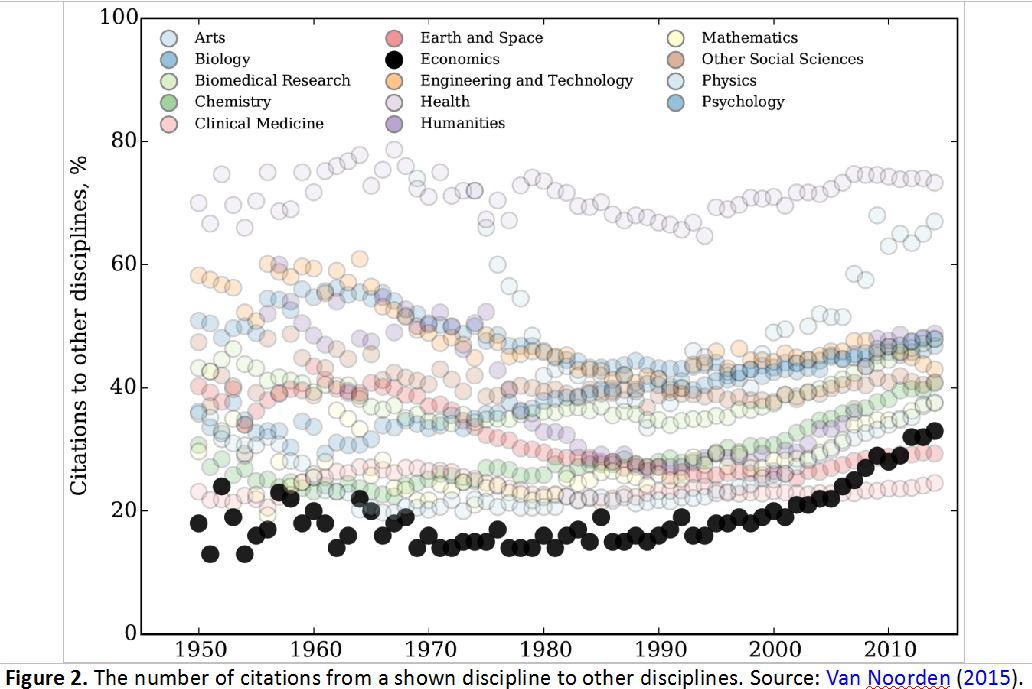
There is a little more to say about why economics is an easy target. Historically it has been very insular, and in this respect quite unlike other social sciences. I have already discussed the paper by Haldane and Turrell in the OXREP Rebuilding Macroeconomic Theory volume on Agent Based Models, but I did not have space to show an interesting chart from the introduction to that paper.


It tracks citations in papers to those in other disciplines. Until around 2000, there was no doubt which was the most insular discipline: economics. This is no surprise to me and I suspect most social scientists.

The paper does not explore the reasons why economics is so self-referential: their aim is simply to suggest that it needs to look to other disciplines to see what methods they use. Here I want to sketch why I think mainstream economics (and here the qualification mainstream is required) is so insular.

I once gave a lecture course on the methodology of economics, and in one lecture I used a large blackboard to describe how nearly all economics can be derived from the basic axioms of rational choice. For example the modern macroeconomics of consumption is just the choice between buying apples or pears transformed to the choice between consumption at different times. In that sense economic theory is like an immense tree, where every branch deductively builds on this core. Sometimes large branches grow by adding new elements, like asymmetric information, which then becomes part of the tree and can be used by other branches. This deductive tree of economic theory did not grow all by itself: its growth was and is influenced by the real world problems it wanted to address.

In using the idea of explaining decisions by optimising welfare under constraints economists have created a whole series of widely applicable tools. Economists naturally think about opportunity costs, adverse selection, moral hazard, incentives etc. There is something distinctive about thinking like an economist. To say, as Tom Clark does here, that sometimes this is just formalising common knowledge may be true (see also Cahal Moran here), but in many cases it is not. Try persuading someone who has invested in what is now a sub-optimal project about sunk costs.

This body of theory includes the neoclassical economics that heterodox economists and others love to hate, but it also includes game theory that has applications well beyond economics, and more. In my first year of studying economics I was told in some lectures that this whole endeavour was a huge ideologically driven misstep, but I began to see it differently after reading this famous 1963 paper by Arrow. It shows why (asymmetric) uncertainty in the health service means that the standard competitive model just cannot work for medical care. That may be obvious to us in the UK but it appears otherwise to many in the US. To be fair Clark also acknowledges that this economic theory has produced positive successes: he mentions auction theory but there are many more.

As to ideology, if you want an effective critique of neoliberalism you have to use economics (see, for example Colin Crouch’s book on neoliberalism or this by Dani Rodrik). So many critiques of economics use a kind of bastardised version that insists that workers are always paid their marginal products that the political right also employs. But monopoly and monopsony power are also part of the deductive tree. A paper I like to refer to in this context is by Piketty, Saez and Stantcheva (discussed here) which uses a simple bargaining model to show how cutting the top rate of tax can increase pre-tax CEO pay.

There is nothing like this deductive tree in other social sciences, and I think it at least partly explains why economics used to be so insular. As non-economists academics seemed to add little to building on this theory, there seemed little point in collaborating or even citing them. But, from the point of view of other disciplines, it was worse than that. Economics could also be imperialistic. Its methods, both theoretical and empirical, could be applied to other fields (with varying degrees of success): here is David Hendry applying his econometric methods to climate change, for example. So not only did economists not talk much to other social sciences, they trod on toes as well.

But although there may still be important branches to be added [2], the limitations of what you can do with a few axioms about rational choice have led in recent years to economics becoming much more empirical, and much less tied to this deductive theory. (See the article by Noah Smith which began this post. Unfortunately in my view an exception to this trend so far is macroeconomics.). We can see this in the citations data above, and the most obvious manifestation is behavioural economics. But a more immediate example of a data rather than theory based idea is the gravity model in international trade, which lies at the heart of why Brexit is such a bad idea. It is irony indeed that just at the point at which we have all these articles attacking economics, a large number of people who believe the UK is committing a large act of self harm are seeing the virtue of just one small part of what economists do.

Having said all this, I think there is an unfortunate hangover from this insularity. As a discipline economics shows little interest in communicating its core knowledge to others [3]. This can be true both within academia and with the outside world. Within academia publishing in top economics journals still has far higher status than top journals in other disciplines. When it comes to policy and the public, there is a belief among many that when either requires our wisdom, they will seek out the best of us for advice. In part this epidemic of articles about the failings of economics reflects this communication failure. More importantly, both Brexit and Trump should be a wake up call that economists as a collective has to get better at communicating the core insights of economics.

[1] There are of course more underlying problems behind the UK productivity crisis beyond the negative shocks of austerity and Brexit. But economists overwhelmingly argue for more R&D spending and more public investment. In short if you want someone to blame for why the UK economy is currently in such a dire state, blame those who have ignored the advice of economists.

[2] Most of the good criticisms that I see of economics amount to requests to add to the tree. But economics is so rich that most things are possible. In part (but only in part) what is done follows the money: you will find it relatively easy to get money for work on free trade compared to work on rent seeking. To blame economists for that is just bad economics. As economists found out after the financial crisis, they had many tools to understand what had happened, but had just not applied them before the crisis.   

[3] I say as a discipline because I mean economists as a collective, not as individuals. There is no equivalent institutional infrastructure in economics to that built by the hard sciences. Of course many individual economists do their best, but there are also others who ignore the consensus to plug their own personal ideas or to further some political or ideological cause.


Wednesday, 12 April 2017

Economics is an inexact science

When I wrote about why the BBC should treat a clear consensus in economics the same way as it now treated climate science, I got a number of comments about why economics is not a science. A common theme was that economics couldn’t prove theories ‘beyond doubt’ the same way as the hard sciences could. A more sophisticated version of this complaint is that most economic theories cannot be disproved in the same way that Popper thought scientific theories could be disproved.

All this ignores a key feature of any social science, which is their inexact nature. Instead we have accumulations of evidence that confirm the applicability of some theories and reject the applicability of others. Economists’ views about what models are applicable change as this evidence accumulates.

A good example involves the minimum wage, as Noah Smith suggests. The basic economic model suggested even a modest minimum wage should significantly reduce employment, but economists discovered that the evidence did not show this. As this evidence accumulated, alternative theories and models (monopsony and search) were thought to be more relevant. It is this response to evidence that makes economics a science.

Jo Michell writes “The scientific method of forming a hypothesis and then testing that hypothesis against reality can never be the final arbiter of knowledge, as it can in the physical sciences.” He is right that no single experiment or regression can kill a theory, but wrong that the accumulation of evidence is not the final arbiter, because no other arbiter is available. He links to a post by Noah Smith which talks about the failures of forecasting. But as that post makes clear, this is not about data rejecting models, but the inability of models to predict the future. We would never dream of condemning medics because they cannot predict the exact time of our death, still less suggest that this failure indicates they are not doing science.

Of course economics involves cases where economists appear too reluctant to give up their favoured models. You can find similar stories in the hard sciences. There will be more such stories in economics because the inexact nature of economics makes it easier to discount any single piece of evidence. What I cannot understand is what leads someone like Russ Roberts to argue against the use of evidence, and instead that “economics is primarily a way of organizing one’s thinking”. Astrology is also a way of organising one’s thinking, but it fails because evidence does not back it up.

That comparison is slightly unfair, because while the theory behind astrology is obviously implausible, the basic principles of microeconomics are not. In a class on economic methodology I once drew a huge tree that showed how most of economics could be derived from principles of rational choice. But go beyond the basics, and add in complications involving information and transactions costs (to name but two) and you very quickly derive competing models. There is no single model that comes from thinking like an economist, so for that reason alone we need data to tell us which models are more applicable.

So thinking like an economist does not tell me at what point raising the minimum wage will reduce employment. But why would anyone want to keep their models from being proved relevant or otherwise by data? The only reason I can think of is that some models give answers that are ideologically convenient. Of course allowing data to establish the relevance of some models over others does not make economics ideology proof. For example people can always select the one study that suggests that fiscal policy does not influence output and ignore the hundreds that show otherwise. That is why the accumulation of evidence, which includes its replicability, is so important. If you think economics has problems in that respect, have a look at psychology.

This is why economists views about the long term impact of Brexit should be treated as knowledge rather than just an opinion. Here knowledge is shorthand for the accumulation of evidence consistent with plausible theory. Sometimes the theories are common sense, like making trade more difficult will reduce trade. Estimates of the size of trade reduction based on evidence are uncertain, but they are better than estimates based on wishful thinking. Empirical gravity equations consistently show that geography still matters a lot in determining how much is traded. Finally there is clear evidence that trade is positively associated with productivity growth. To say that all this has no more worth than some politicians opinion is ultimately to degrade evidence and the science which interprets it.


Sunday, 15 January 2017

Blanchard joins calls for Structural Econometric Models to be brought in from the cold

Mainly for economists

Ever since I started blogging I have written posts on macroeconomic methodology. One objective was to try and convince fellow macroeconomists that Structural Econometric Models (SEMs), with their ad hoc blend of theory and data fitting, were not some old fashioned dinosaur, but a perfectly viable way to do macroeconomics and macroeconomic policy. I wrote this with the experience of having built and published papers with both SEMs and DSGE models.

Olivier Blanchard’s third post on DSGE models does exactly the same thing. The only slight confusion is that he calls them ‘policy models’, but when he writes

“Models in this class should fit the main characteristics of the data, including dynamics, and allow for policy analysis and counterfactuals.”

he can only mean SEMs. [1] I prefer SEMs to policy models because SEMs describe what is in the tin: structural because they utilise lots of theory, but econometric because they try and match the data.

In a tweet, Noah Smith says he is puzzled. “What else is the point of DSGEs??” besides advising policy he asks? This post tries to help him and others see how the two classes of model can work together.

The way I would estimate a SEM today (but not necessarily the only valid way) would be to start with an elaborate DSGE model. But rather than estimate this model using Bayesian methods, I would use it as a theoretical template with which to start econometric work, either on an equation by equation basis or as a set of sub-systems. Where lag structures or cross equation restrictions were clearly rejected by the data, I would change the model to more closely match the data. If some variables had strong power in explaining others but were not in the DSGE specification, but I could think of reasons for a causal relationship (i.e. why the DSGE specification was inadequate), I would include them in the model. That would become the SEM. [2]

If that sounds terribly ad hoc to you, that is right. SEMs are an eclectic mix of theory and data. But SEMs will still be useful to academics and policymakers who want to work with a model that is reasonably close to the data. What those I call DSGE purists have to admit is that because DSGE models do not match the data in many respects, they are misspecified and therefore any policy advice from them is invalid. The fact that you can be sure they satisfy the Lucas critique is not sufficient compensation for this misspecification.

By setting the relationship between a DSGE and a SEM in the way I have, it makes it clear why both types of model will continue to be used, and how SEMs can take their theoretical lead from DSGE models. SEMs are also useful for DSGE model development because their departures from DSGEs provide a whole list of potential puzzles for DSGE theorists to investigate. Maybe one day DSGE will get so good at matching the data that we no longer need SEMs, but we are a long way from that.

Will what Blanchard and I call for happen? It already does to a large extent at the Fed: as Blanchard says what is effectively their main model is a SEM. The Bank of England uses a DSGE model, and the MPC would get more useful advice from its staff if this was replaced by a SEM. The real problem is with academics, and in particular (as Blanchard again identified in an earlier post) journal editors. Of course most academics will go on using DSGE, and I have no problem with that. But the few who do instead decide to use a SEM should not be automatically shut out from the pages of the top journals. They would be at present, and I’m not confident - even with Blanchard’s intervention - that this is going to change anytime soon.


[1] What Ray Fair, longtime builder and user of his own SEM, calls Cowles Commission models.

[2] Something like this could have happened when the Bank of England built BEQM, a model I was consultant on. Instead the Bank chose a core/periphery structure which was interesting, but ultimately too complex even for the economists at the Bank.

Friday, 15 January 2016

Heterodox economists and mainstream eclecticism

I knew when I wrote this post some economists would not like it. These are economists who locate themselves outside the mainstream: heterodox economists. They often claim that mainstream economics is this narrow discipline wedded to particular assumptions that are both implausible and ideological. So when I argue that in principle and practice it is not, they will not like it. Simply saying (as I do) that economists are often too reluctant (sometimes for good reason in terms of the sociology of economists) to explore this freedom is not enough for them. Some of them require mainstream economics to be beyond redemption.

Sure enough, Lars Syll attacks my post. He writes 
“And just as his colleagues, when it really counts, Wren-Lewis shows what he is — a mainstream neoclassical economist fanatically defending the insistence of using an axiomatic-deductive economic modeling strategy.” 

I can only think that reading my post got him so angry he temporarily lost his critical faculties. Because what he writes is completely false. I wrote a comment on his blog but it has not appeared, although fortunately Bruce Wilder makes my point in very gentle terms. As I have been here before with Syll (see the footnote to this post), I will be less gentle.

My post ended with the following sentence:
“Mainstream academic macro is very eclectic in the range of policy questions it can address, and conclusions it can arrive at, but in terms of methodology it is quite the opposite.”

I argue in the post that “this non-eclecticism in terms of excluding non-microfounded work is deeply problematic.” I then link to my many earlier posts where I have expanded on this theme. So how I can be a fanatic defender of insisting that this modelling strategy be used escapes me. Unless I have misunderstood what an ‘axiomatic-deductive’ strategy is. Perhaps for Syll not following this strategy means being able to completely (180 degrees completely) misrepresent what someone else says.

That out of the way, I wanted to say something more substantive. In macro, the insistence on using microfounded models also works as an exclusion device. (I am suggesting this as a fact, not a deliberate strategy.) You cannot just write down an aggregate macro model, based on other people’s work or empirical findings or whatever. You have to microfound it, and that requires a lot of skill and practice, as many a PhD student has found out.

If it also turns out when doing this that the issue you want to address or the innovation you want to make is ‘difficult’ in terms of finding an acceptable microfoundation, there are many wise supervisors who will suggest that the student tries something else. It is hardly surprising that this might put some people off mainstream macro.

I think some knowledge of these things is essential - the kind of knowledge to be able to read and understand a journal article. But the depth of knowledge required to be able to create your own microfounded model, if your own interests are more empirical but you nevertheless want to explore the implications of your empirical work for the economy as a whole? Here I think what Lars Syll says has validity. But his wish to tar even the critics of this aspect of mainstream macro with this brush is just bizarre. More generally heterodox economists misdirect their fire when they accuse mainstream macro of being inescapably narrow in its subject matter or assumptions, when their criticism should be directed at the limitations implied by microfoundations formalism.


Friday, 3 April 2015

Do not underestimate the power of microfoundations

Mainly for economists

Brad DeLong asks why the New Keynesian (NK) model, which was originally put forth as simply a means of demonstrating how sticky prices within an RBC framework could produce Keynesian effects, has managed to become the workhorse of modern macro, despite its many empirical deficiencies. (Recently Stephen Williamson asked the same question, but I suspect from a different perspective!) Brad says his question is closely related to the “question of why models that are microfounded in ways we know to be wrong are preferable in the discourse to models that try to get the aggregate emergent properties right.”

I would guess the two questions are in fact exactly the same. The NK model is the microfounded way of doing Keynesian economics, and microfounded (DSGE) models are de rigueur in academic macro, so any mainstream academic wanting to analyse business cycle issues from a Keynesian perspective will use a variant of the NK model. Why are microfounded models so dominant? From my perspective this is a methodological question, about the relative importance of ‘internal’ (theoretical) versus ‘external’ (empirical) consistency.

As macro 50 years ago was very different, it is an interesting methodological question to ask why things changed, even if you think the change has greatly improved how macro is done (as I do). I would argue that the New Classical (counter) revolution was essentially a methodological revolution. However there are two problems with having such a discussion. First, economists are usually not comfortable talking about methodology. Second, it will be a struggle to get macroeconomists below a certain age to admit this is a methodological issue. Instead they view microfoundations as just putting right inadequacies with what went before.

So, for example, you will be told that internal consistency is clearly an essential feature of any model, even if it is achieved by abandoning external consistency. You will hear how the Lucas critique proved that any non-microfounded model is inadequate for doing policy analysis, rather than it simply being one aspect of a complex trade-off between internal and external consistency. In essence, many macroeconomists today are blind to the fact that adopting microfoundations is a methodological choice, rather than simply a means of correcting the errors of the past.

I think this has two implications for those who want to question the microfoundations hegemony. The first is that the discussion needs to be about methodology, rather than individual models. Deficiencies with particular microfounded models, like the NK model, are generally well understood, and from a microfoundations point of view simply provide an agenda for more research. Second, lack of familiarity with methodology means that this discussion cannot presume knowledge that is not there. (And arguing that it should be there is a relevant point for economics teaching, but is pointless if you are trying to change current discourse.) That makes discussion difficult, but I’m not sure it makes it impossible.


Wednesday, 30 July 2014

Methodological seduction

Mainly for macroeconomists or those interested in economic methodology. I first summarise my discussion in two earlier posts (here and here), and then address why this matters.

If there is such a thing as the standard account of scientific revolutions, it goes like this:

1) Theory A explains body of evidence X

2) Important additional evidence Y comes to light (or just happens)

3) Theory A cannot explain Y, or can only explain it by means which seem contrived or ‘degenerate’. (All swans are white, and the black swans you saw in New Zealand are just white swans after a mud bath.)

4) Theory B can explain X and Y

5) After a struggle, theory B replaces A.

For a more detailed schema due to Lakatos, which talks about a theory’s ‘core’ and ‘protective belt’ and tries to distinguish between theoretical evolution and revolution, see this paper by Zinn which also considers the New Classical counterrevolution.

The Keynesian revolution fits this standard account: ‘A’ is classical theory, Y is the Great Depression, ‘B’ is Keynesian theory. Does the New Classical counterrevolution (NCCR) also fit, with Y being stagflation?

My argument is that it does not. Arnold Kling makes the point clearly. In his stage one, Keynesian/Monetarist theory adapts to stagflation, using the Friedman/Phelps accelerationist Phillips curve. Stage two involves rational expectations, the Lucas supply curve and other New Classical ideas. As Kling says, “there was no empirical event that drove the stage two conversion.” I think from this that Paul Krugman also agrees, although perhaps with an odd quibble.

Now of course the counter revolutionaries do talk about the stagflation failure, and there is no dispute that stagflation left the Keynesian/Monetarist framework vulnerable. The key question, however, is whether points (3) and (4) are correct. On (3) Zinn argues that changes to Keynesian theory to account for stagflation were progressive rather than contrived, and I agree. I also agree with John Cochrane that this adaptation was still empirically inadequate, and that further progress needed rational expectations (see this separate thread), but as I note below the old methodology could (and did) incorporate this particular New Classical innovation.

More critically, (4) did not happen: New Classical models were not able to explain the behaviour of output and inflation in the 1970s and 1980s, or in my view the Great Depression either. Yet the NCCR was successful. So why did (5) happen, without (3) and (4)?

The new theoretical ideas New Classical economists brought to the table were impressive, particularly to those just schooled in graduate micro. Rational expectations is the clearest example. Ironically the innovation that had allowed conventional macro to explain stagflation, the accelerationist Phillips curve, also made it appear unable to adapt to rational expectations. But if that was all, then you need to ask why New Classical ideas could have been gradually assimilated into the mainstream. Many of the counter revolutionaries did not want this (as this note from Judy Klein via Mark Thoma makes clear), because they had an (ideological?) agenda which required the destruction of Keynesian ideas. However, once the basics of New Keynesian theory had been established, it was quite possible to incorporate concepts like rational expectations or Ricardian Eqivalence into a traditional structural econometric model (SEM), which is what I spent a lot of time in the 1990s doing.

The real problem with any attempt at synthesis is that a SEM is always going to be vulnerable to the key criticism in Lucas and Sargent, 1979: without a completely consistent microfounded theoretical base, there was the near certainty of inconsistency brought about by inappropriate identification restrictions. How serious this problem was, relative to the alternative of being theoretically consistent but empirically wide of the mark, was seldom asked.   

So why does this matter? For those who are critical of the total dominance of current macro microfoundations methodology, it is important to understand its appeal. I do not think this comes from macroeconomics being dominated by a ‘self-perpetuating clique that cared very little about evidence and regarded the assumption of perfect rationality as sacrosanct’, although I do think that the ideological preoccupations of many New Classical economists has an impact on what is regarded as de rigueur in model building even today. Nor do I think most macroeconomists are ‘seduced by the vision of a perfect, frictionless market system.’ As with economics more generally, the game is to explore imperfections rather than ignore them. The more critical question is whether the starting point of a ‘frictionless’ world constrains realistic model building in practice.

If mainstream academic macroeconomists were seduced by anything, it was a methodology - a way of doing the subject which appeared closer to what at least some of their microeconomic colleagues were doing at the time, and which was very different to the methodology of macroeconomics before the NCCR. The old methodology was eclectic and messy, juggling the competing claims of data and theory. The new methodology was rigorous! 

Noah Smith, who does believe stagflation was important in the NCCR, says at the end of his post: “this raises the question of how the 2008 crisis and Great Recession are going to affect the field”. However, if you think as I do that stagflation was not critical to the success of the NCCR, the question you might ask instead is whether there is anything in the Great Recession that challenges the methodology established by that revolution. The answer that I, and most academics, would give is absolutely not – instead it has provided the motivation for a burgeoning literature on financial frictions. To speak in the language of Lakatos, the paradigm is far from degenerate.  

Is there a chance of the older methodology making a comeback? I suspect the place to look is not in academia but in central banks. John Cochrane says that after the New Classical revolution there was a split, with the old style way of doing things surviving among policymakers. I think this was initially true, but over the last decade or so DSGE models have become standard in many central banks. At the Bank of England, their main model used to be a SEM, was replaced by a hybrid DSGE/SEM, and was replaced in turn by a DSGE model. The Fed operates both a DSGE model and a more old-fashioned SEM. It is in central banks that the limitations of DSGE analysis may be felt most acutely, as I suggested here. But central bank economists are trained by academics. Perhaps those that are seduced are bound to remain smitten.


Tuesday, 13 May 2014

Humility and Chameleons

Macroeconomics tells you to (temporarily) raise, not cut, government spending when we have a recession caused by deficient demand and interest rates are at their lower bound. That is the claim that some of us make. Others say we are being far too sure of ourselves and our subject, in part because there exist models where this is not true. As a result, we should not loudly complain when politicians do not follow this advice. A bit more humility please.

If you think we should have more humility, imagine the following. The UK or US government tomorrow abolishes their independent central bank, and immediately raises rates to 5%, saying it was about time savers had a better deal. Well macroeconomists generally think that independent central banks are a good idea, and we nearly all believe that raising interest rates when inflation is below target and unemployment is high is crazy. But wait a minute. There are models that suggest keeping interest rates low is causing low inflation, and that raising rates could stimulate the economy - I discuss one here. So perhaps we should not be critical of a government that did this. We should be humble, and leave the politicians to do as they please while we get on with our research. Let us make sure we are absolutely sure before shouting too loud.

Why is that wrong? Two reasons. First, the existence of a model that says higher interest rates could stimulate the economy is not in itself evidence that it might. In an interesting paper, Paul Pfleiderer talks about Chameleon models. He defines a chameleon model as “built on assumptions with dubious connections to the real world but nevertheless has conclusions that are uncritically (or not critically enough) applied to understanding our economy.” The model that I discussed where higher rates could stimulate the economy assumes (among other things) agents believe the inflation target is negative, and that raising rates will show them they are wrong. Possible, but highly improbable.

Second, economic policy always takes place in an uncertain environment. Raising interest rates might have reduced inflation in the past, but maybe this time is different? If we wait until we are all absolutely sure about the impact of a policy change, we will wait forever. However, if we are more than 90% certain that raising interest rates, or cutting government spending, will make the recession worse, we should say so. If politicians ignore this advice, we should make sure everyone knows. This is no intellectual game - people’s welfare is at stake.


Friday, 9 May 2014

Economists and methodology

Where I argue that mainstream economics should think about the methodology of their subject more, but that to study this methodology it is much better to look at what economists actually do than to look at their (occasional) writing on the subject.

Methodology? Why should I worry about that? It’s what all those heterodox people do - lots of ‘isms’ and ‘ologies’ that are totally incomprehensible! Unlike those guys, I get on with doing real economics. After all, doctors do not spend large amounts of their time worrying about the methodology of medicine. So why should economists?

This is a caricature, but not far off the mark for many economists. (When I refer to just economists/economics from now on, I mean mainstream.) Perhaps more of a concern is that very few economists write much about methodology. This would be understandable if economics was just like some other discipline where methodological discussion was routine. This is not the case. Economics is not like the physical sciences for well known reasons. Yet economics is not like most other social sciences either: it is highly deductive, highly abstractive (in the non-philosophical sense) and rarely holistic. This is all nicely expressed in the title of what I think is one of the best books written on economic methodology: Dan Hausman’s ‘The inexact and separate science of economics’.

This is a long winded way of saying that the methodology used by economics is interesting because it is unusual. Yet, as I say, you will generally not find economists writing about methodology. One reason for this is the one implied by my opening paragraph: a feeling that the methodology being used is unproblematic, and therefore requires little discussion.

I cannot help giving the example of macroeconomics to show that this view is quite wrong. The methodology of macroeconomics in the 1960s was heavily evidence based. Microeconomics was used to suggest aggregate relationships, but not to determine them. Consistency with the data (using some chosen set of econometric criteria) often governed what was or was not allowed in a parameterised (numerical) model, or even a theoretical model. It was a methodology that some interpreted as Popperian. The methodology of macroeconomics now is very different. Consistency with microeconomic theory governs what is in a DSGE model, and evidence plays a much more indirect role. Now I have only a limited knowledge of the philosophy of science, and have only published one paper on methodology, but I know enough to recognise this as an important methodological change. Yet I find many macroeconomists just assume that their methodology is unproblematic, because it is what everyone mainstream currently does.  

This reluctance by economists to investigate their own methodology has a consequence which is the main subject of this post. It occurred to me when I recently re-read a methodology paper entitled “Two Responses to the Failings of Modern Economics: the Instrumentalist and the Realist” by Tony Lawson. The paper, written in 2001, starts on the first page with “There is little doubt that the modern discipline of economics is in a state of some disarray.” This is a strong claim. For example, I have previously written that the influence of economists within the UK government at that time may have been at an all time high, and as this account (pdf) shows, economics remains very influential within the civil service. Where is the evidence for the claim about disarray? The answer in this paper is a selection of quotes from economists writing about aspects of their subject. Now any economist would immediately wonder how representative these quotes were. But more fundamentally, are expressions of concern within a discipline equivalent to it being ‘in disarray’? (For example, see the first quote from a physicist here. Would this be a good basis for a paper that asserts than physics is in disarray?)

Even if we ignore these concerns, given the unfamiliarity of most economists with methodological discussion, it may be unwise to use what economists write about their discipline as evidence about what economists actually do.  The classic example of an economist writing about methodology is Friedman’s Essays in Positive Economics. This puts forward an instrumentalist view: the idea that realism of assumptions do not matter, it is results that count.

Yet does instrumentalism describe Friedman’s major contributions to macroeconomics? Well one of those was the expectations augmented Phillips curve. Before his famous 1968 presidential lecture, the Phillips curve had related wage inflation to unemployment, and if expectations about inflation were included (in some way), the coefficient on this expectations term was often empirically determined (see above) and was often less than one. Friedman argued that the coefficient on expected inflation should be one. His main reason for doing so was not that such an adaptation predicted better, but because it was based on better assumptions about what workers were interested in: real rather nominal wages. In other words, it was based on more realistic assumptions. (For a good discussion of the history of the ‘expectations critique’, see this paper by James Forder.)

Economists do not think enough about their own methodology. This means economists are often not familiar with methodological discussion, which implies that using what they write on the subject as evidence about what they do can be misleading. Yet most methodological discussion of economics is (and should be) about what economists do, rather than what they think they do. That is why I find that the more interesting and accurate methodological writing on economics looks at the models and methods economists actually use, rather than relying on selected quotations.

Afterthought

There is a nice self-conformational element to this post. Someone is bound to tell me that, in my comments on Freidman, I do not really understand what instrumentalism means. And that, of course, just goes to make my point that you should not rely on what economists say about their own methodology!


Friday, 25 April 2014

Retiring macroeconomic theory

Dear Professor Diamond

Thank you for sending your paper ‘National Debt in a Neoclassical Growth Model’ to the American Economic Review. The paper has now been read by two referees, and I’m afraid the news is not good.

Referee A raises a fundamental objection. Your model has a two period structure, where agents work in the first period but do not work in the second. This assumption is simply stated in one paragraph on your page 2, but is not justified in any way. In that sense it appears entirely ad hoc. Furthermore, as referee A stresses, it appears to contradict (is internally inconsistent with) another fundamental part of you model, which is that agents attempt to smooth consumption over time. The referee is quite happy with that assumption, as it clearly comes from standard postulates about the utility of the consumption of goods. Yet why should these postulates not also apply to the consumption of leisure? As the referee points out, if agents tried to smooth leisure in the same way as they smoothed consumption, there would not be any ‘retirement’. As this concern strikes at the heart of your model, it is troubling.

Referee B raised rather different issues. They pointed out that the model implies a constant interest rate that is only a function of the population growth rate. The model therefore makes a clear prediction, but as the referee points out interest rates have fallen in this country over the last two decades, without any matching declines in the population growth rate. So the model has been clearly falsified by events, and therefore cannot be the basis of any meaningful discussion of the impact of national debt. The referee is also concerned that you failed to locate your analysis within an ontological discussion of the open rather than closed nature of the social realm, which makes your deductivist and formalist reasoning about socially constructed variables problematic, to say the least.

I am therefore very sorry to inform you that we will be unable to publish your paper. Referee A did make a number of helpful suggestions about how ‘retirement’ could be microfounded, and I am sure you will find the extensive reading list referee B provided on economic methodology helpful in any future work. 


My apologies to Nick Rowe, whose post gave me the idea. I actually think asking the question why we have retirement is revealing, but writing the above was easier than attempting an answer. (And I also think economic methodology is important!)  

Thursday, 19 December 2013

More on the illusion of superiority

For economists, and those interested in methodology

Tony Yates responds to my comment on his post on microfoundations, but really just restates the microfoundations purist position. (Others have joined in - see links below.) As Noah Smith confirms, this is the position that many macroeconomists believe in, and many are taught, so it’s really important to see why it is mistaken. There are three elements I want to focus on here: the Lucas critique, what we mean by theory and time.

My argument can be put as follows: an ad hoc but data inspired modification to a microfounded model (what I call an eclectic model) can produce a better model than a fully microfounded model. Tony responds “If the objective is to describe the data better, perhaps also to forecast the data better, then what is wrong with this is that you can do better still, and estimate a VAR.” This idea of “describing the data better”, or forecasting, is a distraction, so let’s say I want a model that provides a better guide for policy actions. So I do not want to estimate a VAR. My argument still stands.

But what about the Lucas critique? Surely that says that only a microfounded model can avoid the Lucas critique. Tony says we might not need to worry about the Lucas critique if policy changes are consistent with what policy has done in the past. I do not need this, so let’s make our policy changes radical. My argument still stands. The reason is very simple. A misspecified model can produce bad policy. These misspecification errors may far outweigh any errors due to the Lucas critique. Robert Waldmann is I think making the same point here. (According to Stephen Williamson, even Lucas thinks that the Lucas critique is used as a bludgeon to do away with ideas one doesn't like.)

Stephen thinks that I think the data speaks directly to us. What I think is that the way a good deal of research is actually done involves a constant interaction between data and theory. We observe some correlation in the data and think why that might be. We get some ideas. These ideas are what we might call informal theory. Now the trouble with informal theory is that it may be inconsistent with the rest of the theory in the model - that is why we build microfounded models. But this takes time, and in the meantime, because it is also possible that the informal theory may be roughly OK, I can incorporate it in my eclectic model.[1] In fact we could have a complete model that uses informal theory - what Blanchard and Fischer call useful models. The defining characteristic of microfounded models is not that they use theory, but that the theory they use can be shown to be internally consistent.

Now Tony does end by saying “ad-hoc modifications seem attractive if they are a guess at what a microfounded model would look like, and you are a policymaker who can’t wait, and you find a way to assess the Lucas-Critique errors you might be making.” I have dealt with the last point – it’s perfectly OK to say the Lucas critique may apply to my model, but that is a price worth paying to use more evidence than a microfounded model does to better guide policy. For the sake of argument let’s also assume that one day we will be able to build a microfounded model that is consistent with this evidence. (As Noah says, I’m far too deferential, but I want to persuade rather than win arguments.) [2] In that case, if I’m a policy maker who cannot wait for this to happen, Tony will allow me my eclectic model.

This is where time comes in. Tony’s position is that policymakers in a hurry can do this eclectic stuff, but we academics should just focus on building better microfoundations. There are two problems with this. First, building better microfoundations can take a very long time. Second, there is a great deal that academics can say using eclectic, or useful, models.

The most obvious example of this is Keynesian business cycle theory. Go back to the 1970s. The majority of microfoundations modellers at that time, New Classical economists, said price rigidity should not be in macromodels because it was not microfounded. I think Tony, if he had been writing then, would have been a little more charitable: policymakers could put ad hoc price rigidities into models if they must, but academics should just use models without such rigidities until those rigidities could be microfounded.

This example shows us clearly why eclectic models (in this case with ad hoc price rigidities) can be a far superior guide for policy than the best microfounded models available at the time. Suppose policymakers in the 1970s, working within a fixed exchange rate regime, wanted to devalue their currency because they felt it had become overvalued after a temporary burst of domestic inflation. Those using microfounded models would have said there was no point - any change in the nominal exchange rate would be immediately offset by a change in domestic prices. (Actually they would probably have asked how the exchange rate can be overvalued in the first place.) Those using eclectic models with ad hoc price rigidities would have known better. Would those eclectic models have got things exactly right? Almost certainly not, but they would have said something useful, and pointed policy in the right direction.

Should academic macroeconomists in the 1970s have left these policymakers to their own devices, and instead got on with developing New Keynesian theory? In my view some should have worked away at New Keynesian theory, because it has improved our understanding a lot, but this took a decade or two to become accepted. (Acceptance that, alas, remains incomplete.) But in the meantime they could also have done lots of useful work with the eclectic models that incorporated price stickiness, such as working out what policies should accompany the devaluation. Which of course in reality they did: microfoundations hegemony was less complete in those days.

Today I think the situation is rather different. Nearly all the young academic macroeconomists I know want to work with DSGE models, because that is what gets published. They are very reluctant to add what might be regarded as ad hoc elements to these models; however strong the evidence and informal theory might be that could support any modification. They are also understandably unclear about what counts as ad hoc and what does not. The situation in central banks is not so very different.

This is a shame. The idea that the only proper way to do macro that involves theory is to work with fully microfounded DSGE models is simply wrong. I think it can distort policy, and can hold back innovation. If our DSGE models were pretty good descriptions of the world then this misconception might not matter too much, but the real world keeps reminding us that they are not. We really should be more broad minded. 

[1] Suppose there is some correlation in the past that appears to have no plausible informal theory that might explain it. Including that in our eclectic model would be more problematic, for reasons Nick Rowe gives.


[2] I suggest why this might not be the case here. Nick Rowe discusses one key problem, while comments on my earlier post discuss others.