Winner of the New Statesman SPERI Prize in Political Economy 2016


Saturday, 5 May 2018

How to spot fraudulent economic arguments: an example from Lexit


When I last talked about Lexit, I said Lexiter arguments had “many structural similarities to right wing arguments for Brexit.” In this post I want to go further and suggest ways you can spot when economic arguments are fraudulent, using an article by Thomas Fazi and William Mitchell advocating Lexit as an example. To show how generic the tactics are, I will demonstrate how exactly the same techniques were used by those who argued for austerity.

The first sign that the wool is being pulled over your eyes is wildly exaggerating your opponents case. It is so much easier to attack a straw man. This particular article talks about the “Left’s anti-Brexit hysteria” i.e anyone who disagrees with us is acting hysterically. They talk about those opposing Brexit predicting “Brexit Armageddon”. The tactic works particularly well if you can find an example of someone who did exaggerate their case, and focus on how their fears have not come to pass.

I am very familiar with this tactic from the UK in 2013. From 2010 to 2012 growth was very low, and the expected recovery from the Great Recession did not materialise. People like myself blamed austerity, and we were quite right to do so. But some in 2012 made the foolish claim that the economy will never start growing again unless austerity came to an end. So when growth returned to trend in 2013, proponents of austerity used those claims to announce the critics were wrong and austerity had been vindicated. The example that Lexiters and Brexiters alike use is of course the Treasury short term post Brexit forecast.

That forecast was not about the longer term impact of Brexit, but uncertainty about the prospect of Brexit. It overestimated the immediate impact of Brexit. But the real question is not whether forecasts were wrong, but whether the Brexit announcement and subsequent uncertainty has damaged the UK economy. The article says the economy is still growing, and quotes some other selected statistics, implying all is fine. They do not mention that we have gone from the top to the bottom of the international growth league. Of course they cannot avoid acknowledging that sterling fell sharply on announcement. However they say but this has not destroyed the British economy: another straw man (who ever seriously said the depreciation would destroy the economy?!), and no mention of what the depreciation did do, which is cut the real incomes of workers. The debate over whether Brexit uncertainty has harmed the economy is over, as no one seriously thinks it has not. 

A second sign of a fraudulent argument is to focus on a single study that supports what you want to say, and ignore all the rest. The Brexiters have Minford of course, but Lexit have the study by Coutts, Gudgin and Buchanan (CGB) published by the Centre for Business Research (CBR) at Cambridge. Those advocating austerity had two well known papers: one suggested there was empirical evidence that high government debt reduced growth, and the other that austerity was expansionary. In all these cases the studies are outliers, so you need some reason why the majority of academic work can be discredited.

This leads to a third tactic: tar academic work that goes against what you say with some broad assertions that have only a grain of truth. If your audience has a political bias, play to it. With austerity it was that those against austerity were old fashioned Keynesians who just wanted a larger state. (Some were, but most were just using a much more modern Keynesian framework and its macroeconomics implications.) The way this paper does the same with the many studies that have suggested Brexit will be harmful in the longer term is so laughable I have to quote it:
“The neoliberal biases built into these models include the assertion that markets are self-regulating and capable of delivering optimal outcomes so long as they are unhindered by government intervention; that “free trade” is unambiguously positive; that governments are financially constrained; that supply-side factors are much more important than demand-side ones; and that individuals base their decision on “rational expectations” about economic variables, among others. Many of the key assumptions used to construct these exercises bear no relation to reality.”

It will be news to most trade economists whose work is the basis of the long term case against Brexit that they are assuming things like governments being financially constrained and rational expectations. A key part of why Brexit is a bad idea is the gravity equation, which says trade is more likely to take place with neighbouring countries. It is a robust empirical relationship that makes no assumptions about governments or markets at all. [1] The article pours scorn on the ‘neoliberal’ idea that openness to trade is good for the economy, and again neglects to say that the relationship linking openness to productivity growth is also empirical, not theoretical.

Another tactic that if you see being employed you should start to worry is to impugn the motives of your opponents. That may be a common enough tactic in political discourse, but not if you are trying to make a serious economic argument. It is notable how academic economists who have criticised the Brexit work of Minford for example do not try and suggest he is ideologically motivated. Being good academics they instead question the model he uses (e.g. no gravity) and how he uses it. That is what should be done. But this article tries to discredit the current government’s analysis of the impact of Brexit by implying the results have been fiddled to produce large numbers for the long term costs of Brexit. They write:
“The models are notoriously unreliable and easily manipulated to achieve whatever outcome one desires. The British government has refused to release the technical aspects of their modeling, which suggests they do not want independent analysts examining their “black box” assumptions.”

Apparently the current UK government do not want us to see their workings because if we did we could see how they had fiddled results to make Brexit look bad. The attempt in this case is again laughable, because this government is pro-Brexit so any fiddling would go the other way.

All these four signs are easy to spot. The fifth is less obvious to the non-expert, which is to inconsistently use lots of broad brush statistics that do not get the heart of the issue, or which are problematic for other reasons. For example in arguing that Brexit has had as yet little impact on the economy they quote unemployment data, just as the government did from 2013 to argue that the economy was strong as a result of austerity. It is problematic because strong employment growth coupled with weak output growth means poor productivity. As I noted here, current productivity growth performance in the UK is worse than it has been for centuries.

In terms of broad brush statistics, they argue that GDP growth has been weaker rather than stronger than post-war trends as a result of EU membership, as if nothing else had been going on in all these years. The reality is that we joined the EU in part because our post-war growth and particularly productivity was worse than most other countries, and from the 1980s onwards it has if anything been better than other major countries. But why look at GDP rather than exports, where you would expect the impact of EU membership to be clearer. In fact the CGB study they quote from extensively does exactly this, and the following chart shows the results.


The benefits for UK exports of being in the single market are clear from this data. (To see how the CGB study erroneously avoids this conclusion, see here.)

There are of course plenty of Brexit specific points as well (the article does not even mention the Irish border), but this post is long enough already. I wrote it because it struck me when reading the Fazi and Mitchell article how similar its rhetorical devices were to those of many who tried to sell austerity. So if you read anything that wildly exaggerates the opposing position, focuses on a single academic study and ignores the rest, particularly if it suggests that there is some generic problem with these other studies which may include the motives of those who did them, and if it uses broad brush statistics when it could have used data that was more relevant, beware that you may be reading a piece of political persuasion rather than serious analysis.

[1] The confusion is compounded when they quote Paul Romer’s criticism of macroeconomics, and then drop the macro bit to pretend that Romer was talking about the whole of economics.

Wednesday, 2 May 2018

Why was economics so insular?


Noah Smith has a good piece on what seems like the never ending stream of popular articles in the UK slagging off economics (or economists). Here I outlined three potential reasons for this epidemic: people do not understand unconditional macro forecasts, politicians from the right do not like economists spoiling their pet schemes (e.g. Brexit), and many heterodox economists from the left wage endless war against the mainstream. All these complaints get airtime when the economy is bad.

The UK economy, right now, is perhaps in a worse state than at any time in the last eighty years. As John Lewis shows in this Bank blog, productivity growth has perhaps never been as bad as it is now: we have to go back to before 1800 to find anything comparable.


The natural reaction when the economy is bad is to criticise economists. That was what happened after the Global Financial Crisis, with some justification. But what is happening in the UK right now is mainly a result of first austerity and then Brexit. As I explained in detail in my earlier post, if we had followed the advice of mainstream economics austerity and Brexit would not have happened. [1] I have as yet not read a single critique of economics that has pointed that fact out, which if you think about it is extraordinary.

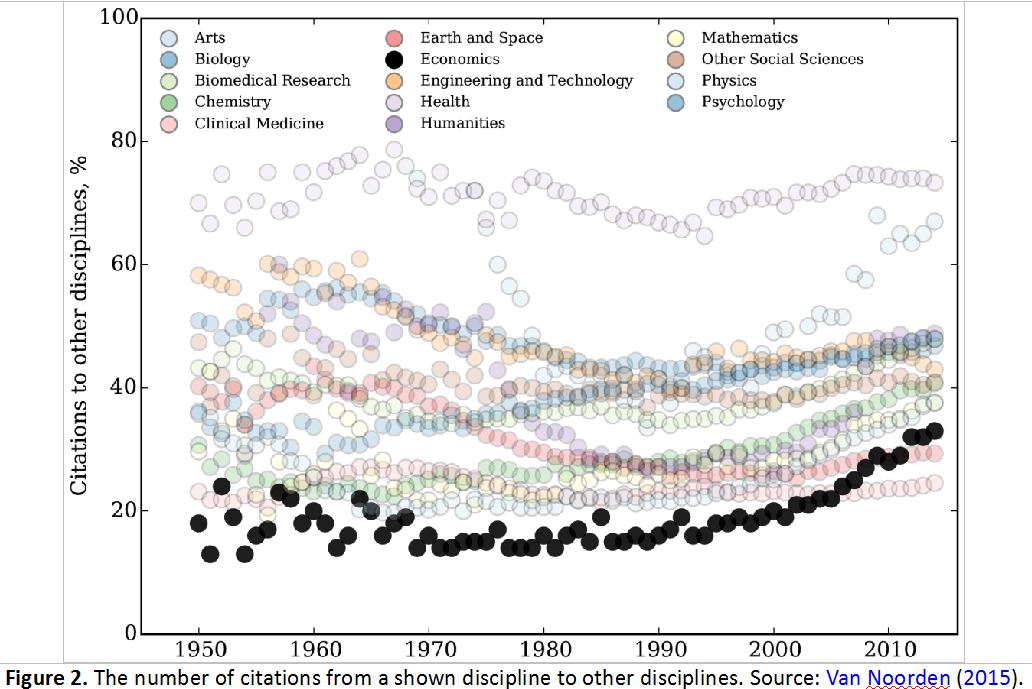
There is a little more to say about why economics is an easy target. Historically it has been very insular, and in this respect quite unlike other social sciences. I have already discussed the paper by Haldane and Turrell in the OXREP Rebuilding Macroeconomic Theory volume on Agent Based Models, but I did not have space to show an interesting chart from the introduction to that paper.


It tracks citations in papers to those in other disciplines. Until around 2000, there was no doubt which was the most insular discipline: economics. This is no surprise to me and I suspect most social scientists.

The paper does not explore the reasons why economics is so self-referential: their aim is simply to suggest that it needs to look to other disciplines to see what methods they use. Here I want to sketch why I think mainstream economics (and here the qualification mainstream is required) is so insular.

I once gave a lecture course on the methodology of economics, and in one lecture I used a large blackboard to describe how nearly all economics can be derived from the basic axioms of rational choice. For example the modern macroeconomics of consumption is just the choice between buying apples or pears transformed to the choice between consumption at different times. In that sense economic theory is like an immense tree, where every branch deductively builds on this core. Sometimes large branches grow by adding new elements, like asymmetric information, which then becomes part of the tree and can be used by other branches. This deductive tree of economic theory did not grow all by itself: its growth was and is influenced by the real world problems it wanted to address.

In using the idea of explaining decisions by optimising welfare under constraints economists have created a whole series of widely applicable tools. Economists naturally think about opportunity costs, adverse selection, moral hazard, incentives etc. There is something distinctive about thinking like an economist. To say, as Tom Clark does here, that sometimes this is just formalising common knowledge may be true (see also Cahal Moran here), but in many cases it is not. Try persuading someone who has invested in what is now a sub-optimal project about sunk costs.

This body of theory includes the neoclassical economics that heterodox economists and others love to hate, but it also includes game theory that has applications well beyond economics, and more. In my first year of studying economics I was told in some lectures that this whole endeavour was a huge ideologically driven misstep, but I began to see it differently after reading this famous 1963 paper by Arrow. It shows why (asymmetric) uncertainty in the health service means that the standard competitive model just cannot work for medical care. That may be obvious to us in the UK but it appears otherwise to many in the US. To be fair Clark also acknowledges that this economic theory has produced positive successes: he mentions auction theory but there are many more.

As to ideology, if you want an effective critique of neoliberalism you have to use economics (see, for example Colin Crouch’s book on neoliberalism or this by Dani Rodrik). So many critiques of economics use a kind of bastardised version that insists that workers are always paid their marginal products that the political right also employs. But monopoly and monopsony power are also part of the deductive tree. A paper I like to refer to in this context is by Piketty, Saez and Stantcheva (discussed here) which uses a simple bargaining model to show how cutting the top rate of tax can increase pre-tax CEO pay.

There is nothing like this deductive tree in other social sciences, and I think it at least partly explains why economics used to be so insular. As non-economists academics seemed to add little to building on this theory, there seemed little point in collaborating or even citing them. But, from the point of view of other disciplines, it was worse than that. Economics could also be imperialistic. Its methods, both theoretical and empirical, could be applied to other fields (with varying degrees of success): here is David Hendry applying his econometric methods to climate change, for example. So not only did economists not talk much to other social sciences, they trod on toes as well.

But although there may still be important branches to be added [2], the limitations of what you can do with a few axioms about rational choice have led in recent years to economics becoming much more empirical, and much less tied to this deductive theory. (See the article by Noah Smith which began this post. Unfortunately in my view an exception to this trend so far is macroeconomics.). We can see this in the citations data above, and the most obvious manifestation is behavioural economics. But a more immediate example of a data rather than theory based idea is the gravity model in international trade, which lies at the heart of why Brexit is such a bad idea. It is irony indeed that just at the point at which we have all these articles attacking economics, a large number of people who believe the UK is committing a large act of self harm are seeing the virtue of just one small part of what economists do.

Having said all this, I think there is an unfortunate hangover from this insularity. As a discipline economics shows little interest in communicating its core knowledge to others [3]. This can be true both within academia and with the outside world. Within academia publishing in top economics journals still has far higher status than top journals in other disciplines. When it comes to policy and the public, there is a belief among many that when either requires our wisdom, they will seek out the best of us for advice. In part this epidemic of articles about the failings of economics reflects this communication failure. More importantly, both Brexit and Trump should be a wake up call that economists as a collective has to get better at communicating the core insights of economics.

[1] There are of course more underlying problems behind the UK productivity crisis beyond the negative shocks of austerity and Brexit. But economists overwhelmingly argue for more R&D spending and more public investment. In short if you want someone to blame for why the UK economy is currently in such a dire state, blame those who have ignored the advice of economists.

[2] Most of the good criticisms that I see of economics amount to requests to add to the tree. But economics is so rich that most things are possible. In part (but only in part) what is done follows the money: you will find it relatively easy to get money for work on free trade compared to work on rent seeking. To blame economists for that is just bad economics. As economists found out after the financial crisis, they had many tools to understand what had happened, but had just not applied them before the crisis.   

[3] I say as a discipline because I mean economists as a collective, not as individuals. There is no equivalent institutional infrastructure in economics to that built by the hard sciences. Of course many individual economists do their best, but there are also others who ignore the consensus to plug their own personal ideas or to further some political or ideological cause.


Monday, 30 April 2018

The strong economy: how Brexit dishonesty began


The first quarter growth figures for the UK are terrible, with GDP per head falling slightly, and they are consistent with an underlying economy which is very weak. As you can see from the chart below, quarter on previous year’s quarter growth in GDP per head was reasonable in 2014, but has been falling since. The economy has been suffering from Brexit uncertainty and the Brexit induced falls in real wages, and as I guessed immediately after the referendum the temporary boost to competitiveness has not been enough to offset this. (More discussion here.) [1]

UK GDP per head quarter on previous year’s quarter growth: source ONS

As Will Hutton says, in any other world there would be national soul searching. But the reaction of the Chancellor to the latest data is that it "reflects some impact from the exceptional weather that we experienced last month, but our economy is strong and we have made significant progress". The Chancellor says the economy is strong when GDP per head, the best measure of average prosperity we have, is falling. And the ONS said the weather had a relatively small impact.

This kind of Orwellian description of the economy (weak is strong) is something that I first noticed in the run up to the 2015 election. The first three years of the Coalition government were terrible in economic terms, and the government did not try to pretend otherwise. Everyone was expecting a recovery and it didn’t come. But that opened the way for dishonesty to emerge from 2013, as the economy began growing again.

UK growth in 2013 and 2014 was really no more than a return to normal growth, but it was enough for both the government and journalists to talk about a recovery, even though there are strong reasons for reserving the term recovery for growth that returns us to a pre-recession trend level of output. The idea that 2013 vindicated austerity was truely Orwellian: no economics student anywhere would get away with such a statement. The government started talking about a strong economy during that period.

The strong economy line became the Conservative’s key claim in the 2015 general election. The economy was pretty well their only strong point among voters, but that did not make the claim true. In reality we had the worst ‘recovery’ in centuries: it was not really a recovery at all because we did not move any closer to pre-crisis trends. Yet parts of the media - what I called mediamacro - accepted the strong economy line, and largely ignored an unprecedented fall in real wages and the associated decline in productivity growth the likes of which we have never seen before. For that reason I argued that the Conservatives won the election because of mediamacro.

When we see Brexiters repeat nonsense about borders between the EU and Switzerland, tell lies about how the EU stops trade with Africa and how they will spend the Brexit dividend they are simply continuing where Cameron and Osborne left off in describing the economy as strong. What Conservative politicians have learned is that the BBC in particular does not have either the expertise or the will to call Conservative politicians out on doublespeak. The more unscrupulous the politician the more they have exploited that weakness in our democracy.

[1] The response of Brexiters is to keep saying its not as bad as the government’s pre-referendum short term forecast. For some reason its a line that reminds me of this.


Friday, 27 April 2018

Macroeconomic Policy Reform the IPPR way


Monetary and fiscal policy makers in the UK seem to think they had a good recession. You can tell that because neither group seem particularly interested in learning any lessons. This is despite the fact that we had the deepest recession since the 1930s, and the slowest recovery for centuries. It is also despite the fact that the level of UK GDP is almost 20% below the level it would be if it had followed pre-recessions trends, and all previous recessions have had the economy catch up with that trend.

You can tell from this paragraph that I do think serious changes are required to how monetary and fiscal policy are done. So does the IPPR, and their detailed analysis and proposals are set out in a new report by Alfie Stirling. The analysis is not too technical, well presented, well researched and I agree with a great deal of what is said. I will look a monetary policy first, and then fiscal policy.

What the Great Recession showed us (although many macroeconomists already knew) is that once nominal interest rates hit their effective lower bound (ELB) [1], monetary policy makers lose their reliable means of combating a recession. The report is dubious about Quantitative Easing (QE) for much the same reason that I have been for anything other than a last resort instrument. In brief, the impact of QE is very uncertain because it is not routinely used, and in addition there may be important non-linearities. It is not a reliable alternative to interest rates.

The report makes much the same point about negative nominal interest rates: partially or perhaps fully removing the lower bound. To quote:
“Like QE, the impacts of negative rates are uncertain and, depending on the behavioural response from banks and savers, could actually reduce spending in the economy, or else increase the number of risky loans (see for example Eggertsson, Juelsrud and Wold 2017).”

I know some macroeconomists will disagree with that assessment, but I think the point is valid.

The report also rejects helicopter money as a solution to the ELB problem. Here I found their discussion less convincing, but they do recognise that a form of helicopter money has already been undertaken by some central banks through creating money to change the relationship between borrowing and lending rates, a point that Eric Lonergan has stressed.

The two reforms to monetary policy that have been suggested and which the report does support are adopting unemployment or nominal GDP as either a second target or as an intermediate target, and raising the inflation target by one or two percent. I have argued strongly for a dual mandate and also for using nominal GDP as an intermediate target, so I have no objections here.

The report recognises, however, that none of their proposed reforms to monetary policy eliminates the ELB problem completely. We have, inevitably, to think about the other reliable and effective instrument that we have to stimulate aggregate demand: fiscal policy. Their proposed fiscal rule is very similar to Labour’s fiscal credibility rule. It includes (a) a ‘knockout’ to switch to fiscal expansion if interest rates reach their ELB, (b) 5 year rolling target for a zero current balance (c) a 5 year rolling target for public investment (d) a similar target for debt to GDP. The last in this list you will not find in Portes and Wren-Lewis, in essence because it involves double counting, and debt targets are less robust to shocks than deficit targets.

If governments followed this fiscal rule, then the ELB would not be the serious problem that it is, because reliable fiscal stimulus would replace reliable monetary stimulus at the ELB. But the IPPR worry that governments might not do what the fiscal rule, and with the knockout what the Bank of England, tells them to do. They are concerned that what they call ‘surplus bias’ might be so strong that the government would not run the deficits that the Bank asks them to run.

To overcome this concern, they suggest an alternative to QE at the ELB: the Bank should create reserves to fund projects that are part of a National Investment Bank (NIB). The NIB would be independent of government in terms of the projects it funded (but not its high level mandate), and it would normally raise funds in the open market. (This makes it different from proposals that the NIB be entirely funded by the Bank: see here.) In an ELB recession, the Bank of England would ask the NIB to fund additional projects, with the Bank providing the finance.

As public investment is particularly effective as a countercyclical tool if undertaken immediately, and as it is usually possible to some degree to bring forward investment projects, this proposal seems a superior alternative to QE, as long as the link between additional purchases of NIB debt and additional investment by the NIB was reasonably clear. The key point here is that although conventional QE might try to stimulate private investment by reducing firm borrowing costs, in a situation where there is chronic lack of demand that can be like trying to push on a string. The same problem should not arise with an NIB. In that sense it just seems like a good idea.

Whether it would be enough alone to circumvent the problem of a rabid surplus bias government during a recession I doubt. The kind of public investment that is easy to ramp up quickly in a recession are things like flood defences or filling holes in the road, rather than the kind of things an NIB would fund. A government suffering strong surplus bias could cut these things quicker than an NIB could fund additional projects. Some form of QE would be more powerful in this respect. The danger in either case is that you just encourage the government to try and get down debt even faster: if QE gives money directly to people, the government just raises VAT.

How seriously should we worry about (design policy for) a government offsetting everything the Bank is able to do to stimulate demand in a recession? The answer may be given by imagining the following scenario. The government operates a fiscal rule that has an explicit ELB knockout. The Bank of England, when rates hit the ELB, requests the government undertake fiscal stimulus. If Cameron/Osborne had been faced with both those things, would they have still cut back public investment? I suspect the answer is no. That of course by implication means that central bankers in Europe played a large part in facilitating (or encouraging) austerity, which in the UK stemmed from a failure to admit the problems of the ELB because of a naive faith in QE.

Which brings us to central bank independence and what I call the conventional assignment (outwith the ELB, monetary policy deals with macroeconomic stabilisation). The IPPR stay with the mainstream macroeconomic consensus in wanting to keep both. People with a more MMT type view, like Richard Murphy, would reverse [2] the conventional assignment, and have fiscal policy doing the macroeconomic stabilisation. I have written a great deal on the distinction and will not repeat that here. However it is worth making one point on independence.

The reasons for making central banks independent are not peculiar to monetary policy. They are that if the complex task of macroeconomic stabilisation is left in the hands of politicians who get secret advice, they can mess things up for political ends. [3] Messing things up can be minor (e.g. delaying necessary measures), structural (e.g. time inconsistency) or explosive (e.g. hyperinflation). Austerity shows that this fear is justified. MMT’s answer to the IPPRs concern about a surplus bias government is that this is just a cost of democracy or the good guys would always be in power, which I suspect many might not find reassuring. Yet that is also why European central bank’s encouragement of austerity was far from helpful to the case for the delegation of macroeconomic stabilisation.

[1] 'Effective' because in practice it is up to the central bank to decide at what point they cannot reduce nominal rates further. 

[2] Not strictly true. In the conventional assignment monetary policy does inflation/aggregate demand and government looks after its debt, while in MMT fiscal does inflation/aggregate demand and government debt looks after itself.

[3] I hope time inconsistency can be subsumed under this broad definition.


Wednesday, 25 April 2018

Brexit: it’s the economics, stupid.


The Global Future report published about a week ago, and particularly the polls it contained, received some attention, but in my view not nearly as much as they deserved. Respondents were shown four possible Brexit scenarios, together with an estimate of what each would do to the amount of money available to spend on public services. One of these options was the government’s preferred bespoke deal. All the options were overwhelming rejected, by Leave voters.


The Jack of Kent blog had a take on something similar that could also be applied to this poll result, after a well known children’s book: ‘That’s not my Brexit!’. It is very apt for this poll because it makes clear that none of the four types of Brexit offered are remotely like the Brexit people voted for. What is wrong with EEA, FTA, WTO or Bespoke in the mind of these voters? They all imply substantially less money for public services. The Brexit people voted for involved more money for public services.

This fits with the finding that most Leave voters continue to believe that they will be better off in economic terms as a result of Brexit. Many voted for Brexit because they were told more money would go to the NHS. The Remain side said that would not happen because of adverse macroeconomic consequences, but many voters believed the Leave side when they said these claims were just Project Fear. They were told that the EU would not decrease the ability of UK firms to trade with the EU because it was not in the EU's interests to do so. 

This is why polls that ask “In hindsight, do you think Britain was right or wrong to vote to leave the European Union?” only show a narrow majority for staying in the EU. In answering that question most Leave voters still believe they will be better off after Brexit. When presented with specific options that show we will not be (i.e. when presented with likely reality), you get quite different answers.

Forget those who say that the Brexit vote was all about sovereignty and not about economics. Economics matters, and the poll shows that in this case it matters a lot more than sovereignty or immigration. What Project Fear achieved, with considerable help from the media, was to take the economic factors that mattered off the table, or even replace them with mythical economic gains. [1] Voters went for what they saw as certain: £350 million a week, plus less immigration reducing pressure on public services. Both were lies, but Leave voters did not know that. Which is why most Leave voters continue to believe they will be better off, and why none of the four options they were presented with in the Global Future poll was the Brexit they voted for.

In short, half of the voting public bought snake-oil believing the claims made for it. Most continue to believe the claims, and put down the fact that the government appears not to be delivering what they were promised to something other than that they were sold a pig in a poke. If you think that is implausibly foolish, your main source of news is probably not a pro-Brexit newspaper or even the BBC.

The implications of this are huge. The Global Future poll shows that most Leave voters, and certainly most voters, do not want any Brexit deal that is actually possible. They only want the impossible deal they were promised by Brexiters. That means that any referendum on the final deal that included the government’s own realistic assessment of its economic consequences would result in a massive majority to Remain in the EU.

This is why Brexiter claims that everyone (and for the maths to work it has to be almost everyone) who voted Leave knew that meant leaving the Customs Union are beside the point, as well as being as economical with the truth as most Brexiter claims. Most Leave voters probably had only a hazy idea of what the Customs Union and Single Market were, but most clearly wanted a Brexit that delivered more money for public services. As it is now quite clear that the Brexiters cannot deliver that, then there is no mandate for Brexit. That is what these polls show.

I do not normally disagree with Martin Wolf, but I do when he says another referendum would tear the country apart. Instead, it would be the opportunity for most of those that voted Leave to realise that what they voted for is not on the table because it is not possible, and for them to gracefully retreat by changing their minds in the privacy of the voting booth. On the other hand to continue with Brexit would do far more harm to the UK’s body politic. We would have allowed politicians to put forward a fantasy and get away with it, which means every election from now on will involve claims more and more divorced from reality. The government, desperate to avoid the disappointed expectations of Leave voters, will resort to ever more populist tactics. The lurch towards an anti-pluralist democracy that we have seen since the referendum result could become entrenched in the UK.

Governments have been elected making impossible claims before, but when it turns out that they cannot deliver they can get voted out after 5 or less years. We have to think of the referendum in the same terms. We will have had two years to see if the government can produce the Brexit people voted for, and what these polls show is that they have failed to do so. That may be no surprise to many, but it is news for Leave voters. These polls show that Leave voters do not want the Brexit that is likely to be delivered. To deny people the chance of recognising that the Brexit they voted for is not possible in a referendum on the final deal is deeply undemocratic.

[1] I argue Trump did something very similar.


Monday, 23 April 2018

A hostile environment


The received wisdom on immigration goes as follows. Growing public concern about increased immigration to the UK led the Coalition government to put in place a target for net migration, and then enact measures to achieve that target. Creating a ‘hostile environment’ to discourage immigration was part of that effort. The Windrush generation and descendants are unfortunate victims of overzealous or box ticking officials.

Almost everything in this received wisdom is wrong. Although immigration has never been popular, active concern as reflected in opinion polls increased followed the Conservative party highlighting the issue as a way to attack the then Labour government (Hague: foreign land, Howard: are you thinking what we are thinking), and more importantly an increasing number of articles in the right wing press portraying immigrants or asylum seekers in a negative light. Most people didn't think immigration was a problem locally, but they perceived it was a problem for the country as a whole. The best predictors of immigration concern was readership of the Mail, Express and Sun. 

In my post about neoliberal overreach, I listed austerity and immigration as the two ways in which the 2010 Coalition government went too far in an effort to achieve neoliberal goals. Austerity was what I call deficit deceit: using scare stories about the deficit to shrink the state. The focus on immigration with the tens of thousands target was also deceit because most of the government had no intention of achieving that target. The hostile environment policy was there for show, as part of the deceit. The 'go home' vans were meant to be seen by the public, not illegal immigrants. Most of the government knew that seriously trying to achieve their immigration target would damage the economy, but rather than tell the public this they continued the facade to take votes off Labour and UKIP. 

The facade came back to bite the Conservative government during the Brexit referendum. Cameron could not credibly start talking up the benefits of EU freedom of movement while at the same time putting policies in place that made it appear as if he was trying to hit his own immigration target, and then failing to do so. In that sense the Conservative's immigration policy created the Brexit disaster. 

Part of the facade of trying to hit that target was the hostile environment policy. Some ministers were right to suggest that the policy was “almost reminiscent of Nazi Germany”. To say that the policy only applied to illegal immigrants misses the key point: people were assumed guilty of being illegal until they could prove, and pay to prove, that they had a legitimate right to be here. Being assumed guilty could mean losing your job or your home. If the Home Office made a mistake, the applicant had to pay to try to put it right. If the mistake was large enough, they could be detained without trial.

What is worse, the policy entrapped landlords, employers and nurses into acting as extensions of this Home Office regime. Some, fearing the consequences of getting things wrong, were bound to be tempted to discriminate against anyone who was not white and did not have a British accent. In that sense the policy actively encouraged discrimination. But the Conservative party didn't mind, just as it didn't see any problem in conducting an Islamophobic campaign against Sadiq Kahn 

The hostile environment policy, like austerity, has ruined people’s lives. Some are Windrush, some are not. The Home Office were warned about how the policy was entrapping innocent people in 2014, but did nothing. Rudd and May could see what the policy was doing to innocent people caught in their net, and they made no attempt to change anything. They only acknowledged problems when they were forced to by public opinion. [1]

Like austerity, the Conservative party’s focus on immigration seemed like a useful political tactic at the time, as well as playing to the xenophobic elements in the party’s base. Like austerity, the policy started to do real harm to innocent people, yet the leadership showed no inclination to dilute or abandon their policy. While Cameron and Osborne could see that the immigration target was only there for show, they had given the responsibility of achieving it to someone who didn’t get the deceit. Worse still, Theresa May seemed quite happy with any collateral damage as she stubbornly pursued the impossible.

So austerity and the hostile environment continue, because the Chancellor and Prime Minister respectively are committed to these policies, and seem indifferent to the consequences until forced to undertake partial palliatives. This is why I called both policies neoliberal overreach. Past Labour leaderships have unfortunately felt they had to tag along with both or suffer electoral costs. Liberal Democrats were part of the government that enacted both. The media helped construct or went along with narratives that made both policies seem essential. But there was a small group of Labour MPs who opposed both policies on principle, and continue to do so. Is it any wonder that it is they who now lead the opposition party? Is it any wonder that the political and media consensus that enacted neoliberal overreach will do anything they can to prevent that group gaining power?

[1] The same public opinion that supposedly was clamouring for policies to control immigration. It is sometimes said that most people dislike immigration not immigrants. When confronted (thanks to persistent strong journalism) with the human consequences of anti-immigration policy on actual immigrants, the public pull back. Most of the public lack the ideological zeal and indifference to its human consequences of many of their political leaders.


Thursday, 19 April 2018

Did macroeconomics give up on explaining recent economic history?


The debate that continues about whether a Phillips curve still exists partly reflects the situation in various countries where unemployment has fallen to levels that had previously led to rising inflation but this time wage inflation seems pretty static. In all probability this reflects two things: the existence of hidden unemployment, and that the NAIRU has fallen. See Bell and Blanchflower on both for the UK.

The idea that the NAIRU can move gradually over time leads many to argue that the Phillips curve itself becomes suspect. In this post I tried to argue this is a mistake. It is also a mistake to think that estimating the position of the NAIRU is a mugs game. It is what central banks have to do if they take a structural approach to modelling inflation (and what other reasonable approaches are there?). Which raises the question as to why analysis of how the NAIRU moves is not a more prominent part of macro.

The following account may be way off, but I want to set it down because I am not aware of seeing it outlined elsewhere. I want to start with my account of why modern macro left the financial sector out of their models before the crisis. To cut a long story short, a focus on business cycle dynamics meant that medium term shifts in the relationship between consumption and income were largely ignored. Those who did study these shifts convincingly related them to changes in financial sector behaviour. Had more attention been paid to this, we might have seen much more analysis and more understanding of finance to real linkages.

Could the same story be told about the NAIRU? As with medium term trends in consumption, there is a literature on medium term movements in the NAIRU (or structural unemployment), but it does not tend to get into the top journals. One of the reasons, as with consumption, is that such analysis tends to be what modern macroeconomists would call ad hoc: it uses lots of theoretical ideas, none of which are carefully microfounded within the same paper. That is not a choice by those who do this kind of empirical work, but a necessity.

Much the same could apply to other key macro aggregates like investment. When economists ask whether investment is currently unusually high or low, they typically draw graphs and calculate trends and averages. We should be able to do much better than that. We should instead be looking at the equation that best captures the past 30 odd years of investment data, and asking whether it currently over or under predicts. The same is true for equilibrium exchange rates.

It was not just the New Classical Counter Revolution in macro that led to this downgrading of what we might call structural time series analysis of key macro relationships. Equally responsible was Sims famous paper 1980 ‘Macroeconomics and Reality’, that attacked the type of identification restrictions used in time series analysis and which proposed instead VAR methods. This perfect storm relegated the time series analysis that had been the bread and butter of macroeconomics to the minor journals.

I do not think it is too grandiose to claim that as a consequence macroeconomics gave up on trying to explain recent macroeconomic history: what could be called the medium term behaviour of macroeconomic aggregates, or why the economy did what it did over the last 30 or 40 years. Macro focused on the details of how business cycles worked, instead of how business cycles linked together.

Leading macroeconomists involved in policy see the same gaps, but express this dissatisfaction in a different way (with the important exception of Olivier Blanchard). For example John Williams, who has just been appointed to run the New York Fed, calls here for the next generation of DSGE models to focus on three areas. First they need to have a greater focus on modelling the labour market and the degree of slack, which I think amounts to the same thing as how the NAIRU changes over time. Second, he talks about a greater focus on medium- or long- run developments to both the ‘supply’ and ‘demand’ sides of the economy. The third of course involves incorporating the financial sector.

Perhaps one day DSGE models will do all this, although I suspect the macroeconomy is so complex that there will always be important gaps in what can be microfounded. But if it does happen, it will not come anytime soon. It is time that macroeconomics revisited the decisions it made around 1980, and realise that the deficiencies with traditional time series analysis that it highlighted were not as great as future generations have subsequently imagined. Macroeconomics needs to start trying to explain recent macroeconomic history once again.