Winner of the New Statesman SPERI Prize in Political Economy 2016


Friday, 25 February 2022

Why the price of Johnson staying in power is measured in yet more human lives


Next weeks blog is early because of topicality and grandchildren. It is probably a failed attempt at transforming raw anger into meaningful prose.


Both the Financial Times and Times have good accounts of what the former calls Boris Johnson’s money network, following earlier analysis in Open Democracy. (See Peter Geoghegan’s book Democracy for Sale in particular.) I have talked before about the ‘Leaders Group’, a longstanding club for Tory donors who enjoy monthly lunches with ministers, but there is also an even more select ‘Advisory Board’. This, according to the Times, “granted privileged access to the prime minister, ministers and advisers at the top of government.”


Before linking this to policy over Covid, it is important that we are clear about what is going on here. The official line is that this is just a group of people with money helping the Conservative cause. But as all the accounts above make perfectly clear, that is the half-truth that allows the myth of that official line to persist. What those who donate large sums are doing here is not just supporting the Conservative cause, but also buying direct access (and therefore inevitably influence) with whichever minister they choose.


Equally others might ask what is new here. The CEOs who run our large companies have always had the ability to contact ministers when they needed to. I have in the past talked about institutionalised links between finance and the Treasury, which gives banks in particular direct access to key areas of government decision making. But that is access based on power, not money. Who does and doesn’t have power matters hugely of course, but it is not what is going on with Johnson’s money networks.


What is giving those who are part of that network unrivalled access to ministers and the Prime Minister is money, pure and simple. Those with money may also be powerful, but their access through the leaders group and the Advisory board is based on financial donations to the Conservative party. Once again, that individuals have been able in the past to use party donations to buy influence is not new. What is new is its institutionalisation, which has happened gradually over the last decade and is now under Boris Johnson, it seems, complete.


It is no surprise that Johnson has given priority to completing his money network. He himself is not that wealthy compared to some other Conservative ministers and is also hopeless with money: he needs a lot of it and hates raising it. But he also knows the Conservative party today needs to spend so much more than its rivals because its message is so often dishonest (see here for a clear example). This is what gives donors all the leverage they need with Conservative ministers.


This is partly why I have over the past few years described the UK under the Conservatives, and the US under Trump, as an elected plutocracy - government by the wealthy, for the wealthy. Once access and influence within a governing political party becomes institutionalised to the extent that it now is in the Conservative party, then it becomes legitimate to talk about an institutionalised plutocracy. That does not mean that those with money always have the final say - normal politics still functions to a degree - but critically it becomes almost impossible for us to say how big an influence those within the money network do have on government decisions. In normal democracies we would describe a plutocracy by another, equally valid, name: corruption.


Nor is this corruption confined to the party leader and his ministers. Many Conservative MPs are now in the market for becoming paid lobbyists for particular firms wanting favours from the government, as Open Democracy reports. Paterson was not one bad apple, but part of an increasing pattern in this Conservative party.


Covid policy has become, very unfortunately, a good example of this plutocracy in action. The Times report goes on: “According to a source, board members — whose investments spanned property, construction and big tobacco — were alarmed by the effect of Covid-19 on their businesses. A number of those present requested swift action, including the relaxation of measures designed to stop transmission.” How much influence does that have? We just do not know, but to pretend it has no influence on what the Prime Minister decides is no longer a tenable position.


More well known has been the constant pressure from the billionaires who own the right wing press, both directly and through their papers, to relax any protections from catching Covid, and to ‘get back to normal’. Of course this influence is plutocracy institutionalised as well, just a more familiar one mediated through money buying newspapers. But we also have perhaps a majority of his mask phobic MPs who are constantly pushing in the same direction. As MPs should take account of what the electorate thinks, the UK remains in theory an elected plutocracy, rather than just a pure plutocracy, but on Covid the majority of mask-phobic MPs in the Conservative party are certainly not representing their electorate. 


When Boris Johnson’s position as leader of his party was under serious threat as a result of him lying to parliament over partygate, he announced plans to end all of what he calls ‘restrictions on freedom’ associated with Covid, and which I would call protections against catching Covid. That included removing the legal requirement to self-isolate and free testing. The timing was no coincidence, but a survival tactic. He needed to get the large number of his mask-phobic MPs on his side, but he also needed to keep the support of the press and the party’s donors (the leaders group and advisor board). So, putting scientific advice in the bin, he did what they wanted.


This is perhaps the most blatant example of UK elected plutocracy in action since Brexit, and it is also likely to have the biggest effect on some people’s lives since Brexit. But it is far from the only example. As Russia started it invasion of Ukraine Boris Johnson, having talked big beforehand about what he would do, produced a set of sanctions that can only be described as pathetic, The Conservative party’s own considerable funding by Russian oligarchs remains untouched. Russian money has, despite what Johnson says, successfully destablised Western countries through support for Trump and the Leave campaign, and as the Russia report made clear Johnson's government pleads ignorance because it hasn't looked. It shouldn't just be people around Biden who are worrying about the extent to which Johnson is compromised by his and his party's Russian links.   


Countless health professionals have condemned the ending of Covid protections including mandatory self-isolation as rash and premature. Of course the media will find some health experts who agree with the government, but it’s the overall plurality of scientific opinion that matters here, just as it was with economists and Brexit. As with Brexit, it is clear where that plurality lies, and so the media has no excuse ignoring what health professionals are saying.


This government, whose Covid policy always had a very loose connection with science, has now severed the connection with scientific and medical advice completely. It and its supporters have chosen to bask in the (temporary?) glory of declaring victory over the virus instead, a glory that - when it comes to self-isolation at least - most people would rather not have. This is Covid policy for the unrepresentative donors, newspaper owners and MPs who have a phobia about masks, rather than those who elect our government.


Of course the virus will not be impressed by whatever victory Johnson declares, but it will relish the new contacts that his decisions allow. Infection levels remain at around the same high rate they were before Omicron hit, after the last time (we should not forget) Johnson declared victory over the virus on ‘freedom day’ last summer. Covid levels remain high in many schools. Nearly one thousand people died last week from Covid. If we are lucky, and no new variants start pushing UK cases up, we should have seen a steady decline under previous arrangements as we head into Spring. That might be the time to start relaxing some measures. Johnson is doing it now because it helps keep him remain Prime Minister: more people will die unnecessarily as a result, and more people will get Long Covid as a result.


However we may not be lucky with new variants. One may arise with the same infectiousness of Omicron (and, crucially, the ability to reinfect those who have had earlier variants). We already have BA.2. It is also quite possible that a future variant will involve greater vaccine escape, and it is also possible (despite widespread belief) that a future variant could be more life threatening than Omicron. Learning to live with Covid means investing in measures that reduce its impact, not pretending the disease doesn't exist. 


The government’s approach seems to be to ignore this threat, and by testing less hope that only those that catch a new variant will notice it. Whatever he may say, the message those pushing him to ignore Covid are putting out is that the pandemic is over, and people don’t need to wear masks in crowded spaces, don’t need to protect vulnerable people by paying for tests and wearing masks, and don’t even need to self isolate if they catch Covid. By pandering to this line, Johnson will be responsible for its consequences.


All Johnson’s talk of personal responsibility is designed to hide an uncomfortable truth: he is making it harder for most people to behave responsibly, and he is allowing others to be irresponsible. We ban smoking in certain public spaces rather than give smokers ‘individual responsibility’ not to smoke there, when it is obvious who is smoking, so why should individuals be personally responsible over who they do or do not give Covid to, when others cannot tell who has Covid?! He has made England a less safe place, and many will die as a result. He is ignoring scientific advice to be more cautious because his position is under threat, and so he is giving in to the ego-libertarian factions that now control the Conservative party: the right wing press, mask-phobic MPs and the donors to the party that make up the UK’s elected plutocracy.


This week, when compulsory self-isolation ends, has been a sad day for most people in England who would rather not catch Covid, but will now find that much harder to avoid doing so. It is a sad day for the influence of medical science, which has gone the same way as economics as a guide to what our government does. It is also a sad day for our democracy, when the survival of one man means that party donors, newspaper editors and anti-science MPs have become more important than the electorate.




Monday, 21 February 2022

We are in an unprecedented era of UK relative macroeconomic decline


Long time readers of this blog will be familiar with this chart, of UK real GDP per capita since just after WWII.


It shows a remarkably constant trend rise of output/income per head of 2.25% per annum since 1955. The booms of the mid-70s and end-80s, and the recessions of the early 80s are only just visible, but thankfully the trend in GDP per capita always reasserted itself. Until, of course, the period after the Global Financial Crisis, when it didn’t in a quite spectacular way.


Not only did we not bounce back in any way from that recession, but GDP per head started growing more slowly. (These observations are so much clearer when using GDP per head, rather than GDP which is strongly influenced by inward migration.) I watched and blogged in horror as the gap between the previous trend and what was actually happening to living standards [1] kept growing wider.


The little blip at the end is the pandemic of course, and once again using GDP per head shows clearly how we are yet to fully recover in terms of living standards. At the end of 2021 GDP per head was almost 4% lower than it was in 2019. (Once again, it shows how misleading using GDP data is if you are trying to gauge anything to do with welfare.) Remarkably GDP per head at the end of 2021 was only around 5.5% higher than it was at the end of 2007! (That is annual growth of less than 0.4%!).


However, using a constant trend rate of growth of 2.25% as a reference point was a convenience rather than a realistic aspiration. The main reason is that trend growth has for some time been slowing down across the world. What to use instead? In the chart below, I compare the UK to the global technological leader, the United States. I make no attempt to make a realistic comparison of levels of income per head, which is in any case distorted by factors like workers in the US have less holidays than we do in europe, for example. I’m just concerned with the trend rate of growth in GDP per capita.


I have scaled US GDP per capita (red line) so that it matches the level of UK GDP per capita from the mid-50s until the mid-80s. UK and US living standards were growing at a similar rate over that period. There was much angst in the UK at the time about economic decline, but that in part reflected a dynamic Europe, and also we were not catching up with what is generally agreed is a large level’s gap with the US. You can see by eye that US trend growth in GDP per capita starts to decline as we reach the middle of the period. 


The first interesting deviation from parity of growth rates starts in the mid-80s, and is clearer if I redraw the chart starting in 1979.


UK GDP per capita continued to grow at a constant rate in the 1980s and 1990s, while US GDP per capita growth started to decline from the late 1980s. This divergence grew wider during the period of the Labour government, such that by the end of 2007 we were ahead of the US trend by 6% compared to previous levels. You can tell many stories about this apparent success story, but it does correlate with more detailed studies of trends in growth over this period: the UK was more than holding its own, and catching up in level’s terms with the US and to some extent France and Germany.


But that is just the backdrop to the main point of this post. Since the GFC, the UK has been doing worse than the US consistently, reversing all of the post-mid 80s gains. Half of the 6% gain was lost during that crucial austerity period from 2010-12. Of course all countries around the world did badly through a common policy of austerity after 2010, with the important exception of China. Only in China was a substantial Keynesian expansion created that offset the impact of the GFC. But, compared to the US, the UK lost ground.


The next major period of UK decline began shortly after the Brexit referendum. By the end of 2019, that initial 2007 6% gain had fallen to little over 1%. The policy response in the pandemic made it worse still. By the end of 2021 the UK had fallen to just over 2% below the US line, reflecting a stronger (stimulus led) US recovery from the pandemic. If we take the period from the start of 2010 until the end of 2021 as a whole, UK GDP per capita appears to have grown by 6% less than US GDP per capita. That is, since 1955, an unprecedented period of economic decline for the UK.


To show this isn’t an artefact of my method, here is a small table


Country

GDP pc 2010

GDP pc 2221

Total growth

annualised

UK (ONS)

30027

32514

8.3%

0.7%

US (BEA)

202068

234497

16.0%

1.4%

Germany (ES)

31940

35250

10.4%

0.9%


In the table I’ve included data for Germany (the only major EU country with data for 2021 on Eurostat). Germany is also falling behind the US, but by less than the UK. The reason is straightforward - Germany is also addicted to an austerity mindset.


This is the reality behind the government’s bluster of strong and steady growth. Macroeconomic success should be measured in terms of GDP per head, and not the size of some government deficit. Forget cherry picked statistics after the UK suffered the largest fall in GDP during the initial pandemic. This is the reality - an unprecedented decade of relative macroeconomic decline that started in 2010, and with Brexit still influencing growth there is no end in sight.


This analysis ties in the underlying growth in the economy, taking out the direct impact of migration, with the UK’s so called cost of living crisis. These are not separate problems, but as Rachel Reeves highlighted in a recent speech they have a common cause, which is weak UK growth. The government cannot at the same time appear fatalistic about falling living standards and yet try to talk up UK economic performance, because to do so is mutually contradictory. Advancing living standards, particularly those at the bottom of the income distribution, is what good management of the economy is all about.


It is always relatively easy to find reasons why this UK macroeconomic decline is all bad luck, and nothing to do with policy. It always is. But since the Conservatives came to power in 2010 they have had two big economic ideas which directly influence macroeconomic performance. The first was prioritising reducing the deficit over the recovery from the GFC recession and, more recently, the pandemic recession. The second was Brexit. Both have been disastrous for the economy, and predictably so as they went against basic economic principles.


There is a refusal among Conservative MPs and ministers to recognise the recent reality of UK macroeconomic decline we are now living through (and its contrast to  our earlier strong performance), let alone their responsibility for it. Instead they live in a fantasy world, and try to convince us their fantasy is real. Apart from the regular use of cherry picked and misleading statistics, we have a situation where the queues of lorries waiting to be checked at Dover are nothing to do with Brexit, they tell us, but because of EU red tape. You wouldn’t want such people in charge of the most trivial tasks, let alone managing the economy. It is time to recognise the reality of recent UK macroeconomic decline, and to assign responsibility for it in two huge failures of economic policy.


[1] GDP per head is equivalent to the average income generated by domestic output per head. Of course that average is hiding the gradual redistribution of income towards the 1% in the 1980s and 1990s, a redistribution which has had a significant impact on median wage growth during that period. Finally the purchasing power of median UK earnings has declined because of two recent depreciations in sterling: the first during the GFC and the second after the Brexit referendum.


Tuesday, 15 February 2022

No one should be impartial when it comes to defending democracy on either side of the Atlantic


Two recent events, one in the US and one in the UK.


In the US the Republican National Committee, in its annual meeting in Salt Lake City, declared the riot where protesters invaded the Capitol, roaming almost at will as members of Congress were barricaded into rooms for their own protection, a “legitimate political discourse”. A resolution approved unanimously said two Republicans, Cheney and Kinzinger, were engaged in the “persecution of ordinary citizens engaged in legitimate political discourse” for taking part in a House investigation into the episode. 7 people died and 100 officers were hurt during the riots.


In the UK, the Prime Minister Boris Johnson, fighting for his political survival as a result of lying to MPs about his knowledge of numerous illegal parties held at No.10 Downing Street, picks up a far right meme suggesting Keir Starmer, leader of the opposition, personally failed to prosecute Jimmy Saville’s cases of child abuse. The claim was false, as the Prime Minister later admitted, but he has not apologised for making it. Last Monday Starmer had to be protected by police against a far right mob that shouted Savile’s name.


The far right often uses physical violence to intimidate opponents. What we are not used to in either the UK or US is one of the two main political parties resorting to far right tactics or trying to legitimise them. The reaction to these events will determine whether they become routine. In the UK, for now at least, the independent media has departed from type to frame Johnson's smear as false, illegitimate and something he should apologise for. This departure from normal two-sided impartiality is welcome, and helps illustrate what should be the reaction to threats to democracy and what should not.


In the US the Republican National Committee’s embrace of the Capitol Rioters met a muted response from Republican politicians. The most notable was Mitch McConnell, who said the decision was wrong and outside the committee’s jurisdiction, but he wasn’t going to make a big fuss about it. This and more muted responses meant the news story faded away, and we went back to the normal ‘two sides’ political discourse.


It is this last step that is the most worrying. Essentially you have an extremely influential part of the Republican party siding with a violent attempt to overturn the legitimate result of the last election, an attempt largely orchestrated by the President who lost that election and who intends to run again as the Republican candidate. We know that a majority of the Republican base believe the last election was stolen from them, and may therefore support attempts to steal any future election. Finally, as I have noted earlier, Trump himself has been busy making sure that his people are in positions of power to at least sow confusion about the validity of any general election result in key states, and perhaps do worse, something he failed to pressure Republican officials to do last time. Trump’s position, even among voters, is far from guaranteed, but it would be equally foolish to ignore the threat he poses, or just as importantly what he has revealed about too many Republican legislators.


If public discourse in the US ignores this most of the time, and conducts a normal two-sided political debate about other issues, then they are playing into Republican and Trump’s hands. The Republicans, with the help of substantial gerrymandering supported by a right wing Supreme Court, will win back control of one or both the Senate and House, ensuring Biden becomes a lame duck, vetoing president. Forget any chance of US progress on climate change, among other issues.


That gridlock will pave the way for a Republican President in 2024, who could well be Donald Trump again. He will have learnt his lessons from 2020. What might follow does not bear speculating about. This all stems from the normalisation of the Republican Party’s anti-democratic turn in public discourse, both by the media and to a large extent the Democratic party itself. In a recent post, John Quiggin describes this normalisation as ‘the end of hope for US democracy’.


The situation in the UK is different in many ways. In particular the post-Brexit Conservative party or its leader has never disputed an election result. But assaults on democratic values take many forms, especially when we recognise our democracy has always had a plurality of centres of power and is not just about elections. It is in attacking these alternative centres of power to the government, like parliament, the courts, an independent media, that Johnson's government shows its anti-democratic zeal. In addition democracy requires that party leaders do not flaunt their own laws, do not leave themselves willingly open to moneyed interests and do not lie incessantly (without correction) to a sovereign parliament.


Sometimes these differences between the US and UK are less than they first appear. For example we do not hold primaries to decide who represents a political party in an election, with instead MPs chosen by local party members behind closed doors, with often a large steer (or more) from the centre. That would seem to limit the ability for private money and right wing media to quickly create an apparently bottom up movement to shift MPs to the right as the Tea Party so successfully did in the US. But the far right’s influence is still there in the UK, albeit more gradual and difficult to track. Many former UKIP members have joined the Conservative party. Furthermore I have argued that the influence of Brexit, widely pushed by right wing media and some private money, has allowed Conservative party members through their choice of MP to largely transform the Conservative party, both in terms of the quality and political position of a majority of MPs. That is why we often see common cause between positions taken up by the Republican Party and large groups of Conservative MPs (like being anti-mask during the pandemic).


Once he became Prime Minister Boris Johnson has not shied away from using the populist, right wing tabloid language of the far right to undermine our pluralist democracy. The impact on the far right has been predictable. Paul Mason describes the Starmer intimidation as “the third iteration of a phenomenon Johnson introduced to British politics: a far-right mob, inspired by words he’s said, harassing politicians in the streets around Westminster.” He goes on: “Hannah Arendt once described fascism as the “temporary alliance of the elite and the mob”. Well, that’s what the Prime Minister has created.“


The good thing about the Savile affair (and what was missing in so much commentary around the prorogation of parliament for example) is that the broadcast media has not resorted to both-siding what Johnson has done. Instead they clearly describe Johnson’s allegation about Starmer as false, and have made the issue about whether Johnson should apologise, and his responsibility for the mob’s attack on Starmer. Here Ros Atkins is typical.


Does the PM deliberately undermine UK democracy? Perhaps we can say he is naturally intolerant of it. You don’t prorogue parliament if you believe it is sovereign, and constantly pass legislation that seeks to avoid parliamentary discussion of ministerial decisions. Johnson behaves like a typical populist, believing it is only his view of what the people want that matters, and in any moment of accountability he can lie with abandon and without consequence.


His party is now little better. It has collectively decided to start gerrymandering, using the excuse of almost non-existent voter fraud and while at the same time railing against ID culture. Conservative MPs in their own wisdom seem for the moment to have decided to give Johnson another chance.  We can only conclude that they think breaking the law and lying to parliament are a price worth paying for their belief that Johnson can regain some magic with voters. (The evidence is that his 'magic' has a marginal impact, but this Conservative party tends to prefer convenient myths to evidence.) 


Behind all this, in both the US and UK, is rampant corruption by money (from corporations to Russian oligarchs), fed to politicians for a return. It is far from exclusive to the right, but it has become endemic in both right wing parties to an extent that, when they are in government, they act as plutocracies for the rich in general, and those who give them money in particular. This may continue with the formal apparatus of general elections in place, but private money wants a return more than it respects democracy, which means democracy is never safe in an elected plutocracy.


This is the threat that public discourse on both sides of the Atlantic should remorselessly focus on. It should never become normalised, by supposedly savvy journalists who convince themselves of the lie that this is nothing new and both sides do it. The events of the last few months should not be forgotten in favour of blind impartiality coloured by campaign money and personal charisma. The threat to democracy is one-sided and comes from the right alone.


The US media can champion the truth rather than remain impartial when it chooses to, as it did when Trump first started disputing the 2020 vote count during the election. As I noted above, the UK media is doing the same over the Savile slur. In addition, for better or worse, a non-partisan media is capable of constantly reminding people about a political party's flaws when it chooses to. In the US it did so when Sanders became the Democratic front runner. We saw the same relentlessness in the UK with the broadcast media over Labour and charges of antisemitism. Public discourse could be relentless in a more noble cause and serve as our collective memory, keeping past violations of democracy at the forefront of debate. If it fails to do so there is an acute danger that democracy as we know it in the US and UK will whither away.


Monday, 7 February 2022

Why are interest rates on the rise in the UK and US?


Interest rates have increased twice in the UK and the Fed has signaled increases to come. To some the reason for this might seem obvious. Inflation is 7% in the US and expected to be over 7% in the UK by April. Surely the job of interest rate setting central banks is to use higher rates to control inflation? While it is not as simple as this, the fact that some people think it is can weigh heavily on monetary policy decision makers.


In reality that is not the central bank’s job for two reasons. First, sometimes the economy is hit by temporary shocks, like higher energy prices, which will only raise inflation for a year or two. Second, it takes time (2 years?) for the full effects of higher interest rates to impact inflation, and it works mainly by depressing output. Put the two together, and raising rates following temporary shocks would do little to reduce the size of those shocks, and instead would reduce inflation just as it was coming down anyway. More importantly, it would lead to pointless instability in output, incomes and unemployment.


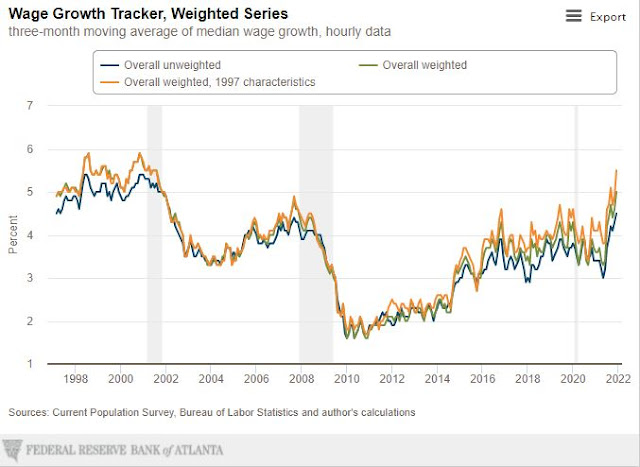
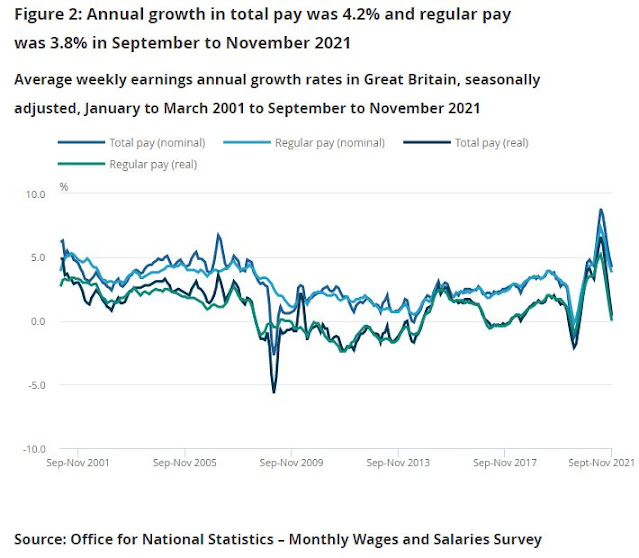
Crudely, this was the view of central banks in 2021 as inflation began to rise. So what has changed in 2022 in the US and UK? The answer, for those in the US, was not fiscal stimulus, because the bounce in inflation has been pretty similar in character across the G7 [1]. Instead, I believe, it is earnings growth in the context of a tight labour market produced by the recovery from the pandemic that is worrying central bankers. Here are two charts, for the US and UK. Source US, UK.


How should we interpret these charts? If we are thinking about how domestic inflation is likely to develop, looking at real wages (the spending power of wages) as shown in the UK chart is the wrong measure. Instead we should look at nominal wage growth, subtract likely underlying productivity growth (because wages should get the benefit of productivity growth), and see if that is above or below the inflation target of 2%.


Unfortunately what underlying productivity growth will be after the pandemic is not known for certain. But in the UK the Bank of England is expecting productivity growth of about 1% a year. That means wage inflation of 3% a year is not inflationary, but pay increases at the end of last year were significantly higher than this, and the Bank’s agents suggest firms are planning wage increases in the 4+% range. That would be inconsistent with the Bank’s inflation target of 2%. US forecast productivity may be slightly higher than 1%, but very recent numbers for both the Atlanta Fed’s tracker above and the EPI wage tracker suggest wage increases are running at an inflation target busting level.


This was why the Governor of the Bank of England took the unusual step last week (as the MPC raised rates to 0.5%) of appealing for wage restraint (more below). The background behind higher wage increases is a tight labour market as output finishes its recovery from the pandemic. The reason for the tight labour market in the UK is not buoyant demand (the UK has only just reached pre-pandemic activity levels) but a withdrawal of a large number of workers from the labour market compared to pre-pandemic levels. Demand is higher in the US, but the same phenomenon is happening there. There are theories why this is happening, but little strong evidence.


The tight labour market is why this episode is so different from 2011, when the ECB raised rates following higher commodity prices but the Fed and BoE didn’t (just). Then there was widespread unemployment, so no risk that wage inflation would rise. In that episode the ECB ended up looking very foolish. Today is more like the period between 2004-7, when oil prices rose slowly but substantially, and UK and US interest rates rose significantly.


But, but, but, you might say, the purchasing power of wages are falling a lot! Surely it is reasonable for workers to have higher wage increases in these circumstances? Unfortunately, to the extent that the higher fuel and food prices are permanently higher, you have to first answer this question: who ultimately pays for higher food and energy prices? Replying “someone else” is not a good answer, because it leads to exactly what these central banks want to avoid, which is a wage price spiral as workers and firms try to pass on these higher costs to each other.


While the economic logic of this is sound, the politics are not, which is why the Governor’s remarks on wage settlements were badly judged. Telling people their living standards must fall by even more because of higher energy prices and ignoring what is happening to, for example, the profits of energy companies is just asking for trouble. The governor of the Bank of England should appear even handed on such sensitive issues, and not single out wages for special pleading.


There are two major reasons why raising rates rapidly might be a major mistake,  particularly in the UK where the recovery in the economy since the pandemic is much weaker than the US. The first risk is that the recent increase in earnings turns out to be short-lived of its own accord. The annualised three month wage inflation data (HT @BruceReuters) for the UK gives a hint of that. The Bank is placing a lot of weight on their agent surveys. Wage inflation could tail off because those who have withdrawn from the labour market could be enticed back in by the higher wages we have already seen. In addition, if the Omicron wave dies down (as seems likely as we move away from winter) will firms be able to utilise their existing workforce more effectively, negating the need for higher wages to attract staff?


The second risk is the impact on the economy. Again the UK is particularly vulnerable, as no fiscal major stimulus has or will take place during the pandemic recovery period. There are already plenty of forces dragging demand down, You can see the problem for the UK in the Bank’s own forecasts. In its central forecast, with rates continuing to rise and energy prices staying high, the Bank expects inflation to overshoot its target, falling to 1.5% in 2025Q1 (the end of their published forecast), with rising unemployment and demand less than supply. In contrast with rates staying at 0.5%, inflation comes down to target in 2025Q1. So why go further than 0.5%, as some MPC members wanted last week? In addition, if energy prices start falling as the market expects, inflation will be lower sooner.


To cut a long story short, if rates continue to rise we may find the Bank in a year or two’s time cutting rates as quickly as they are expected to raise rates this year, in the context of a very gloomy outlook for the UK economy. Activity is more bouyant in the US, but similar risks apply there, with the additional political costs of bringing an anti-democratic political party into power. Worse still, if central banks are slow to reduce rates, in the context of a huge hit to personal incomes, we could be talking about a new recession that UK and/or US central banks have contributed to.


So what might at first appear to be an inevitable rise in interest rates following a large inflationary shock, in fact represents a big gamble by central banks that could backfire badly. 


[1] As I have suggested before, that fiscal stimulus may have raised US inflation earlier and slightly more than elsewhere, but as it is likely to be temporary if the pandemic unwinds, it seems a price well worth paying for a recovery that is up to 4% of GDP stronger in the US.


Monday, 31 January 2022

The US has had the best vaccine-shaped recovery from the pandemic, despite inflation fears, yet Tory ministers pretend otherwise


One of my (partially) unfulfilled quests is to understand why voters think the Conservatives are better at running the economy, when the objective data suggests they are hopeless at it. A part of the answer is that they use their (greater) airtime much better than Labour, by repeating a few generally misleading lines to take over and over again.


All this week the Prime Minister and ministers have deflected questions about partygate and instead trotted out the ‘real’ successes that Johnson has achieved. Often these are straight lies, but at other times they involve cherry picking statistics. The clearest example of the latter is that the IMF are forecasting the UK to have the most rapid growth among the G7 this year. This is sometimes linked to a claim that Johnson has made the right calls over the pandemic.


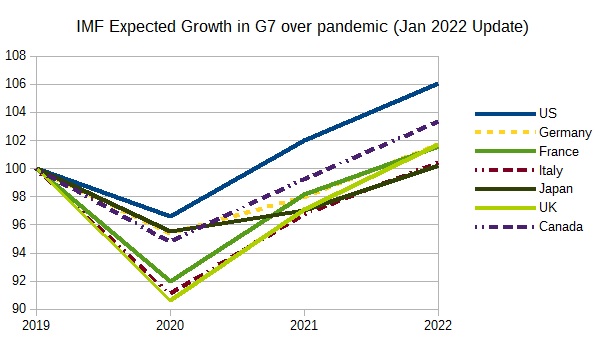
Here is the IMF’s latest projection for growth over the pandemic period, where I have made 2019=100. May contain rounding errors.


It is true that forecast UK growth for 2022 is higher than any of the other G7 countries. But as the chart shows, all that indicates is that we had the biggest recession of all the G7 during the pandemic, and so need faster growth to catch up with pre-pandemic trends. Claiming that faster growth as an indication that the UK made the right calls during the pandemic is clearly ludicrous.


However that is not the point. The point is that ministers and the Prime Minister get away with misleading the public, because these bogus or misleading claims are very rarely picked up in any interview. The technique is simple: make lots of positive claims in an interview about something other than what the interviewer wants to talk about and the interviewer will rarely dispute one, let alone them all. Johnson explains it here.


I first became aware of this technique in the early Cameron years. Conservative ministers when interviewed would always claim that they inherited a deficit at crisis proportions caused by Labour, and therefore they had no choice but to embark on austerity. Then Labour chose not to argue otherwise, and I never saw any interviewer question the claim (which was nonsense on stilts). Together with the right wing press pushing similar nonsense, the result was a large proportion of voters blame Labour for austerity.


Today, Labour politicians understandably talk about the cost of living crisis, but perhaps they are missing a trick here. Voters do not need to be told about the cost of living, but they have much less knowledge about ‘the economy’. They will not bother to check the accuracy of Tory lines to take, and may even think that because these lines go unchallenged they must be true. As a result, the Tory lead on the economy may remain intact. Labour needs to follow the example of the Shadow Chancellor, Rachel Reeves, who in her recent speech explicitly focused on how growth had deteriorated under successive Tory governments since 2010.


Returning to the Chart above, two points stand out. First, the success story among the G7 is the US. Only they appear to have got back to something like where trend growth would be if the pandemic hadn’t happened. The reason was a large fiscal stimulus, and whether that went too far I’ll discuss below. Second, everyone has had a (kind of) V shaped recovery. However with variants appearing just as cases were under control in many countries, I think the vaccines were crucial in getting a V shaped recovery.


Without vaccines, you need regular lockdowns. Even without lockdowns, each new variant spike will mean many consumers withdraw from social consumption (travel, recreation, shopping etc). Vaccines gave people the chance to partially continue social consumption, and largely avoided lockdowns. It therefore allowed an initial recovery to be sustained.


But is the US really the success story the chart above suggests, given current 7% inflation? Did the first Biden stimulus go to far, as some have suggested? The table below is helpful in this respect.


US Real Personal Consumption Expenditures by Type of Product, Quantity Indexes (source)


2019Q4

2020Q2

2020Q4

2021Q4

Total

119.929

106.418

117.023

125.303

Goods

131.59

128.261

141.709

151.881

Services

114.795

97.405

106.847

114.392


Note first that the total hides very different behaviour between consumption of goods and services. Social consumption is concentrated in services, like travel and recreation. Both types of consumption fell in the first COVID wave (2020Q2), but services by much more. From then on, goods consumption grew quickly, largely immune from the impact of later waves of the pandemic. (Durable consumption has grown even faster.) In contrast, service consumption was only just back to pre-pandemic levels at the end of last year, and it will be interesting to see what impact Omicron has in 2022.


In our study of a flu type pandemic ten years before COVID, I assumed exactly this pattern would emerge. What I didn’t assume, which may also have happened, is some displacement of social consumption into durables. As this has been happening worldwide, it is perhaps not surprising that we might be seeing some inflation in specific goods sectors. One final assumption I made, which is not unreasonable, is that inflation would occur just after any pandemic ended as consumers not only increased social consumption to previous trends, but overshot these trends initially to partially make up what they had lost.


We don’t know how much Omicron will suppress social consumption, and whether any new variant waves will be milder or not. At least two scenarios are possible. In the first, COVID variants become more transmissible but milder (with the help of vaccines). If this is the case, expect a return to previous trends in social consumption, with probably a temporary boom as people try and make good a bit of what they lost. That might add additional but temporary pressure to inflation. However demand for goods may plateau or even fall at the same time, relieving some inflationary pressure from that source. The second scenario is that new threatening variants continue for a long time, with vaccines playing catch-up. In that case we may see a medium run shift in the structure of demand away from social consumption.


Rising world fuel and food costs have produced inflation in most advanced economies. US inflation may be the highest because demand there is strongest, revealing both auto supply problems and reflecting expected house prices. All of these things are temporary, and price increases over 2021 were unusually concentrated in particular areas, which does not indicate persistent inflation. The paragraph above suggests it is possible that new sources of inflationary pressure may arise if the pandemic largely ends, but these again are temporary, although temporary needn’t mean over in a few months.


Temporary inflation a bit above UK and European levels is a price well worth paying for output after the pandemic 4-5% higher than most other G7 countries, including the UK. The only reason not to try and emulate the US in enacting a strong fiscal stimulus is if you think temporary inflation becomes embedded in expectations i.e. real wage [1] increases in excess of productivity gains.


It would be a healthy sign if interest rates rise a little because Biden’s (now much more modest) infrastructure plan will maintain demand after all the pandemic effects are over (if they are ever over). The big danger for the Fed is if this doesn’t happen, they still raise rates because of temporary increases in inflation, and the economy dips in time for political gains for the (now anti-democratic) Republic party.


Just as current US inflation is unlikely to negate the achievement of having such a strong recovery from recession, relatively poor performances in most other G7 countries (UK included) are shown to be a policy choice, in most part because deficit concerns ruled out a large fiscal stimulus. Permanently losing a few percentage points of output to the pandemic is such a bigger cost than temporary inflation at 5% rather than 7%.


After 2010 everyone pivoted to austerity outside China, so it was difficult to find a country that showed its folly. It is a tribute to Biden and those around him that at least one country has now understood the folly of worrying about the government’s deficit in a recession. It is the example of the US that interviewers should mention the next time Conservative ministers trot out their line to take on the UK recovery.


[1] By real wages here I mean deflated by output prices, not consumer prices.

Thursday, 27 January 2022

The damage caused by Boris Johnson and Brexit goes way beyond his office parties


This post is not about the personality of Boris Johnson (for an excellent account of his rise and fall, see Peter Jukes here). Instead it is about whether things will change much with any successor. The general theme of this post is that the damage to the Conservative party caused by both Brexit and Johnson has been so great that any successor will be very restricted in the changes they can make even if they were minded to make changes.


In short, if Johnson goes, can the Conservative party mend itself? To assess this, we first need to outline the damage he has done, the damage Brexit has done and whether there are any silver linings. The next step is to speculate on whether any of the likely successors to Johnson might undo any or all of this damage.


Brexit has done obvious damage to the UK economy. Johnson’s attitude to Brexit has also damaged the Conservative party in a number of ways. To understand this, you first have to recognise that Brexit was always a foolhardy project. As such, it was good at sorting between those who were capable and sensible in the party, and those who were not. Johnson took the attitude of Brexit at any cost, and without compromise of any kind. That naturally alienated those in the party who were prepared to accept the referendum verdict, but not Johnson’s kind of Brexit.


His response to some of these more sensible party members was to throw them out of the party before the General Election, and suspend parliament. Candidates at the General Election had to take a Brexit loyalty oath to Johnson’s kind of Brexit. Once elected, it didn’t take long for Johnson to appoint a cabinet that was notable not for its political weight or good judgement, but to blind loyalty to Johnson, most perfectly willing to do as they were told.


To be fair to Johnson, this effect whereby Brexit acted as a selection device to find the worst candidate and give them the job, was also working at a constituency level, as constituency members tended to be very pro-Brexit. So the parliamentary party itself was gradually electing MPs whose views largely mirrored the right wing press, and who had little time for values like doing the best for the economy, respecting the truth, integrity or following the science.


The two taken together have produced a large group of MPs (perhaps half) that you can almost count on not to make sound judgements in many areas. How can I make such a sweeping statement? I’m afraid Covid has provided an excellent test of good judgement. Do you follow the science in trying to reduce the amount of hospitalisations, deaths and long covid, or do you fetishise not wearing a mask and wanting to get rid of social protections as quickly as possible, whatever the cost. The fact that half of Tory MPs appear to be in the second group gives me all the justification I need to write the first sentence of this paragraph.


Consider Johnson himself. Totally unsuited to becoming Prime Minister, as anyone could see given his past record and how he works. Yet Conservative MPs appointed him because he could win them an election, and now seem to find it hard to let him go. MPs who complain about an ID society when it comes to vaccine mandates, but are happy to make people require ID to vote because it helps them stay in power. Who laud liberalism for themselves while trying to criminalise demonstrations. Who think Lord Frost is an effective operator, and the Europeans will crumble in the face of obstinacy. Who seemed to adopt Johnson’s constant lying all too easily.


Elevation (to MP) and promotion based on a loyalty test (to an idea or to party leaders) rather than because of ability is a constant danger in any government. Unfortunately the Conservative party and this government have taken this to its extreme, because of both Brexit and Johnson. The result is that any new leader after Johnson, even if they had the will to do so, would find it hard to break with the Johnson/Brexit legacy.


If there is a silver lining under Johnson, it is the first hint of a break with the anti-public spending/low tax ethos of the post-Thatcher era of Conservatism. This has been only a hint. Extra money for the NHS paid for by, in effect, a tax hike was largely forced by the growing demand and need for health spending. There has been a partial reversal of earlier austerity in both education and police spending, but the squeeze on justice, local authorities and elsewhere has continued. Levelling up has not happened yet, and some would argue we have had levelling down so far.


Yet this silver lining has been achieved with much complaint for many Tory MPs, many of whom remain wedded to earlier ideas and a neoliberal ideology. Not only will any successor to Johnson have to promise to continue to ignore the science about the pandemic, they will also promise to return to tax cutting ways. This is particularly true if Sunak is Johnson’s successor. (Sunak's likely popularity as leader is considered by Ben Walker here.)


Even if an alternative new leader attempts to avoid returning to the Conservatives comfort zone of low taxes, getting the state (and unions) off the back of firms and so on, they have to contend with the huge obstacle of half the parliamentary party essentially embodying the political philosophy of the right wing press, as well as having to deal with that press directly. The two combined make it almost impossible for a Conservative government to rejuvenate an economy that has become increasingly moribund over time, and not only because of Brexit.


It is moribund because what firms involved in adding value to society rather than just rent seeking need is a partnership with the state, both directly and indirectly in providing the kind of society that allows individuals who might contribute to firm growth to have both the necessary knowledge and imagination to do that well. This is the opposite of what austerity achieves and what a low tax economy and diminished state accomplish. The initial economic dynamism of the Thatcher period (more apparent than real) was achieved by a one-off destruction of older ways of doing things, but also off the back of largely squandering North Sea Oil.


Johnson’s populism may have brought a partial and modest reversal of austerity, but it has also brought something new and extremely damaging to good government. This is the introduction of what is essentially rule by a plutocracy. The leaders group provide the funds for the party to win elections, and in return either help direct the overall political project or get large rewards for themselves or their businesses. The VIP lane for protection equipment for the pandemic was just one manifestation of this way of doing business and the business of government.


The emphasis on who you know rather than what you can do, of rent seeking rather than adding value, is entirely destructive to general prosperity or a fair society. It can only survive as a political force if the government creates and fosters divisions within society, either us versus them (where us are called ‘the people’ by the populist politicians and them are called woke), or ‘the people’ against various minorities or foreigners who are constantly denigrated.


I suspect all a successor to Johnson can achieve is to dismantle this plutocracy. No more regular meetings with the leaders group, and preferably no leaders group at all. An end to constant brinkmanship with Europe, and making some attempt to soften the edges of Johnson’s hard Brexit for the benefit of both our firms and consumers. Some movement towards true one nation Conservatism, and away from constant culture war.


This is, I think, the limit of what progress we can realistically hope for once Johnson has gone. The consequences of Brexit in terms of the quality of the parliamentary party, and the consequences of Johnson in the form of the current cabinet and its modus operandi, will make anything more than this very hard to do. Of course hoping does nothing to ensure that even this it will happen, but recognising the limits any new leader will face does make clear how damaging Brexit has been to the Conservative party.